A French Vocabulary Lesson
Welcome to a little French lesson about the food we eat!
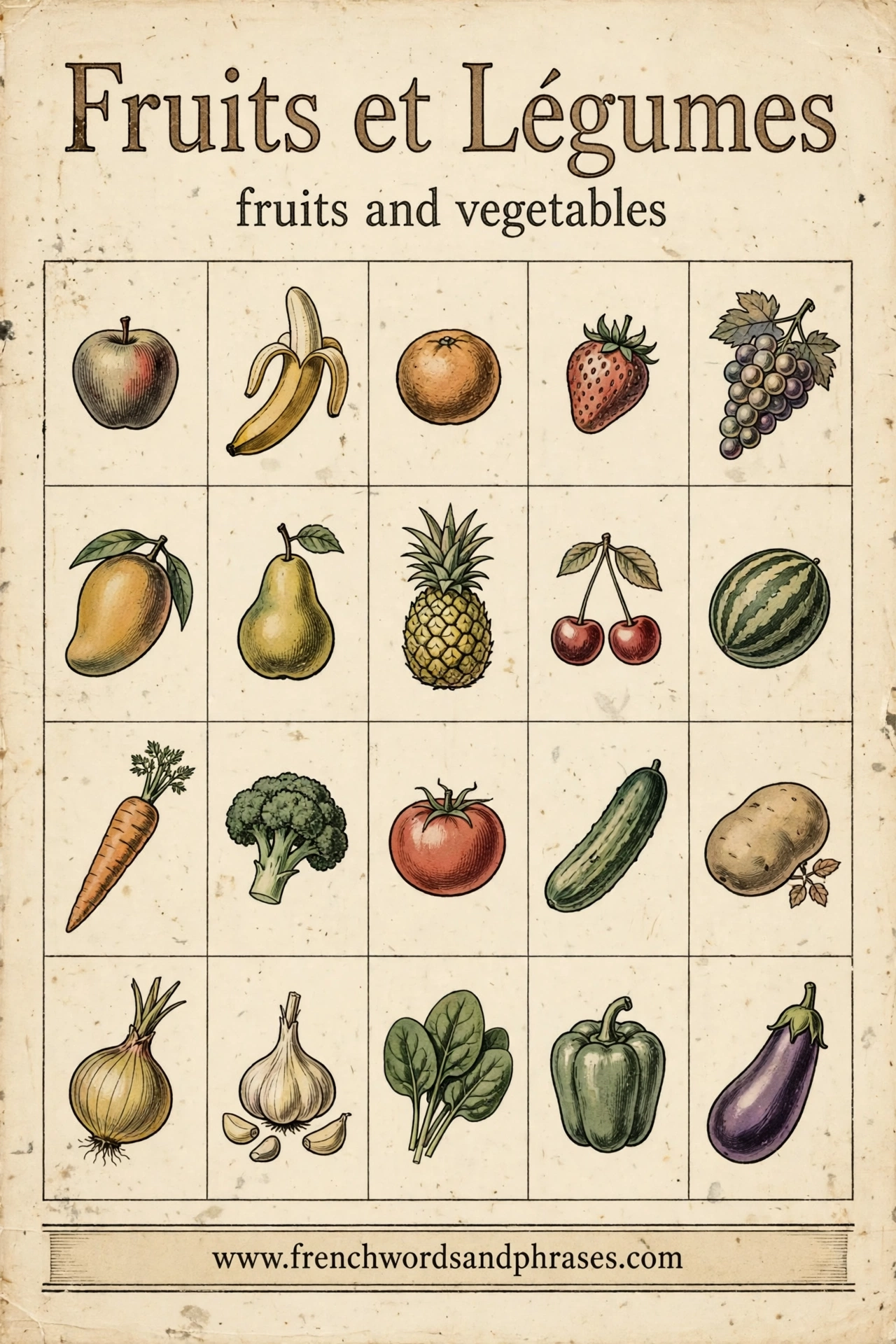
Les fruits et les légumes means fruits and vegetables. In this lesson, you’ll discover twenty useful French words for the fruits and vegetables you’ll find at any French market.
Learning vocabulary is easier when you see words used in real situations. So instead of memorizing a list, let’s go shopping at a French market and fill a basket, stall by stall.
Our Story: Un Samedi au Marché
Imagine that it is Saturday morning. Your French friend Claire is going to the market with a big basket, because today she is preparing a family lunch.
Read the story in French first. The English translation follows each passage to help you understand.
Le Marché du Samedi
Le samedi matin, Claire va au marché avec un grand panier. Aujourd’hui, elle prépare un déjeuner de famille : une ratatouille, une grande salade et un dessert aux fruits.
On Saturday morning, Claire goes to the market with a large basket. Today, she is preparing a family lunch: a ratatouille, a big salad, and a fruit dessert.
D’abord, les légumes pour la ratatouille. Claire choisit deux belles aubergines, trois poivrons rouges et jaunes, des tomates bien mûres, un gros oignon et une tête d’ail.
First, the vegetables for the ratatouille. Claire chooses two beautiful eggplants, three red and yellow bell peppers, some ripe tomatoes, one large onion, and a head of garlic.
Pour la salade, elle prend un concombre, quatre carottes et un sac d’épinards frais. Elle ajoute aussi un brocoli pour la soupe du soir.
For the salad, she takes a cucumber, four carrots, and a bag of fresh spinach. She also adds a broccoli for the evening soup.
N’oublions pas les pommes de terre ! Claire en achète un kilo. À la maison, elle va les couper et les mettre au four avec un peu d’huile d’olive.
Let’s not forget the potatoes! Claire buys a kilo of them. At home, she will cut them up and put them in the oven with a little olive oil.
Maintenant, les fruits. Claire achète des pommes rouges pour la tarte et des bananes pour les enfants. Elle choisit aussi des oranges pour le jus du matin.
Now, the fruit. Claire buys red apples for the tart and bananas for the children. She also chooses oranges for the morning juice.
Au centre du marché, les fraises sentent délicieusement bon. Claire en prend deux barquettes, avec une grappe de raisin et quelques cerises pour décorer le dessert.
In the middle of the market, the strawberries smell delicious. Claire takes two punnets of them, with a bunch of grapes and a few cherries to decorate the dessert.
Pour finir, quelque chose d’exotique : une mangue bien mûre, un ananas doré et deux poires fondantes. Et pour les journées chaudes, une grande pastèque bien lourde !
To finish, something exotic: a ripe mango, a golden pineapple, and two meltingly soft pears. And for hot days, one big, heavy watermelon!
Le panier de Claire est plein et très lourd. Elle rentre à la maison, heureuse. Ce déjeuner de famille va être délicieux !
Claire’s basket is full and very heavy. She goes home, happy. This family lunch is going to be delicious!
The Vocabulary: 20 French Words for Fruits and Vegetables
Now let’s look at the twenty important words from our story. Try saying each French word aloud before looking at its English meaning.
Les Fruits — The Fruits
| French | English |
|---|---|
| 1. La pomme | The apple |
| 2. La banane | The banana |
| 3. L’orange | The orange |
| 4. La fraise | The strawberry |
| 5. Le raisin | Grapes |
| 6. La mangue | The mango |
| 7. La poire | The pear |
| 8. L’ananas | The pineapple |
| 9. La cerise | The cherry |
| 10. La pastèque | The watermelon |
Les Légumes — The Vegetables
| French | English |
|---|---|
| 11. La carotte | The carrot |
| 12. Le brocoli | Broccoli |
| 13. La tomate | The tomato |
| 14. Le concombre | The cucumber |
| 15. La pomme de terre | The potato |
| 16. L’oignon | The onion |
| 17. L’ail | Garlic |
| 18. Les épinards | Spinach |
| 19. Le poivron | The bell pepper |
| 20. L’aubergine | The eggplant |
A small but useful language tip:
At home, almost nobody in France says les pommes de terre in everyday conversation — they say les patates. La pomme de terre is the full, proper name you’ll see written in shops and recipes, but une patate is the word you’ll actually hear around the kitchen table.
French in Everyday Life: Useful Expressions
Knowing the names of fruits and vegetables is a good beginning. But how do you use these words when you shop and cook?
Here are some simple expressions you might hear or use at a French market.
Example 1 — At the market stall
Je voudrais un kilo de tomates, s’il vous plaît.
I would like a kilo of tomatoes, please.
Example 2 — Choosing fruit
Ces fraises sont délicieuses.
These strawberries are delicious.
Example 3 — Asking the price
Combien coûte la pastèque ?
How much does the watermelon cost?
Example 4 — In the kitchen
Épluche les carottes, s’il te plaît.
Peel the carrots, please.
Example 5 — At the table
Encore un peu d’épinards ?
A little more spinach?
Example 6 — A healthy snack
Une pomme par jour, c’est bon pour la santé.
An apple a day is good for your health.
A Little French Grammar: Du, De La, Des — Talking About Food
When you talk about food in French, you rarely use le or la alone. Instead, French uses the partitive articles du, de la and des to mean “some”.
- Du is used with masculine nouns: du raisin, du brocoli.
- De la is used with feminine nouns: de la pastèque, de la salade.
- De l’ is used before a vowel sound: de l’ail, de l’aubergine.
- Des is used with plurals: des pommes, des carottes, des épinards.
After a quantity, French uses de on its own: un kilo de tomates (a kilo of tomatoes), une barquette de fraises (a punnet of strawberries).
So at the market, listen for des and de — they are the little words that hold French food sentences together.
Test Your Knowledge: French Fruits and Vegetables
Let’s see how much you remember. Try each question before opening the answer.
Quick Quiz 1
Which French word means “the potato”?
Reveal the answer
La pomme de terre
Quick Quiz 2
Complete the sentence:
Claire achète un kilo de ______ pour la tarte.
Reveal the answer
pommes
Claire achète un kilo de pommes pour la tarte.
Claire buys a kilo of apples for the tart.
Quick Quiz 3
How do you say “the cucumber” in French?
Reveal the answer
Le concombre
Quick Quiz 4
Which word means “the eggplant”?
Reveal the answer
L’aubergine
Quick Quiz 5
Complete the sentence:
Elle met de l’______ dans la ratatouille.
Reveal the answer
ail
Elle met de l’ail dans la ratatouille.
She puts garlic in the ratatouille.
Can You Translate These French Sentences?
Now let’s reverse the exercise. Read each French sentence and try to translate it into English.
Question 1
La pastèque est lourde.
What does this mean?
Reveal the answer
The watermelon is heavy.
Question 2
Les épinards sont verts.
What does this mean?
Reveal the answer
The spinach is green.
Question 3
Je mange une banane.
What does this mean?
Reveal the answer
I am eating a banana.
Question 4
Le poivron est rouge.
What does this mean?
Reveal the answer
The bell pepper is red.
Question 5
L’ananas est sucré.
What does this mean?
Reveal the answer
The pineapple is sweet.
Discover a Little French Market Culture
In France, the open-air market — le marché — is a way of life. Most towns hold a market at least once or twice a week, and many people still plan their meals around what looks best at the stalls that morning.
At a French market, you usually point to what you want and the stallholder chooses and weighs it for you. Fruit especially is often picked by the seller, not by the customer.
And here’s a useful expression:
Le samedi, nous faisons notre marché.
On Saturdays, we do our market shopping.
The expression faire son marché means to do your food shopping at the market — a small phrase that opens the door to one of France’s favourite weekly rituals.
How to Remember Your New French Words
The easiest way to remember vocabulary is to connect each word to something familiar.
Try this little exercise in your own kitchen and at the supermarket:
- When you open the fridge, say les carottes and le concombre.
- When you make a salad, think les épinards and la tomate.
- When you peel a banana, think la banane.
- When you cook potatoes, think les pommes de terre — or les patates, like a French family.
- When you cut a watermelon, think la pastèque.
- When you choose dessert fruit, think les fraises and les cerises.
A few minutes of practice each day can make these words part of your everyday French vocabulary.
Your Final Challenge
Can You Do Your Market Shopping in French?
Imagine that you are at a French market on Saturday morning.
Can you write a shopping list of eight fruits and vegetables, and describe the lunch you will cook with them?
Here is a little example to get you started:
Demain, je prépare une salade avec des tomates, un concombre et des carottes. Pour le dessert, je sers des fraises et une pastèque bien fraîche.
Tomorrow, I am preparing a salad with tomatoes, a cucumber, and carrots. For dessert, I am serving strawberries and a lovely chilled watermelon.
Now it’s your turn!
Try writing a few sentences about your market shopping in French. Don’t worry about making mistakes. Every new sentence is another step toward speaking French.
Today’s Lesson: Fruits et Légumes — Fruits and Vegetables
Twenty new words. A little story. A little French culture.
Learn French one lesson at a time!