A French Word to Live By
Translate Raisin to English
/ʁɛ.zɛ̃/
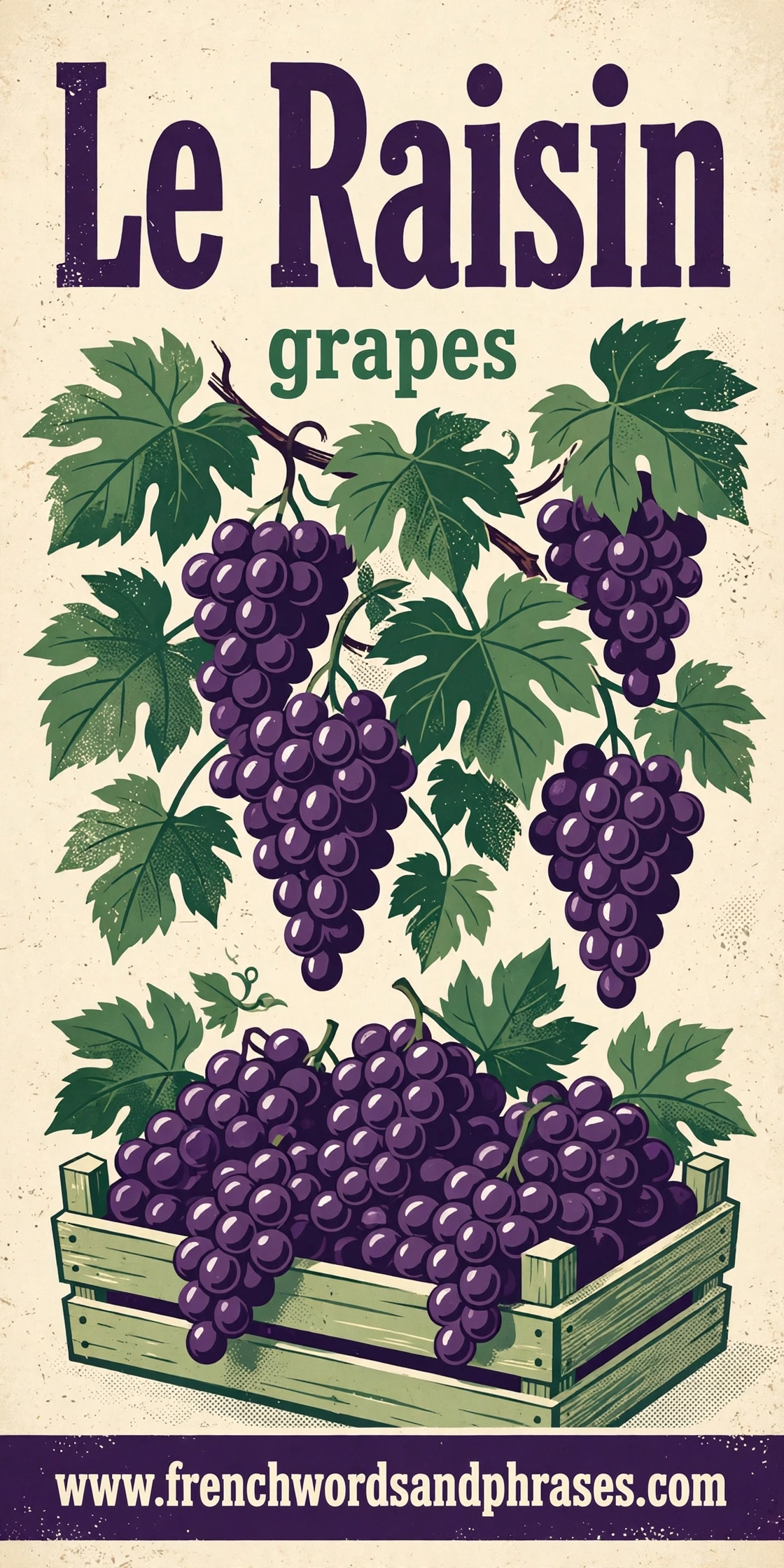
Le raisin means grapes.
September at the market: the stalls are heavy with bunches, black and gold, and the stallholder cuts one open so you can count the pips of the season — le raisin, grapes, the fruit of the harvest and of the vine.
In this guide, you’ll learn what raisin means in English, how to use it with its articles, how to form its plural, and how it appears in everyday French. Explore French examples, English translations, and practice quizzes.
Understanding the French Noun Raisin
Raisin is a masculine French noun. It is learned together with its article: le raisin. It is a collective noun: in French you do not count grapes one by one, you buy du raisin — some grapes — by the bunch. A single grape, when you really need one, is un grain de raisin, one grain of grape.
It means grapes — the fruit of la vigne, the vine, sold in bunches, des grappes de raisin, eaten at the table as le raisin de table, pressed into le jus de raisin, or carried off to the cellars to become wine. September is its month: the vendanges, the grape harvest, fill the vineyards of France with pickers.
Gender: Masculine
Definite article: le — le raisin (grapes, the grapes)
Indefinite article: du — du raisin (some grapes)
Plural: les raisins (bunches, crops, varieties of grapes)
English equivalents: Grapes (collective). One grape is un grain de raisin; a dried grape — an English raisin — is un raisin sec.
One important usage detail — a famous false friend: the English word raisin, the little dried fruit in cakes, is un raisin sec in French, a dry grape. Fresh grapes on the vine are simply le raisin. Order un gâteau aux raisins secs and you get the dried ones; ask for du raisin at the market and you get a fresh bunch.
Experience the Word
Raisin is more than a fruit. It is the harvest itself — the bunch cut from the vine, the juice on your fingers, the whole of September in the wine country of France.
Imagine the vendanges at dawn: rows of vines in the mist, baskets filling bunch by bunch, the pickers’ hands purple by noon, and the first taste of the year straight from the grappe.
You have not just eaten grapes. You have joined the harvest.
How to Use Raisin in French: Complete Guide
Let’s explore how raisin works in French, beginning with its articles.
Raisin with the Definite Article (Le, Les)
Used for grapes in general, or the grapes everyone in the conversation knows — le raisin, the fruit of the vine.
| Number | French |
|---|---|
| Singular | le raisin |
| Plural | les raisins |
Example
Le raisin de septembre est doux et sucré.
September grapes are soft and sweet.
Raisin with the Partitive and Indefinite Articles (Du, Des)
Raisin is a collective: you buy some grapes — du raisin — and whole bunches, des grappes.
| Number | French |
|---|---|
| Some grapes | du raisin |
| Bunches of grapes | des grappes de raisin |
Example
Il achète du raisin au marché le samedi.
He buys grapes at the market on Saturdays.
Raisin, Grain by Grain
Grains, bunches and the dried impostor — the words that travel with raisin.
| French | In English |
|---|---|
| un grain de raisin | a single grape |
| une grappe de raisin | a bunch of grapes |
| le raisin blanc | white grapes |
| le raisin noir | black grapes |
| un raisin sec | a raisin (the dried fruit) |
| le jus de raisin | grape juice |
Example
L’enfant mange un grain de raisin après l’autre.
The child eats one grape after another.
Quick Quiz 1
What is un grain de raisin?
Reveal the answer
A single grape — one grain of the collective le raisin. French counts grapes by the grain and by the bunch, never one raisin at a time.
Donne-moi un grain de raisin, juste un.
Give me one grape, just one.
The Plural of Raisin
The plural les raisins exists, but it speaks of bunches, harvests and varieties — for the fruit on your plate, French prefers du raisin.
| Number | French |
|---|---|
| Singular | le raisin |
| Plural | les raisins |
Example
Les raisins de cette région donnent un vin célèbre.
The grapes of this region make a famous wine.
Raisin with Possessive Adjectives (Mon, Ton, Son…)
Possessives agree with the noun, not with the owner — and raisin is masculine, so it takes mon, ton, son.
| Owner | French |
|---|---|
| my | mon raisin |
| your (tu) | ton raisin |
| his / her | son raisin |
| our | notre raisin |
| your (vous) | votre raisin |
| their | leur raisin |
Example
Le vigneron goûte son raisin avant les vendanges.
The winegrower tastes his grapes before the harvest.
Quick Quiz 2
Complete the sentence:
Elle met ______ raisin dans le panier. (her)
Reveal the answer
son
Elle met son raisin dans le panier.
She puts her grapes in the basket.
Raisin with Demonstrative Adjectives (Ce, Ces)
Used to point: these grapes here, this harvest there.
| Number | French |
|---|---|
| Singular | ce raisin |
| Plural | ces raisins |
Example
Ce raisin est encore trop vert pour être cueilli.
These grapes are still too green to be picked.
Raisin with Adjectives
Adjectives agree with raisin, masculine — mûr, sucré, frais.
| Adjective | With Raisin |
|---|---|
| mûr (ripe) | du raisin mûr |
| sucré (sweet) | du raisin sucré |
| blanc (white) | du raisin blanc |
| noir (black) | du raisin noir |
| frais (fresh) | du raisin frais |
Example
Du raisin blanc bien mûr, c’est le dessert de septembre.
Really ripe white grapes — that is September’s dessert.
Quick Quiz 3
Complete the sentence:
Nous achetons du raisin ______ au marché. (black)
Reveal the answer
noir
Nous achetons du raisin noir au marché.
We buy black grapes at the market.
Everyday Expressions with Raisin
Bunches, harvests and half-and-half feelings — the raisin phrases of daily life.
| Expression | In English |
|---|---|
| une grappe de raisin | a bunch of grapes |
| un grain de raisin | a single grape |
| le raisin de table | table grapes (for eating) |
| les vendanges | the grape harvest |
| mi-figue mi-raisin | so-so, neither one thing nor the other |
| du raisin sec | raisins (the dried fruit) |
Example
Son nouveau travail, c’est mi-figue mi-raisin.
His new job is so-so — neither one thing nor the other.
Words from the Same Family as Raisin
Vines, vineyards and wine — the words that travel with raisin.
| French | In English |
|---|---|
| la vigne | the vine |
| le vignoble | the vineyard |
| le vigneron | the winegrower |
| le vin | wine |
| la grappe | the bunch, the cluster |
| sécher | to dry (how a raisin sec is born) |
Example
La vigne couvre les collines autour du village.
The vine covers the hills around the village.
Quick Quiz 4
A recipe says: « Ajoutez les raisins secs. » Your friend reaches for a fresh bunch. What is the trap?
Reveal the answer
Raisins secs are dried grapes — the English raisins. Fresh grapes are le raisin, and they would ruin the cake.
Les raisins secs vont dans le gâteau, le raisin frais va sur la table.
The dried raisins go in the cake, the fresh grapes go on the table.
Raisin in Everyday French: Real-Life Examples
Now that you know the word, let’s see how raisin appears in everyday French.
Example 1 — At the market
Je voudrais du raisin blanc, s’il vous plaît.
I would like some white grapes, please.
Example 2 — One single grape
L’enfant demande un grain de raisin à sa mère.
The child asks his mother for a single grape.
Example 3 — The false friend
Pour le gâteau, il faut des raisins secs, pas du raisin frais.
For the cake, you need dried raisins, not fresh grapes.
Example 4 — The harvest
En septembre, tout le village fait les vendanges.
In September, the whole village does the grape harvest.
Example 5 — A snack
Elle mange une grappe de raisin en lisant.
She eats a bunch of grapes while reading.
Example 6 — So-so
Le film était mi-figue mi-raisin, ni bon ni mauvais.
The film was so-so, neither good nor bad.
See le raisin in a story: Fruits and Vegetables: French Vocabulary (Fruits et Légumes) — a Saturday trip to a French market.
Beyond Translation: The Meaning of Raisin
Raisin is the fruit France is built on: the vine covers its hillsides from Champagne to Provence, and the September vendanges remain a national season of their own. The collective noun tells the story — French never meets one grape alone, only bunches, harvests and vineyards, grain by patient grain.
To say raisin is to stand in the vineyard at harvest time.
It evokes the grappe cut at dawn, the juice and the wine to come, and the little dried raisin sec hiding in the cake — the false friend every learner meets exactly once.
How to Remember the French Noun Raisin
Remember it this way: Raisin is grapes — masculine and collective, bought by the bunch, counted by the grain, and dried into a false friend.
- You buy some — du raisin au marché, masculine with le.
- You count one — un grain de raisin, a single grape.
- You dodge the trap — an English raisin is un raisin sec, a dried grape.
The key idea is le raisin by the bunch — un grain at a time — un raisin sec in the cake.
Test Your Knowledge of Raisin
Let’s see how much you’ve learned. Try answering these questions before revealing the answers.
Question 1
Is raisin masculine or feminine?
Reveal the answer
Masculine — le raisin, du raisin.
Question 2
How do you say one single grape in French?
Reveal the answer
Un grain de raisin — one grain of the collective grapes.
Question 3
Translate: He buys grapes at the market.
Reveal the answer
Il achète du raisin au marché.
Question 4
What is un raisin sec?
Reveal the answer
A dried grape — an English raisin — the false friend hiding in cakes.
Question 5
Complete the sentence:
Elle mange une grappe de ______.
Reveal the answer
raisin
Elle mange une grappe de raisin.
She eats a bunch of grapes.
Your Final Challenge
Can You Use It?
How would you say this in French?
“In September, the whole village picks the grapes.”
Reveal the answer
En septembre, tout le village cueille le raisin.
In September, the whole village picks the grapes.
A little French. A little curiosity. A richer everyday life.
LEARN FRENCH ONE WORD AT A TIME