A French Word to Live By
Translate Oignon to English
/ɔ.ɲɔ̃/
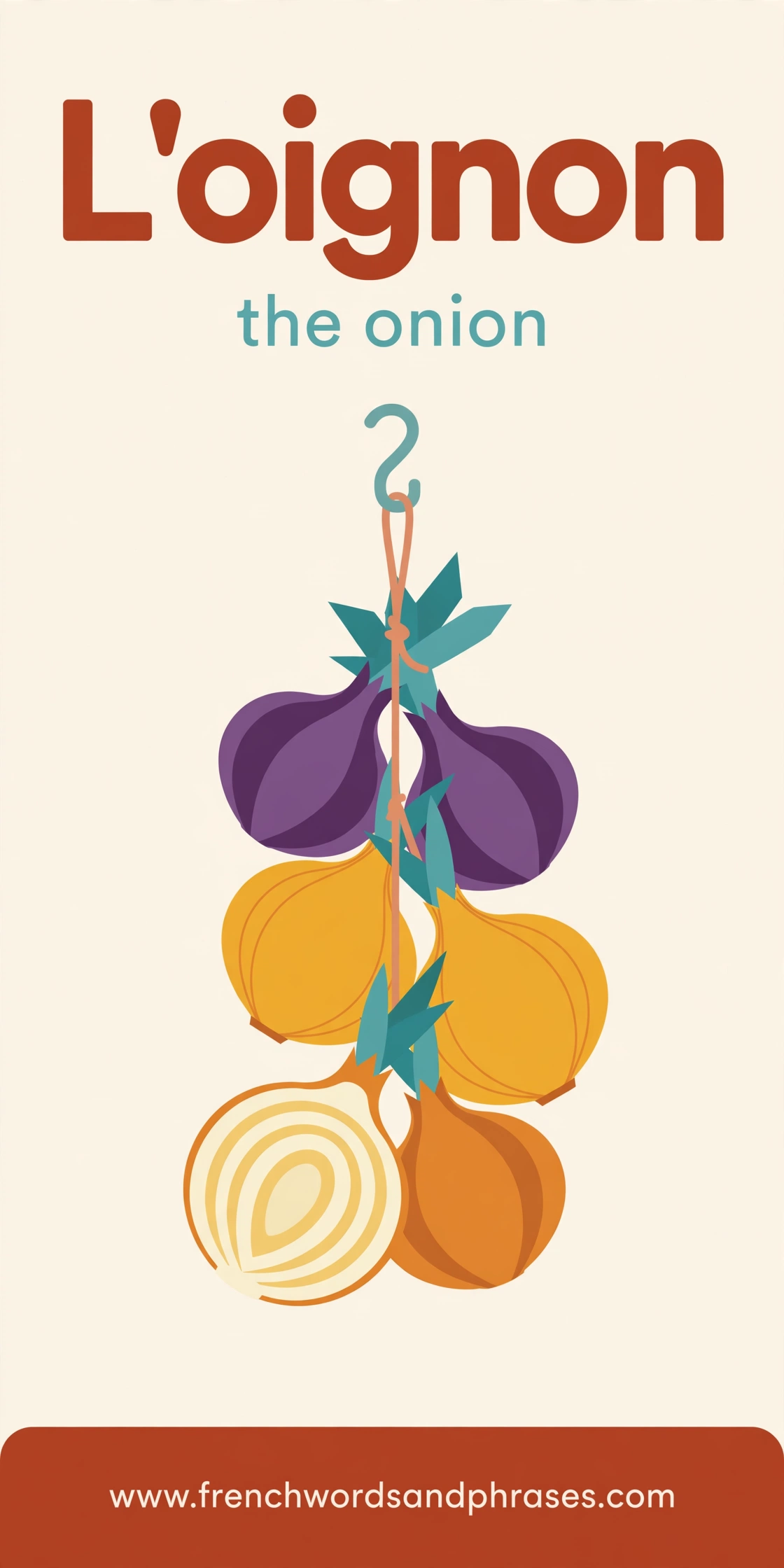
L’oignon means the onion.
Saturday market, the vegetable stall. Your eyes are already watering before you have touched a thing: baskets of golden onions are stacked in pyramids, their skins shining like paper — les oignons, the first word of half the recipes in France.
In this guide, you’ll learn what oignon means in English, how to use it with its articles, how to form its plural, and how it appears in everyday French. Explore French examples, English translations, and practice quizzes.
Understanding the French Noun Oignon
Oignon is a masculine French noun. It is learned together with its article: l’oignon, un oignon. Because it begins with a vowel, the definite article shrinks to l’ — but the noun underneath stays firmly masculine.
It means the onion — the round, layered bulb that begins almost every French sauce, soup and stew. Raw, it crunches in salads; cooked slowly, it turns sweet and golden. It is also famous for its tears: peeling and chopping an oignon is the one kitchen job that can make the whole room cry.
Gender: Masculine
Definite article: l’ — l’oignon (the onion)
Indefinite article: un — un oignon (an onion)
Plural: les oignons
English equivalents: The onion.
One important usage detail — a spelling quirk every French schoolchild meets: oignon is written with an oi that sounds like a plain o, so the word sounds like ‘ognon’. The 2016 spelling reform made the simpler spelling ognon official too, but you will still see oignon almost everywhere. And guard your secrets: occupe-toi de tes oignons — look after your own onions — is how French tells you to mind your own business.
Experience the Word
Oignon is more than a vegetable. It is the first sound of French cooking — the knife on the board, the slices falling, the pan already warming.
Imagine a winter kitchen in Paris a century ago: the porters of Les Halles, the great market, warming their hands around bowls of soupe à l’oignon, thick with bread and melted cheese.
You have not just chopped a vegetable. You have started a French recipe the way France starts it.
How to Use Oignon in French: Complete Guide
Let’s explore how oignon works in French, beginning with its articles.
Oignon with the Definite Article (L’, Les)
Oignon begins with a vowel, so le shrinks to l’ — l’oignon — while the plural is les oignons.
| Number | French |
|---|---|
| Singular | l’oignon |
| Plural | les oignons |
Example
L’oignon est dans le panier, avec les carottes.
The onion is in the basket, with the carrots.
Oignon with the Indefinite Article (Un, Des)
Used for an onion in general — the one in the recipe, the one on your shopping list.
| Number | French |
|---|---|
| Singular | un oignon |
| Plural | des oignons |
Example
Il faut un oignon pour la soupe.
You need an onion for the soup.
The Oignon in the Kitchen
Peeled, sliced and simmered — the onion at work in French cooking.
| French | In English |
|---|---|
| la soupe à l’oignon | French onion soup |
| éplucher un oignon | to peel an onion |
| un oignon émincé | a sliced onion |
| faire revenir les oignons | to sweat the onions gently |
| les oignons nouveaux | spring onions |
| un oignon rouge | a red onion |
Example
La soupe à l’oignon est un classique des bistrots parisiens.
Onion soup is a classic of Parisian bistros.
Quick Quiz 1
What is la soupe à l’oignon?
Reveal the answer
French onion soup — the famous soup of onions, bread and melted cheese.
La soupe à l’oignon se sert bien chaude, avec du fromage.
Onion soup is served very hot, with cheese.
The Plural of Oignon
Oignon adds an -s in the plural — les oignons, the onions of the market stall.
| Number | French |
|---|---|
| Singular | l’oignon |
| Plural | les oignons |
Example
Les oignons de ce marché sont très doux.
The onions at this market are very mild.
Oignon with Possessive Adjectives (Mon, Ton, Son…)
Possessives agree with the noun, not with the owner — and oignon is masculine, so it takes mon, ton, son.
| Owner | French |
|---|---|
| my | mon oignon |
| your (tu) | ton oignon |
| his / her | son oignon |
| our | notre oignon |
| your (vous) | votre oignon |
| their | leur oignon |
Example
Ton oignon est encore dans le panier.
Your onion is still in the basket.
Quick Quiz 2
Complete the sentence:
Épluche ______ oignon, s’il te plaît. (your)
Reveal the answer
ton
Épluche ton oignon, s’il te plaît.
Peel your onion, please.
Oignon with Demonstrative Adjectives (Cet, Ces)
Used to point: this onion here — and because oignon begins with a vowel, ce becomes cet.
| Number | French |
|---|---|
| Singular | cet oignon |
| Plural | ces oignons |
Example
Cet oignon est énorme !
This onion is huge!
Oignon with Adjectives
Adjectives agree with oignon, masculine — gros, rouge, doux.
| Adjective | With Oignon |
|---|---|
| gros (big) | un gros oignon |
| rouge (red) | un oignon rouge |
| doux (mild, sweet) | un oignon doux |
| nouveau (new, spring) | un oignon nouveau |
| émincé (sliced) | un oignon émincé |
Example
Un oignon doux ne fait pas pleurer.
A mild onion does not make you cry.
Quick Quiz 3
Complete the sentence:
C’est un ______ oignon, il pèse presque un kilo ! (big)
Reveal the answer
gros
C’est un gros oignon, il pèse presque un kilo !
It’s a big onion, it weighs almost a kilo!
Everyday Expressions with Oignon
From the soup pot to the telling-off — the oignon phrases of daily life.
| Expression | In English |
|---|---|
| occupe-toi de tes oignons | mind your own business |
| aux petits oignons | done with great care, just perfect |
| en rang d’oignon | in a neat row, in single file |
| éplucher un oignon | to peel an onion |
| la soupe à l’oignon | French onion soup |
| faire revenir les oignons | to sweat the onions |
Example
Ce repas, préparé aux petits oignons, était parfait.
This meal, prepared with great care, was perfect.
Words from the Same Family as Oignon
Shallots, leeks and layers — the words that travel with oignon in the kitchen.
| French | In English |
|---|---|
| l’échalote | the shallot |
| le poireau | the leek |
| l’ail | the garlic |
| la ciboule | the spring onion |
| la peau | the skin |
| une couche | a layer |
Example
L’oignon et l’échalote sont cousins dans la cuisine.
The onion and the shallot are cousins in the kitchen.
Quick Quiz 4
Your neighbour cries: ‘Occupe-toi de tes oignons !’ What is she telling you?
Reveal the answer
Mind your own business — literally, look after your own onions.
Ce n’est pas ton affaire, occupe-toi de tes oignons !
It’s none of your business, mind your own business!
Oignon in Everyday French: Real-Life Examples
Now that you know the word, let’s see how oignon appears in everyday French.
Example 1 — At the market
Au marché, je prends trois oignons et une tête d’ail.
At the market, I take three onions and a head of garlic.
Example 2 — Making soup
Pour la soupe à l’oignon, il faut du fromage râpé.
For onion soup, you need grated cheese.
Example 3 — Peeling
Épluche l’oignon sans pleurer, si tu peux !
Peel the onion without crying, if you can!
Example 4 — Being told off
Occupe-toi de tes oignons, ce n’est pas ton problème.
Mind your own business, it’s not your problem.
Example 5 — In the salad
Un oignon rouge cru donne du goût à la salade.
A raw red onion gives flavour to the salad.
Example 6 — Careful cooking
Elle prépare le dîner aux petits oignons pour ses invités.
She prepares dinner with great care for her guests.
See l’oignon in a story: Fruits and Vegetables: French Vocabulary (Fruits et Légumes) — a Saturday trip to a French market.
Beyond Translation: The Meaning of Oignon
The onion has been cooked in France since Roman times, but its monument is the soupe à l’oignon of Paris: the dish of market porters and of late-night revellers, crowned with bread and cheese and browned under the grill.
To say oignon is to smell a French kitchen starting its work.
It evokes the baskets of the market and the tears at the chopping board, the layers you peel away one by one — and, in the language of the street, your own private business: tes oignons, the things that are yours alone to look after.
How to Remember the French Noun Oignon
Remember it this way: Oignon is the onion — masculine with l’, spelled with an oi that sounds like o, and guarded by the idiom occupe-toi de tes oignons.
- You hear the trick — oi sounds like a plain o in oignon.
- You chop and cry — éplucher un oignon fait pleurer.
- You keep your secrets — occupe-toi de tes oignons, mind your own business.
The key idea is l’oignon — an oi that sounds like o.
Test Your Knowledge of Oignon
Let’s see how much you’ve learned. Try answering these questions before revealing the answers.
Question 1
Is oignon masculine or feminine?
Reveal the answer
Masculine — l’oignon, un oignon.
Question 2
What is strange about the spelling of oignon?
Reveal the answer
The oi sounds like a plain o — the word sounds like ‘ognon’, and the 2016 reform allows that simpler spelling too.
Question 3
Translate: Peel the onion without crying.
Reveal the answer
Épluche l’oignon sans pleurer.
Question 4
What does occupe-toi de tes oignons mean?
Reveal the answer
Mind your own business — literally, look after your own onions.
Question 5
Complete the sentence:
Je mets ______ oignon dans la soupe.
Reveal the answer
un
Je mets un oignon dans la soupe.
I’m putting an onion in the soup.
Your Final Challenge
Can You Use It?
How would you say this in French?
“Peel the onion and add it to the soup.”
Reveal the answer
Épluche l’oignon et ajoute-le à la soupe.
Peel the onion and add it to the soup.
A little French. A little curiosity. A richer everyday life.
LEARN FRENCH ONE WORD AT A TIME