
A French Word to Live By
Translate Poivron to English
/pwa.vʁɔ̃/
Le poivron means the bell pepper.
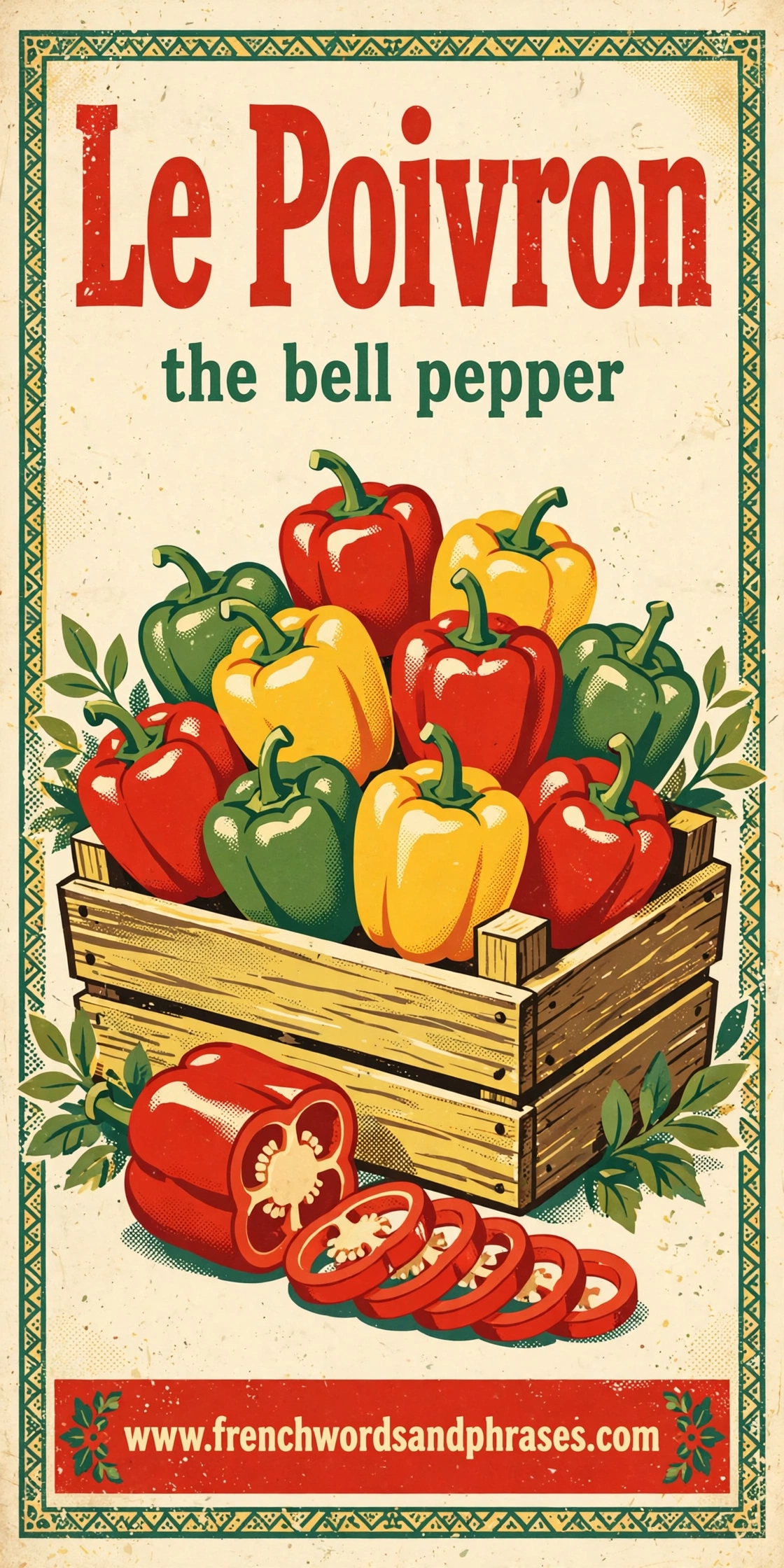
The stall is a traffic light of vegetables: red, yellow and green bells piled in glossy pyramids, sweet and crunchy and smelling faintly of summer — les poivrons, the peppers you eat, not the pepper you grind.
In this guide, you’ll learn what poivron means in English, how to use it with its articles, how to form its plural, and how it appears in everyday French. Explore French examples, English translations, and practice quizzes.
Understanding the French Noun Poivron
Poivron is a masculine French noun. It is learned together with its article: le poivron, un poivron. It is the sweet, fleshy pepper eaten as a vegetable — a different word from the spice and from the chilli, as the usage note below explains.
It means the bell pepper — the big, sweet, hollow pepper that France grills, stuffs and slices into ratatouille and piperade. It comes in three famous colours: le poivron vert, picked young and sharp; le poivron jaune, mild and sunny; and le poivron rouge, fully ripe and the sweetest of the three. The colours are not different plants — they are different moments in one pepper’s life.
Gender: Masculine
Definite article: le — le poivron (the bell pepper)
Indefinite article: un — un poivron (a bell pepper)
Plural: les poivrons
English equivalents: The bell pepper; a sweet pepper.
One important usage detail: French keeps three peppers apart, and so must you. Le poivron is the sweet bell pepper, eaten as a vegetable. Le poivre is pepper the spice — the black grains you grind over a dish. And le piment is the chilli, the hot one. Ask for poivre at the market and you will be handed a spice jar, not a vegetable.
Experience the Word
Poivron is more than a vegetable. It is the colour of the summer stall — red, yellow and green, glossy as painted bells.
Imagine a Basque kitchen at noon: peppers roasting until their skins blacken, tomatoes softening, eggs waiting — the piperade coming together in the pan.
You have not just sliced a pepper. You have opened the summer of the South-West.
How to Use Poivron in French: Complete Guide
Let’s explore how poivron works in French, beginning with its articles.
Poivron with the Definite Article (Le, Les)
Used for the bell pepper everyone knows — the one in the basket, the one for tonight’s ratatouille.
| Number | French |
|---|---|
| Singular | le poivron |
| Plural | les poivrons |
Example
Le poivron rouge est plus doux que le vert.
The red bell pepper is sweeter than the green one.
Poivron with the Indefinite Article (Un, Des)
Used for a bell pepper in general — the one in the recipe, the one on your list.
| Number | French |
|---|---|
| Singular | un poivron |
| Plural | des poivrons |
Example
Il faut un poivron jaune pour la salade.
You need a yellow bell pepper for the salad.
The Poivron in Three Colours
Green, yellow and red — one pepper at three moments of its life.
| French | In English |
|---|---|
| le poivron rouge | the red bell pepper |
| le poivron jaune | the yellow bell pepper |
| le poivron vert | the green bell pepper |
| le poivron orange | the orange bell pepper |
| un poivron farci | a stuffed pepper |
| les poivrons grillés | grilled peppers |
Example
Les poivrons farcis sont un plat d’été.
Stuffed peppers are a summer dish.
Quick Quiz 1
Which bell pepper is sweeter, the green or the red?
Reveal the answer
The red — it is fully ripe; the green one is picked before ripening.
Le poivron rouge est le plus doux des trois.
The red bell pepper is the sweetest of the three.
The Plural of Poivron
Poivron adds an -s in the plural — les poivrons, the peppers of the summer stall.
| Number | French |
|---|---|
| Singular | le poivron |
| Plural | les poivrons |
Example
Les poivrons du marché sont rouges, jaunes et verts.
The market’s bell peppers are red, yellow and green.
Poivron with Possessive Adjectives (Mon, Ton, Son…)
Possessives agree with the noun, not with the owner — and poivron is masculine, so it takes mon, ton, son.
| Owner | French |
|---|---|
| my | mon poivron |
| your (tu) | ton poivron |
| his / her | son poivron |
| our | notre poivron |
| your (vous) | votre poivron |
| their | leur poivron |
Example
Mon poivron farci est dans le four.
My stuffed pepper is in the oven.
Quick Quiz 2
Complete the sentence:
Elle coupe ______ poivron en petits morceaux. (her)
Reveal the answer
son
Elle coupe son poivron en petits morceaux.
She cuts her bell pepper into small pieces.
Poivron with Demonstrative Adjectives (Ce, Ces)
Used to point: this bell pepper here, those bell peppers there.
| Number | French |
|---|---|
| Singular | ce poivron |
| Plural | ces poivrons |
Example
Ce poivron est parfait pour la ratatouille.
This bell pepper is perfect for the ratatouille.
Poivron with Adjectives
Adjectives agree with poivron, masculine — rouge, jaune, vert, farci.
| Adjective | With Poivron |
|---|---|
| rouge (red) | un poivron rouge |
| jaune (yellow) | un poivron jaune |
| vert (green) | un poivron vert |
| doux (sweet) | un poivron doux |
| farci (stuffed) | un poivron farci |
| grillé (grilled) | un poivron grillé |
Example
Un poivron grillé a un goût fumé délicieux.
A grilled bell pepper has a delicious smoky taste.
Quick Quiz 3
Complete the sentence:
Je cherche un poivron ______, pas un vert. (yellow)
Reveal the answer
jaune
Je cherche un poivron jaune, pas un vert.
I’m looking for a yellow bell pepper, not a green one.
Everyday Expressions with Poivron
Stuffed, sliced and in the piperade — the poivron phrases of the summer kitchen.
| Expression | In English |
|---|---|
| un poivron farci | a stuffed pepper |
| couper le poivron en lamelles | to slice the pepper into strips |
| les poivrons grillés | grilled peppers |
| la piperade basque | Basque piperade, the pepper and tomato dish |
| des poivrons marinés | marinated peppers |
| la ratatouille | ratatouille |
Example
La piperade basque se fait avec des poivrons et des tomates.
Basque piperade is made with bell peppers and tomatoes.
Words from the Same Family as Poivron
Spices, chillies and summer cousins — the words that travel with poivron, and the two it must never be confused with.
| French | In English |
|---|---|
| le poivre | black pepper, the spice |
| le piment | the chilli, the hot pepper |
| la tomate | the tomato |
| l’aubergine | the eggplant |
| la courgette | the courgette, the zucchini |
| le paprika | paprika |
Example
Le poivron, la tomate et l’aubergine font la ratatouille.
The bell pepper, the tomato and the eggplant make ratatouille.
Quick Quiz 4
At the market you ask for du poivre, hoping for a bell pepper. What will you get?
Reveal the answer
Black pepper, the spice — the vegetable is le poivron.
Le poivre est une épice, le poivron est un légume.
Poivre is a spice, poivron is a vegetable.
Poivron in Everyday French: Real-Life Examples
Now that you know the word, let’s see how poivron appears in everyday French.
Example 1 — At the market
Je prends un poivron rouge et deux poivrons verts.
I’ll take one red bell pepper and two green ones.
Example 2 — Cooking
Elle coupe le poivron en lamelles pour la piperade.
She slices the bell pepper into strips for the piperade.
Example 3 — Choosing
Le poivron jaune est doux et joli dans la salade.
The yellow bell pepper is sweet and pretty in the salad.
Example 4 — Stuffed
Les poivrons farcis cuisent au four pendant une heure.
The stuffed peppers bake in the oven for an hour.
Example 5 — Ratatouille
Il faut des poivrons pour une bonne ratatouille.
You need bell peppers for a good ratatouille.
Example 6 — A warning
Ce n’est pas un piment, c’est un poivron doux.
It’s not a chilli, it’s a sweet bell pepper.
See le poivron in a story: Fruits and Vegetables: French Vocabulary (Fruits et Légumes) — a Saturday trip to a French market.
Beyond Translation: The Meaning of Poivron
The poivron is an American by birth: peppers crossed the Atlantic with Columbus and took root so completely in the Basque country and in Provence that France now treats them as its own — in the piperade of the South-West, in ratatouille, and on every summer grill.
To say poivron is to choose a colour: red, yellow or green.
It evokes stuffed peppers in the oven and strips sizzling in olive oil — the sweet one of the pepper family, the one that crunches in salads and never, ever burns.
How to Remember the French Noun Poivron
Remember it this way: Poivron is the bell pepper — masculine, sweet and eaten as a vegetable; poivre is the spice and piment is the hot chilli.
- You eat the sweet one — le poivron rouge, jaune ou vert.
- You grind the spice — le poivre noir, dans le moulin.
- You fear the hot one — le piment pique, attention !
The key idea is le poivron is sweet — le poivre is ground, le piment is hot.
Test Your Knowledge of Poivron
Let’s see how much you’ve learned. Try answering these questions before revealing the answers.
Question 1
Is poivron masculine or feminine?
Reveal the answer
Masculine — le poivron, un poivron.
Question 2
What is the difference between le poivron and le poivre?
Reveal the answer
Le poivron is the bell pepper, a vegetable; le poivre is pepper the spice — the grains you grind.
Question 3
Translate: The red bell pepper is sweeter than the green one.
Reveal the answer
Le poivron rouge est plus doux que le poivron vert.
Question 4
What is le piment?
Reveal the answer
The chilli — the hot pepper, cousin of the sweet poivron.
Question 5
Complete the sentence:
Elle achète ______ poivron jaune pour la salade.
Reveal the answer
un
Elle achète un poivron jaune pour la salade.
She buys a yellow bell pepper for the salad.
Your Final Challenge
Can You Use It?
How would you say this in French?
“I need a red bell pepper for the ratatouille.”
Reveal the answer
Il me faut un poivron rouge pour la ratatouille.
I need a red bell pepper for the ratatouille.
A little French. A little curiosity. A richer everyday life.
LEARN FRENCH ONE WORD AT A TIME




