
A French Word to Live By
Translate Aubergine to English
/o.bɛʁ.ʒin/
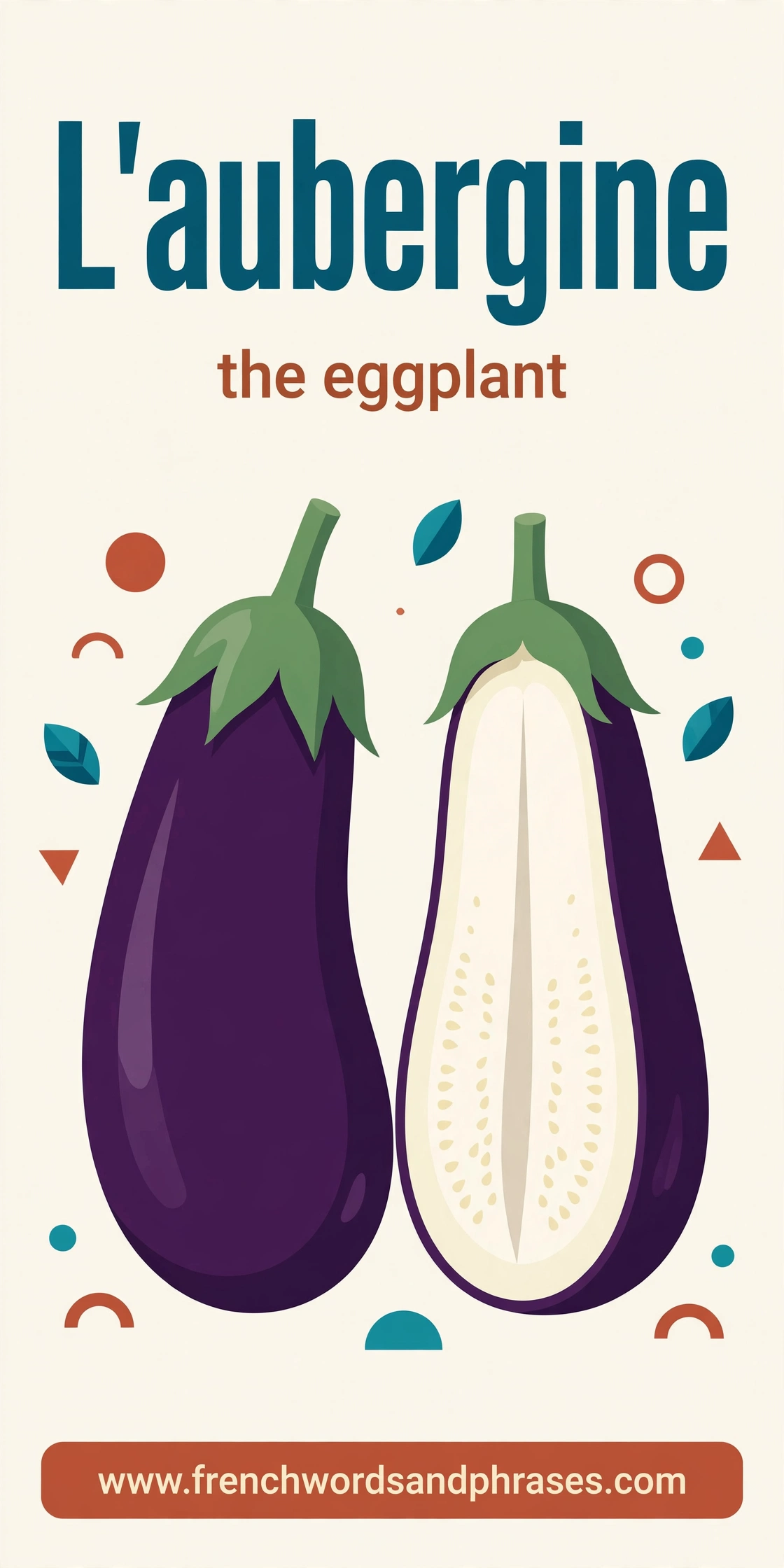
L’aubergine means the eggplant.
At the Provençal stall, they shine like polished stones: deep purple, smooth and heavy in the hand, lined up beside the tomatoes and the courgettes — les aubergines, the queens of the summer ratatouille.
In this guide, you’ll learn what aubergine means in English, how to use it with its articles, how to form its plural, and how it appears in everyday French. Explore French examples, English translations, and practice quizzes.
Understanding the French Noun Aubergine
Aubergine is a feminine French noun. It is learned together with its article: l’aubergine, une aubergine. Because it begins with a vowel, the definite article shrinks to l’ — and English speakers may know this word already, as the usage note explains.
It means the eggplant — the glossy purple vegetable at the heart of ratatouille, moussaka and the famous caviar d’aubergine. It drinks olive oil like a sponge, turns silky in the oven, and is chosen heavy and shiny: a light, dull aubergine is an old aubergine. Botanically, it is a cousin of the tomato, the poivron and even the potato — all one family.
Gender: Feminine
Definite article: l’ — l’aubergine (the eggplant)
Indefinite article: une — une aubergine (an eggplant)
Plural: les aubergines
English equivalents: The eggplant (American); the aubergine (British) — the same word as the French.
One important usage detail: this French word lives a double life in English. In Britain, the vegetable is called an aubergine — the French word itself, borrowed whole. In America it is an eggplant, a name that comes from old white varieties shaped like eggs. So when a British recipe says aubergine, you already know the French.
Experience the Word
Aubergine is more than a vegetable. It is the shine of the summer market — purple, polished and promising, the colour of Mediterranean cooking.
Imagine a kitchen in Nice at noon: aubergines grilling until they collapse, tomatoes and poivrons waiting their turn, the ratatouille assembling itself in the great pan.
You have not just bought a vegetable. You have carried home a piece of the Mediterranean sun.
How to Use Aubergine in French: Complete Guide
Let’s explore how aubergine works in French, beginning with its articles.
Aubergine with the Definite Article (L’, Les)
Aubergine begins with a vowel, so la shrinks to l’ — l’aubergine — while the plural is les aubergines.
| Number | French |
|---|---|
| Singular | l’aubergine |
| Plural | les aubergines |
Example
L’aubergine est le légume violet de la ratatouille.
The eggplant is the purple vegetable of ratatouille.
Aubergine with the Indefinite Article (Une, Des)
Used for an eggplant in general — the one in the recipe, the one on your list.
| Number | French |
|---|---|
| Singular | une aubergine |
| Plural | des aubergines |
Example
Il faut une grosse aubergine pour la moussaka.
You need a big eggplant for the moussaka.
The Aubergine in the Kitchen
Grilled, stuffed and turned into caviar — the aubergine at work.
| French | In English |
|---|---|
| le caviar d’aubergine | eggplant caviar, the roasted eggplant dip |
| une aubergine grillée | a grilled eggplant |
| une aubergine farcie | a stuffed eggplant |
| la moussaka | moussaka |
| la ratatouille | ratatouille |
| la peau violette | the purple skin |
Example
Le caviar d’aubergine se mange avec du pain grillé.
Eggplant caviar is eaten with toasted bread.
Quick Quiz 1
What is le caviar d’aubergine?
Reveal the answer
A dip of roasted eggplant — the aubergine’s flesh, mashed and seasoned; no fish is involved.
On sert le caviar d’aubergine à l’apéritif.
Eggplant caviar is served as an appetizer.
The Plural of Aubergine
Aubergine adds an -s in the plural — les aubergines, shining in a row at the market.
| Number | French |
|---|---|
| Singular | l’aubergine |
| Plural | les aubergines |
Example
Les aubergines du marché sont brillantes et violettes.
The market eggplants are shiny and purple.
Aubergine with Possessive Adjectives (Mon, Ton, Son…)
A famous exception: aubergine is feminine, but because it begins with a vowel it takes mon, ton, son — mon aubergine, never ‘ma aubergine’.
| Owner | French |
|---|---|
| my | mon aubergine |
| your (tu) | ton aubergine |
| his / her | son aubergine |
| our | notre aubergine |
| your (vous) | votre aubergine |
| their | leur aubergine |
Example
Mon aubergine est encore dans le panier.
My eggplant is still in the basket.
Quick Quiz 2
Complete the sentence:
Elle fait griller ______ aubergine au four.
Reveal the answer
son
Elle fait griller son aubergine au four.
She is roasting her eggplant in the oven — son, not sa, because aubergine begins with a vowel.
Aubergine with Demonstrative Adjectives (Cette, Ces)
Used to point: this eggplant here, those eggplants there.
| Number | French |
|---|---|
| Singular | cette aubergine |
| Plural | ces aubergines |
Example
Cette aubergine est parfaite pour la ratatouille.
This eggplant is perfect for the ratatouille.
Aubergine with Adjectives
Adjectives agree with aubergine, feminine — grosse, violette, grillée.
| Adjective | With Aubergine |
|---|---|
| grosse (big) | une grosse aubergine |
| violette (purple) | une aubergine violette |
| grillée (grilled) | une aubergine grillée |
| farcie (stuffed) | une aubergine farcie |
| brillante (shiny) | une aubergine brillante |
Example
Une aubergine brillante est une aubergine fraîche.
A shiny eggplant is a fresh eggplant.
Quick Quiz 3
Complete the sentence:
C’est une aubergine très ______. (purple)
Reveal the answer
violette
C’est une aubergine très violette.
It’s a very purple eggplant.
Everyday Expressions with Aubergine
From the grill to the moussaka — the aubergine phrases of the summer table.
| Expression | In English |
|---|---|
| le caviar d’aubergine | eggplant caviar, the dip |
| une aubergine farcie | a stuffed eggplant |
| faire dégorger l’aubergine | to salt and drain the eggplant |
| griller des aubergines | to grill eggplants |
| la moussaka grecque | Greek moussaka |
| la ratatouille niçoise | Nice-style ratatouille |
Example
On fait dégorger les aubergines avec du sel.
You salt the eggplants to draw out the water.
Words from the Same Family as Aubergine
Tomatoes, peppers and potatoes — the aubergine’s cousins in one great family.
| French | In English |
|---|---|
| la tomate | the tomato |
| le poivron | the bell pepper |
| la pomme de terre | the potato |
| la courgette | the courgette, the zucchini |
| la ratatouille | ratatouille |
| violet | purple |
Example
L’aubergine, la tomate et la pomme de terre sont de la même famille.
The eggplant, the tomato and the potato are from the same family.
Quick Quiz 4
A British friend says ‘aubergine’ and an American says ‘eggplant’. Who is right?
Reveal the answer
Both — it is the same vegetable; British English kept the French word, American English named it after an egg.
En anglais britannique, on dit aubergine, comme en français.
In British English, you say aubergine, like in French.
Aubergine in Everyday French: Real-Life Examples
Now that you know the word, let’s see how aubergine appears in everyday French.
Example 1 — At the market
Je prends deux aubergines bien brillantes.
I’ll take two nice shiny eggplants.
Example 2 — Ratatouille
L’aubergine est indispensable dans la ratatouille.
Eggplant is essential in ratatouille.
Example 3 — Grilling
Nous grillons les aubergines au barbecue.
We’re grilling the eggplants on the barbecue.
Example 4 — In Britain
À Londres, on dit aubergine, comme en français.
In London, they say aubergine, like in French.
Example 5 — Stuffed
Elle prépare des aubergines farcies à la viande.
She’s making eggplants stuffed with meat.
Example 6 — Choosing
Choisis une aubergine lourde et brillante.
Choose a heavy, shiny eggplant.
See l’aubergine in a story: Fruits and Vegetables: French Vocabulary (Fruits et Légumes) — a Saturday trip to a French market.
Beyond Translation: The Meaning of Aubergine
Few words have travelled like aubergine: born in India, carried through Persia and the Arab world, it crossed Spain and arrived in France with its purple skin and its exotic name, long before America renamed it after an egg.
To say aubergine is to speak three continents in one word.
It evokes the silk of a roasted aubergine and the dip it becomes, the moussaka of Greece and the ratatouille of Nice — and the pleasure, for an English speaker, of a French word that Britain never gave back.
How to Remember the French Noun Aubergine
Remember it this way: Aubergine is the eggplant — feminine with l’, the same word in British English, and eggplant in American English.
- You shine at the market — l’aubergine lourde et brillante.
- You cross the Channel — en Angleterre, on dit aussi aubergine.
- You cross the Atlantic — en Amérique, c’est eggplant.
The key idea is l’aubergine — aubergine in Britain, eggplant in America.
Test Your Knowledge of Aubergine
Let’s see how much you’ve learned. Try answering these questions before revealing the answers.
Question 1
Is aubergine masculine or feminine?
Reveal the answer
Feminine — but with l’: l’aubergine, une aubergine.
Question 2
What do the British call this vegetable?
Reveal the answer
An aubergine — British English uses the French word itself; Americans say eggplant.
Question 3
Translate: Eggplant is essential in ratatouille.
Reveal the answer
L’aubergine est indispensable dans la ratatouille.
Question 4
Why do we say mon aubergine and not ma aubergine?
Reveal the answer
Because aubergine begins with a vowel sound — feminine nouns starting with a vowel take mon, ton, son.
Question 5
Complete the sentence:
Il achète ______ aubergines au marché.
Reveal the answer
des
Il achète des aubergines au marché.
He buys some eggplants at the market.
Your Final Challenge
Can You Use It?
How would you say this in French?
“I am buying two eggplants for the ratatouille.”
Reveal the answer
J’achète deux aubergines pour la ratatouille.
I am buying two eggplants for the ratatouille.
A little French. A little curiosity. A richer everyday life.
LEARN FRENCH ONE WORD AT A TIME




