A French Vocabulary Lesson
Welcome to a little French lesson about going on holiday!
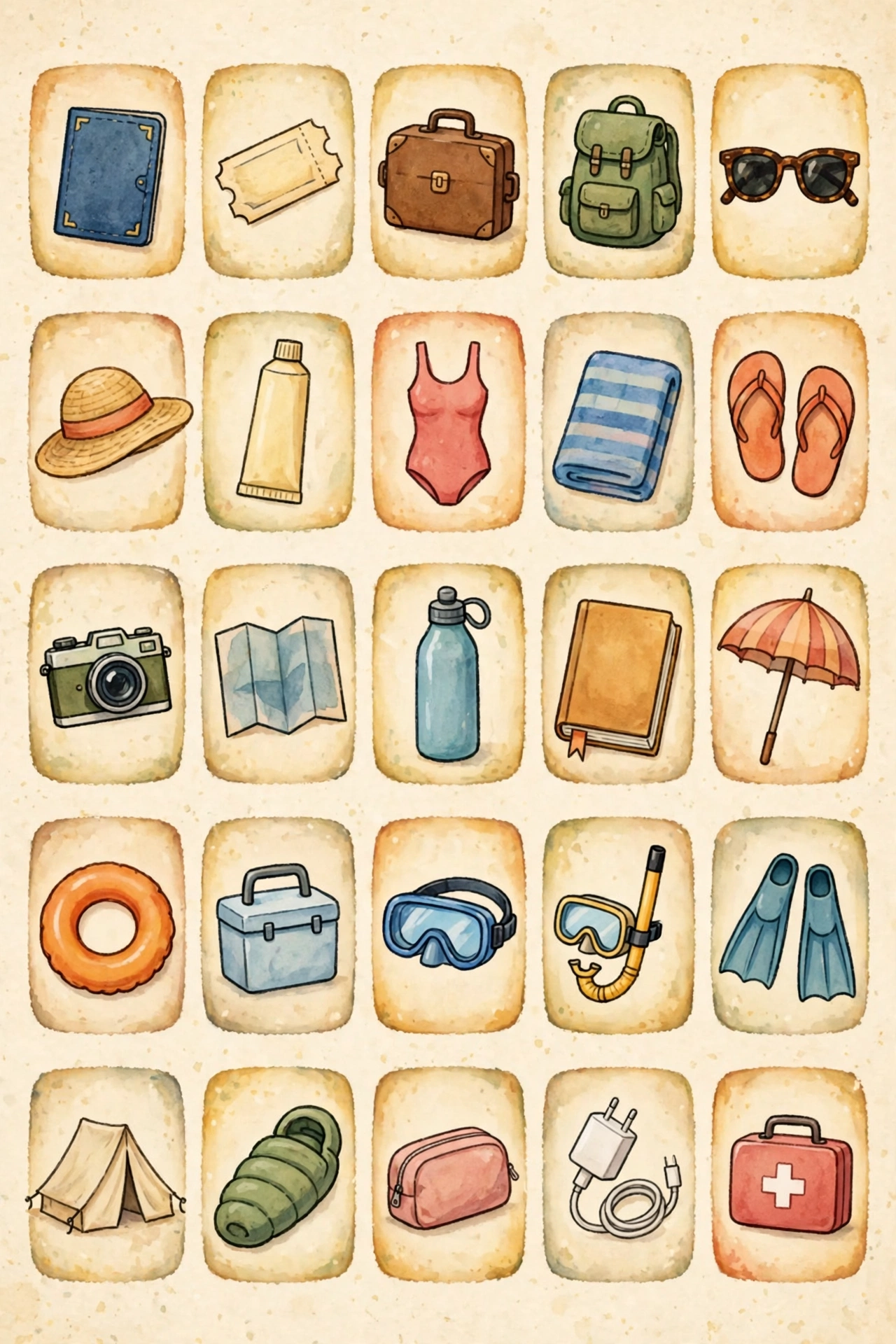
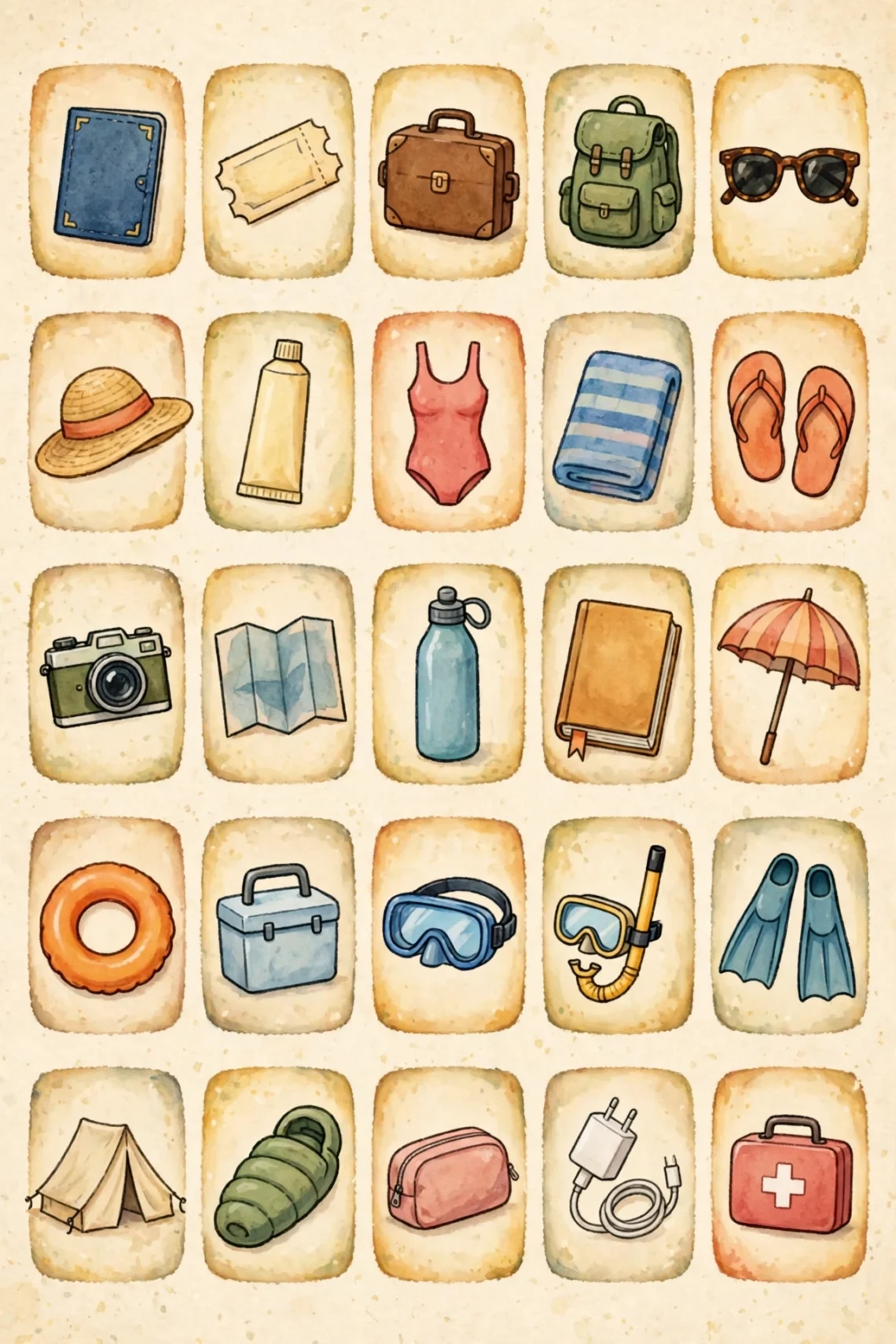
Les objets de vacances means holiday objects. In this lesson, you’ll discover twenty-five useful French words for the things you pack, carry and use on a trip to the sun.
Learning vocabulary is easier when you see words used in real situations. So instead of memorizing a list, let’s pack a suitcase, fly south, spend a day at the beach and sleep one night under canvas.
Our Story: Les Vacances d’Emma
Imagine that it is the evening before the holidays. Emma is packing her bags, because tomorrow she is flying to the south of France for a week of beach and camping with her brother Léo.
Read the story in French first. The English translation follows each passage to help you understand.
Le Départ d’Emma
La veille du départ, Emma fait sa valise sur son lit. Elle met d’abord son maillot de bain, sa serviette de plage et ses tongs. Puis elle ajoute la crème solaire, le chapeau de soleil et les lunettes de soleil — dans le Sud, le soleil est fort !
The day before leaving, Emma packs her suitcase on her bed. First she puts in her swimsuit, her beach towel and her flip-flops. Then she adds the sun cream, the sun hat and the sunglasses — in the South, the sun is strong!
Dans son sac à dos, Emma glisse les objets importants : son passeport, son billet d’avion, son appareil photo et son guide de voyage. Elle n’oublie pas la carte de la région, une gourde pleine d’eau, le chargeur de son téléphone et sa trousse de toilette. La trousse de secours va dans la poche du devant — on ne sait jamais !
In her rucksack, Emma slips the important objects: her passport, her plane ticket, her camera and her travel guide. She does not forget the map of the region, a water bottle full of water, her phone charger and her toiletry bag. The first-aid kit goes in the front pocket — you never know!
Le lendemain, à l’aéroport, Emma montre son passeport et son billet d’avion. Deux heures plus tard, l’avion arrive à Nice. Dehors, le soleil brille déjà et l’air sent la mer.
The next day, at the airport, Emma shows her passport and her plane ticket. Two hours later, the plane arrives in Nice. Outside, the sun is already shining and the air smells of the sea.
À la plage, Léo plante le parasol dans le sable et Emma étale sa serviette de plage. Dans la glacière, les boissons et les sandwichs restent bien frais. Près de l’eau, les enfants jouent avec une grande bouée rose.
At the beach, Léo plants the parasol in the sand and Emma spreads out her beach towel. In the cool box, the drinks and sandwiches stay nice and cold. Near the water, the children play with a big pink rubber ring.
L’après-midi, Emma met son masque de plongée, son tuba et ses palmes. Sous l’eau, elle voit des petits poissons argentés entre les rochers, et elle prend des photos avec son appareil photo.
In the afternoon, Emma puts on her diving mask, her snorkel and her flippers. Under the water, she sees little silver fish between the rocks, and she takes photos with her camera.
Le soir, au camping, ils montent la tente près des pins. Après le dîner, Emma déroule son sac de couchage et regarde les étoiles. Demain, on retourne à la plage !
In the evening, at the campsite, they pitch the tent near the pine trees. After dinner, Emma unrolls her sleeping bag and looks at the stars. Tomorrow, back to the beach!
Quelle belle première journée de vacances ! Emma ferme les yeux, fatiguée mais heureuse. Les vacances commencent bien.
What a lovely first day of the holidays! Emma closes her eyes, tired but happy. The holidays are off to a good start.
The Vocabulary: 25 French Words for Holiday Objects
Now let’s look at the twenty-five important words from our story. Try saying each French word aloud before looking at its English meaning.
Les Objets du Voyage — Travel Objects
| French | English |
|---|---|
| 1. Le passeport | The passport |
| 2. Le billet d’avion | The plane ticket |
| 3. La valise | The suitcase |
| 4. Le sac à dos | The rucksack |
| 5. Les lunettes de soleil | Sunglasses |
| 6. Le chapeau de soleil | The sun hat |
| 7. La crème solaire | Sun cream |
| 8. Le maillot de bain | The swimsuit |
| 9. La serviette de plage | The beach towel |
| 10. Les tongs | Flip-flops |
| 11. L’appareil photo | The camera |
| 12. La carte | The map |
| 13. La gourde | The water bottle |
| 14. Le guide de voyage | The travel guide |
À la Plage et au Camping — At the Beach and the Campsite
| French | English |
|---|---|
| 15. Le parasol | The parasol |
| 16. La bouée | The rubber ring |
| 17. La glacière | The cool box |
| 18. Le masque de plongée | The diving mask |
| 19. Le tuba | The snorkel |
| 20. Les palmes | Flippers |
| 21. La tente | The tent |
| 22. Le sac de couchage | The sleeping bag |
| 23. La trousse de toilette | The toiletry bag |
| 24. Le chargeur | The charger |
| 25. La trousse de secours | The first-aid kit |
A small but useful language tip:
On the beach, listen carefully: many French people don’t say les tongs at all — they say les claquettes. Both words mean flip-flops, and les claquettes is the word you’ll hear in campsites and beach shops all over France. Les tongs is perfectly correct and understood everywhere, but les claquettes will make you sound like a regular.
French in Everyday Life: Useful Expressions
Knowing the names of holiday objects is a good beginning. But how do you use these words when you travel?
Here are some simple expressions you might hear or use on holiday.
Example 1 — Packing
Fais ta valise, on part demain !
Pack your suitcase, we’re leaving tomorrow!
Example 2 — Before leaving
N’oublie pas ton passeport !
Don’t forget your passport!
Example 3 — At the airport
Voici mon billet d’avion, s’il vous plaît.
Here is my plane ticket, please.
Example 4 — At the beach
Mets de la crème solaire avant de nager.
Put some sun cream on before swimming.
Example 5 — In the water
Regarde les poissons avec ton masque et ton tuba !
Look at the fish with your mask and snorkel!
Example 6 — At the campsite
Où est le chargeur ? Mon téléphone n’a plus de batterie.
Where is the charger? My phone has run out of battery.
A Little French Grammar: Emporter or Emmener — Taking Things and People on Holiday
French has two different verbs for “to take with you”, and choosing the right one is a classic holiday skill.
- Emporter is used for things — the objects you carry away with you: J’emporte ma valise, mon appareil photo et ma gourde. (I’m taking my suitcase, my camera and my water bottle.)
- Emmener is used for people and animals — the companions who come with you: Emma emmène son frère à la plage. (Emma takes her brother to the beach.)
Packing itself has its own little verb phrase: faire sa valise means “to pack your suitcase”, and you put things into it with mettre dans la valise: Elle met son maillot de bain dans la valise. (She puts her swimsuit in the suitcase.)
And for the things you must not leave behind, French uses il ne faut pas oublier de + infinitive — “you must not forget to”: Il ne faut pas oublier de prendre le passeport et le chargeur. (You must not forget to take the passport and the charger.)
So before any trip, run through the checklist in French: emporter les objets, emmener les gens — and don’t forget the passeport!
Test Your Knowledge: French Holiday Objects
Let’s see how much you remember. Try each question before opening the answer.
Quick Quiz 1
Which French word means “the passport”?
Reveal the answer
Le passeport
Quick Quiz 2
Complete the sentence:
Emma met son maillot de bain dans sa ______.
Reveal the answer
valise
Emma met son maillot de bain dans sa valise.
Emma puts her swimsuit in her suitcase.
Quick Quiz 3
How do you say “the tent” in French?
Reveal the answer
La tente
Quick Quiz 4
Which word means “sunglasses”?
Reveal the answer
Les lunettes de soleil
Quick Quiz 5
Complete the sentence:
Il ne faut pas oublier le ______ du téléphone.
Reveal the answer
chargeur
Il ne faut pas oublier le chargeur du téléphone.
You must not forget the phone charger.
Can You Translate These French Sentences?
Now let’s reverse the exercise. Read each French sentence and try to translate it into English.
Question 1
La tente est près des pins.
What does this mean?
Reveal the answer
The tent is near the pine trees.
Question 2
Je mets de la crème solaire.
What does this mean?
Reveal the answer
I am putting on sun cream.
Question 3
Les palmes sont dans le sac à dos.
What does this mean?
Reveal the answer
The flippers are in the rucksack.
Question 4
Elle prend des photos avec son appareil photo.
What does this mean?
Reveal the answer
She takes photos with her camera.
Question 5
Le parasol est sur le sable.
What does this mean?
Reveal the answer
The parasol is on the sand.
Discover a Little French Holiday Culture
In France, the summer holidays — les grandes vacances — are almost sacred. Many French families take three or four weeks off in July or August, and whole cities seem to empty as everyone heads for the coast, the mountains or the countryside.
There are even names for the two tribes of holidaymakers: les juillettistes leave in July, and les aoûtiens leave in August. And the most popular holiday accommodation of all? The campsite — France has more campsites than any other country in Europe.
And here’s a useful expression:
Bonnes vacances et bon voyage !
Have a great holiday and a good trip!
You’ll hear bonnes vacances everywhere from late June onwards — in shops, at work, between neighbours. It is the phrase that opens the door to the French summer.
How to Remember Your New French Words
The easiest way to remember vocabulary is to connect each word to something familiar.
Try this little exercise next time you pack a bag or spend a day outside:
- When you pack your suitcase, say la valise and le sac à dos.
- When you put on sunglasses, think les lunettes de soleil.
- When you spread out your towel at the beach or the pool, think la serviette de plage.
- When you fill your water bottle, think la gourde.
- When you pitch a tent or roll out a sleeping bag, think la tente and le sac de couchage.
- When you plug in your phone at night, think le chargeur.
A few minutes of practice each day can make these words part of your everyday French vocabulary.
Your Final Challenge
Can You Pack for Your Holiday in French?
Imagine that you are leaving tomorrow for a week by the sea.
Can you write a packing list of eight holiday objects, and describe your first day at the beach?
Here is a little example to get you started:
Dans ma valise, je mets mon maillot de bain, ma serviette de plage et mes lunettes de soleil. À la plage, je nage avec mon masque de plongée et mon tuba, puis je lis mon guide de voyage sous le parasol.
In my suitcase, I put my swimsuit, my beach towel and my sunglasses. At the beach, I swim with my diving mask and my snorkel, then I read my travel guide under the parasol.
Now it’s your turn!
Try writing a few sentences about your holiday packing in French. Don’t worry about making mistakes. Every new sentence is another step toward speaking French.
Today’s Lesson: Les Objets de Vacances — Holiday Objects
25 new words. A little story. A little French culture.
Learn French one lesson at a time!