A French Word to Live By
Translate Orange to English
/ɔ.ʁɑ̃ʒ/
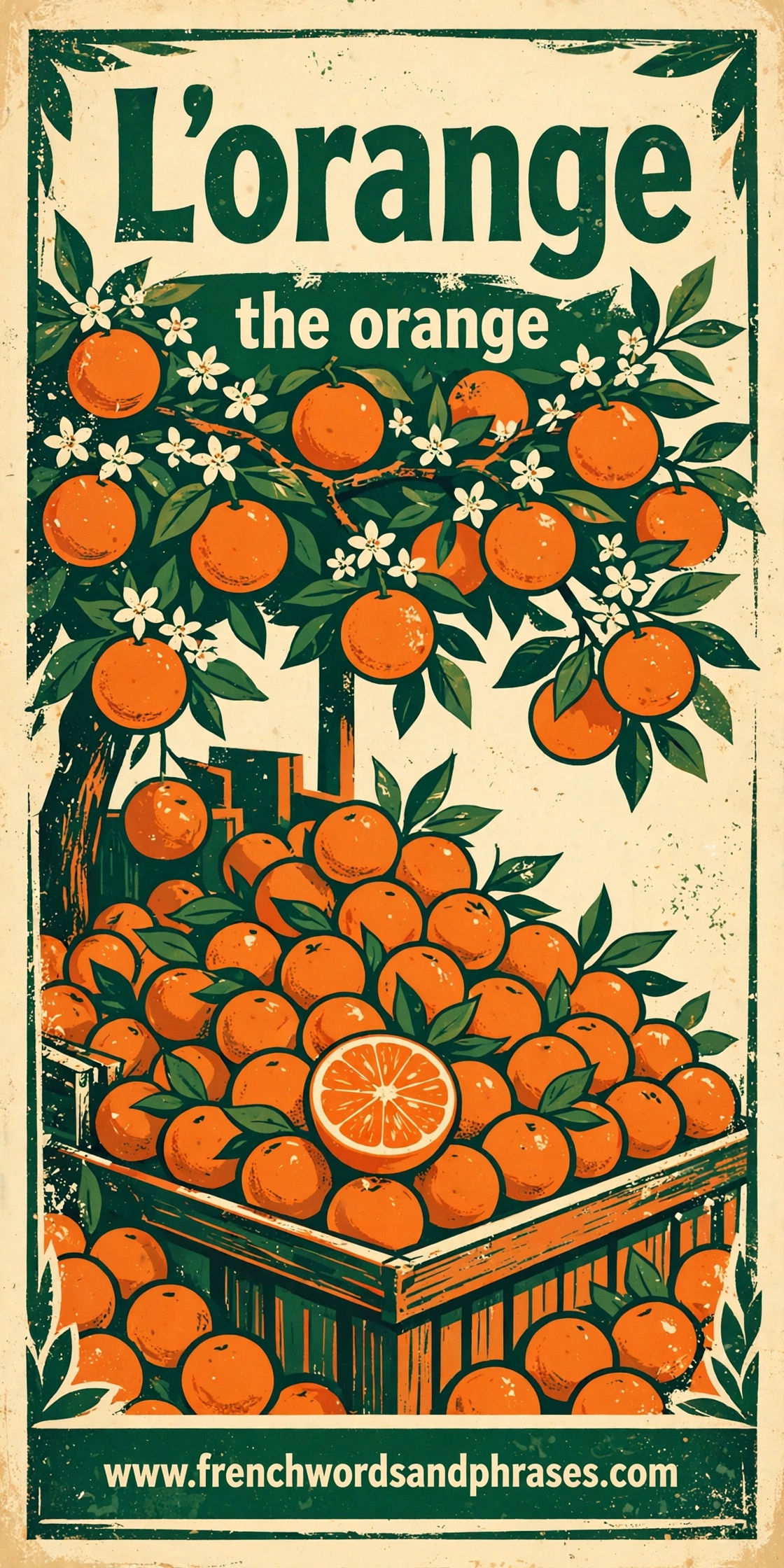
L’orange means the orange.
Winter morning in the kitchen: someone is pressing oranges at the counter, the juice is foaming into the jug, and the whole room smells of sunshine in the middle of January — l’orange, the orange.
In this guide, you’ll learn what orange means in English, how to use it with its articles, how to form its plural, and how it appears in everyday French. Explore French examples, English translations, and practice quizzes.
Understanding the French Noun Orange
Orange is a feminine French noun. It is learned together with its article: l’orange, une orange. Because it begins with a vowel, the definite article shrinks to l’. The same word names the fruit and the colour — but, as we will see, the two oranges obey very different rules.
It means the orange — the round citrus fruit of l’oranger, the orange tree, squeezed for le jus d’orange, peeled at the table, or cooked into la confiture d’oranges, the marmalade. In winter it is the fruit of the season in France: crates of oranges arrive just when the days are shortest and greyest.
Gender: Feminine
Definite article: l’ — l’orange (the orange)
Indefinite article: une — une orange (an orange)
Plural: les oranges
English equivalents: The orange (the fruit); also the colour orange — but that orange never changes.
One important usage detail: as a colour, orange is an invariable adjective — it never agrees and never takes an -s. Des robes orange, orange dresses; des chaussures orange, orange shoes — never « des robes oranges ». But the fruit is an ordinary noun with an ordinary plural: je mange deux oranges. Same word, two jobs: the colour stands still, the fruit multiplies.
Experience the Word
Orange is more than a fruit. It is winter sunshine you can hold — the brightest thing in the fruit bowl on the darkest morning of the year.
Imagine the first glass of freshly pressed juice: the oranges halved and squeezed one by one, the jug filling with gold, the kitchen smelling like a grove in January.
You have not just drunk juice. You have pressed the sun into a glass.
How to Use Orange in French: Complete Guide
Let’s explore how orange works in French, beginning with its articles.
Orange with the Definite Article (L’, Les)
Orange begins with a vowel, so le and la both shrink to l’ — l’orange — while the plural is les oranges.
| Number | French |
|---|---|
| Singular | l’orange |
| Plural | les oranges |
Example
L’orange est à côté de la pomme dans le saladier.
The orange is next to the apple in the fruit bowl.
Orange with the Indefinite Article (Une, Des)
Used for an orange in general — the one you squeeze, the one you take to a friend in hospital.
| Number | French |
|---|---|
| Singular | une orange |
| Plural | des oranges |
Example
Elle apporte des oranges à son amie malade.
She brings oranges to her sick friend.
Orange at the Table
Juice, zest and marmalade — the words that travel with orange.
| French | In English |
|---|---|
| le jus d’orange | orange juice |
| une orange pressée | a squeezed orange |
| le zeste d’orange | orange zest |
| la confiture d’oranges | orange marmalade |
| l’oranger | the orange tree |
| la peau d’orange | orange peel |
Example
Le jus d’orange frais est prêt pour le petit déjeuner.
The fresh orange juice is ready for breakfast.
Quick Quiz 1
What is l’oranger?
Reveal the answer
The orange tree — the tree the oranges grow on. Watch the ending: the tree is l’oranger, the fruit is l’orange.
L’oranger du jardin est couvert de fleurs blanches.
The orange tree in the garden is covered in white flowers.
The Plural of Orange
The fruit adds an -s in the plural like any noun — les oranges. Only the colour orange refuses to change.
| Number | French |
|---|---|
| Singular | l’orange |
| Plural | les oranges |
Example
Les oranges d’hiver sont les plus juteuses.
Winter oranges are the juiciest.
Orange with Possessive Adjectives (Mon, Ton, Son…)
A famous exception: orange is feminine, but because it begins with a vowel it takes mon, ton, son — mon orange, never « ma orange ».
| Owner | French |
|---|---|
| my | mon orange |
| your (tu) | ton orange |
| his / her | son orange |
| our | notre orange |
| your (vous) | votre orange |
| their | leur orange |
Example
Il presse son orange pour le petit déjeuner.
He squeezes his orange for breakfast.
Quick Quiz 2
Complete the sentence:
Elle épluche ______ orange. (her)
Reveal the answer
son
Elle épluche son orange.
She peels her orange — son, not sa, because orange begins with a vowel.
Orange with Demonstrative Adjectives (Cette, Ces)
Used to point: this orange here, those oranges there.
| Number | French |
|---|---|
| Singular | cette orange |
| Plural | ces oranges |
Example
Cette orange est énorme, elle fera deux verres de jus.
This orange is enormous, it will make two glasses of juice.
Orange with Adjectives
Adjectives agree with the fruit, feminine — juteuse, sucrée, mûre. Only the colour word orange itself never changes.
| Adjective | With Orange |
|---|---|
| juteuse (juicy) | une orange juteuse |
| sucrée (sweet) | une orange sucrée |
| mûre (ripe) | une orange mûre |
| douce (sweet, mild) | une orange douce |
| amère (bitter) | une orange amère |
Example
Une orange juteuse et sucrée, voilà le vrai jus du matin.
A juicy, sweet orange — that is real morning juice.
Quick Quiz 3
Spot the trap: « Elle porte des chaussures oranges. » What is wrong?
Reveal the answer
The colour orange never takes an -s — it is invariable. The sentence should read: des chaussures orange. Only the fruit has a plural: des oranges.
Elle porte des chaussures orange et elle mange une orange.
She is wearing orange shoes and eating an orange.
Everyday Expressions with Orange
Pressing, peeling and visiting the sick — the orange phrases of daily life.
| Expression | In English |
|---|---|
| presser une orange | to squeeze an orange |
| un jus d’orange frais | a fresh orange juice |
| éplucher une orange | to peel an orange |
| apporter des oranges aux malades | to bring oranges to the sick (the classic hospital visit) |
| une orange sanguine | a blood orange |
| la couleur orange | the colour orange (invariable) |
Example
Le matin, il presse deux oranges pour toute la famille.
In the morning, he squeezes two oranges for the whole family.
Words from the Same Family as Orange
Trees, juice and zest — the words that travel with orange.
| French | In English |
|---|---|
| l’oranger | the orange tree |
| le jus | the juice |
| le zeste | the zest |
| presser | to squeeze, to press |
| éplucher | to peel |
| le citron | the lemon |
Example
On presse les oranges, on ne les épluche pas, pour le jus.
For juice, you squeeze the oranges, you do not peel them.
Quick Quiz 4
How do you say « orange shoes » in French — and why?
Reveal the answer
Des chaussures orange — the colour orange is invariable: no agreement, no -s, ever. The plural oranges belongs to the fruit alone.
Des chaussures orange, un sac orange, une robe orange.
Orange shoes, an orange bag, an orange dress.
Orange in Everyday French: Real-Life Examples
Now that you know the word, let’s see how orange appears in everyday French.
Example 1 — At breakfast
Elle boit un verre de jus d’orange frais.
She drinks a glass of fresh orange juice.
Example 2 — At the market
Je voudrais deux kilos d’oranges, s’il vous plaît.
I would like two kilos of oranges, please.
Example 3 — The colour trap
Il a acheté un vélo orange pour sa fille.
He bought an orange bike for his daughter.
Example 4 — A hospital visit
Nous apportons des oranges et des fleurs à grand-père.
We are bringing oranges and flowers to grandfather.
Example 5 — Making marmalade
En janvier, elle prépare sa confiture d’oranges.
In January, she makes her orange marmalade.
Example 6 — Peeling
L’enfant épluche son orange tout seul.
The child peels his orange all by himself.
See l’orange in a story: Fruits and Vegetables: French Vocabulary (Fruits et Légumes) — a Saturday trip to a French market.
Beyond Translation: The Meaning of Orange
The orange arrived in Europe along the old trade routes and gave its name to a colour — before oranges, French described the shade with mixtures and comparisons. The fruit kept the honour and the oddity: as a colour it froze in place, invariable forever, while as a fruit it stayed a living noun with plurals, trees and juice.
To say orange is to carry winter sunshine — and French grammar’s most colourful exception.
It evokes the pressed juice of January mornings, the oranges carried to hospital visits, and the little spelling trap that catches every learner once: the colour never, ever takes an -s.
How to Remember the French Noun Orange
Remember it this way: Orange is the orange — feminine with l’, a fruit with a normal plural, and a colour that never changes at all.
- You squeeze one — l’orange, feminine, with une and les oranges.
- You dress in it — des robes orange, the colour never takes an -s.
- You dodge the exception — mon orange, pas ma orange, because of the vowel.
The key idea is the fruit takes oranges — the colour stays orange.
Test Your Knowledge of Orange
Let’s see how much you’ve learned. Try answering these questions before revealing the answers.
Question 1
Is orange masculine or feminine?
Reveal the answer
Feminine — but with l’: l’orange, une orange.
Question 2
How do you say orange dresses in French?
Reveal the answer
Des robes orange — the colour orange is invariable and never takes an -s.
Question 3
Translate: She drinks a glass of orange juice.
Reveal the answer
Elle boit un verre de jus d’orange.
Question 4
What is l’oranger?
Reveal the answer
The orange tree — mind the ending: l’oranger is the tree, l’orange is the fruit.
Question 5
Complete the sentence:
Je presse ______ orange pour le jus. (my)
Reveal the answer
mon
Je presse mon orange pour le jus.
I squeeze my orange for the juice — mon, because orange begins with a vowel.
Your Final Challenge
Can You Use It?
How would you say this in French?
“In winter, we squeeze oranges every morning.”
Reveal the answer
En hiver, nous pressons des oranges tous les matins.
In winter, we squeeze oranges every morning.
A little French. A little curiosity. A richer everyday life.
LEARN FRENCH ONE WORD AT A TIME