A French Word to Live By
Translate Fraise to English
/fʁɛz/
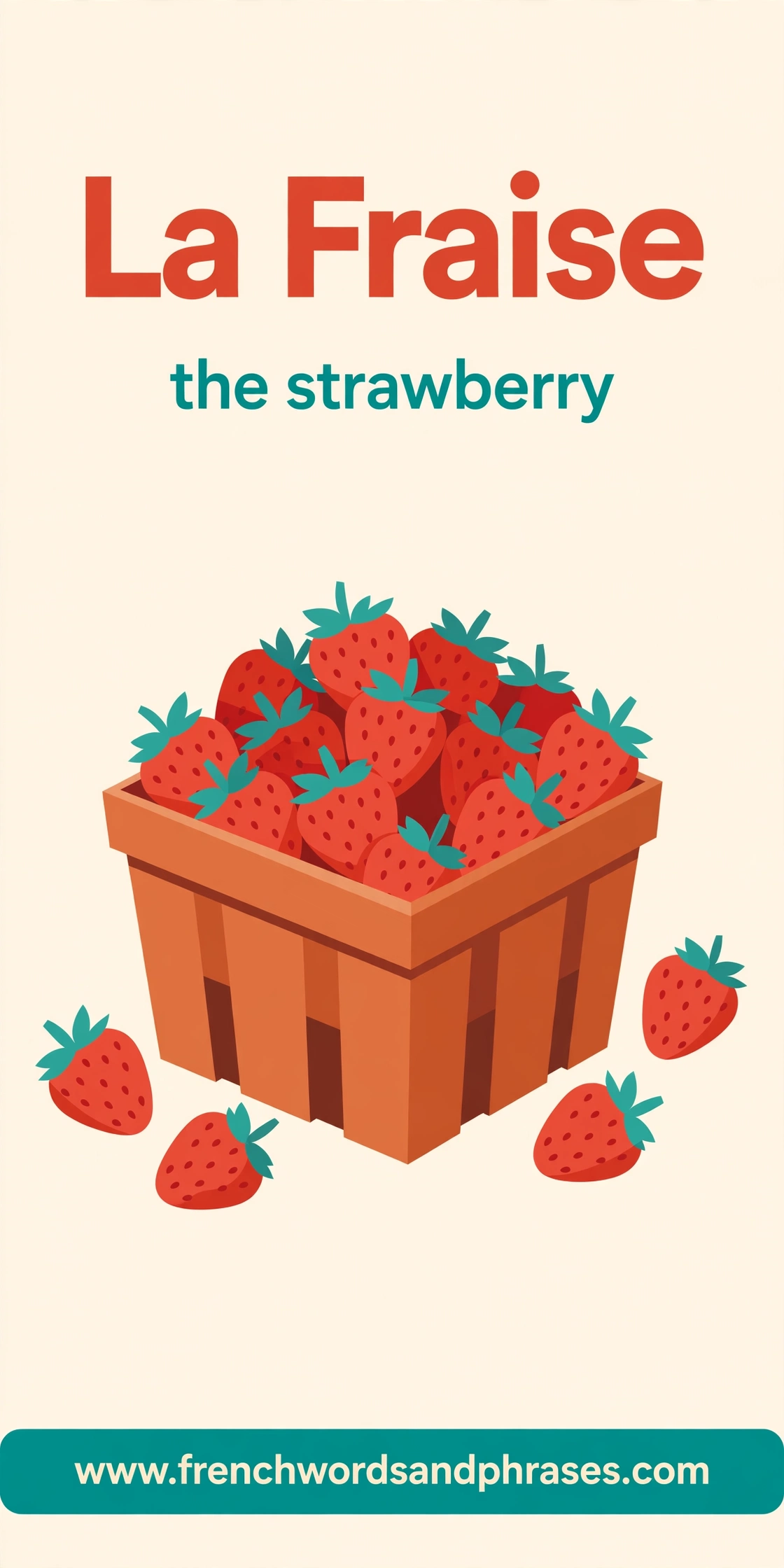
La fraise means the strawberry.
Late May at the market: the first punnets of the year are lined up on the stall, red and gleaming, and the stallholder lets you taste one before you even ask the price — la fraise, the strawberry, the first fruit of summer.
In this guide, you’ll learn what fraise means in English, how to use it with its articles, how to form its plural, and how it appears in everyday French. Explore French examples, English translations, and practice quizzes.
Understanding the French Noun Fraise
Fraise is a feminine French noun. It is learned together with its article: la fraise, une fraise. It names the soft red fruit of le fraisier, the strawberry plant — and France guards its strawberries jealously, from the famous gariguette of spring to the tiny fraises des bois of the woods.
It means the strawberry — eaten fresh with a little sugar or cream, cooked into la confiture de fraises, or laid in shining rows over une tarte aux fraises. The season is short and sacred: the first French strawberries of May are an event, and the wild ones, les fraises des bois, are a treasure hunt in the woods.
Gender: Feminine
Definite article: la — la fraise (the strawberry)
Indefinite article: une — une fraise (a strawberry)
Plural: les fraises
English equivalents: The strawberry.
One important usage detail: ramener sa fraise — literally, to bring your strawberry back — is familiar French for turning up uninvited or sticking your nose in. Il ramène toujours sa fraise: he always has to butt in. It is playful, not polite — save it for friends. In the garden, the useful phrase is les fraises des bois: the little wild strawberries.
Experience the Word
Fraise is more than a fruit. It is the announcement of summer — the first red thing in the market, the smell of May, the dessert that needs nothing done to it at all.
Imagine the punnet opened on the way home: one for the road, warm from the sun, so ripe it perfumes the whole bag, and half of them gone before the front door.
You have not just bought strawberries. You have tasted the first day of summer.
How to Use Fraise in French: Complete Guide
Let’s explore how fraise works in French, beginning with its articles.
Fraise with the Definite Article (La, Les)
Used for the strawberry everyone in the conversation knows — the one on the tart, the one in the punnet.
| Number | French |
|---|---|
| Singular | la fraise |
| Plural | les fraises |
Example
La fraise est le fruit préféré de ma fille.
The strawberry is my daughter’s favourite fruit.
Fraise with the Indefinite Article (Une, Des)
Used for a strawberry in general — the one you taste at the stall, the ones in the jam.
| Number | French |
|---|---|
| Singular | une fraise |
| Plural | des fraises |
Example
Elle goûte une fraise avant d’acheter la barquette.
She tastes a strawberry before buying the punnet.
Strawberries, from Plant to Plate
Plants, punnets and wild treasure — the words that travel with fraise.
| French | In English |
|---|---|
| le fraisier | the strawberry plant |
| les fraises des bois | wild strawberries |
| la barquette de fraises | the punnet of strawberries |
| la confiture de fraises | strawberry jam |
| une tarte aux fraises | a strawberry tart |
| la queue de la fraise | the strawberry’s green top |
Example
Les fraises des bois poussent au bord des chemins.
Wild strawberries grow at the edge of the paths.
Quick Quiz 1
What are les fraises des bois?
Reveal the answer
Wild strawberries — the tiny, intensely perfumed ones that grow in the woods, des bois. Small fruit, enormous flavour.
Nous avons trouvé des fraises des bois près du chemin.
We found wild strawberries near the path.
The Plural of Fraise
Fraise adds an -s in the plural — les fraises, and nobody ever buys just one.
| Number | French |
|---|---|
| Singular | la fraise |
| Plural | les fraises |
Example
Les fraises sont mûres, il faut les cueillir aujourd’hui.
The strawberries are ripe, they must be picked today.
Fraise with Possessive Adjectives (Ma, Ta, Sa…)
Possessives agree with the noun, not with the owner — and fraise is feminine, so it takes ma, ta, sa.
| Owner | French |
|---|---|
| my | ma fraise |
| your (tu) | ta fraise |
| his / her | sa fraise |
| our | notre fraise |
| your (vous) | votre fraise |
| their | leur fraise |
Example
Il a donné sa plus belle fraise à sa petite sœur.
He gave his finest strawberry to his little sister.
Quick Quiz 2
Complete the sentence:
______ tarte aux fraises est célèbre dans tout le village. (Their)
Reveal the answer
Leur
Leur tarte aux fraises est célèbre dans tout le village.
Their strawberry tart is famous throughout the village.
Fraise with Demonstrative Adjectives (Cette, Ces)
Used to point: this strawberry here, those strawberries there.
| Number | French |
|---|---|
| Singular | cette fraise |
| Plural | ces fraises |
Example
Ces fraises sont trop mûres pour attendre demain.
These strawberries are too ripe to wait until tomorrow.
Fraise with Adjectives
Adjectives agree with fraise, feminine — rouge, mûre, parfumée.
| Adjective | With Fraise |
|---|---|
| rouge (red) | une fraise rouge |
| mûre (ripe) | une fraise mûre |
| sucrée (sweet) | une fraise sucrée |
| parfumée (fragrant) | une fraise parfumée |
| fraîche (fresh) | une fraise fraîche |
Example
Une fraise bien rouge et parfumée annonce l’été.
A really red, fragrant strawberry announces summer.
Quick Quiz 3
Complete the sentence:
Je cherche des fraises bien ______. (fragrant)
Reveal the answer
parfumées
Je cherche des fraises bien parfumées.
I’m looking for really fragrant strawberries.
Everyday Expressions with Fraise
Picking, jamming and butting in — the fraise phrases of daily life.
| Expression | In English |
|---|---|
| ramener sa fraise | to butt in, to turn up uninvited (familiar) |
| cueillir des fraises | to pick strawberries |
| la saison des fraises | strawberry season |
| des fraises au sucre | strawberries with sugar |
| une tarte aux fraises | a strawberry tart |
| les fraises des bois | wild strawberries |
Example
Il n’était pas invité, mais il a ramené sa fraise.
He was not invited, but he turned up anyway.
Words from the Same Family as Fraise
Plants, picking and jam — the words that travel with fraise.
| French | In English |
|---|---|
| le fraisier | the strawberry plant |
| cueillir | to pick |
| la confiture | jam |
| la barquette | the punnet |
| le sucre | sugar |
| la crème | cream |
Example
Le fraisier donne des fraises de mai à juillet.
The strawberry plant gives strawberries from May to July.
Quick Quiz 4
Your friend grins: « Attention, il ramène sa fraise. » Is he bringing strawberries?
Reveal the answer
No — he is about to butt in. Ramener sa fraise is familiar French for turning up and joining in, invited or not.
Il ramène toujours sa fraise quand on parle de football.
He always butts in when we talk about football.
Fraise in Everyday French: Real-Life Examples
Now that you know the word, let’s see how fraise appears in everyday French.
Example 1 — At the market
Je voudrais une barquette de fraises, s’il vous plaît.
I would like a punnet of strawberries, please.
Example 2 — In the garden
Nous cueillons des fraises dans le jardin.
We pick strawberries in the garden.
Example 3 — Dessert
Ce soir, des fraises au sucre pour tout le monde.
Tonight, strawberries with sugar for everyone.
Example 4 — Making jam
Grand-mère prépare la confiture de fraises en juin.
Grandmother makes the strawberry jam in June.
Example 5 — In the woods
Les enfants cherchent des fraises des bois.
The children are looking for wild strawberries.
Example 6 — The familiar idiom
Il ramène encore sa fraise, comme toujours.
He is butting in again, as always.
See la fraise in a story: Fruits and Vegetables: French Vocabulary (Fruits et Légumes) — a Saturday trip to a French market.
Beyond Translation: The Meaning of Fraise
France takes its strawberries personally: the gariguette, the ciflorette and the mara des bois each have their season and their loyalists, and whole festivals are held in their honour. The wild fraise des bois, tiny and perfumed, is the connoisseur’s prize — the fruit the garden varieties are always being compared to, and never quite equal.
To say fraise is to announce that summer has begun.
It evokes the first punnet of May, jam bubbling in June, and the cheeky friend who ramène sa fraise — the strawberry you eat, and the nose you poke in.
How to Remember the French Noun Fraise
Remember it this way: Fraise is the strawberry — feminine, with la and une, the first fruit of summer and a cheeky familiar idiom.
- You pick them in May — des fraises du jardin, feminine with la.
- You hunt the wild ones — les fraises des bois, small and perfumed.
- You watch for the joker — ramener sa fraise, to butt in.
The key idea is la fraise of summer — sa fraise you butt in with.
Test Your Knowledge of Fraise
Let’s see how much you’ve learned. Try answering these questions before revealing the answers.
Question 1
Is fraise masculine or feminine?
Reveal the answer
Feminine — la fraise, une fraise.
Question 2
What does ramener sa fraise mean?
Reveal the answer
To butt in, to turn up uninvited — familiar French, literally to bring your strawberry back.
Question 3
Translate: We pick strawberries in the garden.
Reveal the answer
Nous cueillons des fraises dans le jardin.
Question 4
What are les fraises des bois?
Reveal the answer
Wild strawberries — the tiny wild ones from the woods.
Question 5
Complete the sentence:
Elle achète ______ barquette de fraises.
Reveal the answer
une
Elle achète une barquette de fraises.
She buys a punnet of strawberries.
Your Final Challenge
Can You Use It?
How would you say this in French?
“In June, grandmother makes strawberry jam.”
Reveal the answer
En juin, grand-mère prépare la confiture de fraises.
In June, grandmother makes strawberry jam.
A little French. A little curiosity. A richer everyday life.
LEARN FRENCH ONE WORD AT A TIME