A French Word to Live By
Translate Carotte to English
/ka.ʁɔt/
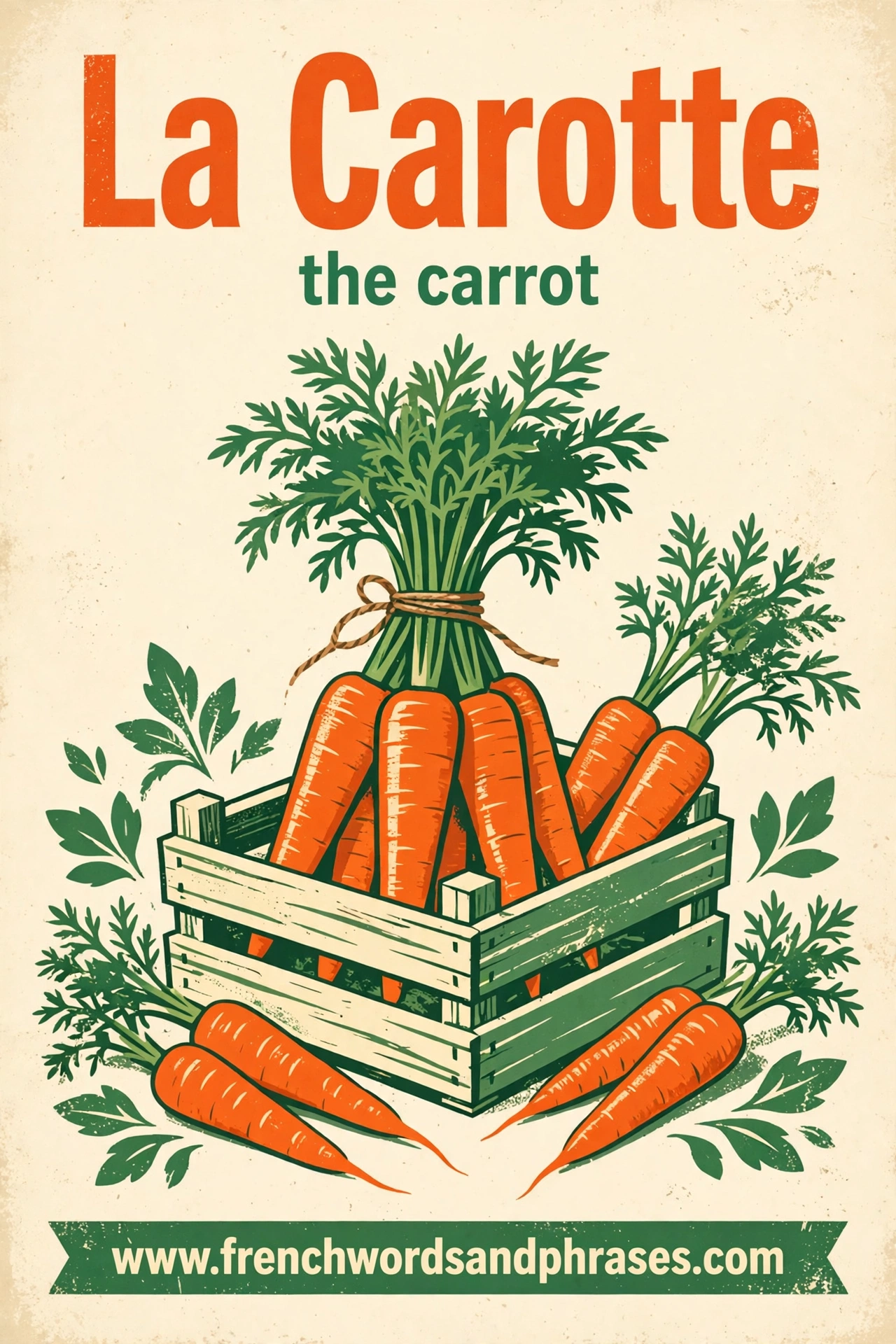
La carotte means the carrot.
Saturday morning at the market: the stallholder pulls a muddy bunch from the crate, shakes off the earth, and holds up a row of bright orange roots, green tops still fresh — la carotte, straight from the soil.
In this guide, you’ll learn what carotte means in English, how to use it with its articles, how to form its plural, and how it appears in everyday French. Explore French examples, English translations, and practice quizzes.
Understanding the French Noun Carotte
Carotte is a feminine French noun. It is learned together with its article: la carotte, une carotte. It is a root vegetable that grows underground, and France loves it two ways above all: raw and crunchy, or finely grated as the classic starter, les carottes râpées.
It means the carrot — the sweet orange root that is eaten raw in salads, grated with lemon and parsley, or cooked in soups, stews and the great beef dishes of winter. At the market you buy it by the bunch: une botte de carottes, a bunch of carrots, tops and all.
Gender: Feminine
Definite article: la — la carotte (the carrot)
Indefinite article: une — une carotte (a carrot)
Plural: les carottes
English equivalents: The carrot.
One important usage detail: the carrot owns one of the most famous French idioms. Les carottes sont cuites — literally ‘the carrots are cooked’ — means it is all over, the game is up, nothing more can be done. When the last train has left and the plan has failed, a French shrug says it all: les carottes sont cuites.
Experience the Word
Carotte is more than a vegetable. It is the orange flash in the winter soup, the crunch in the summer salad — the hardest-working root in the French kitchen.
Imagine the Sunday pot-au-feu: the broth simmering for hours, and in it the carottes, soft and sweet, having given their colour and their sugar to the whole dish.
You have not just eaten a root. You have tasted the soil of the potager, sweetened.
How to Use Carotte in French: Complete Guide
Let’s explore how carotte works in French, beginning with its articles.
Carotte with the Definite Article (La, Les)
Used for the carrot everyone in the conversation knows — the one in this dish, the one from our garden.
| Number | French |
|---|---|
| Singular | la carotte |
| Plural | les carottes |
Example
La carotte est un légume orange qui pousse sous la terre.
The carrot is an orange vegetable that grows underground.
Carotte with the Indefinite Article (Une, Des)
Used for a carrot in general — the one on the shopping list, the one the rabbit is waiting for.
| Number | French |
|---|---|
| Singular | une carotte |
| Plural | des carottes |
Example
Je mange une carotte crue avant le déjeuner.
I eat a raw carrot before lunch.
The Carrot in the Kitchen
Grated, juiced or simmered — the carrot at work in French cooking.
| French | In English |
|---|---|
| les carottes râpées | grated carrots |
| une botte de carottes | a bunch of carrots |
| le jus de carotte | carrot juice |
| la soupe de carottes | carrot soup |
| les carottes Vichy | Vichy carrots — sliced carrots glazed with butter |
| éplucher une carotte | to peel a carrot |
Example
En entrée, nous prenons des carottes râpées au citron.
As a starter, we are having grated carrots with lemon.
Quick Quiz 1
What are les carottes râpées?
Reveal the answer
Grated carrots — finely grated raw carrot with lemon, oil and parsley, the classic starter of French canteens and bistros.
Les carottes râpées sont une entrée classique en France.
Grated carrots are a classic starter in France.
The Plural of Carotte
Carotte adds an -s in the plural — les carottes, the carrots of the market stall.
| Number | French |
|---|---|
| Singular | la carotte |
| Plural | les carottes |
Example
Les carottes du marché sont très fraîches ce matin.
The carrots at the market are very fresh this morning.
Carotte with Possessive Adjectives (Ma, Ta, Sa…)
Possessives agree with the noun, not with the owner — and carotte is feminine, so it takes ma, ta, sa.
| Owner | French |
|---|---|
| my | ma carotte |
| your (tu) | ta carotte |
| his / her | sa carotte |
| our | notre carotte |
| your (vous) | votre carotte |
| their | leur carotte |
Example
Elle a donné sa carotte à son lapin.
She gave her carrot to her rabbit.
Quick Quiz 2
Complete the sentence:
______ carotte est prête, on peut la récolter. (Our)
Reveal the answer
Notre
Notre carotte est prête, on peut la récolter.
Our carrot is ready, we can pick it.
Carotte with Demonstrative Adjectives (Cette, Ces)
Used to point: this carrot here, those carrots there.
| Number | French |
|---|---|
| Singular | cette carotte |
| Plural | ces carottes |
Example
Cette carotte vient de notre jardin.
This carrot comes from our garden.
Carotte with Adjectives
Adjectives agree with carotte, feminine — longue, fraîche, croquante.
| Adjective | With Carotte |
|---|---|
| longue (long) | une carotte longue |
| fraîche (fresh) | une carotte fraîche |
| croquante (crunchy) | une carotte croquante |
| douce (sweet, mild) | une carotte douce |
| orange (orange) | une carotte orange |
Example
Une carotte fraîche et croquante, c’est un régal.
A fresh, crunchy carrot is a treat.
Quick Quiz 3
Complete the sentence:
Une carotte bien ______ se mange crue. (crunchy)
Reveal the answer
croquante
Une carotte bien croquante se mange crue.
A nice crunchy carrot is eaten raw.
Everyday Expressions with Carotte
Idioms and kitchen phrases — the carotte expressions of daily life.
| Expression | In English |
|---|---|
| les carottes sont cuites | it’s all over, the game is up |
| la carotte et le bâton | the carrot and the stick |
| des carottes râpées | grated carrots |
| une botte de carottes | a bunch of carrots |
| le jus de carotte | carrot juice |
| une soupe aux carottes | a carrot soup |
Example
Le dernier train est parti — les carottes sont cuites !
The last train has left — it’s all over!
Words from the Same Family as Carotte
Gardens, grating and colour — the words that travel with carotte.
| French | In English |
|---|---|
| le carotène | carotene — the pigment that colours the carrot |
| râper | to grate |
| croquer | to crunch, to bite into |
| le légume | the vegetable |
| le potager | the vegetable garden |
| la carotte sauvage | the wild carrot |
Example
C’est le carotène qui donne leur belle couleur aux carottes.
It is carotene that gives carrots their beautiful colour.
Quick Quiz 4
Your train has left and your friend shrugs: « Les carottes sont cuites. » What does she mean?
Reveal the answer
It is all over — nothing more can be done; the carrots are cooked and the situation cannot be saved.
Le match est perdu, les carottes sont cuites.
The match is lost, it’s all over.
Carotte in Everyday French: Real-Life Examples
Now that you know the word, let’s see how carotte appears in everyday French.
Example 1 — At the market
Je prends une botte de carottes, s’il vous plaît.
I’ll take a bunch of carrots, please.
Example 2 — In the kitchen
Elle épluche les carottes pour la soupe.
She peels the carrots for the soup.
Example 3 — As a starter
Nous mangeons des carottes râpées avec un peu de citron.
We eat grated carrots with a little lemon.
Example 4 — In the garden
Les carottes poussent bien cette année.
The carrots are growing well this year.
Example 5 — For the rabbit
L’enfant donne une carotte à son lapin.
The child gives a carrot to his rabbit.
Example 6 — A healthy snack
Les enfants croquent des carottes crues.
The children crunch raw carrots.
See la carotte in a story: Fruits and Vegetables: French Vocabulary (Fruits et Légumes) — a Saturday trip to a French market.
Beyond Translation: The Meaning of Carotte
The carrot was not always orange. For centuries it grew purple, white or yellow, until Dutch growers of the seventeenth century bred the sweet orange root we know today — and the whole world followed. France took it to heart: râpée in the canteen, glazed at Vichy, simmered in the pot-au-feu.
To say carotte is to pull dinner out of the earth.
It evokes the muddy bunch at the market and the rabbit’s favourite treat — and, when everything has failed, the great shrug of surrender: les carottes sont cuites.
How to Remember the French Noun Carotte
Remember it this way: Carotte is the carrot — feminine, with la and une, famous raw and grated, and the star of the idiom les carottes sont cuites.
- You buy it — une botte de carottes au marché.
- You grate it — des carottes râpées en entrée.
- You give up — les carottes sont cuites, c’est fini.
The key idea is la carotte râpée to start — les carottes sont cuites at the end.
Test Your Knowledge of Carotte
Let’s see how much you’ve learned. Try answering these questions before revealing the answers.
Question 1
Is carotte masculine or feminine?
Reveal the answer
Feminine — la carotte, une carotte.
Question 2
How do you say grated carrots in French?
Reveal the answer
Les carottes râpées — the classic starter, with lemon and parsley.
Question 3
Translate: The carrots are fresh.
Reveal the answer
Les carottes sont fraîches.
Question 4
What does ‘les carottes sont cuites’ mean?
Reveal the answer
It is all over — the game is up and nothing more can be done.
Question 5
Complete the sentence:
Je mange ______ carotte crue.
Reveal the answer
une
Je mange une carotte crue.
I eat a raw carrot.
Your Final Challenge
Can You Use It?
How would you say this in French?
“I buy a bunch of carrots at the market.”
Reveal the answer
J’achète une botte de carottes au marché.
I buy a bunch of carrots at the market.
A little French. A little curiosity. A richer everyday life.
LEARN FRENCH ONE WORD AT A TIME