A French Word to Live By
Translate Banane to English
/ba.nan/
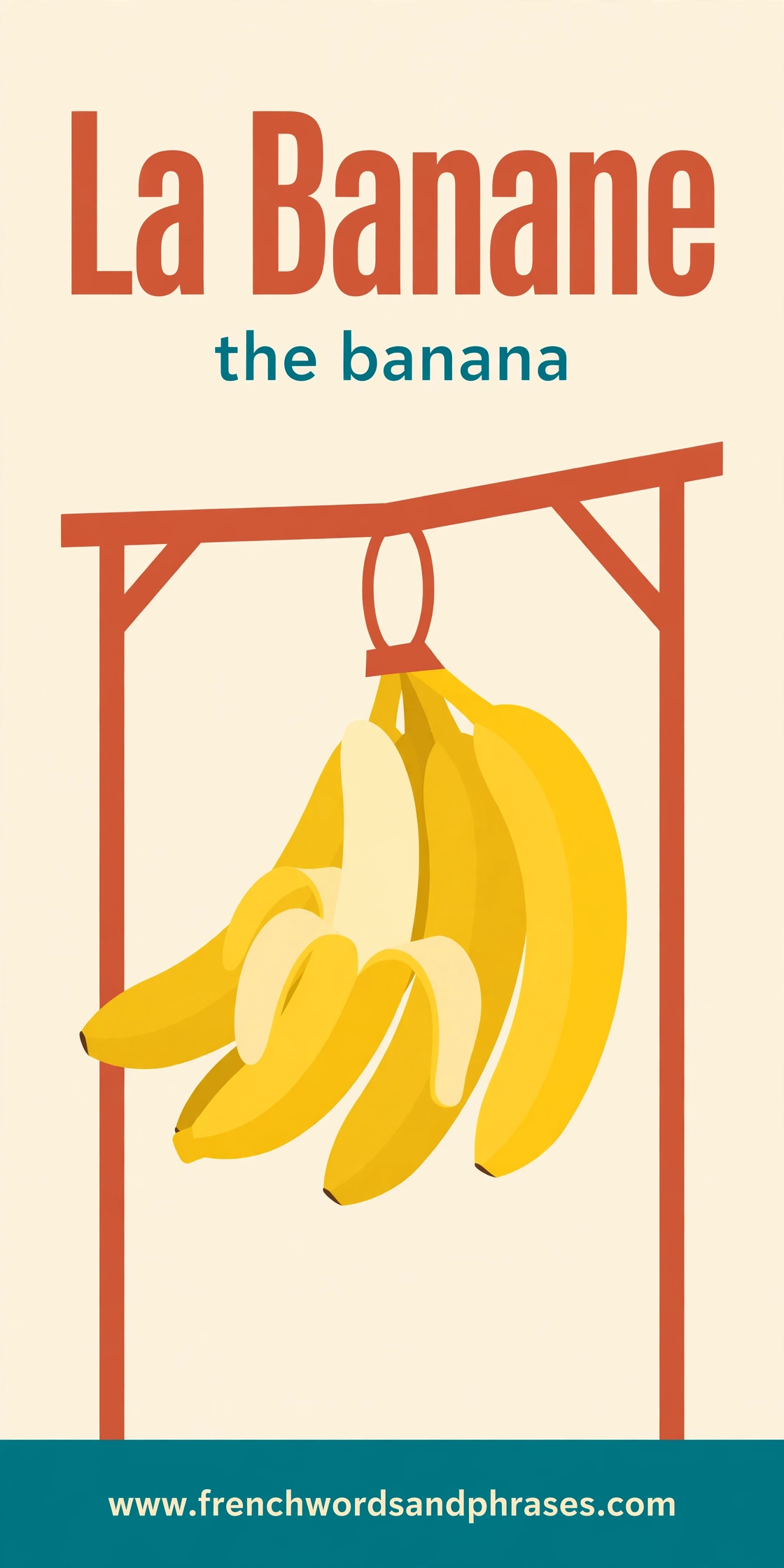
La banane means the banana.
Break time at school: lunchboxes open, and out comes the same yellow curve from half the bags in the playground — la banane, the banana, the snack that travels anywhere and asks for nothing but a peel.
In this guide, you’ll learn what banane means in English, how to use it with its articles, how to form its plural, and how it appears in everyday French. Explore French examples, English translations, and practice quizzes.
Understanding the French Noun Banane
Banane is a feminine French noun. It is learned together with its article: la banane, une banane. It names the long yellow fruit of le bananier, the banana plant, and it is one of the happiest words in French — a whole expression for being in a good mood is built on it.
It means the banana — eaten as it is, sliced over breakfast, blended into a smoothie, or baked when it has gone too ripe. Bananas are sold by the bunch, un régime de bananes, and their skin, la peau de banane, is famous twice over: slippery underfoot in cartoons, and a sly trap in everyday French.
Gender: Feminine
Definite article: la — la banane (the banana)
Indefinite article: une — une banane (a banana)
Plural: les bananes
English equivalents: The banana.
One important usage detail: avoir la banane — literally, to have the banana — means to be in a great mood, grinning from ear to ear. The banana’s curve is the shape of a big smile. The opposite trap is la peau de banane, the banana skin: glisser sur une peau de banane is to slip up, and in office French it can mean a nasty little trap laid for someone.
Experience the Word
Banane is more than a fruit. It is the snack of schoolbags and sports bags, the yellow curve that means energy, good humour and no washing up.
Imagine the market stall in Guadeloupe or Martinique, where so many French bananas grow: bunches stacked high, green ones for cooking, yellow ones for today, and the stallholder’s smile as wide as the fruit itself.
You have not just peeled a banana. You have got la banane — the grin that comes with it.
How to Use Banane in French: Complete Guide
Let’s explore how banane works in French, beginning with its articles.
Banane with the Definite Article (La, Les)
Used for the banana everyone in the conversation knows — the one on the counter, the one in the fruit bowl.
| Number | French |
|---|---|
| Singular | la banane |
| Plural | les bananes |
Example
La banane est encore verte, attends deux jours.
The banana is still green, wait two days.
Banane with the Indefinite Article (Une, Des)
Used for a banana in general — the one in the lunchbox, the one before the run.
| Number | French |
|---|---|
| Singular | une banane |
| Plural | des bananes |
Example
Il mange une banane avant le sport.
He eats a banana before sport.
The Banana, from Bunch to Peel
Bunches, skins and ripeness — the words that travel with banane.
| French | In English |
|---|---|
| le bananier | the banana plant |
| un régime de bananes | a bunch of bananas |
| la peau de banane | the banana skin |
| une banane mûre | a ripe banana |
| une banane verte | an unripe banana |
| une banane plantain | a plantain, a cooking banana |
Example
Ce régime de bananes est trop vert pour aujourd’hui.
This bunch of bananas is too green for today.
Quick Quiz 1
What is un régime de bananes?
Reveal the answer
A bunch of bananas — the whole cluster, just as it is cut from the plant. Nothing to do with a diet here!
Elle achète un régime de bananes au marché.
She buys a bunch of bananas at the market.
The Plural of Banane
Banane adds an -s in the plural — les bananes, whole bunches of them.
| Number | French |
|---|---|
| Singular | la banane |
| Plural | les bananes |
Example
Les bananes de ce régime sont déjà mûres.
The bananas in this bunch are already ripe.
Banane with Possessive Adjectives (Ma, Ta, Sa…)
Possessives agree with the noun, not with the owner — and banane is feminine, so it takes ma, ta, sa.
| Owner | French |
|---|---|
| my | ma banane |
| your (tu) | ta banane |
| his / her | sa banane |
| our | notre banane |
| your (vous) | votre banane |
| their | leur banane |
Example
Elle a mis sa banane dans son sac de sport.
She put her banana in her sports bag.
Quick Quiz 2
Complete the sentence:
Tu as pris ______ banane pour la récréation ? (your)
Reveal the answer
ta
Tu as pris ta banane pour la récréation ?
Did you take your banana for break time?
Banane with Demonstrative Adjectives (Cette, Ces)
Used to point: this banana here, those bananas there.
| Number | French |
|---|---|
| Singular | cette banane |
| Plural | ces bananes |
Example
Cette banane est parfaite pour le smoothie.
This banana is perfect for the smoothie.
Banane with Adjectives
Adjectives agree with banane, feminine — mûre, verte, sucrée.
| Adjective | With Banane |
|---|---|
| mûre (ripe) | une banane mûre |
| verte (green, unripe) | une banane verte |
| jaune (yellow) | une banane jaune |
| sucrée (sweet) | une banane sucrée |
| douce (soft, mild) | une banane douce |
Example
Une banane bien mûre est douce et sucrée.
A really ripe banana is soft and sweet.
Quick Quiz 3
Complete the sentence:
Je préfère les bananes bien ______. (ripe)
Reveal the answer
mûres
Je préfère les bananes bien mûres.
I prefer really ripe bananas.
Everyday Expressions with Banane
Smiles, slips and bunches — the banane phrases of daily life.
| Expression | In English |
|---|---|
| avoir la banane | to be in a great mood, to have a big grin |
| glisser sur une peau de banane | to slip up, to come a cropper |
| la peau de banane | the banana skin (also a sly trap) |
| un régime de bananes | a bunch of bananas |
| manger une banane | to eat a banana |
| une banane plantain | a plantain, for cooking |
Example
Depuis sa bonne nouvelle, il a la banane toute la journée.
Since his good news, he has been grinning all day.
Words from the Same Family as Banane
Plants, peels and ripening — the words that travel with banane.
| French | In English |
|---|---|
| le bananier | the banana plant |
| la peau | the skin, the peel |
| mûrir | to ripen |
| éplucher | to peel |
| le smoothie | the smoothie |
| le goûter | the afternoon snack |
Example
Épluche la banane et mets-la dans le smoothie.
Peel the banana and put it in the smoothie.
Quick Quiz 4
Your colleague arrives beaming and someone says: « Il a la banane ! » What do they mean?
Reveal the answer
He is in a great mood — the banana’s curve is the shape of his grin.
Il a la banane depuis ce matin.
He has been grinning since this morning.
Banane in Everyday French: Real-Life Examples
Now that you know the word, let’s see how banane appears in everyday French.
Example 1 — Break time
Les enfants mangent une banane à la récréation.
The children eat a banana at break time.
Example 2 — At the market
Ces bananes sont mûres, parfaites pour aujourd’hui.
These bananas are ripe, perfect for today.
Example 3 — Before sport
Elle mange toujours une banane avant de courir.
She always eats a banana before running.
Example 4 — A good mood
Après l’examen, tout le monde avait la banane.
After the exam, everyone was grinning.
Example 5 — In the kitchen
Je mets une banane trop mûre dans le gâteau.
I put an overripe banana in the cake.
Example 6 — The slippery trap
Attention à la peau de banane sur le trottoir !
Watch out for the banana skin on the pavement!
See la banane in a story: Fruits and Vegetables: French Vocabulary (Fruits et Légumes) — a Saturday trip to a French market.
Beyond Translation: The Meaning of Banane
The banana travelled to French tables from the Caribbean departments — Martinique and Guadeloupe grow the bananes that fill mainland market stalls — and the fruit brought its sunshine with it into the language. Avoir la banane turns its curve into a smile; la peau de banane turns its skin into the oldest slapstick trap in the world.
To say banane is to grin in French.
It evokes the bunch on the stall, the snack in the schoolbag, and the wide smile of someone whose day is going exactly right.
How to Remember the French Noun Banane
Remember it this way: Banane is the banana — feminine, with la and une, sold by the bunch and famous for a smile.
- You snack — une banane à la récréation, feminine with la.
- You grin — avoir la banane, to be in a great mood.
- You watch your step — la peau de banane, the slippery trap.
The key idea is la banane you eat — la banane you wear as a smile.
Test Your Knowledge of Banane
Let’s see how much you’ve learned. Try answering these questions before revealing the answers.
Question 1
Is banane masculine or feminine?
Reveal the answer
Feminine — la banane, une banane.
Question 2
What does avoir la banane mean?
Reveal the answer
To be in a great mood — to be grinning from ear to ear.
Question 3
Translate: The children eat a banana at break time.
Reveal the answer
Les enfants mangent une banane à la récréation.
Question 4
What is un régime de bananes?
Reveal the answer
A bunch of bananas — the whole cluster from the plant.
Question 5
Complete the sentence:
Elle épluche ______ banane mûre.
Reveal the answer
une
Elle épluche une banane mûre.
She peels a ripe banana.
Your Final Challenge
Can You Use It?
How would you say this in French?
“He eats a banana before his run.”
Reveal the answer
Il mange une banane avant sa course.
He eats a banana before his run.
A little French. A little curiosity. A richer everyday life.
LEARN FRENCH ONE WORD AT A TIME