A French Vocabulary Lesson
Welcome to a little French lesson about babies!
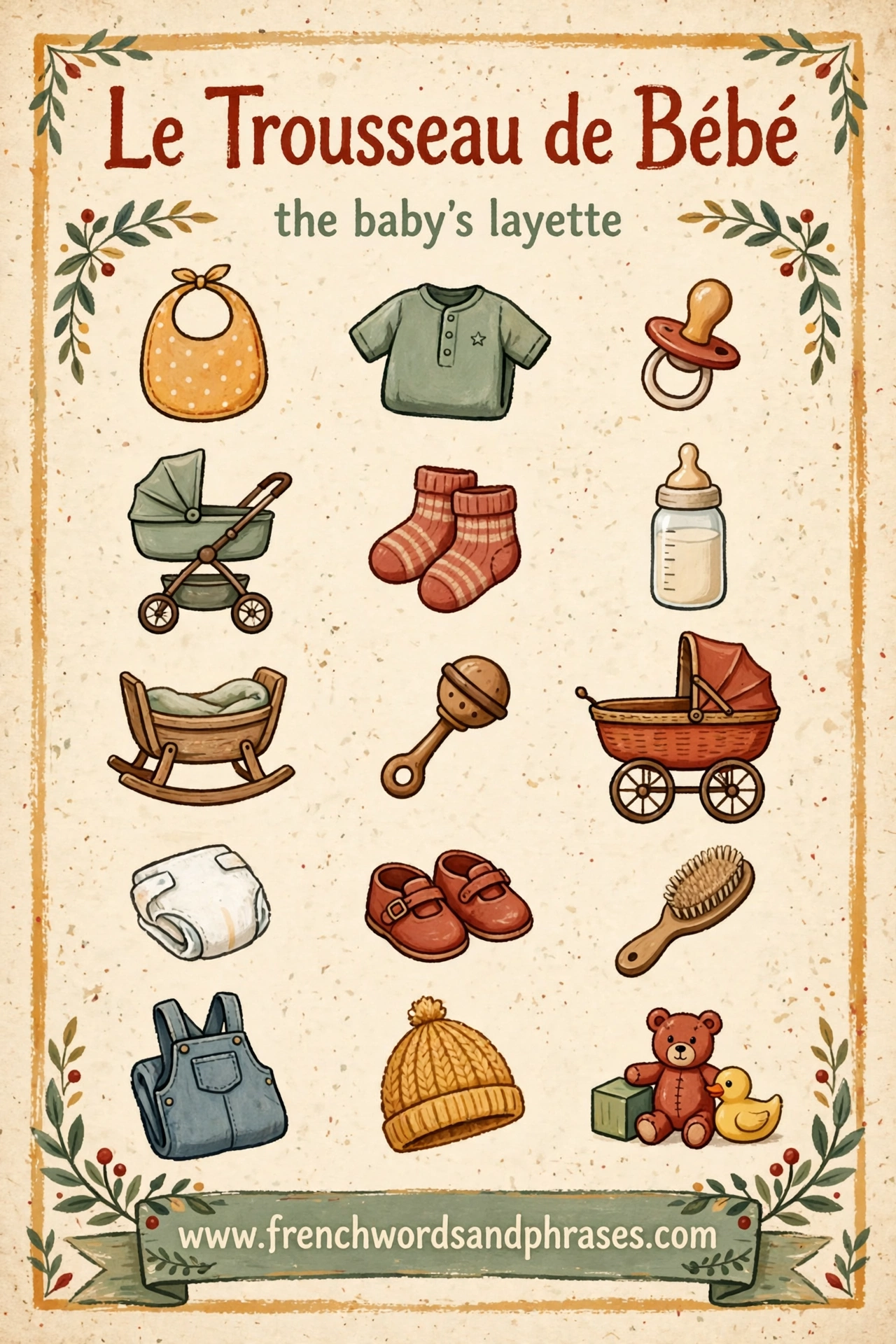
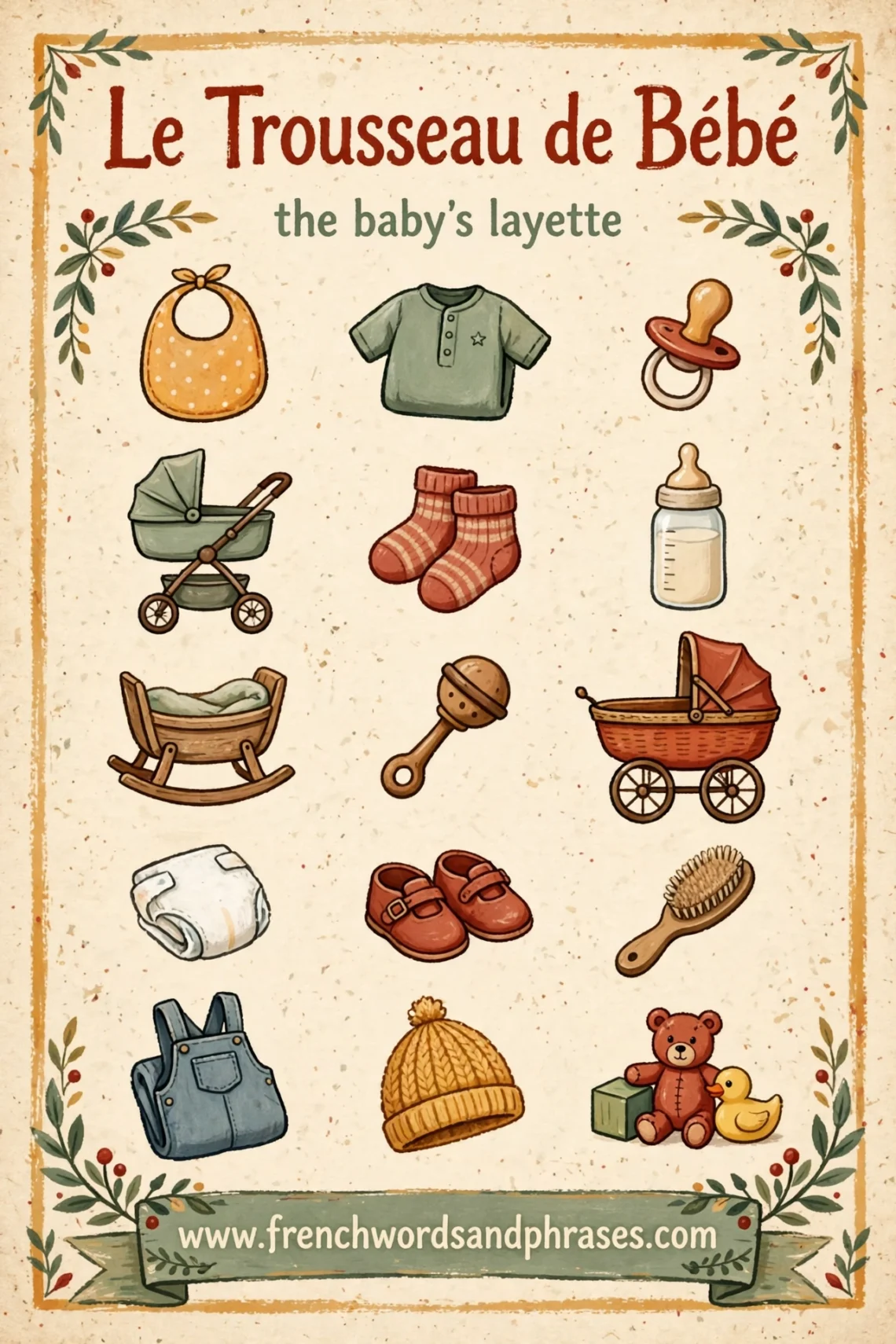
Le trousseau de bébé means the baby’s layette — all the little clothes and equipment a baby needs. In this lesson, you’ll discover fifteen useful French words for the things around every French baby.
Learning vocabulary is easier when you see words used in real situations. So instead of memorizing a list, let’s visit a brand-new baby and discover everything around her.
Our Story: Bienvenue, Petite Léa !
Imagine that your friend Marie has just had a baby girl, Léa, who is three weeks old. Today, her sister Sophie is coming to visit.
Read the story in French first. The English translation follows each passage to help you understand.
Une Visite chez Bébé Léa
Aujourd’hui, Sophie rend visite à sa sœur Marie. Marie a une petite fille, Léa, qui a trois semaines. Dans le couloir, il y a un beau landau bleu et une poussette légère pour les promenades.
Today, Sophie is visiting her sister Marie. Marie has a little girl, Léa, who is three weeks old. In the hallway, there is a beautiful blue pram and a light stroller for walks.
Léa dort dans son berceau, dans une jolie grenouillère rose. Sur sa tête, elle porte un petit bonnet blanc, et à ses pieds, des chaussettes toutes douces.
Léa is sleeping in her cradle, in a pretty pink onesie. On her head, she is wearing a little white hat, and on her feet, very soft socks.
Bientôt, Léa se réveille. Marie la prend dans ses bras et lui donne le biberon. Après le biberon, elle met un bavoir à Léa pour protéger ses vêtements.
Soon, Léa wakes up. Marie takes her in her arms and gives her the bottle. After the bottle, she puts a bib on Léa to protect her clothes.
Sophie secoue doucement le hochet. Léa regarde le hochet avec de grands yeux. Puis elle sourit et prend sa sucette.
Sophie gently shakes the rattle. Léa looks at the rattle with big eyes. Then she smiles and takes her pacifier.
Après le repas, il faut changer la couche de Léa. Marie travaille vite : une couche propre, et voilà un bébé tout propre !
After the feed, Léa’s diaper needs changing. Marie works quickly: a clean diaper, and there’s a lovely clean baby!
Pour la promenade de l’après-midi, Marie habille Léa : une salopette bleue, des petites chaussures blanches et son bonnet. Elle passe doucement la brosse sur les cheveux fins du bébé.
For the afternoon walk, Marie dresses Léa: blue overalls, little white shoes, and her hat. She gently passes the brush over the baby’s fine hair.
Dans le salon, il y a un coffre plein de jouets : un ours en peluche, une balle et des cubes de toutes les couleurs. Léa est encore trop petite pour jouer, mais elle regarde tout avec curiosité.
In the living room, there is a box full of toys: a teddy bear, a ball, and blocks of every colour. Léa is still too little to play, but she looks at everything with curiosity.
Quelle belle journée ! Sophie embrasse sa petite nièce et promet de revenir très bientôt. Bienvenue dans la famille, petite Léa !
What a lovely day! Sophie kisses her little niece and promises to come back very soon. Welcome to the family, little Léa!
The Vocabulary: 15 French Words for a Baby
Now let’s look at the fifteen important words from our story. Try saying each French word aloud before looking at its English meaning.
| French | English |
|---|---|
| 1. Le bavoir | The bib |
| 2. Une grenouillère | A onesie |
| 3. Une sucette | A pacifier |
| 4. Une poussette | A stroller |
| 5. Des chaussettes | Socks |
| 6. Un biberon | A baby bottle |
| 7. Un berceau | A cradle |
| 8. Le hochet | The rattle |
| 9. Un landau | A pram |
| 10. La couche de bébé | The diaper |
| 11. Des chaussures | Shoes |
| 12. La brosse | The brush |
| 13. Une salopette | Overalls |
| 14. Un bonnet | A hat |
| 15. Des jouets | Toys |
A small but useful language tip:
In the shops, nappies are sold as les couches de bébé — that’s the full name printed on the packets. But at home, nobody says all of that. In everyday French, people simply say la couche: il faut changer la couche — the diaper needs changing.
French in Everyday Life: Useful Expressions
Knowing the names of baby things is a good beginning. But how do you use these words around a real baby?
Here are some simple expressions you might hear or use with a French baby.
Example 1 — Admiring the baby
Qu’elle est mignonne !
She is so cute!
Example 2 — Feeding time
C’est l’heure du biberon.
It’s time for the bottle.
Example 3 — Changing the baby
Il faut changer la couche.
The diaper needs changing.
Example 4 — Getting dressed
Mets-lui son bonnet, il fait frais.
Put her hat on, it’s chilly.
Example 5 — Going out
On met Léa dans la poussette et on va se promener.
We put Léa in the stroller and go for a walk.
Example 6 — Playtime
Regarde, elle secoue son hochet !
Look, she’s shaking her rattle!
A Little French Grammar: The -ette Family Is Feminine
Look closely at the words in this lesson. Four of them end in the same three letters: -ette.
- La sucette — the pacifier
- La poussette — the stroller
- La chaussette — the sock
- La salopette — the overalls
This is no accident. The ending -ette is a feminine ending in French — it often suggests something small. So when you meet a new word ending in -ette, you can be confident it goes with la.
Notice, too, that things which come in pairs or groups are usually plural in the lesson: les chaussettes (the socks), les chaussures (the shoes), les jouets (the toys) — with des when you simply mean “some”.
Test Your Knowledge: French Baby Vocabulary
Let’s see how much you remember. Try each question before opening the answer.
Quick Quiz 1
Which French word means “the bib”?
Reveal the answer
Le bavoir
Quick Quiz 2
Complete the sentence:
Marie donne le ______ à Léa.
Reveal the answer
biberon
Marie donne le biberon à Léa.
Marie gives the bottle to Léa.
Quick Quiz 3
How do you say “the rattle” in French?
Reveal the answer
Le hochet
Quick Quiz 4
Which word means “the pram”?
Reveal the answer
Le landau
Quick Quiz 5
Complete the sentence:
Il faut changer la ______.
Reveal the answer
couche
Il faut changer la couche.
The diaper needs changing.
Can You Translate These French Sentences?
Now let’s reverse the exercise. Read each French sentence and try to translate it into English.
Question 1
Léa dort dans son berceau.
What does this mean?
Reveal the answer
Léa is sleeping in her cradle.
Question 2
La poussette est dans le couloir.
What does this mean?
Reveal the answer
The stroller is in the hallway.
Question 3
Elle porte une salopette bleue.
What does this mean?
Reveal the answer
She is wearing blue overalls.
Question 4
Les jouets sont dans le coffre.
What does this mean?
Reveal the answer
The toys are in the box.
Question 5
Le bonnet est blanc.
What does this mean?
Reveal the answer
The hat is white.
Discover a Little French Baby Culture
In France, preparing le trousseau — the baby’s layette — is a much-loved tradition. Weeks before the birth, the family washes and folds tiny clothes, and grandparents often knit the baby’s first bonnet and little socks by hand.
When the baby arrives, the parents send out un faire-part, a printed birth announcement with the baby’s name, weight and first photograph.
And here’s the expression you’ll need most:
Félicitations pour la naissance de Léa !
Congratulations on the birth of Léa!
In France, félicitations is the word for every happy occasion — a new baby, an exam passed, a wedding. Learn it once, and you’ll use it all your life.
How to Remember Your New French Words
The easiest way to remember vocabulary is to connect each word to something familiar.
Try this little exercise as you walk through a baby’s day:
- When the baby wakes up, think le berceau.
- At feeding time, think le biberon and le bavoir.
- When you change the baby, think la couche.
- When you dress the baby, think la grenouillère, les chaussettes and le bonnet.
- At playtime, think le hochet and les jouets.
- When you go out, think la poussette.
A few minutes of practice each day can make these words part of your everyday French vocabulary.
Your Final Challenge
Can You Describe a Baby’s Morning in French?
Imagine that you are looking after a French baby for the morning.
Can you describe what the baby does, using at least five of the vocabulary words from this lesson?
Here is a little example to get you started:
Le matin, Léa boit son biberon. Ensuite, je change sa couche et je lui mets une grenouillère propre, des chaussettes et un petit bonnet.
In the morning, Léa drinks her bottle. Then I change her diaper and put a clean onesie, socks, and a little hat on her.
Now it’s your turn!
Try writing a few sentences about a baby’s morning in French. Don’t worry about making mistakes. Every new sentence is another step toward speaking French.
Today’s Lesson: Le Trousseau de Bébé — The Baby’s Layette
Fifteen new words. A little story. A little French culture.
Learn French one lesson at a time!