A French Word to Live By
Translate Pastèque to English
/pas.tɛk/
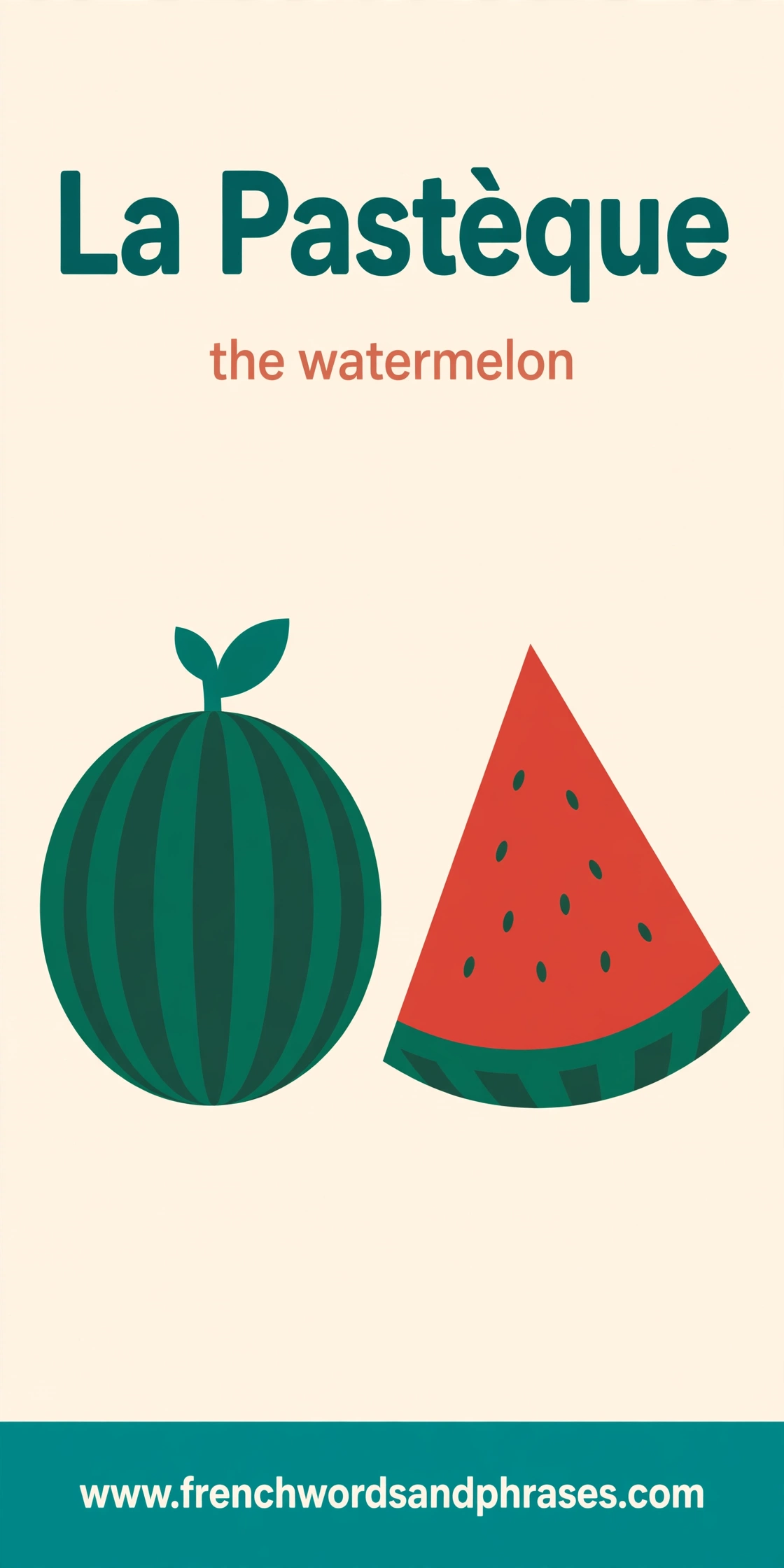
La pastèque means the watermelon.
High summer, a picnic by the river: someone carries the great green melon down to the water to cool, and later the knife goes in with a crack and the red slices go round — la pastèque, the fruit of the hottest days.
In this guide, you’ll learn what pastèque means in English, how to use it with its articles, how to form its plural, and how it appears in everyday French. Explore French examples, English translations, and practice quizzes.
Understanding the French Noun Pastèque
Pastèque is a feminine French noun. It is learned together with its article: la pastèque, une pastèque. It names the biggest fruit on the stall — green outside, red inside, and made, it seems, almost entirely of water and summer.
It means the watermelon — the large round or oval fruit with a smooth green rind, sweet red flesh, and small black seeds, les pépins. In France it is sold whole, by the half, or by the slice — une tranche de pastèque — and it is eaten very cold, at picnics, on terraces, and at the beach, all summer long.
Gender: Feminine
Definite article: la — la pastèque (the watermelon)
Indefinite article: une — une pastèque (a watermelon)
Plural: les pastèques
English equivalents: The watermelon.
One important usage detail: a whole pastèque is heavy, so French markets happily sell it in pieces — une demi-pastèque, half a watermelon, or une tranche, a slice. And the golden rule of the fruit: serve it bien froide, very cold, straight from the fridge.
Experience the Word
Pastèque is more than a fruit. It is summer itself, cut into slices — the picnic fruit, the beach fruit, the fruit that needs no plate and no manners.
Imagine the hottest afternoon of August: the melon comes out of the cold water, the rind cracks open, and the red slices pass from hand to hand while the juice runs to everyone’s elbows.
You have not just eaten a fruit. You have shared the summer — with la pastèque, bien froide.
How to Use Pastèque in French: Complete Guide
Let’s explore how pastèque works in French, beginning with its articles.
Pastèque with the Definite Article (La, Les)
Used for the watermelon everyone in the conversation knows — the one in the fridge, the one for the picnic.
| Number | French |
|---|---|
| Singular | la pastèque |
| Plural | les pastèques |
Example
La pastèque est au frigo depuis ce matin.
The watermelon has been in the fridge since this morning.
Pastèque with the Indefinite Article (Une, Des)
Used for a watermelon in general — the one on the stall, the one you are strong enough to carry.
| Number | French |
|---|---|
| Singular | une pastèque |
| Plural | des pastèques |
Example
Cette pastèque est trop lourde pour mon sac.
This watermelon is too heavy for my bag.
Serving la Pastèque
Slices, seeds and red flesh — the words for the biggest fruit on the stall.
| French | In English |
|---|---|
| une tranche de pastèque | a slice of watermelon |
| la chair rouge | the red flesh |
| les pépins | the seeds, the pips |
| l’écorce | the rind |
| une demi-pastèque | half a watermelon |
| couper une pastèque | to cut a watermelon |
Example
Il coupe la pastèque en grandes tranches.
He cuts the watermelon into big slices.
Quick Quiz 1
What are les pépins?
Reveal the answer
The seeds, the pips — the small black seeds inside the watermelon’s red flesh.
Les enfants enlèvent les pépins de la pastèque.
The children take the pips out of the watermelon.
The Plural of Pastèque
Pastèque adds an -s in the plural — les pastèques, the watermelons of the whole summer market.
| Number | French |
|---|---|
| Singular | la pastèque |
| Plural | les pastèques |
Example
Les pastèques sont empilées devant le magasin.
The watermelons are piled up in front of the shop.
Pastèque with Possessive Adjectives (Ma, Ta, Sa…)
Possessives agree with the noun, not with the owner — and pastèque is feminine, so it takes ma, ta, sa.
| Owner | French |
|---|---|
| my | ma pastèque |
| your (tu) | ta pastèque |
| his / her | sa pastèque |
| our | notre pastèque |
| your (vous) | votre pastèque |
| their | leur pastèque |
Example
Ma pastèque est trop grosse pour le frigo.
My watermelon is too big for the fridge.
Quick Quiz 2
Complete the sentence:
______ pastèque est pour le pique-nique de demain. (Our)
Reveal the answer
Notre
Notre pastèque est pour le pique-nique de demain.
Our watermelon is for tomorrow’s picnic.
Pastèque with Demonstrative Adjectives (Cette, Ces)
Used to point: this watermelon here, those watermelons there.
| Number | French |
|---|---|
| Singular | cette pastèque |
| Plural | ces pastèques |
Example
Cette pastèque pèse au moins cinq kilos.
This watermelon weighs at least five kilos.
Pastèque with Adjectives
Adjectives agree with pastèque, feminine — grosse, lourde, fraîche.
| Adjective | With Pastèque |
|---|---|
| grosse (big) | une grosse pastèque |
| lourde (heavy) | une pastèque lourde |
| fraîche (cool, fresh) | une pastèque bien fraîche |
| sucrée (sweet) | une pastèque sucrée |
| juteuse (juicy) | une pastèque juteuse |
Example
Une pastèque bien fraîche, c’est le bonheur en été.
A nice cold watermelon is happiness in summer.
Quick Quiz 3
Complete the sentence:
Sers la pastèque bien ______, s’il te plaît. (cold, fresh)
Reveal the answer
fraîche
Sers la pastèque bien fraîche, s’il te plaît.
Serve the watermelon nice and cold, please.
Everyday Expressions with Pastèque
Picnics, beaches and hot afternoons — the pastèque phrases of the summer.
| Expression | In English |
|---|---|
| manger de la pastèque | to eat some watermelon |
| une tranche de pastèque | a slice of watermelon |
| la pastèque bien froide | the watermelon nice and cold |
| un jus de pastèque | a watermelon juice |
| une demi-pastèque | half a watermelon |
| en été, vive la pastèque | in summer, long live the watermelon |
Example
À la plage, nous mangeons de la pastèque bien froide.
At the beach, we eat nice cold watermelon.
Words from the Same Family as Pastèque
Melons, slices and summer — the words that travel with pastèque.
| French | In English |
|---|---|
| le melon | the melon |
| la tranche | the slice |
| les pépins | the seeds, the pips |
| la chair | the flesh |
| l’été | the summer |
| le fruit | the fruit |
Example
Le melon et la pastèque sont les fruits de l’été.
The melon and the watermelon are the fruits of summer.
Quick Quiz 4
The stallholder asks: « Une entière ou une demi ? » What is he asking?
Reveal the answer
Whether you want a whole watermelon or a half — une pastèque entière ou une demi-pastèque, because a whole one is heavy.
Une demi-pastèque, s’il vous plaît, elle est pour deux personnes.
Half a watermelon, please, it’s for two people.
Pastèque in Everyday French: Real-Life Examples
Now that you know the word, let’s see how pastèque appears in everyday French.
Example 1 — At the market
Je prends une demi-pastèque, s’il vous plaît.
I’ll take half a watermelon, please.
Example 2 — At the picnic
Nous mangeons de la pastèque au bord de la rivière.
We are eating watermelon by the river.
Example 3 — On a hot day
En été, nous mangeons de la pastèque tous les jours.
In summer, we eat watermelon every day.
Example 4 — Serving slices
Elle sert de grandes tranches de pastèque.
She serves big slices of watermelon.
Example 5 — Too heavy
Cette pastèque est trop lourde, aide-moi.
This watermelon is too heavy, help me.
Example 6 — Keeping it cold
Mets la pastèque au frigo avant le dîner.
Put the watermelon in the fridge before dinner.
See la pastèque in a story: Fruits and Vegetables: French Vocabulary (Fruits et Légumes) — a Saturday trip to a French market.
Beyond Translation: The Meaning of Pastèque
The pastèque is the democratic fruit of the French summer: sold by the slice at markets and beaches, carried to rivers and parks, shared without plates or ceremony. Its name travelled to French from the Mediterranean world of melons and gourds, and it has been cooling French summers ever since.
To say pastèque is to call everyone to the picnic blanket.
It evokes the crack of the rind, the red slices going round, the pips spat into the grass — a fruit too big for one person, and all the better for it.
How to Remember the French Noun Pastèque
Remember it this way: Pastèque is the watermelon — feminine, with la and une, the giant summer fruit sold whole, by the half, or by the slice.
- You buy it in pieces — une demi-pastèque ou une tranche.
- You serve it cold — la pastèque bien fraîche, toujours.
- You share it in summer — en été, on mange de la pastèque tous les jours.
The key idea is la pastèque is summer, served cold and shared.
Test Your Knowledge of Pastèque
Let’s see how much you’ve learned. Try answering these questions before revealing the answers.
Question 1
Is pastèque masculine or feminine?
Reveal the answer
Feminine — la pastèque, une pastèque.
Question 2
How do you say a slice of watermelon in French?
Reveal the answer
Une tranche de pastèque — une tranche is a slice.
Question 3
Translate: In summer, we eat watermelon every day.
Reveal the answer
En été, nous mangeons de la pastèque tous les jours.
Question 4
What are les pépins in a pastèque?
Reveal the answer
The seeds, the pips — the small black seeds in the red flesh.
Question 5
Complete the sentence:
Mets ______ pastèque au frigo.
Reveal the answer
la
Mets la pastèque au frigo.
Put the watermelon in the fridge.
Your Final Challenge
Can You Use It?
How would you say this in French?
“In summer, we eat watermelon every day.”
Reveal the answer
En été, nous mangeons de la pastèque tous les jours.
In summer, we eat watermelon every day.
A little French. A little curiosity. A richer everyday life.
LEARN FRENCH ONE WORD AT A TIME