A French Word to Live By
Translate Pomme de terre to English
/pɔm də tɛʁ/
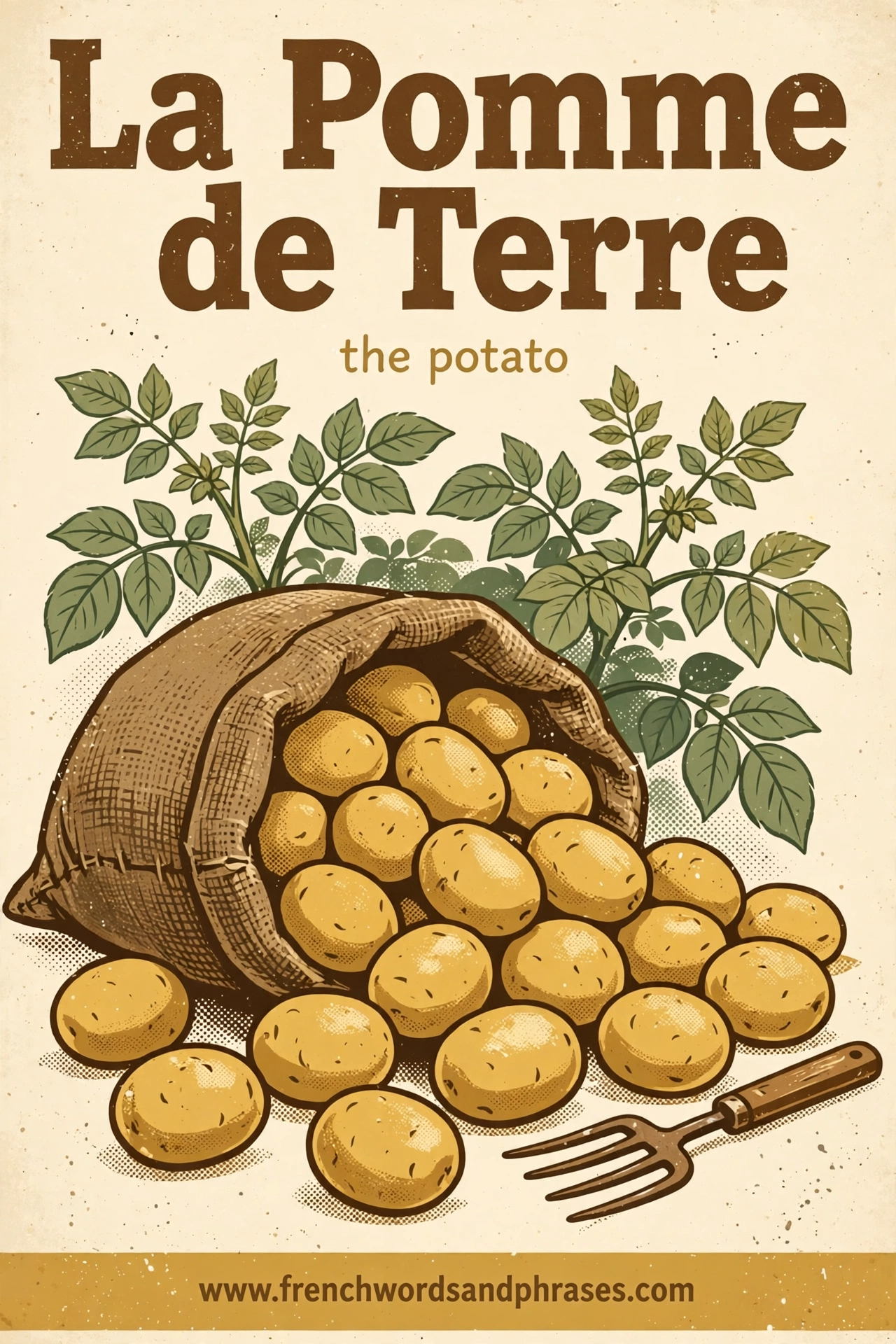
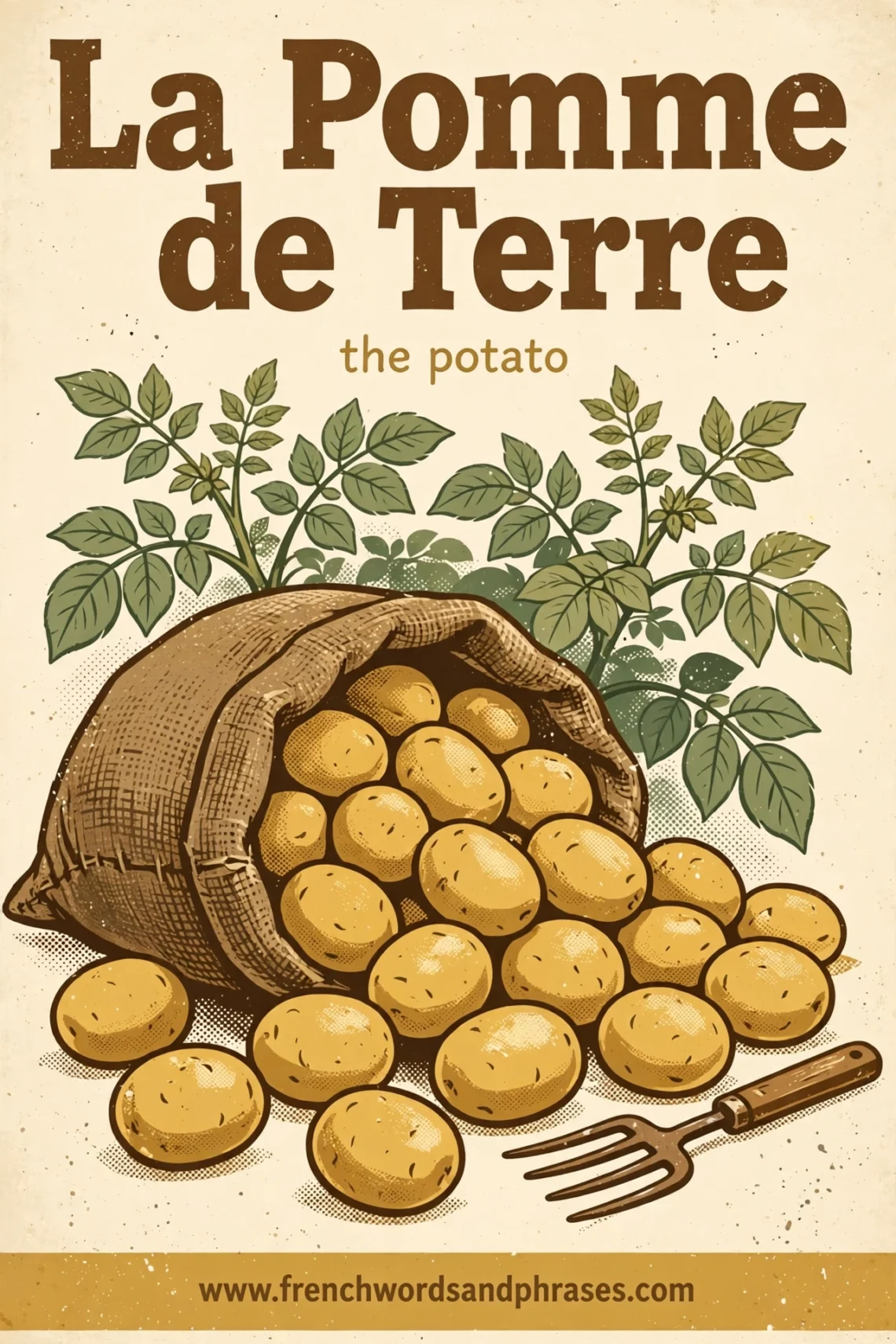
La pomme de terre means the potato.
Friday evening at the bistro: the steak arrives under a mountain of golden frites, crisp and salted, steam rising. At the centre of the French plate, modest and unbeatable, sits la pomme de terre.
In this guide, you’ll learn what pomme de terre means in English, how to use it with its articles, how to form its plural, and how it appears in everyday French. Explore French examples, English translations, and practice quizzes.
Understanding the French Noun Pomme de terre
Pomme de terre is a feminine French noun. It is learned together with its article: la pomme de terre, une pomme de terre. It is a compound built from la pomme, the apple, and la terre, the earth — the ‘apple of the earth’, the round treasure that grows underground instead of on the tree.
It means the potato — quite simply the most loved vegetable in France, the hero of les frites, of la purée (mashed potato), of gratins, soups and stews. In everyday speech it almost always answers to its nickname: la patate. And notice the beautiful logic of its real name: la pomme grows on the tree, la pomme de terre grows in the earth.
Gender: Feminine
Definite article: la — la pomme de terre (the potato)
Indefinite article: une — une pomme de terre (a potato)
Plural: les pommes de terre — only pomme takes the -s
English equivalents: The potato — and, in everyday speech, la patate.
One important usage detail: the potato has two names. La pomme de terre is the full, proper name, the one on menus and market stalls. La patate is the familiar nickname everybody uses at home — and it gives a joyful idiom: avoir la patate means to be full of energy, on great form. Its sweet cousin, the sweet potato, is la patate douce.
Experience the Word
Pomme de terre is more than a vegetable. It is the foundation of the French plate — the food of peasants that became the food of kings, frites on Friday, purée on Sunday.
Imagine the gratin coming out of the oven: golden on top, the cream bubbling at the edges, the potatoes underneath soft as butter. The whole table leans in.
You have not just eaten a potato. You have eaten the earth apple — la pomme de terre.
How to Use Pomme de terre in French: Complete Guide
Let’s explore how pomme de terre works in French, beginning with its articles.
Pomme de terre with the Definite Article (La, Les)
Used for the potato everyone knows — the one in tonight’s dinner, the one France loves best.
| Number | French |
|---|---|
| Singular | la pomme de terre |
| Plural | les pommes de terre |
Example
La pomme de terre est le légume préféré des Français.
The potato is the favourite vegetable of the French.
Pomme de terre with the Indefinite Article (Une, Des)
Used for a potato in general — the one being peeled, the ones in the sack.
| Number | French |
|---|---|
| Singular | une pomme de terre |
| Plural | des pommes de terre |
Example
Il épluche une pomme de terre pour la soupe.
He peels a potato for the soup.
The Potato in the Kitchen
Frites, purée and the great gratin — la pomme de terre at work in French cooking.
| French | In English |
|---|---|
| les frites | chips, fries |
| la purée de pommes de terre | mashed potato |
| les pommes de terre vapeur | steamed potatoes |
| le gratin dauphinois | the Dauphinois gratin — potatoes baked in cream |
| les pommes de terre sautées | sautéed potatoes |
| la patate douce | the sweet potato |
Example
Les pommes de terre vapeur accompagnent le poisson.
Steamed potatoes go with the fish.
Quick Quiz 1
What is le gratin dauphinois?
Reveal the answer
Potatoes baked in cream — thin slices of potato cooked slowly in cream until golden, a classic from the Dauphiné region.
Le gratin dauphinois demande des pommes de terre et de la crème.
The Dauphinois gratin needs potatoes and cream.
The Plural of Pomme de terre
Only the first word takes the -s: pomme becomes pommes, while terre never changes — les pommes de terre.
| Number | French |
|---|---|
| Singular | la pomme de terre |
| Plural | les pommes de terre |
Example
Elle achète deux kilos de pommes de terre.
She buys two kilos of potatoes.
Pomme de terre with Possessive Adjectives (Ma, Ta, Sa…)
Possessives agree with the noun, not with the owner — and pomme de terre is feminine, so it takes ma, ta, sa.
| Owner | French |
|---|---|
| my | ma pomme de terre |
| your (tu) | ta pomme de terre |
| his / her | sa pomme de terre |
| our | notre pomme de terre |
| your (vous) | votre pomme de terre |
| their | leur pomme de terre |
Example
Elle fait cuire sa pomme de terre au four.
She bakes her potato in the oven.
Quick Quiz 2
Complete the sentence:
______ pomme de terre est énorme ! (Your, tu)
Reveal the answer
Ta
Ta pomme de terre est énorme !
Your potato is huge!
Pomme de terre with Demonstrative Adjectives (Cette, Ces)
Used to point: this potato here, those potatoes there.
| Number | French |
|---|---|
| Singular | cette pomme de terre |
| Plural | ces pommes de terre |
Example
Cette pomme de terre est parfaite pour les frites.
This potato is perfect for chips.
Pomme de terre with Adjectives
Adjectives agree with pomme, feminine — grosse, nouvelle, fondante.
| Adjective | With Pomme de terre |
|---|---|
| grosse (big) | une grosse pomme de terre |
| petite (small) | une petite pomme de terre |
| nouvelle (new) | une pomme de terre nouvelle |
| fondante (soft and melting) | une pomme de terre fondante |
| chaude (hot) | une pomme de terre chaude |
Example
Une grosse pomme de terre au four, avec du beurre, c’est simple et bon.
A big baked potato, with butter, is simple and good.
Quick Quiz 3
Complete the sentence:
En mai, on achète des pommes de terre ______. (new)
Reveal the answer
nouvelles
En mai, on achète des pommes de terre nouvelles.
In May, we buy new potatoes.
Everyday Expressions with Pomme de terre
Energy, frites and tricky problems — the pomme de terre phrases of daily life.
| Expression | In English |
|---|---|
| avoir la patate | to be full of energy, on great form |
| les frites maison | homemade chips |
| la purée maison | homemade mashed potato |
| en robe des champs | in their skins — literally ‘in their field dress’ |
| une patate chaude | a hot potato — a tricky problem nobody wants |
| cuire à l’eau | to boil |
Example
Ce matin, elle a la patate, elle court partout !
This morning she is full of energy, she is running everywhere!
Words from the Same Family as Pomme de terre
Apples, earth and nicknames — the words that travel with pomme de terre.
| French | In English |
|---|---|
| la pomme | the apple |
| la patate | the potato — the familiar nickname |
| la terre | the earth, the soil |
| la frite | the chip, the fry |
| éplucher | to peel |
| le potager | the vegetable garden |
Example
La pomme pousse dans l’arbre, la pomme de terre pousse dans la terre.
The apple grows on the tree, the potato grows in the earth.
Quick Quiz 4
Why is a potato called a pomme de terre?
Reveal the answer
Because it is the ‘apple of the earth’ — a round, apple-like food that grows underground, named after la pomme, the apple of the tree.
La pomme de terre est la pomme qui pousse dans la terre.
The potato is the apple that grows in the earth.
Pomme de terre in Everyday French: Real-Life Examples
Now that you know the word, let’s see how pomme de terre appears in everyday French.
Example 1 — At the market
Deux kilos de pommes de terre, s’il vous plaît.
Two kilos of potatoes, please.
Example 2 — Making chips
Les enfants adorent les frites maison.
The children love homemade chips.
Example 3 — Peeling
J’épluche les pommes de terre pour la purée.
I peel the potatoes for the mash.
Example 4 — Full of energy
Aujourd’hui, il a la patate !
Today, he is full of energy!
Example 5 — At the bistro
Un steak-frites, s’il vous plaît.
A steak and chips, please.
Example 6 — In the garden
Nous récoltons les pommes de terre en septembre.
We harvest the potatoes in September.
See la pomme de terre in a story: Fruits and Vegetables: French Vocabulary (Fruits et Légumes) — a Saturday trip to a French market.
Beyond Translation: The Meaning of Pomme de terre
The potato had to be argued into France. In the eighteenth century most French people distrusted the American root, until Antoine-Augustin Parmentier — agronomist, prisoner of war, and the potato’s great champion — promoted it with feasts, royal flowers and guarded fields, until the whole country wanted a taste. His name still sits on the menu: le hachis Parmentier, France’s shepherd’s pie, is his monument.
To say pomme de terre is to dig up dinner with a story.
It evokes Parmentier’s guarded field and the king wearing its flower, the Friday frites and the Sunday purée — the earth apple that fed a nation.
How to Remember the French Noun Pomme de terre
Remember it this way: Pomme de terre is the potato — feminine, the ‘earth apple’, plural pommes de terre with the -s on pomme alone, and la patate to its friends.
- You name it — la pomme qui pousse dans la terre.
- You pluralise it — les pommes de terre, terre ne change jamais.
- You nickname it — la patate, et avoir la patate, c’est être en forme.
The key idea is les pommes de terre — la patate pour les amis.
Test Your Knowledge of Pomme de terre
Let’s see how much you’ve learned. Try answering these questions before revealing the answers.
Question 1
Is pomme de terre masculine or feminine?
Reveal the answer
Feminine — la pomme de terre, une pomme de terre.
Question 2
What is the plural of la pomme de terre?
Reveal the answer
Les pommes de terre — only pomme takes the -s; terre never changes.
Question 3
Translate: She buys two kilos of potatoes.
Reveal the answer
Elle achète deux kilos de pommes de terre.
Question 4
What does ‘avoir la patate’ mean?
Reveal the answer
To be full of energy — to feel on great form.
Question 5
Complete the sentence:
La ______ pousse dans l’arbre, la pomme de terre pousse dans la terre.
Reveal the answer
pomme
La pomme pousse dans l’arbre, la pomme de terre pousse dans la terre.
The apple grows on the tree, the potato grows in the earth.
Your Final Challenge
Can You Use It?
How would you say this in French?
“My grandmother makes the best mashed potatoes.”
Reveal the answer
Ma grand-mère fait la meilleure purée de pommes de terre.
My grandmother makes the best mashed potatoes.
A little French. A little curiosity. A richer everyday life.
LEARN FRENCH ONE WORD AT A TIME