A French Vocabulary Lesson
Welcome to a little French lesson about the smallest creatures in the garden!
Les insectes means insects. In this lesson, you’ll discover twenty-five useful French words for the insects you’ll meet in any French garden, from the butterfly on the flowers to the firefly in the evening grass.
Learning vocabulary is easier when you see words used in real situations. So instead of memorizing a list, let’s follow a child through one long summer day in the garden, and meet the insects one by one.
Our Story: Une Journée d’Été au Jardin
Imagine that it is a warm day in July. A little girl named Léa spends the whole day in her grandmother’s garden, with a notebook and a magnifying glass.
Read the story in French first. The English translation follows each passage to help you understand.
Le Jardin de Léa
Le matin, Léa entre dans le jardin. Dans les pins, une cigale chante déjà très fort. Sur les fleurs roses, un papillon orange ouvre et ferme ses ailes lentement.
In the morning, Léa walks into the garden. In the pine trees, a cicada is already singing very loudly. On the pink flowers, an orange butterfly slowly opens and closes its wings.
Près de la lavande, une abeille travaille sur chaque fleur. Un gros bourdon, doux et velu, visite les mêmes fleurs sans se presser.
Near the lavender, a bee is working on every flower. A big bumblebee, gentle and furry, visits the same flowers without hurrying.
Sur une rose, Léa trouve une coccinelle rouge à points noirs. La coccinelle mange les petits pucerons verts sur la tige. C’est l’amie du jardinier !
On a rose, Léa finds a red ladybug with black spots. The ladybug is eating the little green aphids on the stem. It is the gardener’s friend!
Sur le chemin, une longue file de fourmis transporte des miettes de pain. Soudain, une sauterelle verte saute devant Léa, puis un criquet brun disparaît dans l’herbe haute.
On the path, a long line of ants is carrying breadcrumbs. Suddenly, a green grasshopper jumps in front of Léa, then a brown locust disappears into the tall grass.
Au bord du petit bassin, une libellule bleue vole au-dessus de l’eau comme un petit avion. À l’heure du déjeuner, une mouche tourne autour de l’assiette, et une guêpe s’intéresse un peu trop à la limonade.
At the edge of the little pond, a blue dragonfly flies above the water like a tiny aeroplane. At lunchtime, a fly circles around the plate, and a wasp is taking a little too much interest in the lemonade.
L’après-midi, un moustique chante près de l’oreille de Léa. Zut ! Il pique ! Sur une feuille, une chenille verte avance doucement, et sur une branche, un phasme immobile ressemble à un petit bâton.
In the afternoon, a mosquito sings near Léa’s ear. Oh no! It bites! On a leaf, a green caterpillar is moving slowly forward, and on a branch, a motionless stick insect looks like a little twig.
Près des rosiers, une mante religieuse attend, verte et patiente, sans bouger. Sous une pierre, Léa découvre un scarabée brillant comme un bijou, et dans l’herbe, un hanneton maladroit tombe sur le dos.
Near the rose bushes, a praying mantis is waiting, green and patient, without moving. Under a stone, Léa discovers a beetle shining like a jewel, and in the grass, a clumsy chafer beetle falls onto its back.
Le chien du voisin secoue ses oreilles : un taon le dérange, et une petite puce saute dans son pelage. Dans le vieux banc en bois, les termites ont creusé de petits tunnels.
The neighbour’s dog shakes its ears: a horsefly is bothering it, and a little flea is jumping in its fur. In the old wooden bench, the termites have dug little tunnels.
Derrière la remise, Léa voit un cafard brun qui court se cacher sous une planche. Et près du vieux chêne, elle entend un frelon énorme passer en volant. Celui-là, on le regarde de loin !
Behind the shed, Léa sees a brown cockroach running to hide under a plank. And near the old oak tree, she hears a huge hornet flying past. That one, we watch from a distance!
Le soir arrive. Un grillon chante dans l’herbe, caché et invisible. Puis, dans la pénombre, un premier ver luisant s’allume comme une petite étoile, puis deux, puis dix. Léa ferme son cahier. Quelle belle journée dans le jardin !
Evening arrives. A cricket is singing in the grass, hidden and invisible. Then, in the half-light, a first firefly lights up like a little star, then two, then ten. Léa closes her notebook. What a beautiful day in the garden!
The Vocabulary: 25 French Words for Insects
Now let’s look at the twenty-five important words from our story. Try saying each French word aloud before looking at its English meaning.
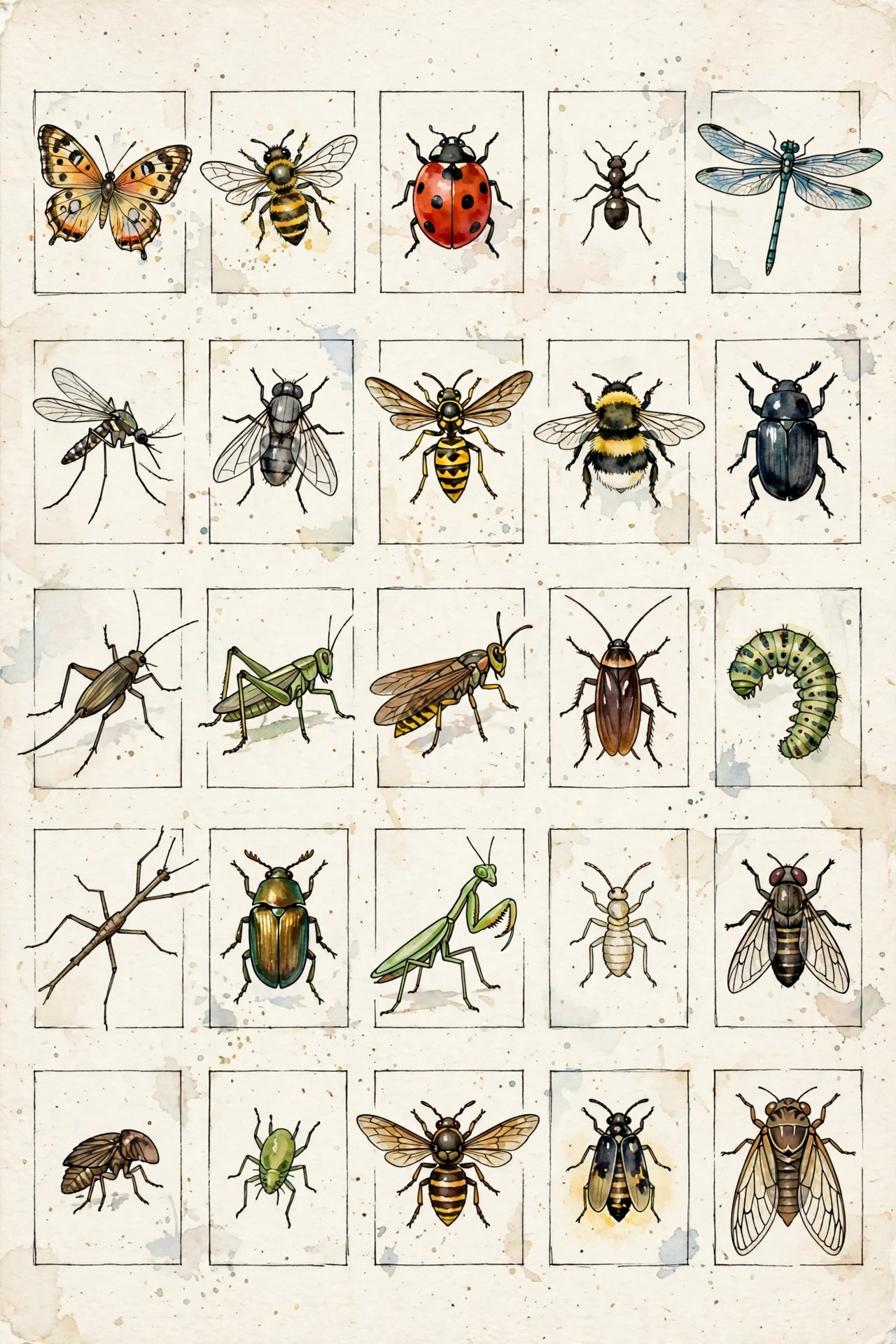
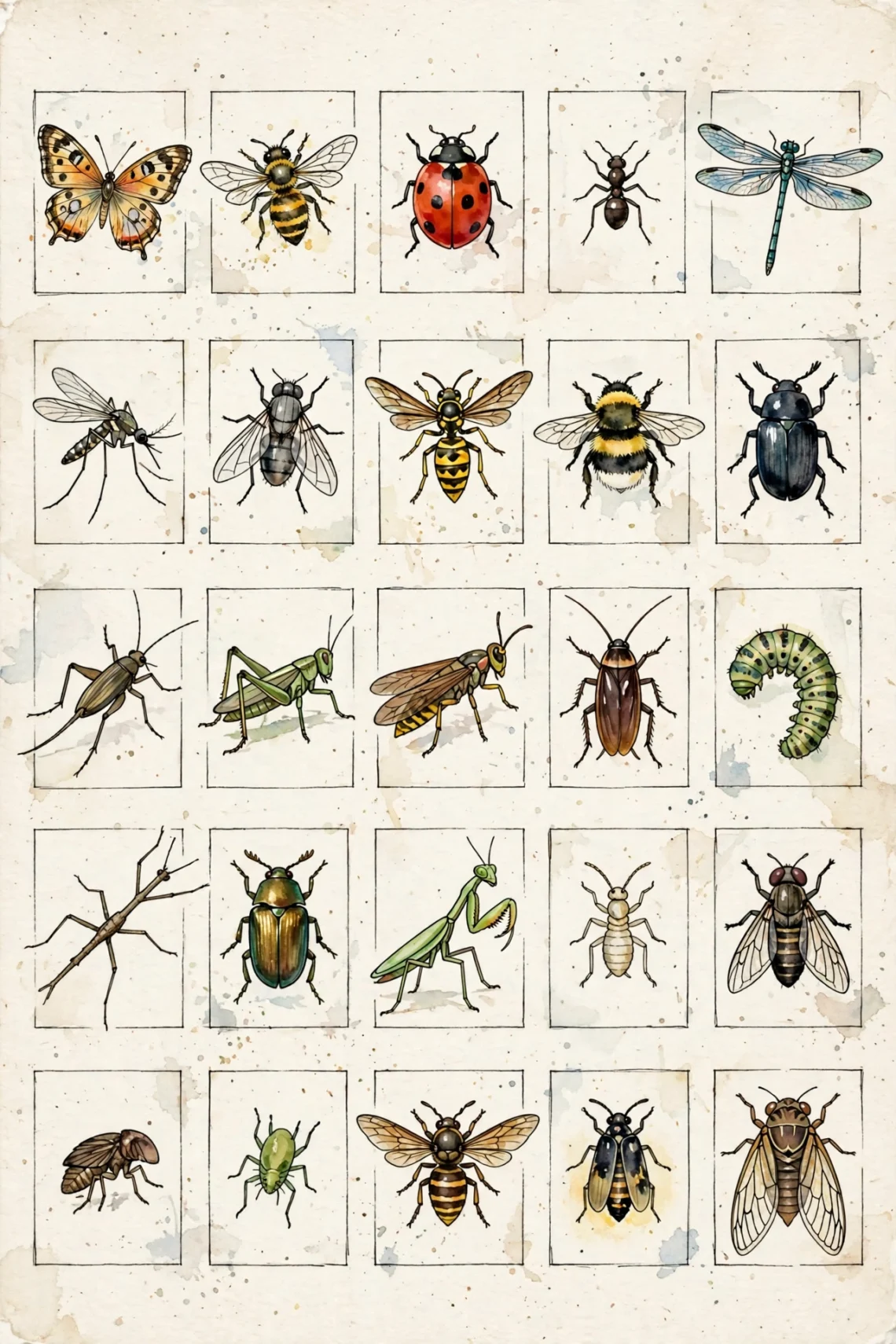
Les Insectes du Jardin — The Insects of the Garden
| French | English |
|---|---|
| 1. Le papillon | The butterfly |
| 2. L’abeille | The bee |
| 3. La coccinelle | The ladybug |
| 4. La fourmi | The ant |
| 5. La libellule | The dragonfly |
| 6. Le moustique | The mosquito |
| 7. La mouche | The fly |
| 8. La guêpe | The wasp |
| 9. Le bourdon | The bumblebee |
| 10. Le scarabée | The beetle |
| 11. Le grillon | The cricket |
| 12. La sauterelle | The grasshopper |
| 13. Le criquet | The locust |
Les Petites Bêtes Cachées — The Little Hidden Creatures
| French | English |
|---|---|
| 14. Le cafard | The cockroach |
| 15. La chenille | The caterpillar |
| 16. Le phasme | The stick insect |
| 17. Le hanneton | The chafer beetle |
| 18. La mante religieuse | The praying mantis |
| 19. Le termite | The termite |
| 20. Le taon | The horsefly |
| 21. La puce | The flea |
| 22. Le puceron | The aphid |
| 23. Le frelon | The hornet |
| 24. Le ver luisant | The firefly |
| 25. La cigale | The cicada |
A small but useful language tip:
The cockroach has a second life in French. When someone feels sad, tired and a little gloomy, they say j’ai le cafard — literally “I have the cockroach” — which means “I feel down” or “I have the blues”. So le cafard is both a little brown insect under a plank and a very French way of talking about a grey day.
French in Everyday Life: Useful Expressions
Knowing the names of insects is a good beginning. But how do you talk about them in the garden and at the table?
Here are some simple expressions you might hear or use on a summer day in France.
Example 1 — At the table
Il y a une mouche dans la soupe !
There’s a fly in the soup!
Example 2 — A warning
Attention, la guêpe pique !
Careful, the wasp stings!
Example 3 — In the garden
Les abeilles font du miel.
Bees make honey.
Example 4 — A beautiful sight
Regarde ce beau papillon orange !
Look at this beautiful orange butterfly!
Example 5 — At night
Les moustiques piquent la nuit.
Mosquitoes bite at night.
Example 6 — In the evening
Le soir, les grillons chantent dans le jardin.
In the evening, the crickets sing in the garden.
A Little French Grammar: Il y a — and Three Insect Verbs
To say that something is there, French uses the little phrase il y a, which means “there is” or “there are”. It never changes, and it is perfect for describing a garden full of insects.
- Il y a with a singular noun: Il y a une coccinelle sur la rose. (There is a ladybug on the rose.)
- Il y a with a plural noun: Il y a des fourmis sur le chemin. (There are ants on the path.)
- Before a vowel, une stays une but the article changes for the bee: Il y a une abeille sur la lavande — and you write it l’abeille with le or la: l’abeille travaille.
Three verbs do most of the work when you talk about insects:
- Voler — to fly: La libellule vole au-dessus de l’eau. Le papillon vole de fleur en fleur.
- Piquer — to sting or to bite: La guêpe pique. Le moustique pique la nuit. Le frelon peut piquer aussi.
- Chanter — to sing: La cigale chante dans les pins. Le grillon chante le soir.
So one small phrase and three verbs — il y a, voler, piquer, chanter — let you describe almost everything the insects in a garden are doing.
Test Your Knowledge: French Insects
Let’s see how much you remember. Try each question before opening the answer.
Quick Quiz 1
Which French word means “the ladybug”?
Reveal the answer
La coccinelle
Quick Quiz 2
Complete the sentence:
Il y a une ______ bleue au-dessus du bassin.
Reveal the answer
libellule
Il y a une libellule bleue au-dessus du bassin.
There is a blue dragonfly above the pond.
Quick Quiz 3
How do you say “the firefly” in French?
Reveal the answer
Le ver luisant
Quick Quiz 4
Which insect sings in the pine trees all summer?
Reveal the answer
La cigale
Quick Quiz 5
Complete the sentence:
La ______ mange les pucerons sur la rose.
Reveal the answer
coccinelle
La coccinelle mange les pucerons sur la rose.
The ladybug eats the aphids on the rose.
Can You Translate These French Sentences?
Now let’s reverse the exercise. Read each French sentence and try to translate it into English.
Question 1
Le papillon vole de fleur en fleur.
What does this mean?
Reveal the answer
The butterfly flies from flower to flower.
Question 2
Les fourmis transportent des miettes de pain.
What does this mean?
Reveal the answer
The ants are carrying breadcrumbs.
Question 3
La chenille devient un papillon.
What does this mean?
Reveal the answer
The caterpillar becomes a butterfly.
Question 4
Le soir, le ver luisant s’allume dans l’herbe.
What does this mean?
Reveal the answer
In the evening, the firefly lights up in the grass.
Question 5
La sauterelle saute très loin.
What does this mean?
Reveal the answer
The grasshopper jumps very far.
Discover a Little French Insect Culture
In France, almost every child knows the story of La Cigale et la Fourmi — The Cicada and the Ant — one of the famous fables of Jean de La Fontaine. The cicada sings all summer while the ant works and stores food, and when winter comes, the hungry cicada has nothing to eat.
In the south of France, in Provence, the cicada is much more than an insect: it is the symbol of summer itself. Its song is the sound of hot afternoons, pine trees and holidays, and you will find cicadas on pottery, tablecloths and key rings all over the region.
And here’s a useful expression:
Travailler comme une fourmi.
To work like an ant.
The expression means to work hard and patiently, little by little — exactly the opposite of the cicada in the fable.
How to Remember Your New French Words
The easiest way to remember vocabulary is to connect each word to something familiar.
Try this little exercise on your next walk in a garden or a park:
- When a butterfly passes, say le papillon.
- When you hear singing in the trees on a hot day, think la cigale.
- When you see a bee on a flower, think l’abeille — and her big cousin, le bourdon.
- When ants cross the path, think les fourmis.
- When something bites you at night, think le moustique.
- When the evening comes and the garden glows, think le ver luisant.
A few minutes of practice each day can make these words part of your everyday French vocabulary.
Your Final Challenge
Can You Describe a Garden in French?
Imagine that you are sitting in a French garden on a summer evening.
Can you write five sentences about the insects around you, using il y a and the verbs voler, piquer and chanter?
Here is a little example to get you started:
Dans le jardin de ma grand-mère, il y a des papillons sur les fleurs et une libellule au-dessus du bassin. La cigale chante dans les pins, et le soir, les vers luisants s’allument dans l’herbe.
In my grandmother’s garden, there are butterflies on the flowers and a dragonfly above the pond. The cicada sings in the pine trees, and in the evening, the fireflies light up in the grass.
Now it’s your turn!
Try writing a few sentences about your garden in French. Don’t worry about making mistakes. Every new sentence is another step toward speaking French.
Today’s Lesson: Insects — Les Insectes
25 new words. A little story. A little French culture.
Learn French one lesson at a time!