
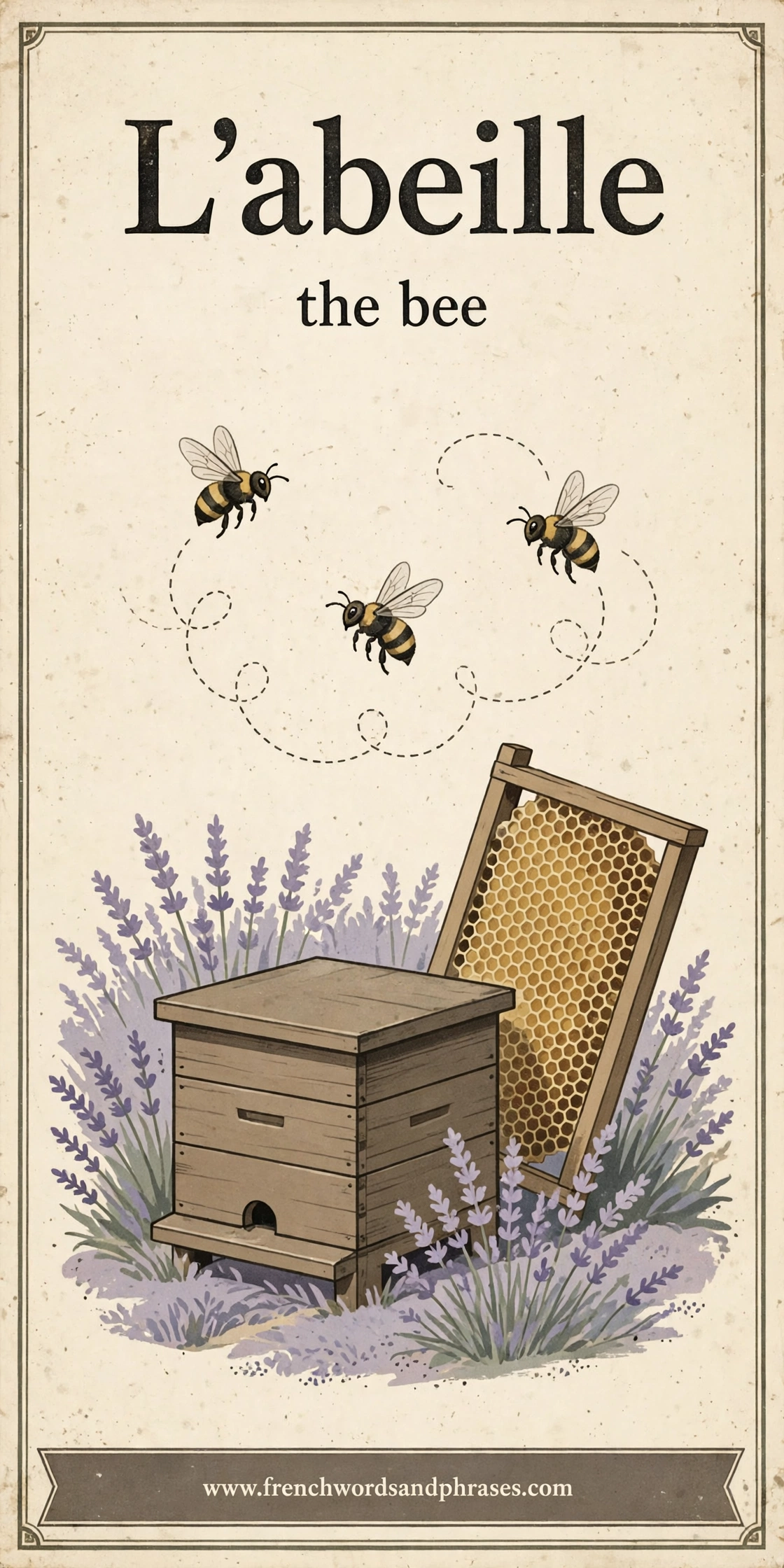
A French Word to Live By
Translate Abeille to English
/a.bɛj/
L’abeille means the bee.
A warm afternoon by the lavender hedge: the air hums, and a small golden worker lands, loads up, and lifts off again, heavy with pollen — l’abeille, the bee, the busiest creature in the French garden.
In this guide, you’ll learn what abeille means in English, how to use it with its articles, how to form its plural, and how it appears in everyday French. Explore French examples, English translations, and practice quizzes.
Understanding the French Noun Abeille
Abeille is a feminine French noun. It is learned together with its article: l’abeille, une abeille. Because it begins with a vowel, the definite article shrinks to l’. It names the honey-making insect that lives in une ruche, a hive, under la reine, the queen.
It means the bee — the striped, humming insect that gathers nectar and pollen from flower to flower, builds wax and honey in the hive, and pollinates a third of everything on the French table. The bee is so woven into French life that it became an emblem of work itself — and, once, the emblem of an emperor.
Gender: Feminine
Definite article: l’ — l’abeille (the bee)
Indefinite article: une — une abeille (a bee)
Plural: les abeilles
English equivalents: The bee.
One important usage detail: the bee’s own verb is butiner — to gather nectar and pollen from flower to flower. Les abeilles butinent de fleur en fleur. And a warning worth learning with the word: une abeille ne pique qu’une fois — a bee stings only once, so French gardeners are taught to stay calm, never wave their arms, and let her work.
Experience the Word
Abeille is more than an insect. It is the sound of summer itself — the hum over the lavender, the promise of honey, the garden’s smallest employee.
Imagine the beekeeper lifting a frame from the hive: thousands of bees flowing like slow gold, calm and busy at once, and the smell of warm wax and flowers rising into the sun.
You have not just seen an insect at work. You have met the creature that feeds the flowers back.
How to Use Abeille in French: Complete Guide
Let’s explore how abeille works in French, beginning with its articles.
Abeille with the Definite Article (L’, Les)
Abeille begins with a vowel, so le and la both shrink to l’ — l’abeille — while the plural is les abeilles.
| Number | French |
|---|---|
| Singular | l’abeille |
| Plural | les abeilles |
Example
L’abeille se pose sur la fleur.
The bee lands on the flower.
Abeille with the Indefinite Article (Une, Des)
Used for a bee in general — the one around the jam jar, the ones around the hive.
| Number | French |
|---|---|
| Singular | une abeille |
| Plural | des abeilles |
Example
Une abeille tourne autour du pot de miel.
A bee circles around the honey jar.
Abeille with the Partitive Article (De — Quantities and Negatives)
Bees are creatures you count, so the partitive appears as de after negatives and quantity words — no bees here, far too many bees there.
| Meaning | French |
|---|---|
| no bees (after a negative) | pas d’abeilles |
| a lot of bees | beaucoup d’abeilles |
| too many bees | trop d’abeilles |
Example
Il y a beaucoup d’abeilles près de la ruche.
There are a lot of bees near the hive.
Quick Quiz 1
What is une ruche?
Reveal the answer
A hive — the bee’s house, where the colony lives and the honey is made.
L’apiculteur ouvre la ruche avec précaution.
The beekeeper opens the hive carefully.
The Plural of Abeille
Abeille adds an -s in the plural — les abeilles, and a healthy hive holds tens of thousands of them.
| Number | French |
|---|---|
| Singular | l’abeille |
| Plural | les abeilles |
Example
Les abeilles travaillent tout l’été.
The bees work all summer long.
Abeille with Possessive Adjectives (Mon, Ton, Son…)
A famous exception: abeille is feminine, but because it begins with a vowel it takes mon, ton, son — mon abeille, never « ma abeille ».
| Owner | French |
|---|---|
| my | mon abeille |
| your (tu) | ton abeille |
| his / her | son abeille |
| our | notre abeille |
| your (vous) | votre abeille |
| their | leur abeille |
Example
Elle dessine son abeille sur la première page du cahier.
She draws her bee on the first page of the notebook.
Quick Quiz 2
Complete the sentence:
Il regarde ______ abeille préférée dans le jardin. (his)
Reveal the answer
son
Il regarde son abeille préférée dans le jardin.
He watches his favourite bee in the garden — son, not sa, because abeille begins with a vowel.
Abeille with Demonstrative Adjectives (Cette, Ces)
Used to point: this bee here, those bees there.
| Number | French |
|---|---|
| Singular | cette abeille |
| Plural | ces abeilles |
Example
Cette abeille revient toujours à la même ruche.
This bee always comes back to the same hive.
Abeille with Adjectives
Adjectives agree with abeille, feminine — travailleuse, douce, rayée.
| Adjective | With Abeille |
|---|---|
| travailleuse (hard-working) | une abeille travailleuse |
| douce (gentle) | une abeille douce |
| rayée (striped) | une abeille rayée |
| occupée (busy) | une abeille occupée |
| dorée (golden) | une abeille dorée |
Example
Une abeille douce et travailleuse ne pique presque jamais.
A gentle, hard-working bee almost never stings.
Quick Quiz 3
Complete the sentence:
Une abeille ______ visite chaque fleur du jardin. (hard-working)
Reveal the answer
travailleuse
Une abeille travailleuse visite chaque fleur du jardin.
A hard-working bee visits every flower in the garden.
Everyday Expressions with Abeille
Hives, queens and tireless work — the abeille phrases of daily life.
| Expression | In English |
|---|---|
| butiner de fleur en fleur | to gather nectar from flower to flower |
| travailler comme une abeille | to work like a bee, tirelessly |
| la reine des abeilles | the queen bee |
| être piqué par une abeille | to be stung by a bee |
| une ruche en pleine activité | a hive in full activity |
| le miel des abeilles | the bees’ honey |
Example
Depuis le matin, elle travaille comme une abeille.
Since this morning, she has been working like a bee.
Words from the Same Family as Abeille
Hives, honey and beekeepers — the words that travel with abeille.
| French | In English |
|---|---|
| la ruche | the hive |
| le miel | honey |
| l’apiculteur | the beekeeper |
| une piqûre | a sting |
| le pollen | pollen |
| butiner | to gather nectar and pollen |
Example
L’apiculteur récolte le miel à la fin de l’été.
The beekeeper harvests the honey at the end of summer.
Quick Quiz 4
Your neighbour says of his daughter: « Elle travaille comme une abeille. » Is he comparing her to an insect?
Reveal the answer
Yes — as a compliment. Travailler comme une abeille means to work tirelessly and cheerfully, like a bee in the hive.
Elle travaille comme une abeille du matin au soir.
She works like a bee from morning to night.
Abeille in Everyday French: Real-Life Examples
Now that you know the word, let’s see how abeille appears in everyday French.
Example 1 — In the garden
Les abeilles butinent la lavande toute la journée.
The bees gather nectar from the lavender all day.
Example 2 — At the hive
L’apiculteur vérifie les ruches au printemps.
The beekeeper checks the hives in spring.
Example 3 — At breakfast
Ce miel vient des abeilles de notre village.
This honey comes from our village’s bees.
Example 4 — A warning
Reste calme, une abeille ne pique qu’une fois.
Stay calm, a bee only stings once.
Example 5 — Hard work
Toute l’équipe travaille comme des abeilles.
The whole team is working like bees.
Example 6 — Summer sound
On entend les abeilles au-dessus des fleurs.
You can hear the bees above the flowers.
See l’abeille in a story: Insects: French Vocabulary (Les Insectes) — a summer day in a grandmother’s garden.
Beyond Translation: The Meaning of Abeille
The bee is one of France’s oldest symbols of tireless, organised work — Napoleon chose the golden bee as his imperial emblem, and French schoolchildren still learn that the ruche is a little city where everyone has a job. Gardeners plant for the bees, villages keep hives on their roofs, and the phrase travailler comme une abeille is among the highest compliments the language can pay.
To say abeille is to praise work done well, quietly, and for everyone.
It evokes the hum over the lavender, the beekeeper’s slow hands, and the jar of honey that began as a thousand flowers.
How to Remember the French Noun Abeille
Remember it this way: Abeille is the bee — feminine with l’, the tireless worker of the hive, with her own verb, butiner.
- You hear one before you see one — l’abeille, feminine, with une and les abeilles.
- You dodge the exception — mon abeille, pas ma abeille, because of the vowel.
- You praise a worker — travailler comme une abeille, to work tirelessly.
The key idea is l’abeille of the hive — travailler comme une abeille.
Test Your Knowledge of Abeille
Let’s see how much you’ve learned. Try answering these questions before revealing the answers.
Question 1
Is abeille masculine or feminine?
Reveal the answer
Feminine — but with l’: l’abeille, une abeille.
Question 2
What does butiner mean?
Reveal the answer
To gather nectar and pollen — the bee’s own verb, flower by flower.
Question 3
Translate: The bees work all summer long.
Reveal the answer
Les abeilles travaillent tout l’été.
Question 4
What is une ruche?
Reveal the answer
A hive — the bees’ house, ruled by la reine, the queen.
Question 5
Complete the sentence:
Il dessine ______ abeille sur le cahier. (his)
Reveal the answer
son
Il dessine son abeille sur le cahier.
He draws his bee in the notebook — son, because abeille begins with a vowel.
Your Final Challenge
Can You Use It?
How would you say this in French?
“The bees gather nectar from flower to flower all summer.”
Reveal the answer
Les abeilles butinent de fleur en fleur tout l’été.
The bees gather nectar from flower to flower all summer.
A little French. A little curiosity. A richer everyday life.
LEARN FRENCH ONE WORD AT A TIME




