
A French Word to Live By
Translate Mouche to English
/muʃ/
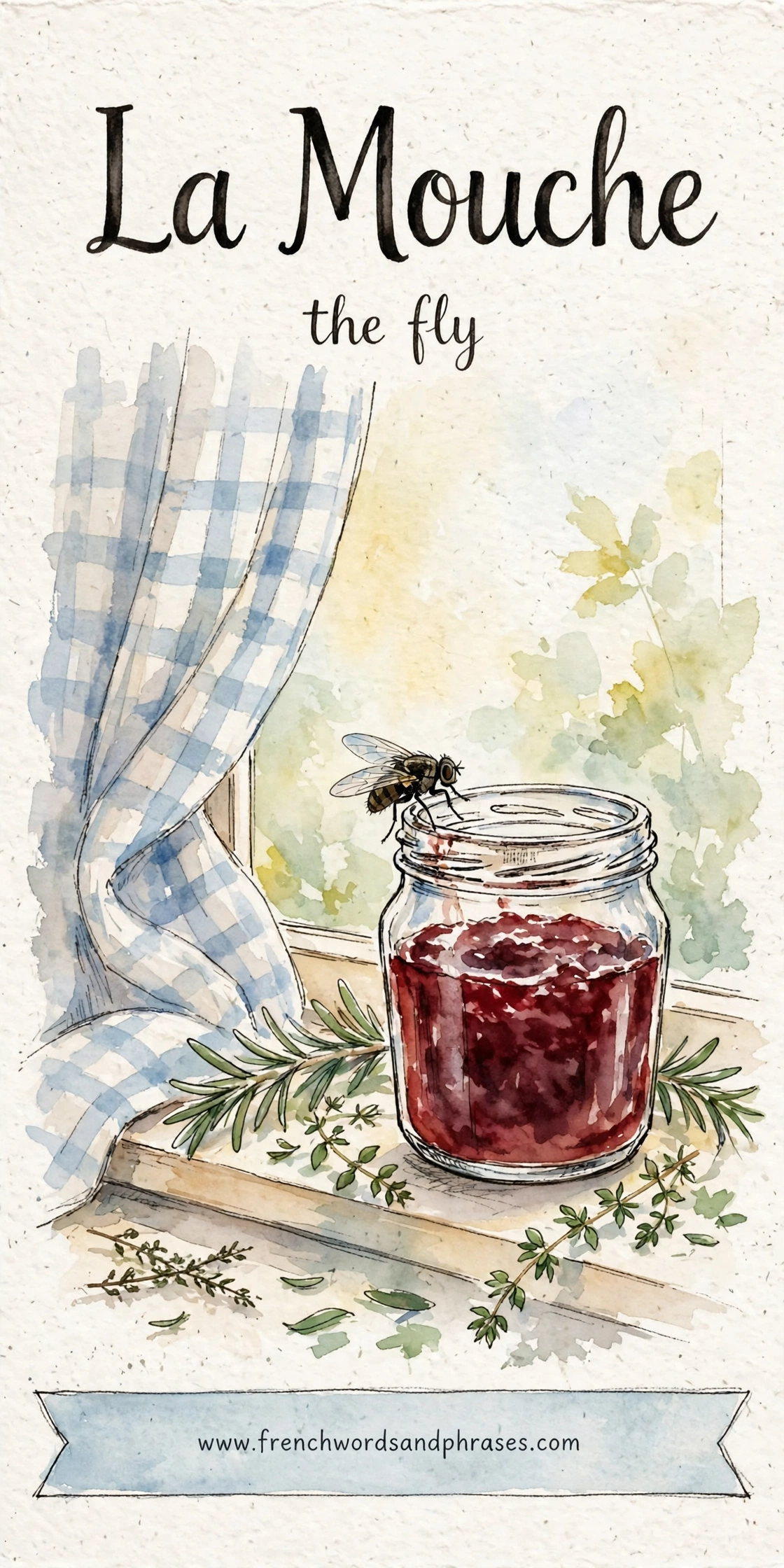
La mouche means the fly.
A quiet kitchen in August: something small and black patrols the ceiling in squares, lands on the rim of the jam jar, and takes off again at the wave of a hand — la mouche, the fly, the uninvited tenant of every French summer.
In this guide, you’ll learn what mouche means in English, how to use it with its articles, how to form its plural, and how it appears in everyday French. Explore French examples, English translations, and practice quizzes.
Understanding the French Noun Mouche
Mouche is a feminine French noun. It is learned together with its article: la mouche, une mouche. It names the common housefly — and French, which loves her more than it admits, has built some of its finest expressions around her.
It means the fly — the small buzzing insect that walks on ceilings, tastes with its feet, and appears the moment food does. Humble as she is, la mouche holds a special place in French: she measures perfect silence, perfect gentleness, and in an old nickname — la mouche à miel, the honey fly — she even lent her name to the bee.
Gender: Feminine
Definite article: la — la mouche (the fly)
Indefinite article: une — une mouche (a fly)
Plural: les mouches
English equivalents: The fly.
One important usage detail: on entendrait une mouche voler — you could hear a fly flying — is the French way of saying a silence is total, the twin of the English pin drop. Quand le professeur est entré, on entendait une mouche voler. And for gentleness: il ne ferait pas de mal à une mouche — he would not hurt a fly.
Experience the Word
Mouche is more than an insect. She is the metronome of the quiet house — the tiny patrol overhead on a hot afternoon when nothing else moves.
Imagine the classroom after the teacher’s question: thirty children frozen, no whisper, no cough, and somewhere near the window the faintest buzz — on entendrait une mouche voler.
You have not just noticed a fly. You have heard silence itself, measured in wings.
How to Use Mouche in French: Complete Guide
Let’s explore how mouche works in French, beginning with its articles.
Mouche with the Definite Article (La, Les)
Used for the fly everyone in the conversation knows — the one on the ceiling, the one on the window.
| Number | French |
|---|---|
| Singular | la mouche |
| Plural | les mouches |
Example
La mouche marche au plafond.
The fly walks on the ceiling.
Mouche with the Indefinite Article (Une, Des)
Used for a fly in general — the one in the kitchen, the ones around the fruit.
| Number | French |
|---|---|
| Singular | une mouche |
| Plural | des mouches |
Example
Une mouche tourne autour des fruits.
A fly circles around the fruit.
Mouche with the Partitive Article (De — Quantities and Negatives)
Flies are counted one by one, so the partitive appears as de after negatives and quantity words — not a single fly, or a whole cloud of them.
| Meaning | French |
|---|---|
| no flies (after a negative) | pas de mouches |
| a lot of flies | beaucoup de mouches |
| too many flies | trop de mouches |
Example
En été, il y a beaucoup de mouches dans la cuisine.
In summer, there are a lot of flies in the kitchen.
Quick Quiz 1
The teacher whispers: « On entendrait une mouche voler. » What does she mean?
Reveal the answer
The silence is total — so complete that you could hear a fly flying. It is the French twin of hearing a pin drop.
Toute la classe se tait, on entendrait une mouche voler.
The whole class falls silent, you could hear a fly.
The Plural of Mouche
Mouche adds an -s in the plural — les mouches, arriving wherever summer food is left uncovered.
| Number | French |
|---|---|
| Singular | la mouche |
| Plural | les mouches |
Example
Les mouches adorent les fruits mûrs.
Flies love ripe fruit.
Mouche with Possessive Adjectives (Ma, Ta, Sa…)
Possessives agree with the noun, not with the owner — and mouche is feminine, so it takes ma, ta, sa.
| Owner | French |
|---|---|
| my | ma mouche |
| your (tu) | ta mouche |
| his / her | sa mouche |
| our | notre mouche |
| your (vous) | votre mouche |
| their | leur mouche |
Example
Le chat surveille sa mouche près de la fenêtre.
The cat watches its fly near the window.
Quick Quiz 2
Complete the sentence:
______ mouche ne veut pas partir de la cuisine. (Your, vous)
Reveal the answer
Votre
Votre mouche ne veut pas partir de la cuisine.
Your fly refuses to leave the kitchen.
Mouche with Demonstrative Adjectives (Cette, Ces)
Used to point: this fly here, those flies there.
| Number | French |
|---|---|
| Singular | cette mouche |
| Plural | ces mouches |
Example
Cette mouche revient toujours sur le même carreau.
This fly always comes back to the same windowpane.
Mouche with Adjectives
Adjectives agree with mouche, feminine — agaçante, rapide, collante.
| Adjective | With Mouche |
|---|---|
| agaçante (annoying) | une mouche agaçante |
| petite (small) | une petite mouche |
| rapide (fast) | une mouche rapide |
| collante (persistent, clingy) | une mouche collante |
| bruyante (noisy) | une mouche bruyante |
Example
Une mouche agaçante et collante suit le pique-nique partout.
An annoying, persistent fly follows the picnic everywhere.
Quick Quiz 3
Complete the sentence:
Je chasse une mouche très ______. (annoying)
Reveal the answer
agaçante
Je chasse une mouche très agaçante.
I’m chasing a very annoying fly.
Everyday Expressions with Mouche
Silence, gentleness and swatters — the mouche phrases of daily life.
| Expression | In English |
|---|---|
| on entendrait une mouche voler | you could hear a pin drop (total silence) |
| ne pas faire de mal à une mouche | to be incapable of hurting anyone, to be utterly gentle |
| tomber comme des mouches | to drop like flies |
| une tapette à mouches | a fly swatter |
| la mouche à miel | the honey fly — an old name for the bee |
| être une fine mouche | to be a sly, sharp operator (familiar) |
Example
Il est si doux qu’il ne ferait pas de mal à une mouche.
He is so gentle that he would not hurt a fly.
Words from the Same Family as Mouche
Wings, buzzing and ceilings — the words that travel with mouche.
| French | In English |
|---|---|
| une aile | a wing |
| bourdonner | to buzz |
| une tapette | a swatter |
| le plafond | the ceiling |
| se poser | to land |
| la fenêtre | the window |
Example
La mouche bourdonne près de la fenêtre.
The fly buzzes near the window.
Quick Quiz 4
Of a very gentle man, someone says: « Il ne ferait pas de mal à une mouche. » What do they mean?
Reveal the answer
He would not hurt a fly — he is incapable of harming anyone, the gentlest person imaginable.
Doux et patient, il ne ferait pas de mal à une mouche.
Gentle and patient, he would not hurt a fly.
Mouche in Everyday French: Real-Life Examples
Now that you know the word, let’s see how mouche appears in everyday French.
Example 1 — In the kitchen
Une mouche tourne autour du saladier.
A fly circles around the fruit bowl.
Example 2 — Silence
Quand elle parle, on entendrait une mouche voler.
When she speaks, you could hear a pin drop.
Example 3 — Gentleness
Mon grand-père ne ferait pas de mal à une mouche.
My grandfather would not hurt a fly.
Example 4 — The swatter
Passe-moi la tapette, la mouche est sur le gâteau.
Pass me the swatter, the fly is on the cake.
Example 5 — Summer fruit
Couvre les pêches, sinon les mouches arrivent.
Cover the peaches, or the flies will come.
Example 6 — On the ceiling
La mouche marche au plafond, la tête en bas.
The fly walks on the ceiling, upside down.
See la mouche in a story: Insects: French Vocabulary (Les Insectes) — a summer day in a grandmother’s garden.
Beyond Translation: The Meaning of Mouche
La mouche may be the humblest word in this lesson, yet French trusts her with its most delicate ideas: the silence so deep you could hear her fly, and the gentleness that would not harm even her. She even gave her name, in older French, to the bee — la mouche à miel — and to the little black beauty spot, une mouche, that ladies once glued to their cheeks as a fashion.
To say mouche is to listen closely to the small sounds of the house.
It evokes the ceiling patrol of August, the frozen classroom, and the fly that measures both silence and kindness.
How to Remember the French Noun Mouche
Remember it this way: Mouche is the fly — feminine, with la and une, the measure of perfect silence and perfect gentleness.
- You hear her in silence — on entendrait une mouche voler, feminine with la.
- You trust the gentle — il ne ferait pas de mal à une mouche.
- You swat carefully — la tapette à mouches is always somewhere in a summer kitchen.
The key idea is la mouche in the silence — la mouche nobody would hurt.
Test Your Knowledge of Mouche
Let’s see how much you’ve learned. Try answering these questions before revealing the answers.
Question 1
Is mouche masculine or feminine?
Reveal the answer
Feminine — la mouche, une mouche.
Question 2
What does on entendrait une mouche voler mean?
Reveal the answer
The silence is total — you could hear a fly flying, like hearing a pin drop.
Question 3
Translate: Flies love ripe fruit.
Reveal the answer
Les mouches adorent les fruits mûrs.
Question 4
What is une tapette à mouches?
Reveal the answer
A fly swatter — the flat swatter kept in every summer kitchen.
Question 5
Complete the sentence:
______ mouche marche au plafond. (The)
Reveal the answer
La
La mouche marche au plafond.
The fly walks on the ceiling.
Your Final Challenge
Can You Use It?
How would you say this in French?
“In the silent classroom, you could hear a fly.”
Reveal the answer
Dans la classe silencieuse, on entendait une mouche voler.
In the silent classroom, you could hear a fly.
A little French. A little curiosity. A richer everyday life.
LEARN FRENCH ONE WORD AT A TIME




