
A French Word to Live By
Translate Moustique to English
/mus.tik/
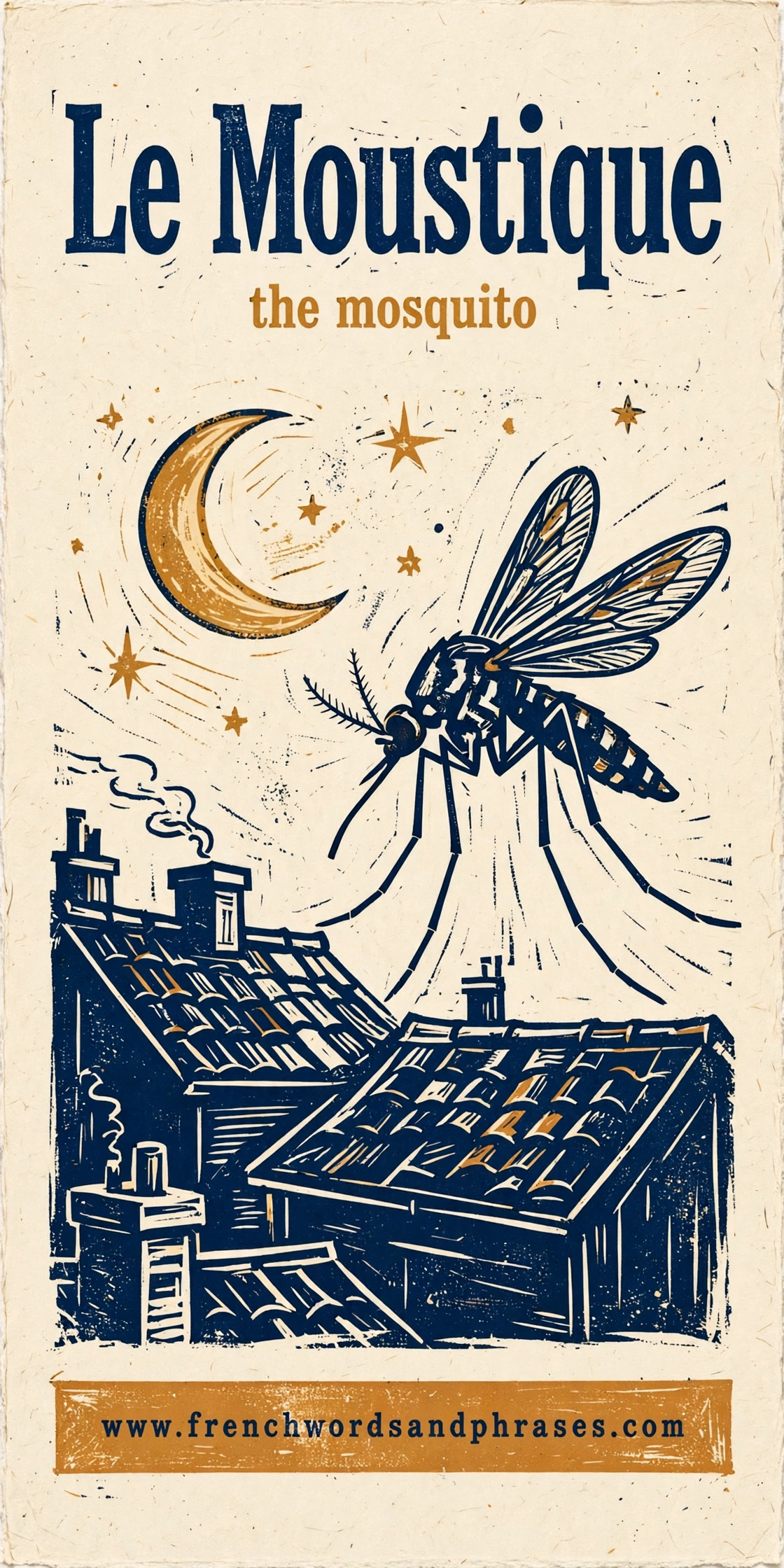
Le moustique means the mosquito.
Two in the morning, lights out, silence — and then, right by your ear, that thin electric whine that means one thing only: le moustique, the mosquito, the least welcome guest of the French summer night.
In this guide, you’ll learn what moustique means in English, how to use it with its articles, how to form its plural, and how it appears in everyday French. Explore French examples, English translations, and practice quizzes.
Understanding the French Noun Moustique
Moustique is a masculine French noun. It is learned together with its article: le moustique, un moustique. It names the small whining fly whose females bite at night — and whose bites, les piqûres, itch for days.
It means the mosquito — the tiny night hunter that finds you by warmth and breath, drinks a drop of blood, and leaves a red, itching bump as a receipt. Summer in the south of France is a long negotiation with the moustique: nets, sprays, citronella candles, and the eternal question of how it got in this time.
Gender: Masculine
Definite article: le — le moustique (the mosquito)
Indefinite article: un — un moustique (a mosquito)
Plural: les moustiques
English equivalents: The mosquito.
One important usage detail: a mosquito bite is une piqûre de moustique, and it démange — it itches. Je me suis fait piquer — I got bitten — is the sentence every camper learns first. The defence has its own word too: la moustiquaire, the mosquito net you sleep under.
Experience the Word
Moustique is more than an insect. It is the sound that ruins a perfect night — three notes of whine between you and sleep.
Imagine the ritual in the dark: light on, everyone hunting the wall with a shoe, the triumphant cry, lights out — and ten minutes later, the whine again, because there is always a second one.
You have not just heard an insect. You have met the true owner of the summer night.
How to Use Moustique in French: Complete Guide
Let’s explore how moustique works in French, beginning with its articles.
Moustique with the Definite Article (Le, Les)
Used for the mosquito everyone in the conversation knows — the one in the bedroom, the ones by the lake.
| Number | French |
|---|---|
| Singular | le moustique |
| Plural | les moustiques |
Example
Le moustique tourne autour de la lampe.
The mosquito circles around the lamp.
Moustique with the Indefinite Article (Un, Des)
Used for a mosquito in general — the one you hear, the ones you never see.
| Number | French |
|---|---|
| Singular | un moustique |
| Plural | des moustiques |
Example
Un moustique m’a piqué trois fois cette nuit.
A mosquito bit me three times last night.
Moustique with the Partitive Article (De — Quantities and Negatives)
Mosquitoes arrive in clouds, so the partitive appears as de after negatives and quantity words — not one mosquito, thank goodness, or far too many.
| Meaning | French |
|---|---|
| no mosquitoes (after a negative) | pas de moustiques |
| a lot of mosquitoes | beaucoup de moustiques |
| too many mosquitoes | trop de moustiques |
Example
Près du lac, il y a trop de moustiques le soir.
Near the lake, there are too many mosquitoes in the evening.
Quick Quiz 1
What is une moustiquaire?
Reveal the answer
A mosquito net — the fine net you hang over the bed to sleep in peace.
Nous dormons sous la moustiquaire tout l’été.
We sleep under the mosquito net all summer.
The Plural of Moustique
Moustique adds an -s in the plural — les moustiques, and one is already too many.
| Number | French |
|---|---|
| Singular | le moustique |
| Plural | les moustiques |
Example
Les moustiques arrivent avec la chaleur du soir.
The mosquitoes arrive with the evening heat.
Moustique with Possessive Adjectives (Mon, Ton, Son…)
Possessives agree with the noun, not with the owner — and moustique is masculine, so it takes mon, ton, son.
| Owner | French |
|---|---|
| my | mon moustique |
| your (tu) | ton moustique |
| his / her | son moustique |
| our | notre moustique |
| your (vous) | votre moustique |
| their | leur moustique |
Example
Chacun a son moustique dans la tente cette nuit.
Everyone has their own mosquito in the tent tonight.
Quick Quiz 2
Complete the sentence:
J’entends ______ moustique près de mon oreille. (my)
Reveal the answer
mon
J’entends mon moustique près de mon oreille.
I can hear my mosquito near my ear.
Moustique with Demonstrative Adjectives (Ce, Ces)
Used to point: this mosquito here, those mosquitoes there.
| Number | French |
|---|---|
| Singular | ce moustique |
| Plural | ces moustiques |
Example
Ce moustique me suit depuis le dîner.
This mosquito has been following me since dinner.
Moustique with Adjectives
Adjectives agree with moustique, masculine — petit, agaçant, bruyant.
| Adjective | With Moustique |
|---|---|
| petit (small) | un petit moustique |
| agaçant (annoying) | un moustique agaçant |
| bruyant (noisy) | un moustique bruyant |
| affamé (hungry) | un moustique affamé |
| invisible (invisible) | un moustique invisible |
Example
Un moustique agaçant et invisible a gâché notre nuit.
An annoying, invisible mosquito ruined our night.
Quick Quiz 3
Complete the sentence:
Un moustique très ______ tourne autour de la lampe. (noisy)
Reveal the answer
bruyant
Un moustique très bruyant tourne autour de la lampe.
A very noisy mosquito circles around the lamp.
Everyday Expressions with Moustique
Bites, itches and nets — the moustique phrases of daily life.
| Expression | In English |
|---|---|
| se faire piquer | to get bitten |
| une piqûre de moustique | a mosquito bite |
| ça démange ! | it itches! |
| une moustiquaire | a mosquito net |
| chasser les moustiques | to chase the mosquitoes away |
| le bourdonnement du moustique | the whine of the mosquito |
Example
Je me suis fait piquer partout, et ça démange !
I got bitten everywhere, and it itches!
Words from the Same Family as Moustique
Bites, scratching and sleepless nights — the words that travel with moustique.
| French | In English |
|---|---|
| piquer | to bite, to sting |
| gratter | to scratch |
| une piqûre | a bite, a sting |
| le sang | blood |
| une moustiquaire | a mosquito net |
| la nuit | the night |
Example
Plus tu grattes la piqûre, plus elle démange.
The more you scratch the bite, the more it itches.
Quick Quiz 4
Your friend shows you a red bump and says: « Ça démange ! » What is she telling you?
Reveal the answer
It itches! Démanger is the verb for the itch of a mosquito bite — and gratter, scratching, only makes it worse.
Ne gratte pas, ça démange encore plus après.
Don’t scratch, it itches even more afterwards.
Moustique in Everyday French: Real-Life Examples
Now that you know the word, let’s see how moustique appears in everyday French.
Example 1 — At night
J’entends un moustique, allume la lumière !
I can hear a mosquito, turn the light on!
Example 2 — Camping
Nous installons la moustiquaire avant la nuit.
We put up the mosquito net before nightfall.
Example 3 — The bite
Je me suis fait piquer au bras et à la cheville.
I got bitten on the arm and the ankle.
Example 4 — By the lake
Le soir, les moustiques chassent les promeneurs.
In the evening, the mosquitoes chase the walkers away.
Example 5 — Defence
Elle met de la citronnelle sur la terrasse.
She puts citronella on the terrace.
Example 6 — The itch
Ne gratte pas ta piqûre de moustique.
Don’t scratch your mosquito bite.
See le moustique in a story: Insects: French Vocabulary (Les Insectes) — a summer day in a grandmother’s garden.
Beyond Translation: The Meaning of Moustique
The moustique shapes French summer more than any postcard admits: whole regions — the Camargue above all — wage organised war on it, and the evening apéritif in the south is a choreography of nets, coils and citronella. French even measures its invasions: a été sans moustiques, a mosquito-free summer, is spoken of like a vintage year.
To say moustique is to hear the whine in the dark and reach for the light.
It evokes the tent at 2 a.m., the bump that itches for three days, and the net that finally lets you sleep.
How to Remember the French Noun Moustique
Remember it this way: Moustique is the mosquito — masculine, with le and un, the whine in the dark and the itch in the morning.
- You hear one — un moustique près de l’oreille, masculine with le.
- You get bitten — je me suis fait piquer, and the piqûre démange.
- You defend the bed — la moustiquaire, the net, is your best friend.
The key idea is le moustique you hear — la moustiquaire you sleep under.
Test Your Knowledge of Moustique
Let’s see how much you’ve learned. Try answering these questions before revealing the answers.
Question 1
Is moustique masculine or feminine?
Reveal the answer
Masculine — le moustique, un moustique.
Question 2
What does ça démange mean?
Reveal the answer
It itches — the classic complaint about a mosquito bite.
Question 3
Translate: A mosquito bit me three times last night.
Reveal the answer
Un moustique m’a piqué trois fois cette nuit.
Question 4
What is une moustiquaire?
Reveal the answer
A mosquito net — the fine net hung over the bed.
Question 5
Complete the sentence:
______ moustiques arrivent avec la chaleur du soir. (The)
Reveal the answer
Les
Les moustiques arrivent avec la chaleur du soir.
The mosquitoes arrive with the evening heat.
Your Final Challenge
Can You Use It?
How would you say this in French?
“Tonight, we sleep under the mosquito net.”
Reveal the answer
Ce soir, nous dormons sous la moustiquaire.
Tonight, we sleep under the mosquito net.
A little French. A little curiosity. A richer everyday life.
LEARN FRENCH ONE WORD AT A TIME




