
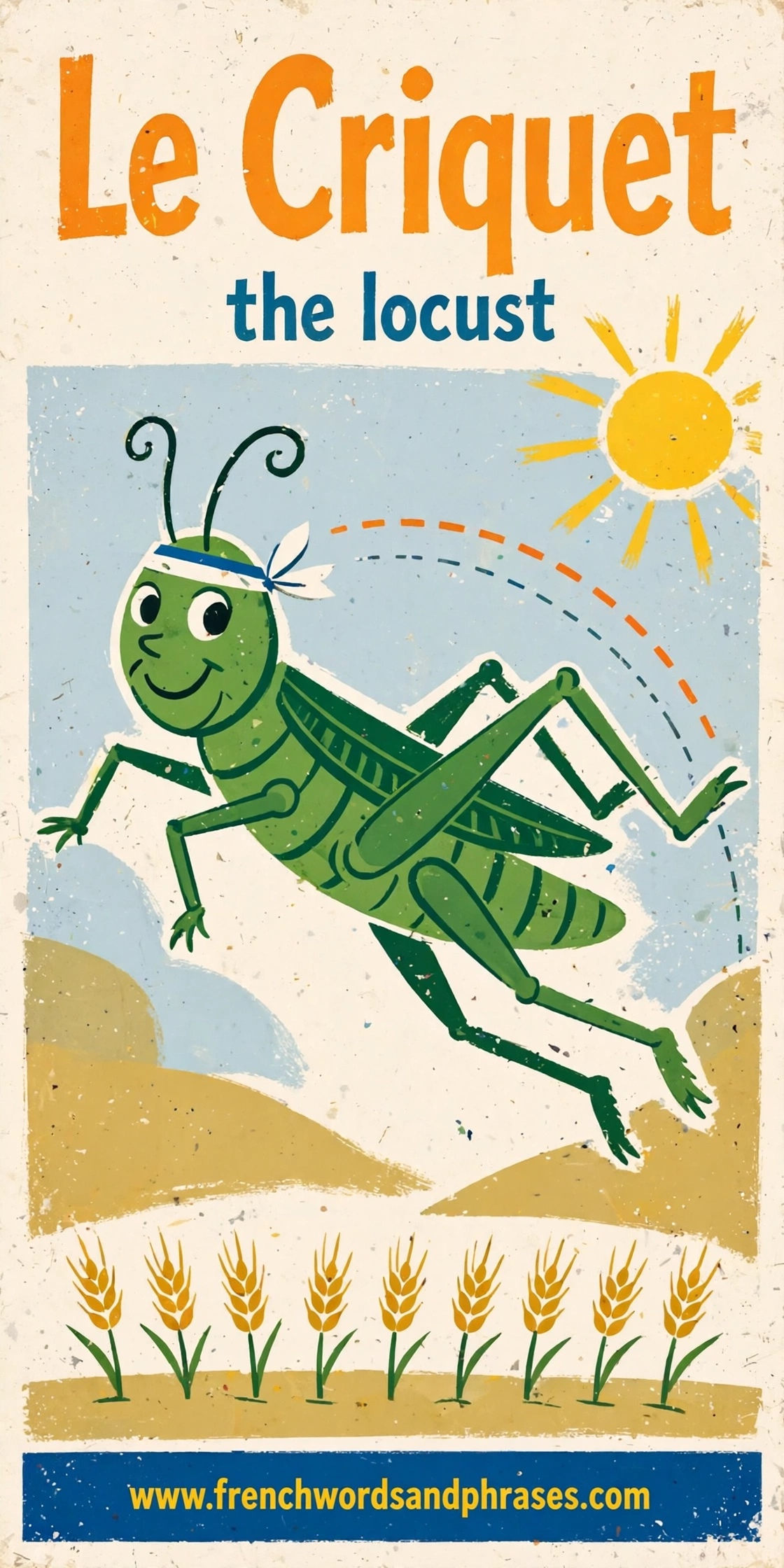
A French Word to Live By
Translate Criquet to English
/kʁi.kɛ/
Le criquet means the locust.
Old stories and news reports agree on the picture: a dark cloud on the horizon that is not a cloud at all, but millions of wings — le criquet, the locust, the grasshopper’s terrible travelling cousin.
In this guide, you’ll learn what criquet means in English, how to use it with its articles, how to form its plural, and how it appears in everyday French. Explore French examples, English translations, and practice quizzes.
Understanding the French Noun Criquet
Criquet is a masculine French noun. It is learned together with its article: le criquet, un criquet. It names the locust — really a grasshopper that changes its life completely when its numbers grow: alone it is harmless, in a swarm it becomes one of the oldest plagues in human history.
It means the locust — the insect of the famous swarms, les essaims de criquets, that can cover the sky and strip a field in hours. The desert locust, le criquet pèlerin, still crosses Africa and the Middle East today, and French keeps the old biblical weight of the word: une invasion de criquets is a catastrophe with wings.
Gender: Masculine
Definite article: le — le criquet (the locust)
Indefinite article: un — un criquet (a locust)
Plural: les criquets
English equivalents: The locust.
One important usage detail: the danger is never one criquet — it is the swarm. French says un essaim de criquets or un nuage de criquets, a cloud of locusts. And keep the family straight: la sauterelle is the peaceful grasshopper of the meadow, le grillon the cricket at home — le criquet is the traveller who arrives by the million.
Experience the Word
Criquet is more than an insect. It is the word for a force of nature — the moment a harmless grasshopper becomes an army, and the sky itself starts to move.
Imagine the farmers watching the horizon: a brown cloud growing at noon, the light dimming, and then the sound — millions of wings and millions of jaws, settling over the fields like a living blanket.
You have not just seen insects. You have seen one of the oldest fears of farming, still flying today.
How to Use Criquet in French: Complete Guide
Let’s explore how criquet works in French, beginning with its articles.
Criquet with the Definite Article (Le, Les)
Used for the locust everyone in the conversation knows — the one in the field, the ones in the swarm.
| Number | French |
|---|---|
| Singular | le criquet |
| Plural | les criquets |
Example
Le criquet dévore les feuilles du champ.
The locust devours the leaves of the field.
Criquet with the Indefinite Article (Un, Des)
Used for a locust in general — one alone is nothing; the plural is where the story starts.
| Number | French |
|---|---|
| Singular | un criquet |
| Plural | des criquets |
Example
Un criquet seul est inoffensif, des millions sont un désastre.
A single locust is harmless, millions are a disaster.
The Locust and Its Swarm
Clouds, crops and invasions — the words that travel with criquet.
| French | In English |
|---|---|
| un essaim de criquets | a swarm of locusts |
| un nuage de criquets | a cloud of locusts |
| le criquet pèlerin | the desert locust |
| dévorer les récoltes | to devour the crops |
| une invasion | an invasion |
| les champs | the fields |
Example
Un nuage de criquets a couvert le ciel à midi.
A cloud of locusts covered the sky at noon.
Quick Quiz 1
What is un essaim de criquets?
Reveal the answer
A swarm of locusts — the millions travelling together as one dark cloud. One criquet is a grasshopper; the essaim is a plague.
L’essaim de criquets avance vers les champs.
The swarm of locusts is moving towards the fields.
The Plural of Criquet
Criquet adds an -s in the plural — les criquets, the word that has worried farmers for thousands of years.
| Number | French |
|---|---|
| Singular | le criquet |
| Plural | les criquets |
Example
Les criquets ont mangé la moitié de la récolte.
The locusts ate half of the harvest.
Criquet with Possessive Adjectives (Mon, Ton, Son…)
Possessives agree with the noun, not with the owner — and criquet is masculine, so it takes mon, ton, son.
| Owner | French |
|---|---|
| my | mon criquet |
| your (tu) | ton criquet |
| his / her | son criquet |
| our | notre criquet |
| your (vous) | votre criquet |
| their | leur criquet |
Example
Le paysan regarde son champ et compte les criquets.
The farmer looks at his field and counts the locusts.
Quick Quiz 2
Complete the sentence:
Les criquets ont dévoré ______ récolte en une journée. (their)
Reveal the answer
leur
Les criquets ont dévoré leur récolte en une journée.
The locusts devoured their harvest in one day.
Criquet with Demonstrative Adjectives (Ce, Ces)
Used to point: this locust here, those locusts there.
| Number | French |
|---|---|
| Singular | ce criquet |
| Plural | ces criquets |
Example
Ces criquets arrivent du sud avec le vent chaud.
These locusts are arriving from the south with the warm wind.
Criquet with Adjectives
Adjectives agree with criquet, masculine — nombreux, affamé, dévastateur.
| Adjective | With Criquet |
|---|---|
| affamé (hungry) | un criquet affamé |
| nombreux (numerous) | des criquets nombreux |
| dévastateur (devastating) | un criquet dévastateur |
| solitaire (solitary) | un criquet solitaire |
| migrateur (migratory) | un criquet migrateur |
Example
Des criquets affamés et nombreux couvrent les champs.
Hungry, countless locusts cover the fields.
Quick Quiz 3
Complete the sentence:
Un criquet ______ ne fait aucun dégât. (solitary)
Reveal the answer
solitaire
Un criquet solitaire ne fait aucun dégât.
A solitary locust does no damage.
Everyday Expressions with Criquet
Swarms, clouds and ruined harvests — the criquet phrases of daily life.
| Expression | In English |
|---|---|
| un essaim de criquets | a swarm of locusts |
| un nuage de criquets | a cloud of locusts |
| le criquet pèlerin | the desert locust |
| une invasion de criquets | a locust invasion |
| dévorer comme des criquets | to devour like locusts (of hearty eaters) |
| les criquets ont tout mangé | the locusts ate everything |
Example
Après le match, les joueurs ont dévoré le buffet comme des criquets.
After the match, the players devoured the buffet like locusts.
Words from the Same Family as Criquet
Fields, harvests and cousins — the words that travel with criquet.
| French | In English |
|---|---|
| la sauterelle | the grasshopper |
| le grillon | the cricket |
| la récolte | the harvest, the crop |
| un essaim | a swarm |
| dévorer | to devour |
| le paysan | the farmer |
Example
La sauterelle vit seule dans le pré, le criquet voyage en essaim.
The grasshopper lives alone in the meadow, the locust travels in swarms.
Quick Quiz 4
The teenagers empty the fridge in ten minutes. Which expression fits them?
Reveal the answer
Ils dévorent comme des criquets — they devour like locusts. The swarm’s appetite has become the family joke about hungry teenagers.
À table, ils dévorent comme des criquets.
At the table, they devour like locusts.
Criquet in Everyday French: Real-Life Examples
Now that you know the word, let’s see how criquet appears in everyday French.
Example 1 — In the news
Un essaim de criquets menace les récoltes du sud.
A swarm of locusts threatens the crops in the south.
Example 2 — In the field
Le paysan surveille le ciel et les criquets.
The farmer watches the sky and the locusts.
Example 3 — One alone
Un criquet solitaire saute dans le jardin, inoffensif.
A solitary locust hops in the garden, harmless.
Example 4 — After the swarm
Les criquets ont tout mangé, il ne reste rien.
The locusts ate everything, nothing is left.
Example 5 — Hungry teenagers
Les enfants dévorent le goûter comme des criquets.
The children devour the snack like locusts.
Example 6 — The desert locust
Le criquet pèlerin traverse le désert en grands essaims.
The desert locust crosses the desert in great swarms.
See le criquet in a story: Insects: French Vocabulary (Les Insectes) — a summer day in a grandmother’s garden.
Beyond Translation: The Meaning of Criquet
The locust is one of the oldest villains in human storytelling: it darkens the sky in the Bible, and it still makes the news today when the desert locust rises in Africa. The strangest part is the transformation — the criquet begins life as an ordinary grasshopper, and only when the rains bring crowds of them together do they change colour, behaviour and destiny, becoming the swarm. Alone, a neighbour; together, a plague.
To say criquet is to remember that numbers change everything.
It evokes the dark cloud at noon, the emptied field, and the family joke about teenagers at the fridge.
How to Remember the French Noun Criquet
Remember it this way: Criquet is the locust — masculine, with le and un, harmless alone and a historic plague in a swarm.
- You meet one in the garden — le criquet, masculine with le.
- You fear the crowd — un essaim de criquets, a swarm, is the real word to know.
- You keep the cousins apart — la sauterelle jumps in the meadow and stays there.
The key idea is un criquet is nothing — un essaim de criquets is a plague.
Test Your Knowledge of Criquet
Let’s see how much you’ve learned. Try answering these questions before revealing the answers.
Question 1
Is criquet masculine or feminine?
Reveal the answer
Masculine — le criquet, un criquet.
Question 2
What is un essaim de criquets?
Reveal the answer
A swarm of locusts — millions travelling and eating together.
Question 3
Translate: A cloud of locusts covered the sky.
Reveal the answer
Un nuage de criquets a couvert le ciel.
Question 4
What is le criquet pèlerin?
Reveal the answer
The desert locust — the great migratory locust of Africa and the Middle East.
Question 5
Complete the sentence:
Les criquets ont dévoré ______ champ. (the)
Reveal the answer
le
Les criquets ont dévoré le champ.
The locusts devoured the field.
Your Final Challenge
Can You Use It?
How would you say this in French?
“A swarm of locusts can devour a whole field in a few hours.”
Reveal the answer
Un essaim de criquets peut dévorer un champ entier en quelques heures.
A swarm of locusts can devour a whole field in a few hours.
A little French. A little curiosity. A richer everyday life.
LEARN FRENCH ONE WORD AT A TIME




