
A French Word to Live By
Translate Phasme to English
/fasm/
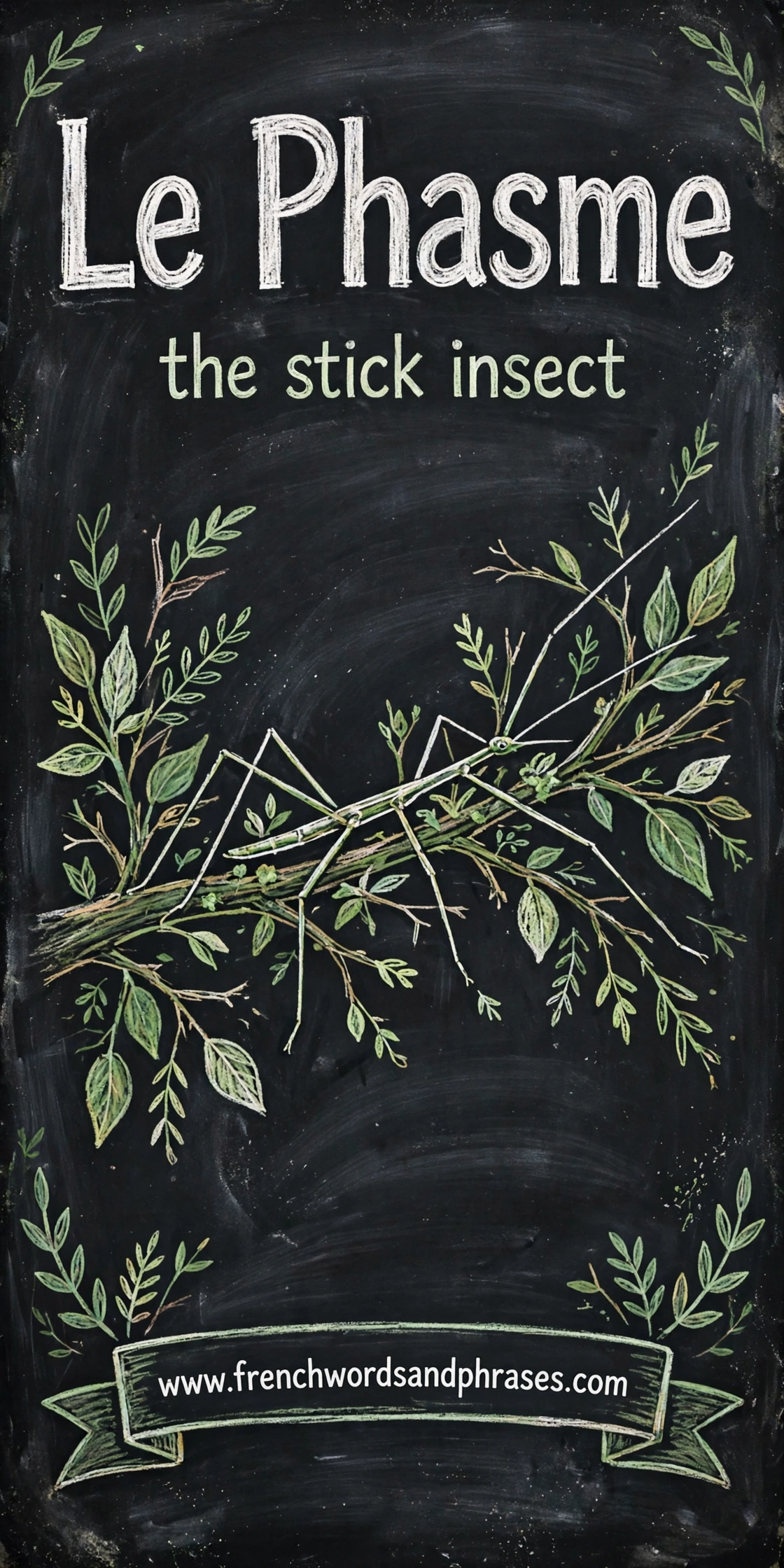
Le phasme means the stick insect.
Look very carefully at the twig in the school terrarium. Look again — the twig has legs, and it is looking back at you: le phasme, the stick insect, the master of disguise.
In this guide, you’ll learn what phasme means in English, how to use it with its articles, how to form its plural, and how it appears in everyday French. Explore French examples, English translations, and practice quizzes.
Understanding the French Noun Phasme
Phasme is a masculine French noun. It is learned together with its article: le phasme, un phasme. It names the stick insects — the long, thin insects that imitate twigs and leaves so perfectly that birds, and people, look straight through them. Its name comes from a Greek word for a phantom: the insect that is there without being seen.
It means the stick insect — the harmless leaf-eater that spends the day frozen as a twig, swaying very slightly as if in a breeze, and walks only at night. Some phasmes imitate green stems, others dry branches, and their cousins the phyllies imitate whole leaves. French classrooms love them: a terrarium of phasmes is a lesson in camouflage that never stops surprising.
Gender: Masculine
Definite article: le — le phasme (the stick insect)
Indefinite article: un — un phasme (a stick insect)
Plural: les phasmes
English equivalents: The stick insect.
One important usage detail: the phasme’s whole talent is not being found — the useful French verb is se confondre avec, to blend in with: le phasme se confond avec la brindille, the stick insect blends in with the twig. When you finally spot one, the everyday exclamation is simply: je ne l’avais pas vu ! — I hadn’t seen it!
Experience the Word
Phasme is more than an insect. It is the garden’s magic trick — a twig that breathes, an animal whose entire strategy is to be mistaken for a plant.
Imagine the classroom terrarium on the first morning: twenty children pressed to the glass, counting branches, arguing — until one branch slowly, politely, walks to a leaf and starts eating it.
You have not just seen an insect. You have watched invisibility itself take a stroll.
How to Use Phasme in French: Complete Guide
Let’s explore how phasme works in French, beginning with its articles.
Phasme with the Definite Article (Le, Les)
Used for the stick insect everyone in the conversation knows — if anyone can find it.
| Number | French |
|---|---|
| Singular | le phasme |
| Plural | les phasmes |
Example
Le phasme se cache parmi les brindilles.
The stick insect hides among the twigs.
Phasme with the Indefinite Article (Un, Des)
Used for a stick insect in general — the one on the branch, the ones in the terrarium.
| Number | French |
|---|---|
| Singular | un phasme |
| Plural | des phasmes |
Example
Il y a un phasme sur la branche, regarde bien.
There is a stick insect on the branch, look carefully.
The Stick Insect, King of Camouflage
Twigs, stillness and slow swaying — the words that travel with phasme.
| French | In English |
|---|---|
| le camouflage | camouflage |
| une brindille | a twig |
| imiter | to imitate, to mimic |
| rester immobile | to stay perfectly still |
| se balancer doucement | to sway gently |
| un terrarium | a terrarium |
Example
Le phasme reste immobile et se confond avec la brindille.
The stick insect stays still and blends in with the twig.
Quick Quiz 1
How does the phasme protect itself?
Reveal the answer
By camouflage — it imitates a twig, stays perfectly still all day, and only walks and eats at night.
Le jour, le phasme est une brindille ; la nuit, il se promène.
By day, the stick insect is a twig; by night, it goes for a walk.
The Plural of Phasme
Phasme adds an -s in the plural — les phasmes, an entire invisible colony.
| Number | French |
|---|---|
| Singular | le phasme |
| Plural | les phasmes |
Example
Les phasmes de la classe mangent des feuilles de lierre.
The class’s stick insects eat ivy leaves.
Phasme with Possessive Adjectives (Mon, Ton, Son…)
Possessives agree with the noun, not with the owner — and phasme is masculine, so it takes mon, ton, son.
| Owner | French |
|---|---|
| my | mon phasme |
| your (tu) | ton phasme |
| his / her | son phasme |
| our | notre phasme |
| your (vous) | votre phasme |
| their | leur phasme |
Example
Elle cherche son phasme dans le terrarium depuis dix minutes.
She has been looking for her stick insect in the terrarium for ten minutes.
Quick Quiz 2
Complete the sentence:
______ phasme est sur la plus haute branche. (His)
Reveal the answer
Son
Son phasme est sur la plus haute branche.
His stick insect is on the highest branch.
Phasme with Demonstrative Adjectives (Ce, Ces)
Used to point — once you have finally managed to see it.
| Number | French |
|---|---|
| Singular | ce phasme |
| Plural | ces phasmes |
Example
Ce phasme ressemble exactement à une brindille sèche.
This stick insect looks exactly like a dry twig.
Phasme with Adjectives
Adjectives agree with phasme, masculine — long, fin, immobile.
| Adjective | With Phasme |
|---|---|
| long (long) | un phasme long |
| fin (thin) | un phasme fin |
| immobile (motionless) | un phasme immobile |
| vert (green) | un phasme vert |
| invisible (invisible) | un phasme invisible |
Example
Un phasme long et fin se balance doucement sur la branche.
A long, thin stick insect sways gently on the branch.
Quick Quiz 3
Complete the sentence:
Le phasme reste ______ toute la journée. (motionless)
Reveal the answer
immobile
Le phasme reste immobile toute la journée.
The stick insect stays motionless all day long.
Everyday Expressions with Phasme
Disguises, terrariums and double-takes — the phasme phrases of daily life.
| Expression | In English |
|---|---|
| le roi du camouflage | the king of camouflage |
| se confondre avec une brindille | to blend in with a twig |
| élever des phasmes | to keep stick insects (a classroom favourite) |
| je ne l’avais pas vu | I hadn’t seen it! |
| un phasme feuille | a leaf insect |
| bouger comme un phasme | to move like a stick insect (very, very slowly) |
Example
Les enfants élèvent des phasmes dans un terrarium à l’école.
The children keep stick insects in a terrarium at school.
Words from the Same Family as Phasme
Camouflage, twigs and patience — the words that travel with phasme.
| French | In English |
|---|---|
| le camouflage | camouflage |
| la brindille | the twig |
| imiter | to imitate |
| une branche | a branch |
| se cacher | to hide |
| la patience | patience |
Example
Le camouflage du phasme est le meilleur du jardin.
The stick insect’s camouflage is the best in the garden.
Quick Quiz 4
Your friend stares at the terrarium and says: « Il n’y a rien ! » Is she right?
Reveal the answer
Almost certainly not — the phasme is there, being a twig. Look for the twig with legs, swaying very slightly.
Regarde encore : le phasme est juste devant toi.
Look again: the stick insect is right in front of you.
Phasme in Everyday French: Real-Life Examples
Now that you know the word, let’s see how phasme appears in everyday French.
Example 1 — At school
La classe élève des phasmes dans un grand terrarium.
The class keeps stick insects in a big terrarium.
Example 2 — Spotting it
Regarde, la brindille bouge — c’est un phasme !
Look, the twig is moving — it is a stick insect!
Example 3 — Feeding time
Le phasme mange des feuilles de lierre la nuit.
The stick insect eats ivy leaves at night.
Example 4 — Perfect stillness
Le phasme reste immobile quand on le regarde.
The stick insect stays motionless when you look at it.
Example 5 — In the garden
Un phasme vert se cache dans le rosier.
A green stick insect is hiding in the rose bush.
Example 6 — The double-take
Je ne l’avais pas vu, il ressemble à une branche.
I had not seen it, it looks like a branch.
See le phasme in a story: Insects: French Vocabulary (Les Insectes) — a summer day in a grandmother’s garden.
Beyond Translation: The Meaning of Phasme
The phasme is the philosopher of the insect world: where others sting, swarm or sing, it simply declines to be seen. Its Greek name means phantom, and it earns it — a creature so committed to stillness that it sways like a twig in a breeze that is not there. It is no wonder French schools adopt them by the terrarium: the phasme teaches the two hardest lessons in natural history, patience and really looking.
To say phasme is to admit the world is fuller than it looks.
It evokes the terrarium glass, the long search, and the small triumph of the moment the twig turns out to have legs.
How to Remember the French Noun Phasme
Remember it this way: Phasme is the stick insect — masculine, with le and un, the phantom insect that survives by looking exactly like a twig.
- You look twice — le phasme, masculine with le, hides on the branch.
- You learn its trick — le camouflage: still all day, walking at night.
- You say the magic words — se confondre avec une brindille, to blend in with a twig.
The key idea is le phasme you cannot see — until the twig walks.
Test Your Knowledge of Phasme
Let’s see how much you’ve learned. Try answering these questions before revealing the answers.
Question 1
Is phasme masculine or feminine?
Reveal the answer
Masculine — le phasme, un phasme.
Question 2
How does the phasme protect itself?
Reveal the answer
By camouflage — it imitates a twig and stays perfectly still all day.
Question 3
Translate: The stick insect hides among the twigs.
Reveal the answer
Le phasme se cache parmi les brindilles.
Question 4
What does the name phasme mean in Greek?
Reveal the answer
Phantom — the insect that is there without being seen.
Question 5
Complete the sentence:
Il y a ______ phasme sur la branche. (a)
Reveal the answer
un
Il y a un phasme sur la branche.
There is a stick insect on the branch.
Your Final Challenge
Can You Use It?
How would you say this in French?
“The stick insect looks like a twig and stays still all day.”
Reveal the answer
Le phasme ressemble à une brindille et reste immobile toute la journée.
The stick insect looks like a twig and stays still all day.
A little French. A little curiosity. A richer everyday life.
LEARN FRENCH ONE WORD AT A TIME




