
A French Word to Live By
Translate Coccinelle to English
/kɔk.si.nɛl/
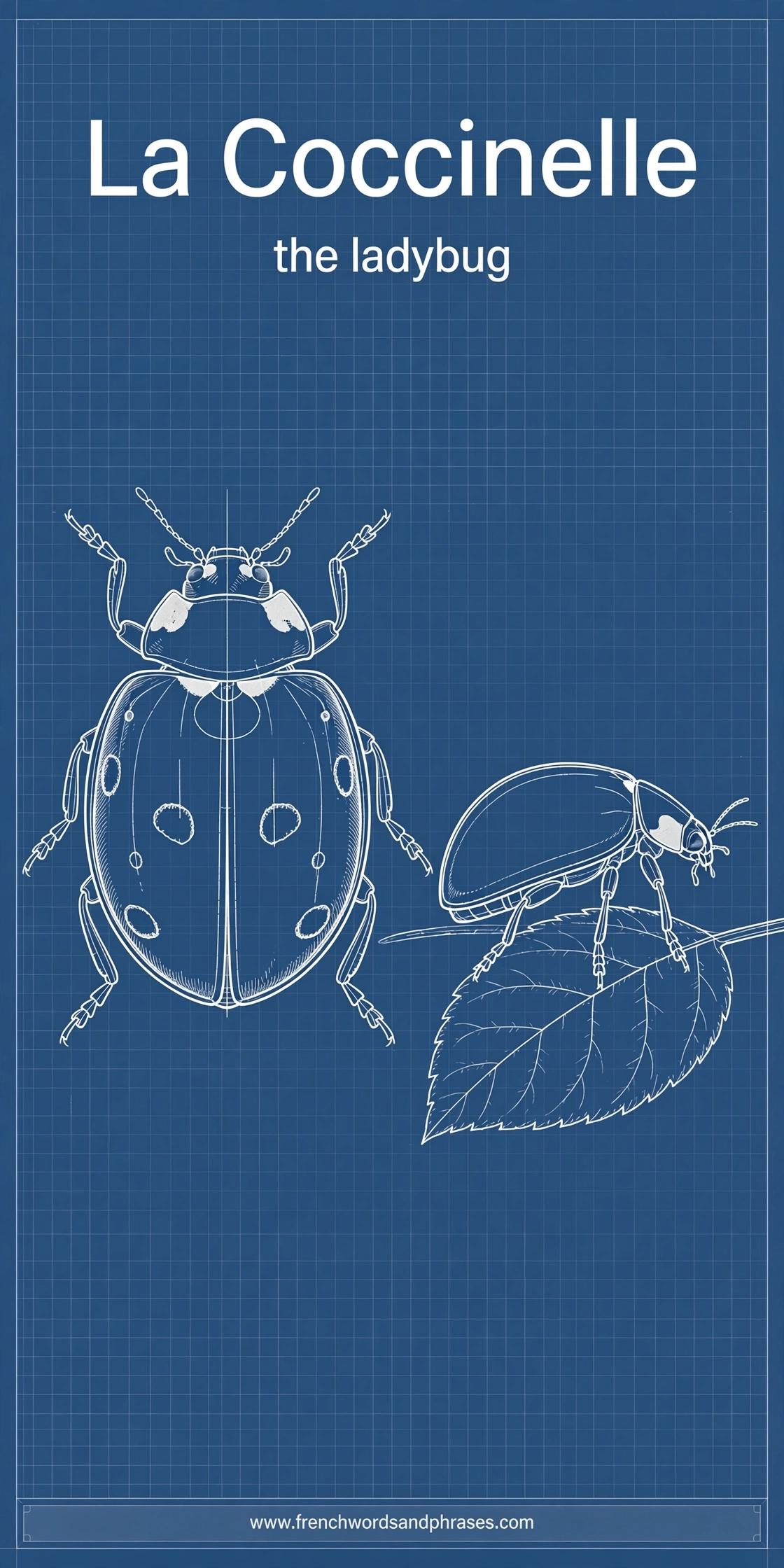
La coccinelle means the ladybug.
A small red dome with black spots is walking up a rose stem in the morning sun; a child holds her breath and puts out a finger for it to climb — la coccinelle, the ladybug, the garden’s lucky charm.
In this guide, you’ll learn what coccinelle means in English, how to use it with its articles, how to form its plural, and how it appears in everyday French. Explore French examples, English translations, and practice quizzes.
Understanding the French Noun Coccinelle
Coccinelle is a feminine French noun. It is learned together with its article: la coccinelle, une coccinelle. It names the little red beetle with black spots — and its beloved nickname, la bête à bon Dieu, tells you how France feels about it.
It means the ladybug (the ladybird, in British English) — the round, red, spotted beetle that patrols roses and beans, eating the aphids gardeners hate. In France the coccinelle is a porte-bonheur, a bringer of luck: if one lands on you, you make a wish and watch it fly away.
Gender: Feminine
Definite article: la — la coccinelle (the ladybug)
Indefinite article: une — une coccinelle (a ladybug)
Plural: les coccinelles
English equivalents: The ladybug, the ladybird.
One important usage detail: the ladybug’s nickname is la bête à bon Dieu — God’s little creature — from an old legend that one saved an innocent man’s life. You will also meet the word far from the garden: la Coccinelle, with a capital C, is the French name of the Volkswagen Beetle, the little round car shaped just like her.
Experience the Word
Coccinelle is more than an insect. It is luck with wings — the one creature in the garden that every child is taught to protect.
Imagine the scene on a fingertip: the tiny red dome opens, the hidden wings unfold like fans, and the coccinelle lifts into the air while a wish is whispered after it.
You have not just found a beetle. You have been visited by the bête à bon Dieu.
How to Use Coccinelle in French: Complete Guide
Let’s explore how coccinelle works in French, beginning with its articles.
Coccinelle with the Definite Article (La, Les)
Used for the ladybug everyone in the conversation knows — the one on the rose, the one on your finger.
| Number | French |
|---|---|
| Singular | la coccinelle |
| Plural | les coccinelles |
Example
La coccinelle marche sur la feuille.
The ladybug walks on the leaf.
Coccinelle with the Indefinite Article (Une, Des)
Used for a ladybug in general — the one that brings luck, the ones that guard the roses.
| Number | French |
|---|---|
| Singular | une coccinelle |
| Plural | des coccinelles |
Example
Une coccinelle se pose sur sa main.
A ladybug lands on her hand.
Coccinelle with the Partitive Article (De — Quantities and Negatives)
Ladybugs are counted one by one, so the partitive appears as de after negatives and quantity words — no ladybugs on this rose, plenty on that one.
| Meaning | French |
|---|---|
| no ladybugs (after a negative) | pas de coccinelles |
| a lot of ladybugs | beaucoup de coccinelles |
| a few ladybugs | quelques coccinelles |
Example
Il y a beaucoup de coccinelles sur les rosiers cette année.
There are a lot of ladybugs on the roses this year.
Quick Quiz 1
What is la bête à bon Dieu?
Reveal the answer
The ladybug’s nickname — God’s little creature, from the legend of the ladybug that saved an innocent man.
Les enfants appellent la coccinelle la bête à bon Dieu.
Children call the ladybug the bête à bon Dieu.
The Plural of Coccinelle
Coccinelle adds an -s in the plural — les coccinelles, a whole patrol of them on the bean plants.
| Number | French |
|---|---|
| Singular | la coccinelle |
| Plural | les coccinelles |
Example
Les coccinelles mangent les pucerons du jardin.
The ladybugs eat the garden’s aphids.
Coccinelle with Possessive Adjectives (Ma, Ta, Sa…)
Possessives agree with the noun, not with the owner — and coccinelle is feminine, so it takes ma, ta, sa.
| Owner | French |
|---|---|
| my | ma coccinelle |
| your (tu) | ta coccinelle |
| his / her | sa coccinelle |
| our | notre coccinelle |
| your (vous) | votre coccinelle |
| their | leur coccinelle |
Example
Elle a trouvé sa coccinelle porte-bonheur sur une rose.
She found her lucky ladybug on a rose.
Quick Quiz 2
Complete the sentence:
______ coccinelle a sept points noirs. (My)
Reveal the answer
Ma
Ma coccinelle a sept points noirs.
My ladybug has seven black spots.
Coccinelle with Demonstrative Adjectives (Cette, Ces)
Used to point: this ladybug here, those ladybugs there.
| Number | French |
|---|---|
| Singular | cette coccinelle |
| Plural | ces coccinelles |
Example
Cette coccinelle va s’envoler, regarde bien.
This ladybug is about to fly away, watch closely.
Coccinelle with Adjectives
Adjectives agree with coccinelle, feminine — rouge, petite, ronde.
| Adjective | With Coccinelle |
|---|---|
| rouge (red) | une coccinelle rouge |
| petite (small) | une petite coccinelle |
| ronde (round) | une coccinelle ronde |
| tachetée (spotted) | une coccinelle tachetée |
| chanceuse (lucky) | une coccinelle chanceuse |
Example
Une petite coccinelle rouge et ronde monte sur la tige.
A small, red, round ladybug climbs up the stem.
Quick Quiz 3
Complete the sentence:
Je cherche une coccinelle bien ______. (red)
Reveal the answer
rouge
Je cherche une coccinelle bien rouge.
I’m looking for a really red ladybug.
Everyday Expressions with Coccinelle
Luck, wishes and one famous little car — the coccinelle phrases of daily life.
| Expression | In English |
|---|---|
| la bête à bon Dieu | the ladybug (God’s little creature) |
| porter bonheur | to bring luck |
| compter les points | to count the spots |
| faire un vœu | to make a wish |
| s’envoler | to fly away |
| la Coccinelle | the Volkswagen Beetle (the car) |
Example
Une coccinelle sur la main porte bonheur, dit grand-mère.
A ladybug on your hand brings luck, says grandmother.
Words from the Same Family as Coccinelle
Spots, wings and aphid patrols — the words that travel with coccinelle.
| French | In English |
|---|---|
| un point noir | a black spot |
| une aile | a wing |
| le puceron | the aphid (her favourite food) |
| la chance | luck |
| un rosier | a rose bush |
| s’envoler | to fly away |
Example
La coccinelle ouvre ses ailes et s’envole.
The ladybug opens its wings and flies away.
Quick Quiz 4
A ladybug lands on your sleeve and your friend says: « Fais un vœu ! » Why?
Reveal the answer
Because the coccinelle brings luck — when one lands on you, you make a wish before it flies away.
La coccinelle porte bonheur à celui qui la trouve.
The ladybug brings luck to whoever finds it.
Coccinelle in Everyday French: Real-Life Examples
Now that you know the word, let’s see how coccinelle appears in everyday French.
Example 1 — In the garden
Les coccinelles protègent les rosiers.
The ladybugs protect the roses.
Example 2 — A lucky moment
Une coccinelle se pose sur mon bras, je fais un vœu.
A ladybug lands on my arm, I make a wish.
Example 3 — Counting spots
Les enfants comptent les points de la coccinelle.
The children count the ladybug’s spots.
Example 4 — Aphid patrol
La coccinelle mange les pucerons des haricots.
The ladybug eats the aphids on the beans.
Example 5 — Flying away
Regarde, la coccinelle ouvre ses ailes et s’envole.
Look, the ladybug opens its wings and flies away.
Example 6 — The little car
Mon oncle collectionne les vieilles Coccinelles.
My uncle collects old Volkswagen Beetles.
See la coccinelle in a story: Insects: French Vocabulary (Les Insectes) — a summer day in a grandmother’s garden.
Beyond Translation: The Meaning of Coccinelle
No insect is more loved in France than the coccinelle. The legend of the bête à bon Dieu — the ladybug that landed on an executioner’s block and saved an innocent man — made her sacred to children, and gardeners prize her for the thousands of aphids one ladybug can eat. She is printed on lucky charms, children’s books and good-luck cards across the country.
To say coccinelle is to wish someone luck in French.
It evokes the fingertip launch, the whispered wish, and the little red dome patrolling the roses like a guardian.
How to Remember the French Noun Coccinelle
Remember it this way: Coccinelle is the ladybug — feminine, with la and une, God’s little creature and the garden’s lucky charm.
- You make a wish — une coccinelle sur la main, feminine with la.
- You count the spots — les points noirs on the little red dome.
- You remember her nickname — la bête à bon Dieu, the creature nobody harms.
The key idea is la coccinelle on your hand — la bête à bon Dieu in the garden.
Test Your Knowledge of Coccinelle
Let’s see how much you’ve learned. Try answering these questions before revealing the answers.
Question 1
Is coccinelle masculine or feminine?
Reveal the answer
Feminine — la coccinelle, une coccinelle.
Question 2
What does la bête à bon Dieu mean?
Reveal the answer
It is the ladybug’s nickname — God’s little creature, from an old legend.
Question 3
Translate: The ladybugs eat the garden’s aphids.
Reveal the answer
Les coccinelles mangent les pucerons du jardin.
Question 4
What is la Coccinelle, with a capital C?
Reveal the answer
The Volkswagen Beetle — the little round car named after the ladybug.
Question 5
Complete the sentence:
Je vois ______ coccinelle sur la rose.
Reveal the answer
une
Je vois une coccinelle sur la rose.
I see a ladybug on the rose.
Your Final Challenge
Can You Use It?
How would you say this in French?
“A ladybug lands on her hand and brings her luck.”
Reveal the answer
Une coccinelle se pose sur sa main et lui porte bonheur.
A ladybug lands on her hand and brings her luck.
A little French. A little curiosity. A richer everyday life.
LEARN FRENCH ONE WORD AT A TIME




