A French Word to Live By
How to Conjugate Frapper in French
/fʁa.pe/
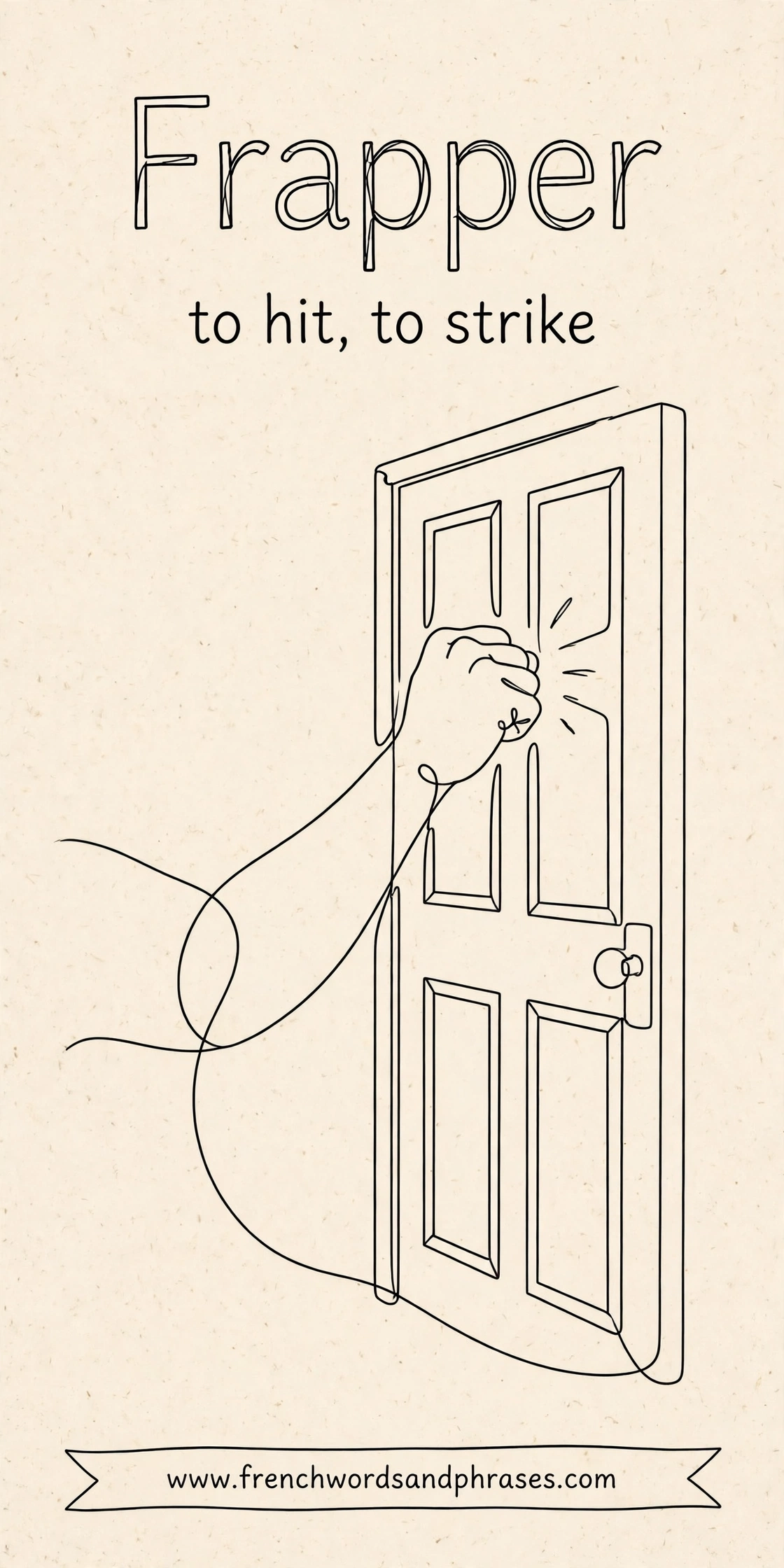
Frapper means to hit, to strike — a hand against a door, a hammer against a nail, a storm against a coast; and in its gentlest everyday life, it is simply how French knocks: frapper à la porte.
A fist raised to a door in the night, a blacksmith’s hammer ringing on iron, waves hammering the cliffs of Brittany — frapper is the verb of the blow and of the knock: every impact French makes, from violence to a polite visit, passes through it.
In this guide, you’ll learn how to conjugate frapper in all the major French tenses and moods. Explore complete conjugation tables, French examples, English translations, and practice quizzes.
Understanding the French Verb Frapper
Frapper is a regular French verb belonging to the first group of verbs, those ending in-er.
It means to hit, to strike. French reaches for frapper far beyond fighting: a disaster frappe une région (strikes a region), an illness frappe les enfants, an idea vous frappe (strikes you, dawns on you), and cold frappe à la porte in December. The noun is une frappe — a strike, a hit, and in football the shot itself: une frappe puissante, a powerful shot.
Verb classification: First group (-er)
Auxiliary verb: Avoir
Past participle: frappé
Present participle: frappant
English equivalents: To hit, to strike, to knock; frapper à la porte — to knock at the door; frapper quelqu’un — to hit someone; frapper un coup — to strike a blow; frapper à la bonne porte — to come to the right person (literally, to knock at the right door); être frappé par — to be struck by (an idea, a sight).
One important detail: frapper doubles its p in every form — je frappe, nous frappons, ils frappent, past participle frappé — a perfectly regular -er verb otherwise. Its most useful everyday frame is frapper à: frapper à la porte, frapper à la fenêtre, to knock at the door, at the window. Without the à, the blow lands on a person or a thing directly: frapper la table du poing, to bang the table with one’s fist.
Experience the Word
Frapper is the verb of contact made loud — the knock, the blow, the wave on the rock: something arrives, and it announces itself with a sound.
Imagine a cottage on the Breton coast in a January storm. All night the sea frappe les rochers below the window, blow after blow, patient as a fist on a door — and in the morning the whole village comes down to look at what the striking has changed.
Door, anvil or cliff, the picture is the same. Something strikes — frappé — and nothing it touches stays silent.
How to Conjugate Frapper: Complete French Conjugation Guide
Let’s explore every major conjugation of frapper, beginning with the indicative mood.
How to Conjugate Frapper in the Indicative Mood
The indicative mood is used to express facts, observations, actions, and events.
How to Conjugate Frapper in the Present Tense (Présent)
Used for actions happening now, habitual actions, and general truths.
| Subject | Conjugation |
|---|---|
| je | frappe |
| tu | frappes |
| il / elle | frappe |
| nous | frappons |
| vous | frappez |
| ils / elles | frappent |
Example
On frappe à la porte, va ouvrir !
Someone is knocking at the door, go and open it!
Quick Quiz 1
Complete the sentence:
Les enfants ______ à la porte avant d’entrer.
Reveal the answer
frappent
Les enfants frappent à la porte avant d’entrer.
The children knock at the door before coming in.
How to Conjugate Frapper in the Passé Composé
Used for completed actions in the past. Frapper takes the auxiliary verb avoir.
| Subject | Conjugation |
|---|---|
| j’ | ai frappé |
| tu | as frappé |
| il / elle | a frappé |
| nous | avons frappé |
| vous | avez frappé |
| ils / elles | ont frappé |
Example
La tempête a frappé la côte pendant la nuit.
The storm struck the coast during the night.
How to Conjugate Frapper in the Imparfait (Imperfect Tense)
Used for habitual past actions, descriptions, and ongoing situations in the past.
| Subject | Conjugation |
|---|---|
| je | frappais |
| tu | frappais |
| il / elle | frappait |
| nous | frappions |
| vous | frappiez |
| ils / elles | frappaient |
Example
Les vagues frappaient les rochers sans relâche.
The waves were striking the rocks without respite.
Quick Quiz 2
Choose the correct form:
The storm struck the coast.
La tempête ______ la côte. (a frappé / est frappée)
Reveal the answer
a frappé
La tempête a frappé la côte.
Frapper takes avoir.
How to Conjugate Frapper in the Plus-que-parfait
Used to describe an action that had already been completed before another past event.
| Subject | Conjugation |
|---|---|
| j’ | avais frappé |
| tu | avais frappé |
| il / elle | avait frappé |
| nous | avions frappé |
| vous | aviez frappé |
| ils / elles | avaient frappé |
Example
Le marteau avait frappé le clou dix fois avant qu’il entre.
The hammer had struck the nail ten times before it went in.
How to Conjugate Frapper in the Passé Simple
Primarily used in formal writing, literature, and historical narratives. It is rarely used in everyday conversation.
| Subject | Conjugation |
|---|---|
| je | frappai |
| tu | frappas |
| il / elle | frappa |
| nous | frappâmes |
| vous | frappâtes |
| ils / elles | frappèrent |
Example
Il frappa trois coups secs à la porte du bureau.
He knocked three sharp knocks at the office door.
How to Conjugate Frapper in the Passé Antérieur
A literary tense used to express an action completed immediately before another past action, generally in the passé simple.
| Subject | Conjugation |
|---|---|
| j’ | eus frappé |
| tu | eus frappé |
| il / elle | eut frappé |
| nous | eûmes frappé |
| vous | eûtes frappé |
| ils / elles | eurent frappé |
Example
Quand la maladie eut frappé le village, l’école ferma ses portes.
When the disease had struck the village, the school closed its doors.
How to Conjugate Frapper in the Future Tense (Futur Simple)
Used to describe actions that will take place in the future.
| Subject | Conjugation |
|---|---|
| je | frapperai |
| tu | frapperas |
| il / elle | frappera |
| nous | frapperons |
| vous | frapperez |
| ils / elles | frapperont |
Example
L’orage frappera la région ce soir.
The storm will strike the region this evening.
How to Conjugate Frapper in the Futur Antérieur (Future Perfect)
Used for an action that will have been completed before a particular point in the future.
| Subject | Conjugation |
|---|---|
| j’ | aurai frappé |
| tu | auras frappé |
| il / elle | aura frappé |
| nous | aurons frappé |
| vous | aurez frappé |
| ils / elles | auront frappé |
Example
Quand tu arriveras, le froid aura frappé les vignes.
When you arrive, the frost will have struck the vines.
How to Conjugate Frapper in the Near Future (Futur Proche)
Used to describe something that is going to happen soon. Formed with aller + infinitive.
| Subject | Conjugation |
|---|---|
| je | vais frapper |
| tu | vas frapper |
| il / elle | va frapper |
| nous | allons frapper |
| vous | allez frapper |
| ils / elles | vont frapper |
Example
Attention, tu vas frapper la table avec ton verre.
Careful, you are going to bang the table with your glass.
How to Conjugate Frapper in the Conditional Mood
The conditional mood expresses what would happen under certain circumstances. It is also frequently used to make polite requests or express wishes.
How to Conjugate Frapper in the Present Conditional
| Subject | Conjugation |
|---|---|
| je | frapperais |
| tu | frapperais |
| il / elle | frapperait |
| nous | frapperions |
| vous | frapperiez |
| ils / elles | frapperaient |
Example
Une telle nouvelle frapperait tout le pays.
Such news would strike the whole country.
How to Conjugate Frapper in the Past Conditional
| Subject | Conjugation |
|---|---|
| j’ | aurais frappé |
| tu | aurais frappé |
| il / elle | aurait frappé |
| nous | aurions frappé |
| vous | auriez frappé |
| ils / elles | auraient frappé |
Example
Sans les digues, la mer aurait frappé le village de plein fouet.
Without the sea walls, the sea would have struck the village full force.
Frapper in the Literary Past Conditional Form
This less common literary form uses the imperfect subjunctive of avoir.
| Subject | Conjugation |
|---|---|
| j’ | eusse frappé |
| tu | eusses frappé |
| il / elle | eût frappé |
| nous | eussions frappé |
| vous | eussiez frappé |
| ils / elles | eussent frappé |
Example
Le sort eût frappé la famille sans l’aide des voisins.
Fate would have struck the family without the neighbours’ help.
How to Conjugate Frapper in the Subjunctive Mood
The subjunctive is used to express wishes, emotions, doubts, necessity, and uncertainty. It frequently follows expressions such as il faut que (it is necessary that) or bien que (although).
How to Conjugate Frapper in the Present Subjunctive
| Subject | Conjugation |
|---|---|
| que je | frappe |
| que tu | frappes |
| qu’il / qu’elle | frappe |
| que nous | frappions |
| que vous | frappiez |
| qu’ils / qu’elles | frappent |
Example
Je crains que l’orage frappe la côte cette nuit.
I fear the storm may strike the coast tonight.
Quick Quiz 3
Complete the sentence using the subjunctive:
Je suis étonné que cette idée te ______ autant.
Reveal the answer
frappe
Je suis étonné que cette idée te frappe autant.
I am surprised this idea strikes you so much.
How to Conjugate Frapper in the Imperfect Subjunctive
A literary tense, rarely encountered in modern spoken French.
| Subject | Conjugation |
|---|---|
| que je | frappasse |
| que tu | frappasses |
| qu’il / qu’elle | frappât |
| que nous | frappassions |
| que vous | frappassiez |
| qu’ils / qu’elles | frappassent |
Example
On ne s’attendait pas qu’il frappât à notre porte à minuit.
Nobody expected him to knock at our door at midnight.
How to Conjugate Frapper in the Pluperfect Subjunctive
A literary construction used to express an action completed before another past action.
| Subject | Conjugation |
|---|---|
| que j’ | eusse frappé |
| que tu | eusses frappé |
| qu’il / qu’elle | eût frappé |
| que nous | eussions frappé |
| que vous | eussiez frappé |
| qu’ils / qu’elles | eussent frappé |
Example
On racontait que la peste eût frappé la ville deux siècles plus tôt.
People said the plague had struck the town two centuries earlier.
How to Conjugate Frapper in the Past Subjunctive
| Subject | Conjugation |
|---|---|
| que j’ | aie frappé |
| que tu | aies frappé |
| qu’il / qu’elle | ait frappé |
| que nous | ayons frappé |
| que vous | ayez frappé |
| qu’ils / qu’elles | aient frappé |
Example
Je suis frappé que tu aies frappé si fort à la porte.
I am struck that you knocked so hard at the door.
How to Conjugate Frapper in the Imperative
The imperative is used to give commands, instructions, invitations, or suggestions. Subject pronouns are omitted.
How to Conjugate Frapper in the Present Imperative
| Person | Conjugation |
|---|---|
| (tu) | frappe |
| (nous) | frappons |
| (vous) | frappez |
Example
Frappe deux coups, puis attends qu’on réponde !
Knock twice, then wait for an answer!
Quick Quiz 4
How would you say Knock twice (tu form)?
Reveal the answer
Frappe deux coups !
French Participles of Frapper
Participles are verb forms that can be used in compound tenses and other grammatical constructions.
Present Participle of Frapper
frappant
En frappant à toutes les portes, il a fini par trouver de l’aide.
By knocking at every door, he eventually found help.
Past Participle of Frapper
frappé
Frappée par la tempête, la côte a changé de visage.
Struck by the storm, the coast has changed its face.
Frapper in Everyday French: Real-Life Examples
Now that you know the conjugations, let’s see how frapper appears in everyday French.
Example 1 — Present
On frappe à la porte.
Someone is knocking at the door.
Example 2 — Passé composé
La tempête a frappé la côte.
The storm struck the coast.
Example 3 — Imparfait
Les vagues frappaient les rochers.
The waves were striking the rocks.
Example 4 — Future
L’orage frappera la région ce soir.
The storm will strike the region this evening.
Example 5 — Conditional
Une telle nouvelle frapperait tout le pays.
Such news would strike the whole country.
Example 6 — Imperative
Frappe deux coups et attends !
Knock twice and wait!
Beyond Translation: The Meaning of Frapper
English splits the work between hit, strike and knock; French gives it all to frapper — and then lets the verb travel: an idea that strikes you, a face that strikes you, a disaster that strikes a province are all frappés by the same blow.
One verb for the fist, the hammer and the lightning.
That is why the polite knock and the violent blow share a word: both are arrivals that make a sound, and French listens first.
How to Remember the French Verb Frapper
Remember it this way: Frapper is about the fist on the door, the hammer on the nail, the wave on the cliff — one verb, every blow.
- Frapper à la porte — to knock at the door; the à is the polite part of the verb.
- Double p everywhere: je frappe, nous frappons, frappé.
- Beyond blows: être frappé par une idée — to be struck by an idea.
The key idea is the fist on the door, the hammer on the nail, the wave on the cliff — one verb, every blow.
Test Your Knowledge of Frapper
Let’s see how much you’ve learned. Try answering these questions before revealing the answers.
Question 1
How do you say to knock at the door in French?
Reveal the answer
Frapper à la porte — the à makes it a knock, not a blow.
Question 2
How do you say The storm struck the coast in French?
Reveal the answer
La tempête a frappé la côte.
Question 3
Translate: The waves were striking the rocks without respite.
Reveal the answer
Les vagues frappaient les rochers sans relâche.
Question 4
What is the past participle of frapper?
Reveal the answer
Frappé.
Question 5
Complete the sentence:
Je crains que l’orage ______ la côte cette nuit.
Reveal the answer
frappe
Je crains que l’orage frappe la côte cette nuit.
I fear the storm may strike the coast tonight.
Your Final Challenge
Can You Use It?
How would you say this in French?
There was a knock at the door at midnight, and the storm that was striking the coast came in with the visitor.
Reveal the answer
On a frappé à la porte à minuit, et la tempête qui frappait la côte est entrée avec le visiteur.
There was a knock at the door at midnight, and the storm that was striking the coast came in with the visitor.
A little French. A little curiosity. A richer everyday life.
LEARN FRENCH ONE WORD AT A TIME