A French Word to Live By
Translate Figue to English
/fiɡ/
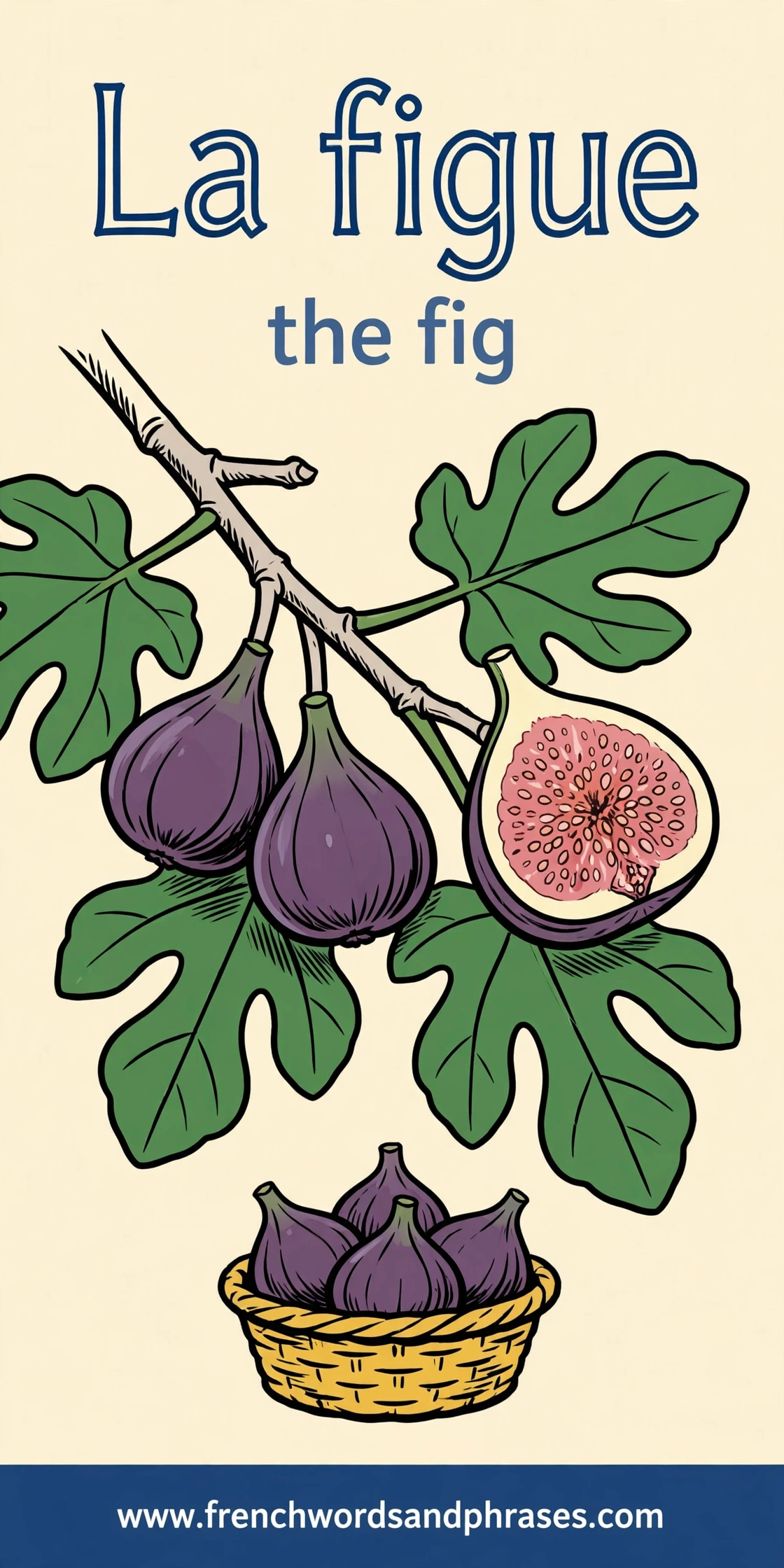
La figue means a fig.
August in Provence: the tree leans over the garden wall, and its fruit splits open in the heat, purple and honeyed: la figue, the fig — the oldest cultivated fruit in the Mediterranean, and still the sweetest argument for doing nothing in the shade.
In this guide, you’ll learn what figue means in English, how to use it with its articles, how to form its plural, and how it appears in everyday French. Explore French examples, English translations, and practice quizzes.
Understanding the French Noun Figue
Figue is a feminine French noun, learned with its article: la figue, une figue. The tree is le figuier. Figs come fresh in late summer — une figue fraîche — and dried all winter — une figue sèche, a dried fig, the traveller’s and the schoolchild’s pocket fruit. A near-namesake from another hemisphere is la figue de Barbarie, the prickly pear.
It means a fig — the soft, pear-shaped fruit with a thousand tiny seeds: manger une figue, to eat a fig, la saison des figues, fig season, une tarte aux figues, a fig tart. Old French slang gave the word a rude second life — mi-figue mi-raisin, half-fig half-grape, means half-hearted, neither one thing nor the other — and that phrase, not the fruit, is what most French speakers quote.
Gender: Feminine — la figue
Definite article: la — la figue (the fig)
Indefinite article: une — une figue (a fig)
Plural: les figues — regular, with a simple -s
Spelling note: the tree is le figuier — the fruit is feminine, the tree masculine
Famous phrase: mi-figue mi-raisin — half-hearted, neither one thing nor the other
English equivalents: A fig.
At the market, choose by touch and by season: fresh figs run from July to October, and French eats them nature, plain, or with cheese and ham. Dried, they travel: des figues sèches in the hiking bag. The phrase mi-figue mi-raisin describes a smile, an answer or a welcome that cannot decide whether it is pleased — half fig (sweet, fresh), half raisin (dry, wrinkled).
Experience the Word
Figue is the fruit of patience: it ripens twice a year on the same tree, and each time it must be eaten within days, under the tree if possible.
Imagine the grandfather splitting a fig with his thumbnail at the garden table, the inside rose-red and glistening — no knife, no plate, la figue se mange là où elle tombe, the fig is eaten where it falls.
You have not just named a fruit. You have named late summer itself — la figue, honey that grows on a tree.
How to Use Figue in French: Complete Guide
Let’s explore how figue works in French, beginning with its articles — la figue, une figue, une figue fraîche.
Figue with the Definite Article (La, Les)
Used for a specific fig — the one on the branch, the one on the plate.
| Form | French |
|---|---|
| Feminine singular | la figue |
| Plural | les figues |
Example
La figue est mûre, elle s’ouvre toute seule.
The fig is ripe, it is splitting open by itself.
Figue with the Indefinite Article (Une, Des)
Used for a fig in general — any fig from the tree or the stall.
| Form | French |
|---|---|
| Feminine singular | une figue |
| Plural | des figues |
Example
Elle a mangé une figue sous l’arbre.
She ate a fig under the tree.
Figue with the Partitive and Quantities (Des figues, un kilo de figues…)
Figs are bought by the kilo and eaten by the handful — the partitive and the measures.
| Quantity | French |
|---|---|
| some figs | des figues |
| a kilo of figs | un kilo de figues |
| a punnet of figs | une barquette de figues |
| a lot of figs | beaucoup de figues |
| dried figs | des figues sèches |
Example
Un kilo de figues, s’il vous plaît, bien mûres.
A kilo of figs, please, nice and ripe.
Quick Quiz 1
Complete the sentence:
______ figue du jardin est déjà mûre. (the)
Reveal the answer
La
La figue du jardin est déjà mûre.
The fig in the garden is already ripe — figue is feminine, so la.
The Plural of Figue
Figue takes a regular plural in -s — a whole treeful at harvest time.
| Number | French |
|---|---|
| Singular | la figue |
| Plural | les figues |
Example
Les figues tombent si on ne les cueille pas.
The figs fall if nobody picks them.
Figue with Possessive Adjectives (Ma, Ta, Sa…)
Possessives agree with the noun: figue is feminine, so ma, ta, sa in the singular.
| Owner | French |
|---|---|
| my | ma figue |
| your (tu) | ta figue |
| his / her | sa figue |
| our | notre figue |
| your (vous) | votre figue |
| their | leur figue |
Example
Il garde sa figue pour la fin du repas.
He is keeping his fig for the end of the meal.
Quick Quiz 2
Complete the sentence:
Elle a posé ______ figue à côté du fromage. (her)
Reveal the answer
sa
Elle a posé sa figue à côté du fromage.
She put her fig next to the cheese — sa, because figue is feminine.
Figue with Demonstrative Adjectives (Cette, Ces)
Used to point: cette figue, this fig — this one, the ripest.
| Form | French |
|---|---|
| Feminine singular | cette figue |
| Plural | ces figues |
Example
Cette figue est la plus sucrée de l’arbre.
This fig is the sweetest on the tree.
Figue with Adjectives
Adjectives agree with figue — feminine singular: une figue mûre, une figue sèche.
| Adjective | With Figue |
|---|---|
| mûre (ripe) | une figue mûre |
| fraîche (fresh) | une figue fraîche |
| sèche (dried) | une figue sèche |
| sucrée (sweet) | une figue sucrée |
| violette (purple) | une figue violette |
Example
Une figue mûre se reconnaît à sa peau douce.
A ripe fig is known by its soft skin.
Quick Quiz 3
Complete the sentence:
C’est une figue bien ______, parfaite pour le dessert. (ripe)
Reveal the answer
mûre
C’est une figue bien mûre, parfaite pour le dessert.
It is a nice ripe fig, perfect for dessert — mûre, feminine, to agree with figue.
Everyday Expressions with Figue
Markets, desserts and half-hearted smiles — the figue phrases of daily life.
| Expression | In English |
|---|---|
| une figue fraîche | a fresh fig |
| des figues sèches | dried figs |
| une tarte aux figues | a fig tart |
| la saison des figues | fig season |
| mi-figue mi-raisin | half-hearted, neither pleased nor displeased |
Example
Il a répondu avec un sourire mi-figue mi-raisin.
He answered with a half-hearted smile.
Words from the Same Family as Figue
Orchards and late summer — the words that travel with figue.
| French | In English |
|---|---|
| le figuier | the fig tree |
| le raisin | the grape — the other half of the famous phrase |
| une prune | a plum |
| une datte | a date (fruit) |
| cueillir | to pick (fruit) |
Example
Le figuier donne deux récoltes par an.
The fig tree gives two harvests a year.
Quick Quiz 4
What does mi-figue mi-raisin mean?
Reveal the answer
Half-hearted — neither one thing nor the other, half pleased, half not.
Son accueil était mi-figue mi-raisin.
His welcome was half-hearted.
Figue in Everyday French: Real-Life Examples
Now that you know the word, let’s see how figue appears in everyday French.
Example 1 — At the market
Un kilo de figues bien mûres, s’il vous plaît.
A kilo of nice ripe figs, please.
Example 2 — Under the tree
Les figues se mangent sous le figuier.
Figs are eaten under the fig tree.
Example 3 — Dessert
La tarte aux figues est encore chaude.
The fig tart is still warm.
Example 4 — Winter
Des figues sèches et des noix pour la randonnée.
Dried figs and nuts for the hike.
Example 5 — Season
La saison des figues commence en juillet.
Fig season begins in July.
Example 6 — The phrase
Sa réponse était mi-figue mi-raisin.
His answer was half-hearted.
Beyond Translation: The Meaning of Figue
The fig may be the first fruit humans ever farmed — fossil figs older than wheat have been found by the Jordan. France met it with Rome and never let it go: the figuier stands in every southern garden, giving two harvests a year, and the fruit is so woven into the language that its name serves in the famous shrug of a phrase, mi-figue mi-raisin — the smile that is half fresh fig, half dried grape, and wholly undecided.
To say figue is to taste the Mediterranean at its ripest — and to keep a phrase for every half-hearted answer.
It evokes August shade, split skins, honeyed insides — and smiles that cannot make up their minds.
How to Remember the French Noun Figue
Remember it this way: Figue is a fig — feminine: la figue; the tree is le figuier, and the famous phrase is mi-figue mi-raisin.
- Always feminine — la figue, une figue, ma figue.
- Fruit and tree — la figue is eaten; le figuier is climbed.
- The phrase — mi-figue mi-raisin, half-hearted, neither pleased nor displeased.
The key idea is la figue — a fig, feminine; mi-figue mi-raisin = half-hearted.
Test Your Knowledge of Figue
Let’s see how much you’ve learned. Try answering these questions before revealing the answers.
Question 1
Is figue masculine or feminine?
Reveal the answer
Feminine — la figue, une figue.
Question 2
How do you say the fig tree?
Reveal the answer
Le figuier — masculine, though its fruit is feminine.
Question 3
Translate: A kilo of nice ripe figs, please.
Reveal the answer
Un kilo de figues bien mûres, s’il vous plaît.
Question 4
What are des figues sèches?
Reveal the answer
Dried figs — the winter and hiking form of the fruit.
Question 5
Complete the sentence:
______ figues de cet arbre sont excellentes. (the)
Reveal the answer
Les
Les figues de cet arbre sont excellentes.
The figs from this tree are excellent.
Your Final Challenge
Can You Use It?
How would you say this in French?
“A kilo of nice ripe figs, please.”
Reveal the answer
Un kilo de figues bien mûres, s’il vous plaît.
A kilo of nice ripe figs, please.
A little French. A little curiosity. A richer everyday life.
LEARN FRENCH ONE WORD AT A TIME