A French Word to Live By
Translate Foule to English
/ful/
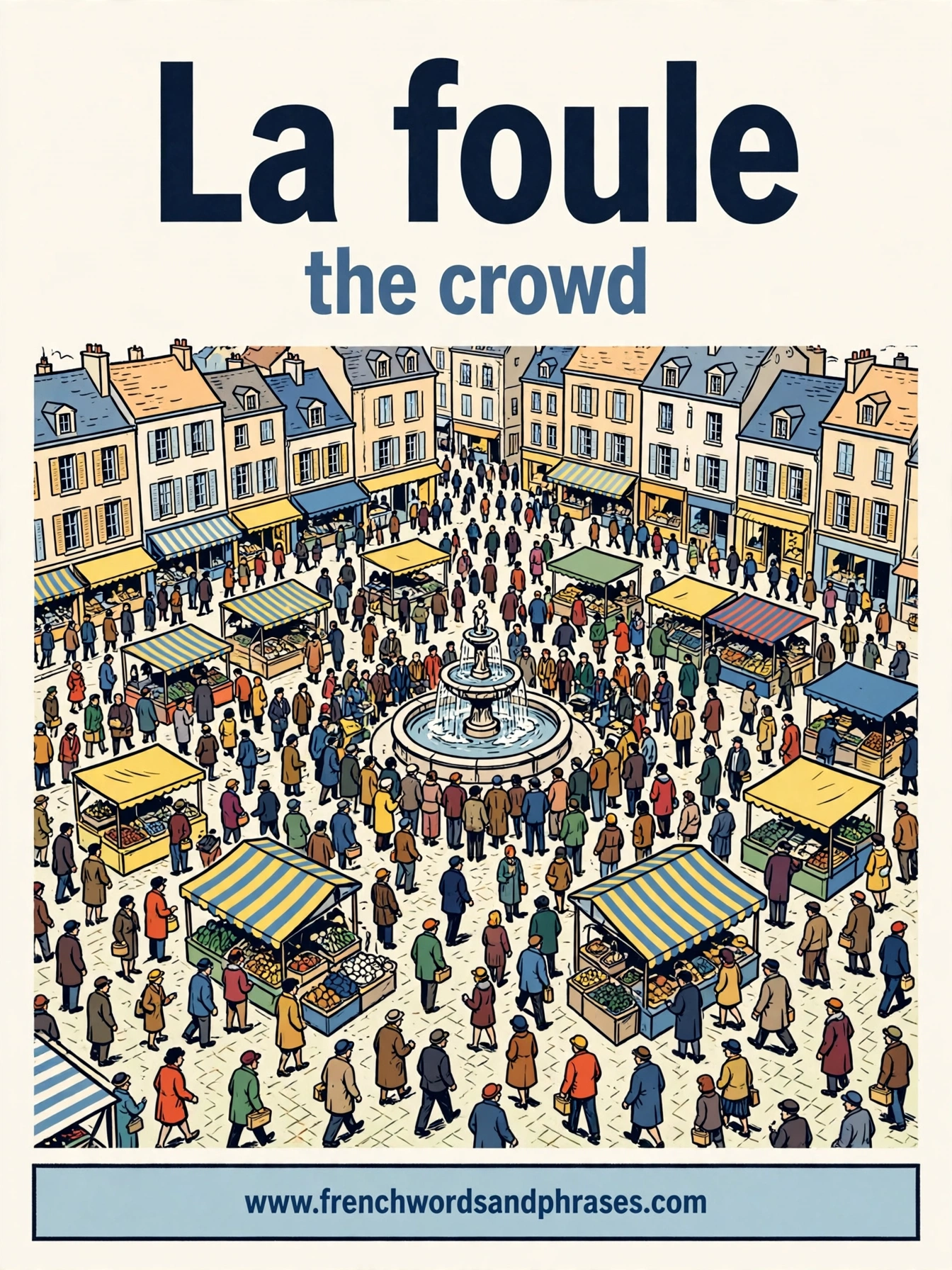
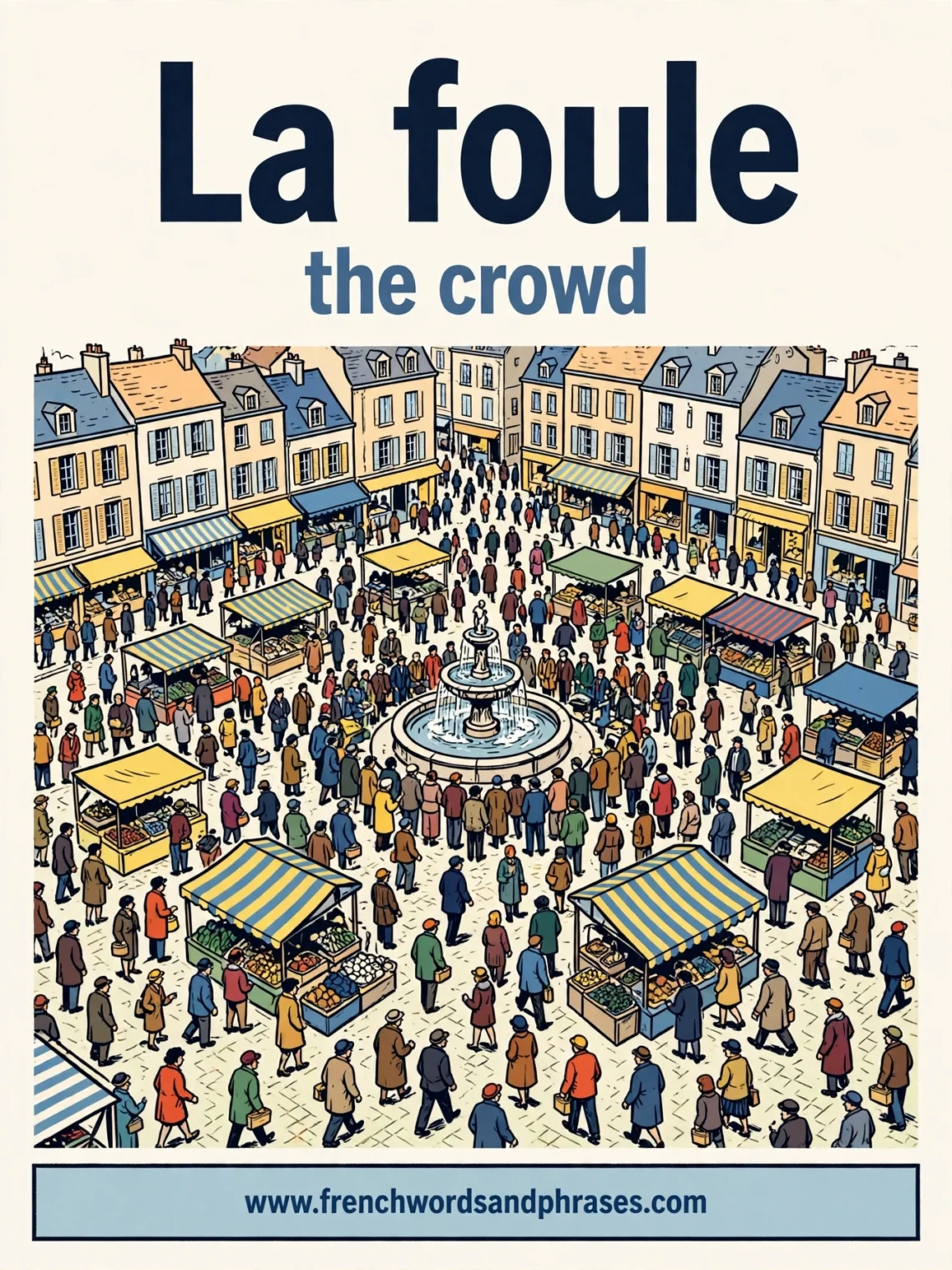
La foule means the crowd.
Shoulders touching, voices merging into one long murmur, the square slowly filling before the fireworks: la foule, the crowd — the moment separate people become a single creature with a thousand heads.
In this guide, you’ll learn what foule means in English, how to use it with its articles, how to form its plural, and how it appears in everyday French. Explore French examples, English translations, and practice quizzes.
Understanding the French Noun Foule
Foule is a feminine French noun, learned with its article: la foule, une foule. It is a collective noun: grammatically singular, it names a multitude — une foule de touristes, a crowd of tourists. The adjective is affluence for the flow of people arriving, and a packed place fait foule or is bondé.
It means a crowd — a large number of people gathered in one place: une foule immense, a huge crowd, la foule des spectateurs, the crowd of spectators, se perdre dans la foule, to lose oneself in the crowd. By extension it counts anything that comes in numbers: une foule de questions, a host of questions, une foule de souvenirs, a crowd of memories. A crowd in motion is also la cohue when it crushes, and a demonstration crowd is les manifestants.
Gender: Feminine — la foule
Definite article: la — la foule (the crowd)
Indefinite article: une — une foule (a crowd)
Plural: les foules — crowds, used for several gatherings or in elevated style
Spelling note: a collective noun: one foule already contains multitudes
Key frame: une foule de + plural noun — une foule de touristes, a crowd of tourists
English equivalents: The crowd, a throng, a multitude.
Because foule is collective, French often completes it: une foule de plus a plural noun — une foule d’admirateurs, de curieux, de journalistes. The verb stays singular: la foule attend, the crowd waits, even when thousands are waiting. For the crush at the sales or the station, everyday French also says la cohue, and il y a foule means the place is packed.
Experience the Word
Foule is the instant a hundred strangers start breathing at the same rhythm — one body made of everybody.
Imagine the station concourse at the first whistle of the holidays: suitcases, announcements, reunions — and through it all la foule avance, recule, se faufile, a river with a thousand currents.
You have not just named many people. You have named the single beast they form together — la foule, the crowd.
How to Use Foule in French: Complete Guide
Let’s explore how foule works in French, beginning with its articles — la foule, une foule, une foule de spectateurs.
Foule with the Definite Article (La, Les)
Used for a specific crowd — the one in the square, the one leaving the stadium.
| Form | French |
|---|---|
| Feminine singular | la foule |
| Plural | les foules |
Example
La foule quitte le stade dans le calme.
The crowd leaves the stadium calmly.
Foule with the Indefinite Article (Une, Des)
Used for a crowd in general — and with de, for a crowd of someone or something.
| Form | French |
|---|---|
| Feminine singular | une foule |
| Plural | des foules |
Example
Une foule de curieux s’est rassemblée devant la vitrine.
A crowd of onlookers gathered in front of the shop window.
Foule with Quantities (Une foule de…)
Foule measures multitudes — of people first, then of anything numerous.
| Quantity | French |
|---|---|
| a crowd of tourists | une foule de touristes |
| a host of questions | une foule de questions |
| a huge crowd | une foule immense |
| a crowd of memories | une foule de souvenirs |
| the holiday crowds | les foules des vacances |
Example
Une foule de questions attendait le ministre à la sortie.
A host of questions awaited the minister on his way out.
Quick Quiz 1
Complete the sentence:
______ foule attend devant les portes du musée. (the)
Reveal the answer
La
La foule attend devant les portes du musée.
The crowd is waiting in front of the museum doors — foule is feminine, so la, and the verb stays singular.
The Plural of Foule
Foule takes a regular plural in -s, used when several crowds are compared or in elevated style.
| Number | French |
|---|---|
| Singular | la foule |
| Plural | les foules |
Example
Les foules de l’été envahissent les plages du sud.
The summer crowds invade the beaches of the south.
Foule with Possessive Adjectives (Ma, Ta, Sa…)
Possessives agree with the noun: foule is feminine, so ma, ta, sa in the singular.
| Owner | French |
|---|---|
| my | ma foule |
| your (tu) | ta foule |
| his / her | sa foule |
| our | notre foule |
| your (vous) | votre foule |
| their | leur foule |
Example
Le chanteur salue sa foule avant la dernière chanson.
The singer greets his crowd before the last song.
Quick Quiz 2
Complete the sentence:
Elle a traversé ______ foule pour le rejoindre. (the)
Reveal the answer
la
Elle a traversé la foule pour le rejoindre.
She crossed the crowd to reach him — la, because foule is feminine.
Foule with Demonstrative Adjectives (Cette, Ces)
Used to point: cette foule, this crowd — this mass of people in front of us.
| Form | French |
|---|---|
| Feminine singular | cette foule |
| Plural | ces foules |
Example
Cette foule bloque tout le boulevard.
This crowd is blocking the whole boulevard.
Foule with Adjectives
Adjectives agree with foule — feminine singular: une foule immense, une foule compacte.
| Adjective | With Foule |
|---|---|
| immense (huge) | une foule immense |
| compacte (dense) | une foule compacte |
| joyeuse (cheerful) | une foule joyeuse |
| silencieuse (silent) | une foule silencieuse |
| nombreuse (large, numerous) | une foule nombreuse |
Example
Une foule joyeuse dansait sur la place après la victoire.
A cheerful crowd was dancing in the square after the victory.
Quick Quiz 3
Complete the sentence:
Une foule ______ remplissait la cathédrale. (silent)
Reveal the answer
silencieuse
Une foule silencieuse remplissait la cathédrale.
A silent crowd filled the cathedral — silencieuse, feminine, to agree with foule.
Everyday Expressions with Foule
Squares, stadiums and sales — the foule phrases of daily life.
| Expression | In English |
|---|---|
| se perdre dans la foule | to lose oneself in the crowd |
| une foule de + nom | a host of, a crowd of |
| il y a foule | it is packed, there is a crowd |
| la foule des spectateurs | the crowd of spectators |
| un bain de foule | a walkabout among the crowd (of a public figure) |
Example
Le candidat a pris un bain de foule après le meeting.
The candidate did a walkabout among the crowd after the rally.
Words from the Same Family as Foule
Gatherings and gatherings of people — the words that travel with foule.
| French | In English |
|---|---|
| la cohue | the crush, the mob (a pushing crowd) |
| la multitude | the multitude |
| affluer | to flock, to stream in (the verb) |
| bondé | packed, crammed (adjective) |
| un rassemblement | a gathering, a rally |
Example
À l’heure de pointe, c’est la cohue dans le métro.
At rush hour, it is a crush in the metro.
Quick Quiz 4
What does il y a foule mean?
Reveal the answer
It is packed — there is a crowd, the place is full of people.
N’y va pas maintenant, il y a foule.
Don’t go now, it is packed.
Foule in Everyday French: Real-Life Examples
Now that you know the word, let’s see how foule appears in everyday French.
Example 1 — At the match
La foule chante avant le coup d’envoi.
The crowd sings before kick-off.
Example 2 — At the station
Une foule de voyageurs attend le train en retard.
A crowd of travellers is waiting for the late train.
Example 3 — In the street
Il s’est perdu dans la foule du marché.
He got lost in the market crowd.
Example 4 — At the sales
Le premier jour des soldes, il y a foule dès l’ouverture.
On the first day of the sales, it is packed from opening time.
Example 5 — Fireworks
La foule lève la tête au premier feu d’artifice.
The crowd lifts its head at the first firework.
Example 6 — Memories
Une foule de souvenirs lui revient en traversant le village.
A crowd of memories comes back to him as he crosses the village.
Beyond Translation: The Meaning of Foule
Foule is one of French’s great collective words, and the language treats it with respect: psychologists wrote of la psychologie des foules, crowd psychology, because a foule is not just people added up — it applauds, panics and hopes as one body. Politicians take un bain de foule, a crowd-bath, to test that body’s temperature; the rest of us simply try to cross it with our shopping intact.
To say foule is to count people by the thousand and feel them as one.
It evokes the square before the fireworks, the concourse at holiday time, and the strange joy of disappearing into everybody.
How to Remember the French Noun Foule
Remember it this way: Foule is the crowd — feminine and collective: la foule, une foule de touristes, and the verb stays singular.
- Always feminine — la foule, une foule, cette foule.
- The frame — une foule de + plural: une foule de questions, a host of questions.
- The packed place — il y a foule, it is packed.
The key idea is la foule — the crowd, feminine; une foule de = a host of.
Test Your Knowledge of Foule
Let’s see how much you’ve learned. Try answering these questions before revealing the answers.
Question 1
Is foule masculine or feminine?
Reveal the answer
Feminine — la foule, une foule.
Question 2
How do you say a crowd of tourists?
Reveal the answer
Une foule de touristes.
Question 3
Translate: The crowd is waiting in front of the museum.
Reveal the answer
La foule attend devant le musée.
Question 4
Why does the verb stay singular with la foule?
Reveal the answer
Because foule is a collective noun — grammatically singular, even though it names multitudes.
Question 5
Complete the sentence:
______ foule des spectateurs applaudit. (the)
Reveal the answer
La
La foule des spectateurs applaudit.
The crowd of spectators applauds.
Your Final Challenge
Can You Use It?
How would you say this in French?
“A crowd of travellers is waiting for the late train.”
Reveal the answer
Une foule de voyageurs attend le train en retard.
A crowd of travellers is waiting for the late train.
A little French. A little curiosity. A richer everyday life.
LEARN FRENCH ONE WORD AT A TIME