A French Vocabulary Lesson
Welcome to a little French lesson about dancing!
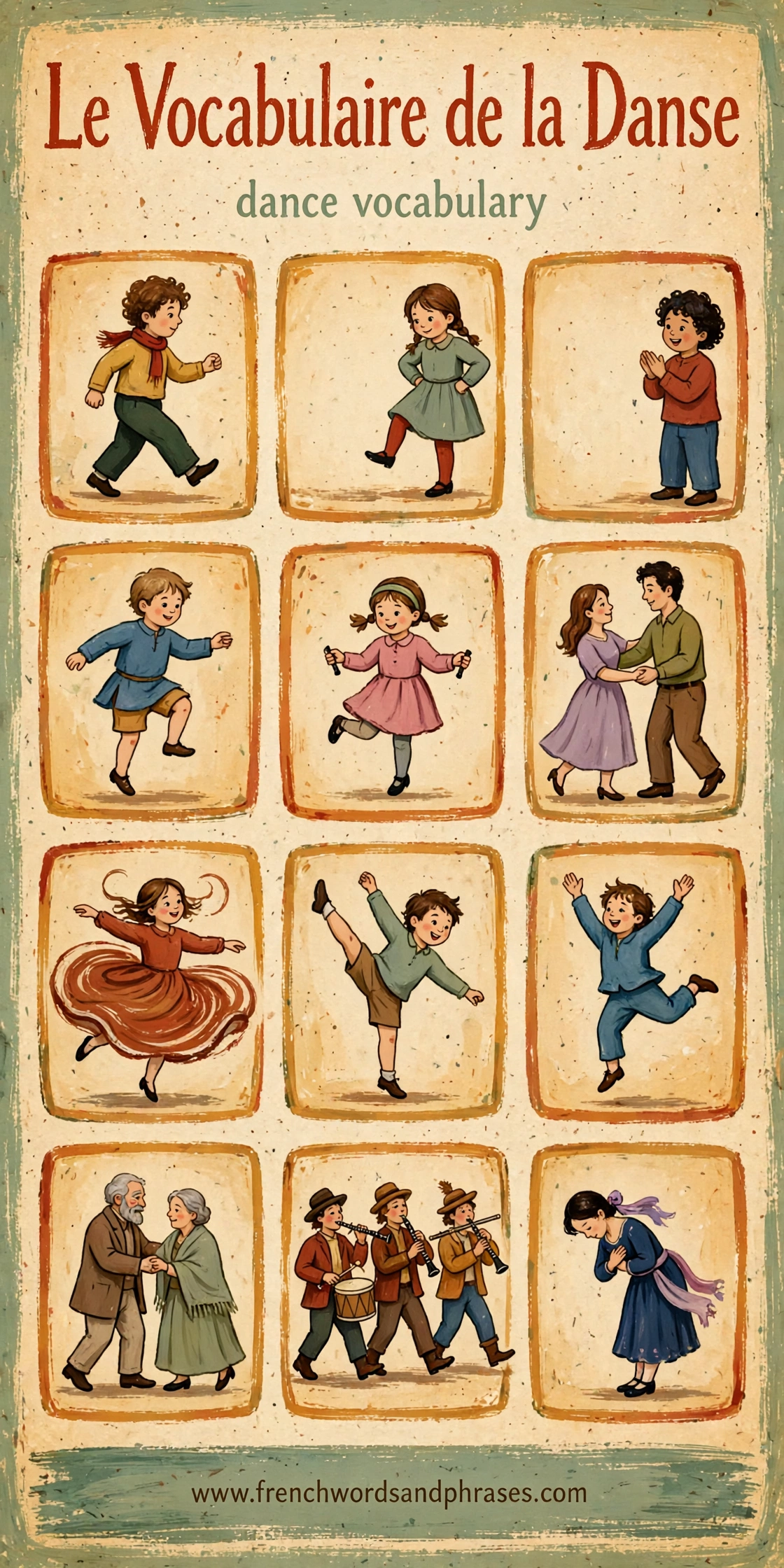
Le vocabulaire de la danse means dance vocabulary. In this lesson, you’ll discover twelve useful French words and phrases for everything your feet — and your hands — can do on a dance floor.
Learning vocabulary is easier when you see words used in real situations. So instead of memorizing a list, let’s go to a village fête on a summer evening, where the whole square is about to dance.
Our Story: Le Bal du Village
Imagine that it is the evening of the village fête. Strings of lights hang over the square, the accordion player is warming up, and everyone — from the mayor to the smallest child — is waiting for the first tune.
Read the story in French first. The English translation follows each passage to help you understand.
La Fête du Village
À huit heures, les musiciens arrivent en marchant derrière le maire, comme une petite procession. Tout le village applaudit. La fête va commencer !
At eight o’clock, the musicians arrive marching behind the mayor, like a little procession. The whole village claps. The party is about to begin!
L’accordéoniste joue la première note. La petite Nina fait un pas en avant, puis un autre. Elle entre dans le cercle — la danse commence !
The accordionist plays the first note. Little Nina takes a step forward, then another. She enters the circle — the dance begins!
Autour de la piste, tout le monde tape du pied en mesure. Les grands-pères, les enfants, même le boulanger : le rythme est partout.
Around the dance floor, everyone is tapping their feet in time. The grandfathers, the children, even the baker: the rhythm is everywhere.
Les enfants sautent et gambadent autour de la fontaine. Ils tournent, ils rient, ils ne tiennent pas en place. Quelle énergie !
The children are jumping and skipping about around the fountain. They turn, they laugh, they can’t keep still. What energy!
Au centre, les couples balancent doucement au rythme de la valse. Les jupes des danseuses tournoient comme des fleurs qui s’ouvrent.
In the centre, the couples are swaying gently to the rhythm of the waltz. The dancers’ skirts are whirling like flowers opening.
Soudain, le jeune Théo bondit au milieu de la piste ! Il donne un coup de pied en l’air, tourne sur lui-même, et tout le monde applaudit.
Suddenly, young Théo leaps into the middle of the floor! He kicks into the air, spins round, and everyone claps.
Pour la dernière danse, le vieux Monsieur Fabre glisse les pieds sur le parquet avec sa femme. Ils dansent ensemble depuis cinquante ans, sans jamais lever les pieds, et c’est magnifique.
For the last dance, old Mr Fabre glides his feet across the floor with his wife. They have danced together for fifty years, without ever lifting their feet, and it is magnificent.
À minuit, la musique s’arrête. Les musiciens et les danseurs s’inclinent devant le public. Tout le village applaudit une dernière fois. Bonne nuit, et à l’année prochaine !
At midnight, the music stops. The musicians and the dancers bow to the audience. The whole village claps one last time. Goodnight, and see you next year!
The Vocabulary: 12 French Words and Phrases for Dancing
Now let’s look at the twelve important words and phrases from our story. Try saying each one aloud before looking at its English meaning.
| French | English |
|---|---|
| 1. Faire un pas | To step |
| 2. Taper du pied | To stomp, to tap your foot |
| 3. Applaudir | To clap |
| 4. Sauter | To hop, to jump |
| 5. Gambader | To skip about |
| 6. Balancer | To sway |
| 7. Tournoyer | To spin |
| 8. Donner un coup de pied | To kick |
| 9. Bondir | To leap |
| 10. Glisser les pieds | To shuffle |
| 11. Marcher | To march, to walk |
| 12. S’incliner | To bow |
A small but useful language tip:
French loves to build actions out of body parts. In this lesson alone: taper du pied (to tap with the foot), donner un coup de pied (to give a blow of the foot), glisser les pieds (to slide the feet). When you meet a new action in French, look for the body part inside it — the phrase will often assemble itself in front of you, piece by piece.
French in Everyday Life: Useful Expressions
Knowing the names of the steps is a good beginning. But how do you use these words in a conversation?
Here are some simple expressions you might hear or use at a dance — or far from one.
Example 1 — The first move
C’est à toi de faire le premier pas.
It’s up to you to make the first move.
Example 2 — Keeping time
Tout le monde tape du pied en mesure.
Everyone is tapping their feet in time.
Example 3 — Joy
Elle a bondi de joie à la nouvelle.
She leapt for joy at the news.
Example 4 — The kitchen jump
Fais sauter les légumes dans la poêle.
Toss the vegetables in the pan.
Example 5 — Yielding gracefully
Il a dû s’incliner devant plus fort que lui.
He had to yield to a stronger opponent.
Example 6 — Step by step
Nous apprendrons la danse pas à pas.
We will learn the dance step by step.
A Little French Grammar: Verbs, Phrases, and One Reflexive
Our twelve words come in three shapes — and learning the shapes is learning the grammar.
- Plain verbs that conjugate: sauter, gambader, balancer, tournoyer (-er verbs), applaudir, bondir (-ir verbs), marcher (-er). Each has its own full page of tables on this site.
- Built phrases that assemble an action: faire un pas (faire + a step), taper du pied (taper + the foot), donner un coup de pied (donner + a blow of the foot), glisser les pieds (glisser + the feet). Only the verb conjugates; the rest of the phrase stays still.
- One reflexive: s’incliner, to bow — you incline yourself, so the verb carries a pronoun (je m’incline) and takes être in compound tenses: elle s’est inclinée.
And watch two small spelling friends along the way: nous balançons with a cedilla, and je tournoie, where the y of tournoyer turns into an i.
Test Your Knowledge: Dance Vocabulary
Let’s see how much you remember. Try each question before opening the answer.
Quick Quiz 1
Which French phrase means “to kick”?
Reveal the answer
Donner un coup de pied
Quick Quiz 2
Complete the sentence:
Tout le monde tape ______ pied en mesure.
Reveal the answer
du
Tout le monde tape du pied en mesure.
Everyone is tapping their feet in time.
Quick Quiz 3
How do you say “to bow” in French?
Reveal the answer
S’incliner
Quick Quiz 4
Which verb means “to leap” — sauter or bondir?
Reveal the answer
Bondir — sauter jumps; bondir springs, like a cat or a heart.
Quick Quiz 5
Complete the sentence:
Les danseurs ______ devant le public.
Reveal the answer
s’inclinent
Les danseurs s’inclinent devant le public.
The dancers bow to the audience.
Can You Translate These French Sentences?
Now let’s reverse the exercise. Read each French sentence and try to translate it into English.
Question 1
Les enfants gambadent autour de la fontaine.
What does this mean?
Reveal the answer
The children are skipping about around the fountain.
Question 2
Les couples balancent au rythme de la valse.
What does this mean?
Reveal the answer
The couples are swaying to the rhythm of the waltz.
Question 3
Sa jupe tournoie quand elle danse.
What does this mean?
Reveal the answer
Her skirt whirls when she dances.
Question 4
Le vieux couple glisse les pieds sur le parquet.
What does this mean?
Reveal the answer
The old couple glides their feet across the wooden floor.
Question 5
Tout le village applaudit les musiciens.
What does this mean?
Reveal the answer
The whole village applauds the musicians.
Discover a Little French Dance Culture: Le Bal Populaire
Every French village has its fête — and every fête has its bal: an open-air dance on the square, with an orchestra or an accordion, strings of lights, and absolutely everybody dancing, from toddlers to great-grandparents.
The most famous bals of all are the bals des pompiers, the firemen’s balls held on the night of July 13th, before Bastille Day, when fire stations across France open their courtyards and the whole town dances until morning.
And here’s a useful expression:
Mener la danse.
To lead the dance — to call the shots, to be in charge.
Learn the steps in this lesson, and one day, at some village bal under the lights, it might be you who mène la danse.
How to Remember Your New French Words
The easiest way to remember vocabulary is to connect each word to something familiar.
Try this little exercise next time you hear music:
- When the beat starts, tape du pied — tap your foot.
- When you step onto the floor, think faire un pas.
- When the music lifts you, saute and bondis — jump and leap.
- When the waltz turns, balance and tournoie — sway and spin.
- When the slow dance comes, glisse les pieds — glide.
- When the music ends, applaudis — and don’t forget to t’incliner.
A few minutes of practice each day can make these words part of your everyday French vocabulary.
Your Final Challenge
Can You Describe the Dance in French?
Imagine that you are telling a French-speaking friend about a village dance you saw last summer.
Can you describe what the dancers did, using at least four of the vocabulary words from this lesson?
Here is a little example to get you started:
D’abord, tout le monde tape du pied en mesure. Les enfants sautent et gambadent, les couples balancent doucement, et les jupes tournoient. À la fin, les danseurs s’inclinent et tout le village applaudit.
First, everyone taps their feet in time. The children jump and skip about, the couples sway gently, and the skirts whirl. At the end, the dancers bow and the whole village claps.
Now it’s your turn!
Try writing a few sentences about a dance in French. Don’t worry about making mistakes. Every new sentence is another step toward speaking French.
Today’s Lesson: Le Vocabulaire de la Danse — Dance Vocabulary
Twelve new words. A little story. A little French culture.
Learn French one lesson at a time!