
A French Word to Live By
How to Conjugate Confondre in French
/kɔ̃.fɔ̃dʁ/
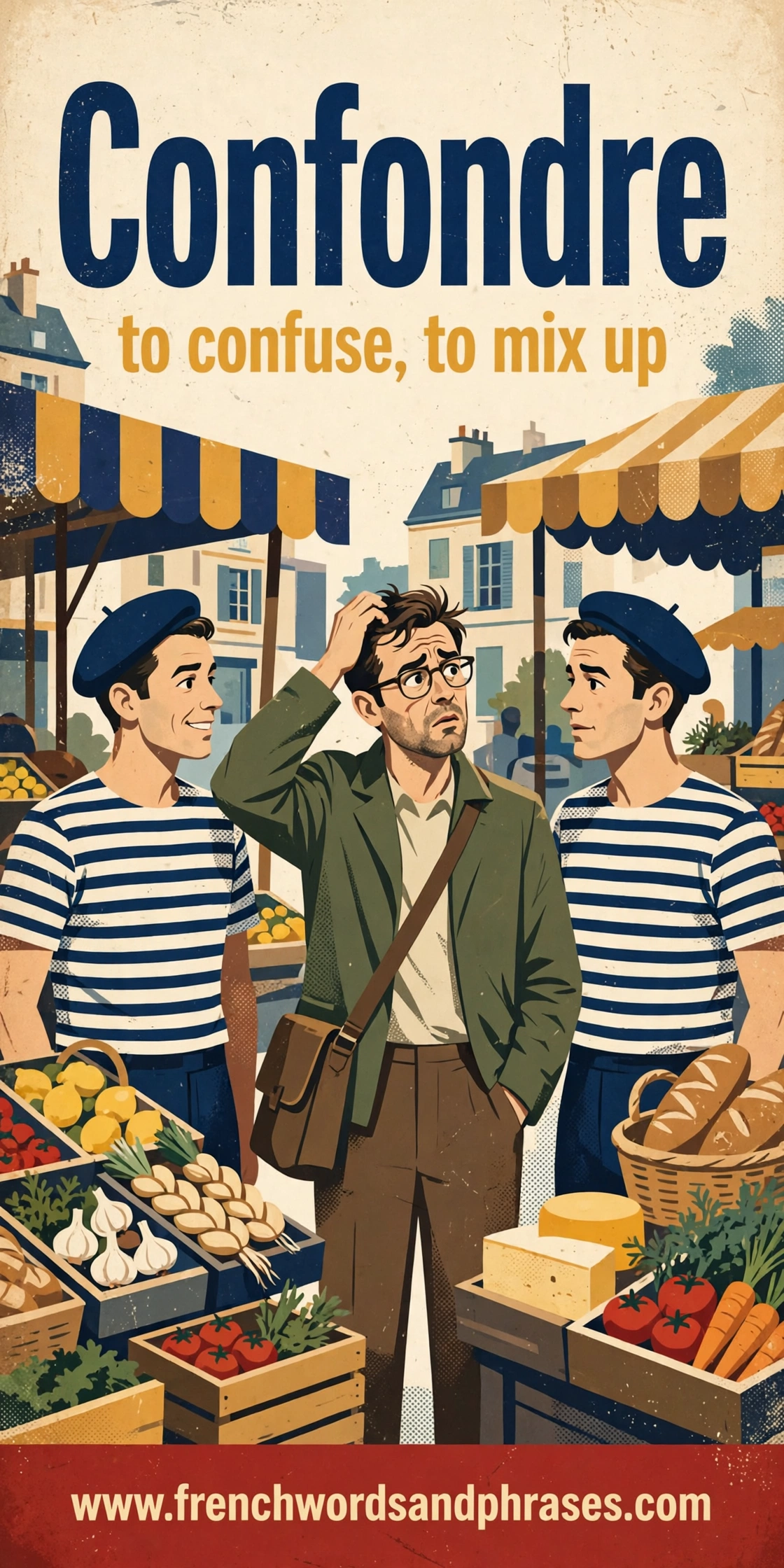
Confondre means to confuse or to mix up.
Two twins in the same school uniform, two streets with almost the same name, two French words that look alike — life is full of things we mix up. In French, that muddling is confondre.
In this guide, you’ll learn how to conjugate confondre in all the major French tenses and moods. Explore complete conjugation tables, French examples, English translations, and practice quizzes.
Understanding the French Verb Confondre
Confondre is a regular French verb belonging to the third group of verbs, those ending in -re.
It means to confuse, to mix up. It is commonly used for mixing up names, faces, words and dates, and in its reflexive form se confondre for merging into something or apologising profusely — se confondre en excuses.
Verb classification: Third group (-re)
Auxiliary verb: Avoir
Past participle: confondu
Present participle: confondant
English equivalents: To confuse, to mix up, to mistake one thing for another.
One important detail: confondre is usually built with avec — you confuse one thing WITH another: je confonds toujours son nom avec celui de son frère. On its own it can also mean to confound or expose: confondre un menteur, to catch a liar out.
Experience the Word
Confondre is the verb of the honest muddle — the wrong name at the right party, the right key in the wrong door.
Imagine a market in Lyon. The stallholder greets you by your brother’s name, you answer to it anyway, and both of you laugh. Some confusion is simply the tax on a life full of people.
You have not failed. You have mixed things up — and lived to untangle them.
How to Conjugate Confondre: Complete French Conjugation Guide
Let’s explore every major conjugation of confondre, beginning with the indicative mood.
How to Conjugate Confondre in the Indicative Mood
The indicative mood is used to express facts, observations, actions, and events.
How to Conjugate Confondre in the Present Tense (Présent)
Used for actions happening now, habitual actions, and general truths.
| Subject | Conjugation |
|---|---|
| je | confonds |
| tu | confonds |
| il / elle | confond |
| nous | confondons |
| vous | confondez |
| ils / elles | confondent |
Example
Je confonds toujours ces deux rues.
I always mix up those two streets.
Quick Quiz 1
Complete the sentence:
Nous ______ toujours les deux noms.
Reveal the answer
confondons
Nous confondons toujours les deux noms.
We always mix up the two names.
How to Conjugate Confondre in the Passé Composé
Used for completed actions in the past. Confondre takes the auxiliary verb avoir.
| Subject | Conjugation |
|---|---|
| j’ | ai confondu |
| tu | as confondu |
| il / elle | a confondu |
| nous | avons confondu |
| vous | avez confondu |
| ils / elles | ont confondu |
Example
Elle a confondu les deux dossiers.
She mixed up the two files.
How to Conjugate Confondre in the Imparfait (Imperfect Tense)
Used for habitual past actions, descriptions, and ongoing situations in the past.
| Subject | Conjugation |
|---|---|
| je | confondais |
| tu | confondais |
| il / elle | confondait |
| nous | confondions |
| vous | confondiez |
| ils / elles | confondaient |
Example
Enfant, il confondait la gauche et la droite.
As a child, he used to confuse left and right.
Quick Quiz 2
Choose the correct form:
He mixed up the files.
Il ______ les dossiers. (a confondu / a confondues)
Reveal the answer
a confondu
Il a confondu les dossiers.
With avoir, the participle does not agree with a following object.
How to Conjugate Confondre in the Plus-que-parfait
Used to describe an action that had already been completed before another past event.
| Subject | Conjugation |
|---|---|
| j’ | avais confondu |
| tu | avais confondu |
| il / elle | avait confondu |
| nous | avions confondu |
| vous | aviez confondu |
| ils / elles | avaient confondu |
Example
Nous avions confondu les dates du mariage.
We had mixed up the wedding dates.
How to Conjugate Confondre in the Passé Simple
Primarily used in formal writing, literature, and historical narratives. It is rarely used in everyday conversation.
| Subject | Conjugation |
|---|---|
| je | confondis |
| tu | confondis |
| il / elle | confondit |
| nous | confondîmes |
| vous | confondîtes |
| ils / elles | confondirent |
Example
Il confondit les deux jumeaux toute la soirée.
He mixed up the twins all evening.
How to Conjugate Confondre in the Passé Antérieur
A literary tense used to express an action completed immediately before another past action, generally in the passé simple.
| Subject | Conjugation |
|---|---|
| j’ | eus confondu |
| tu | eus confondu |
| il / elle | eut confondu |
| nous | eûmes confondu |
| vous | eûtes confondu |
| ils / elles | eurent confondu |
Example
Dès qu’il eut confondu les noms, il rougit.
As soon as he had mixed up the names, he blushed.
How to Conjugate Confondre in the Future Tense (Futur Simple)
Used to describe actions that will take place in the future.
| Subject | Conjugation |
|---|---|
| je | confondrai |
| tu | confondras |
| il / elle | confondra |
| nous | confondrons |
| vous | confondrez |
| ils / elles | confondront |
Example
Tu ne confondras plus ces deux mots.
You will not mix up those two words any more.
How to Conjugate Confondre in the Futur Antérieur (Future Perfect)
Used for an action that will have been completed before a particular point in the future.
| Subject | Conjugation |
|---|---|
| j’ | aurai confondu |
| tu | auras confondu |
| il / elle | aura confondu |
| nous | aurons confondu |
| vous | aurez confondu |
| ils / elles | auront confondu |
Example
À force de pratiquer, vous ne les aurez plus confondus.
With practice, you will no longer have mixed them up.
How to Conjugate Confondre in the Near Future (Futur Proche)
Used to describe something that is going to happen soon. Formed with aller + infinitive.
| Subject | Conjugation |
|---|---|
| je | vais confondre |
| tu | vas confondre |
| il / elle | va confondre |
| nous | allons confondre |
| vous | allez confondre |
| ils / elles | vont confondre |
Example
Attention, tu vas confondre les verres.
Careful, you are going to mix up the glasses.
How to Conjugate Confondre in the Conditional Mood
The conditional mood expresses what would happen under certain circumstances. It is also frequently used to make polite requests or express wishes.
How to Conjugate Confondre in the Present Conditional
| Subject | Conjugation |
|---|---|
| je | confondrais |
| tu | confondrais |
| il / elle | confondrait |
| nous | confondrions |
| vous | confondriez |
| ils / elles | confondraient |
Example
Sans mes lunettes, je confondrais tout.
Without my glasses, I would confuse everything.
How to Conjugate Confondre in the Past Conditional
| Subject | Conjugation |
|---|---|
| j’ | aurais confondu |
| tu | aurais confondu |
| il / elle | aurait confondu |
| nous | aurions confondu |
| vous | auriez confondu |
| ils / elles | auraient confondu |
Example
Il aurait confondu les adresses sans le plan.
He would have mixed up the addresses without the map.
Confondre in the Literary Past Conditional Form
This less common literary form uses the imperfect subjunctive of avoir.
| Subject | Conjugation |
|---|---|
| j’ | eusse confondu |
| tu | eusses confondu |
| il / elle | eût confondu |
| nous | eussions confondu |
| vous | eussiez confondu |
| ils / elles | eussent confondu |
Example
Il eût confondu les deux sœurs sans leurs voix.
He would have mistaken the two sisters without their voices.
How to Conjugate Confondre in the Subjunctive Mood
The subjunctive is used to express wishes, emotions, doubts, necessity, and uncertainty. It frequently follows expressions such as il faut que (it is necessary that) or bien que (although).
How to Conjugate Confondre in the Present Subjunctive
| Subject | Conjugation |
|---|---|
| que je | confonde |
| que tu | confondes |
| qu’il / qu’elle | confonde |
| que nous | confondions |
| que vous | confondiez |
| qu’ils / qu’elles | confondent |
Example
Il faut que tu ne confondes pas les deux clés.
You must not mix up the two keys.
Quick Quiz 3
Complete the sentence using the subjunctive:
Il faut que vous ne ______ pas les verres.
Reveal the answer
confondiez
Il faut que vous ne confondiez pas les verres.
You must not mix up the glasses.
How to Conjugate Confondre in the Imperfect Subjunctive
A literary tense, rarely encountered in modern spoken French.
| Subject | Conjugation |
|---|---|
| que je | confondisse |
| que tu | confondisses |
| qu’il / qu’elle | confondît |
| que nous | confondissions |
| que vous | confondissiez |
| qu’ils / qu’elles | confondissent |
Example
Je craignais qu’elle confondît les médicaments.
I feared she might mix up the medicines.
How to Conjugate Confondre in the Pluperfect Subjunctive
A literary construction used to express an action completed before another past action.
| Subject | Conjugation |
|---|---|
| que j’ | eusse confondu |
| que tu | eusses confondu |
| qu’il / qu’elle | eût confondu |
| que nous | eussions confondu |
| que vous | eussiez confondu |
| qu’ils / qu’elles | eussent confondu |
Example
Il regrettait que nous eussions confondu les horaires.
He regretted that we had mixed up the times.
How to Conjugate Confondre in the Past Subjunctive
| Subject | Conjugation |
|---|---|
| que j’ | aie confondu |
| que tu | aies confondu |
| qu’il / qu’elle | ait confondu |
| que nous | ayons confondu |
| que vous | ayez confondu |
| qu’ils / qu’elles | aient confondu |
Example
Je suis sûr que tu as confondu les deux noms.
I am sure you mixed up the two names.
How to Conjugate Confondre in the Imperative
The imperative is used to give commands, instructions, invitations, or suggestions. Subject pronouns are omitted.
How to Conjugate Confondre in the Present Imperative
| Person | Conjugation |
|---|---|
| (tu) | confonds |
| (nous) | confondons |
| (vous) | confondez |
Example
Ne confonds pas vitesse et précipitation !
Do not confuse speed with haste!
Quick Quiz 4
How would you say Do not mix up (tu form)?
Reveal the answer
Ne confonds pas !
French Participles of Confondre
Participles are verb forms that can be used in compound tenses and other grammatical constructions.
Present Participle of Confondre
confondant
En confondant les deux rues, nous avons fait un détour.
By mixing up the two streets, we made a detour.
Past Participle of Confondre
confondu
Confondu par les questions, le témoin se tut.
Confounded by the questions, the witness fell silent.
Confondre in Everyday French: Real-Life Examples
Now that you know the conjugations, let’s see how confondre appears in everyday French.
Example 1 — Present
Je confonds toujours son prénom avec celui de sa sœur.
I always mix up her first name with her sister’s.
Example 2 — Passé composé
Pardon, j’ai confondu les dates.
Sorry, I mixed up the dates.
Example 3 — Imparfait
Il confondait tous ses élèves au début.
He used to confuse all his pupils at first.
Example 4 — Future
Un jour, tu ne les confondras plus.
One day, you will not mix them up any more.
Example 5 — Conditional
On confondrait facilement les deux maisons.
You could easily mistake the two houses for each other.
Example 6 — Imperative
Ne confondez pas les deux produits !
Do not mix up the two products!
Beyond Translation: The Meaning of Confondre
English separates confuse, mix up and mistake for; French lets confondre carry all three, with avec naming the other half of the muddle.
And confondre has a second, sharper life.
To confondre a liar or a thief is to expose them with proof — confusion turned into a weapon. The same verb muddles the innocent and unmasks the guilty.
How to Remember the French Verb Confondre
Remember it this way: Confondre is about mixing up — confondre X avec Y.
- You confuse one thing WITH another — confondre X avec Y: the avec is part of the verb.
- The present is regular -re: je confonds, il confond — no -t on il.
- Se confondre en excuses — to apologise so much you dissolve into the apology.
The key idea is mixing up — confondre X avec Y.
Test Your Knowledge of Confondre
Let’s see how much you’ve learned. Try answering these questions before revealing the answers.
Question 1
Which little word completes confondre when you mix one thing up with another?
Reveal the answer
Avec — je confonds son nom avec le tien, I mix up his name with yours.
Question 2
How do you say I mixed up the dates in French?
Reveal the answer
J’ai confondu les dates.
Question 3
Translate: She always confuses the twins.
Reveal the answer
Elle confond toujours les jumeaux.
Question 4
What is the past participle of confondre?
Reveal the answer
Confondu.
Question 5
Complete the sentence:
Il faut que tu ne ______ pas les deux clés.
Reveal the answer
confondes
Il faut que tu ne confondes pas les deux clés.
You must not mix up the two keys.
Your Final Challenge
Can You Use It?
How would you say this in French?
I always mix up those two streets, but I get there in the end.
Reveal the answer
Je confonds toujours ces deux rues, mais je finis par arriver.
I always mix up those two streets, but I get there in the end.
A little French. A little curiosity. A richer everyday life.
LEARN FRENCH ONE WORD AT A TIME




