A French Vocabulary Lesson
Welcome to a little French lesson about the state of our clothes!
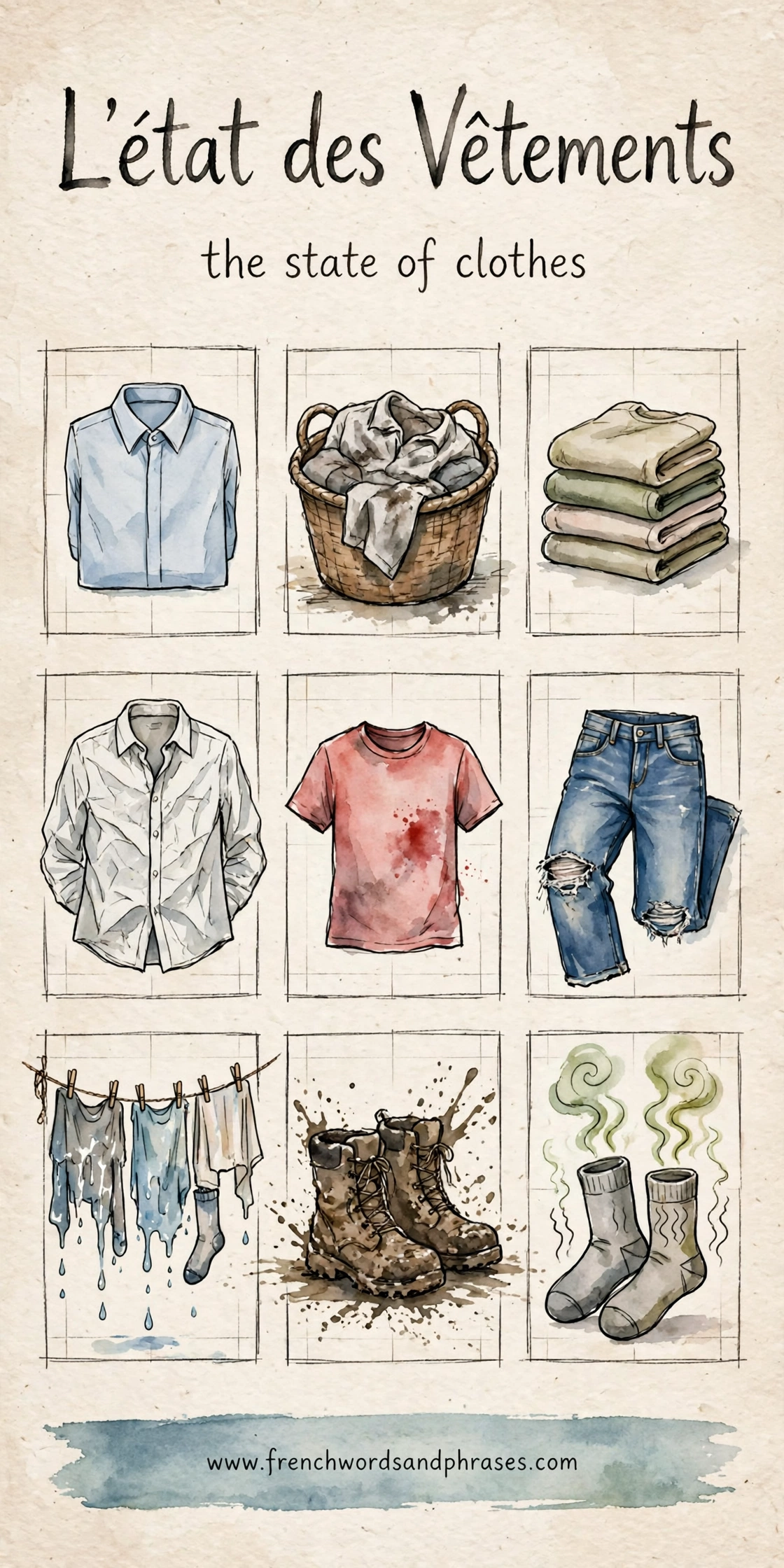
L’état des vêtements means the state of clothes. In this lesson, you’ll discover nine useful French adjectives for everything that can happen to a shirt between the drawer and the washing machine.
Learning vocabulary is easier when you see words used in real situations. So instead of memorizing a list, let’s spend Saturday morning with the Martin family — because today is laundry day.
Our Story: Le Jour de Lessive
Imagine that it is Saturday morning at the Martin family’s house. The laundry basket is overflowing, the machine is waiting, and every garment in the house has a story to tell.
Read the story in French first. The English translation follows each passage to help you understand.
Samedi, Jour de Lessive
Le samedi matin, Madame Martin vide le panier à linge sur le lit. D’un côté, les vêtements propres. De l’autre, les vêtements sales. Le tri commence !
On Saturday morning, Mrs Martin empties the laundry basket onto the bed. On one side, the clean clothes. On the other, the dirty clothes. The sorting begins!
Voici les chemises de Papa, propres et bien pliées. Elles attendent sagement l’armoire. Un pull plié, deux pulls pliés — tout est en ordre.
Here are Dad’s shirts, clean and neatly folded. They are waiting quietly for the wardrobe. One folded jumper, two folded jumpers — everything is in order.
Mais voici le tee-shirt de Lucas : il est taché de sauce tomate ! Et le pantalon de Léa est taché d’herbe aux genoux. Les enfants rient.
But here is Lucas’s t-shirt: it is stained with tomato sauce! And Léa’s trousers are stained with grass at the knees. The children laugh.
Le jean préféré de Papa est déchiré au genou. Il l’a accroché à la clôture du jardin. Maman promet de le raccommoder ce soir.
Dad’s favourite jeans are torn at the knee. He caught them on the garden fence. Mum promises to mend them this evening.
Dans le sac de sport de Lucas, catastrophe : les chaussettes sont malodorantes ! Tout le monde se bouche le nez. Direction la machine, sans discussion !
In Lucas’s sports bag, disaster: the socks are smelly! Everyone holds their nose. Straight into the machine, no discussion!
Après le match de football sous la pluie, le pantalon de Léa est boueux et ses chaussures sont mouillées. Tout reste à la porte, interdit d’entrer dans la cuisine !
After the football match in the rain, Léa’s trousers are muddy and her shoes are wet. Everything stays at the door, forbidden from entering the kitchen!
Les chemises de voyage de Papa sont toutes froissées après la valise. Maman branche le fer à repasser : un peu de vapeur, et elles seront comme neuves.
Dad’s travel shirts are all wrinkled after the suitcase. Mum plugs in the iron: a little steam, and they will be as good as new.
Le soir, le linge propre sèche sur le fil, les chemises sont pliées, et le panier est vide. Le jour de lessive est terminé. Jusqu’à samedi prochain !
In the evening, the clean washing is drying on the line, the shirts are folded, and the basket is empty. Laundry day is over. Until next Saturday!
The Vocabulary: 9 French Words for the State of Clothes
Now let’s look at the nine important words from our story. Try saying each French word aloud before looking at its English meaning. Notice that most of them are past participles — something has happened to each garment.
| French | English |
|---|---|
| 1. Propre | Clean |
| 2. Sale | Dirty |
| 3. Plié | Folded |
| 4. Froissé | Wrinkled |
| 5. Taché | Stained |
| 6. Déchiré | Torn |
| 7. Mouillé | Wet |
| 8. Boueux | Muddy |
| 9. Malodorant | Smelly |
A small but useful language tip:
Most of these adjectives began life as past participles — the shirt has been folded (plié), stained (taché), torn (déchiré), wetted (mouillé). And like all French adjectives, they agree with the garment: une chemise froissée, des chaussettes malodorantes, un jean déchiré. Learn the masculine form first, then let the endings follow the clothes.
French in Everyday Life: Useful Expressions
Knowing the names of the states is a good beginning. But how do you use these words in a conversation?
Here are some simple expressions you might hear or use around the laundry basket.
Example 1 — The clean pile
Cette chemise est propre, tu peux la mettre.
This shirt is clean, you can wear it.
Example 2 — The verdict
Ce tee-shirt est taché de café.
This t-shirt is stained with coffee.
Example 3 — Ironing
Ta chemise est toute froissée, repasse-la.
Your shirt is all wrinkled, iron it.
Example 4 — At the door
Laisse tes bottes boueuses à la porte !
Leave your muddy boots at the door!
Example 5 — The sports bag
Ces chaussettes malodorantes vont à la machine.
These smelly socks are going in the machine.
Example 6 — Mending
Mon pantalon est déchiré au genou.
My trousers are torn at the knee.
A Little French Grammar: Adjectives That Agree
French adjectives are polite: they dress themselves to match the noun they describe — masculine or feminine, singular or plural.
Most of our nine words follow the participle pattern.
- Masculine singular: un jean déchiré, un tee-shirt taché.
- Feminine singular: add an -e — une chemise déchirée, tachée, froissée.
- Plurals: add an -s — des jeans déchirés, des chaussettes malodorantes.
- Boueux is the rebel: the masculine never changes (des chemins boueux), and the feminine becomes boueuse.
And one golden rule of position: these adjectives stand after the noun — une chemise propre, un pantalon boueux, never before it.
Learn the pair together: not just taché, but un tee-shirt taché.
Test Your Knowledge: The State of Clothes
Let’s see how much you remember. Try each question before opening the answer.
Quick Quiz 1
Which French word means “clean”?
Reveal the answer
Propre
Quick Quiz 2
Complete the sentence:
Les chaussettes sont ______. (smelly)
Reveal the answer
malodorantes
Les chaussettes sont malodorantes.
The socks are smelly.
Quick Quiz 3
How do you say “torn” in French?
Reveal the answer
Déchiré
Quick Quiz 4
Which word means “muddy” — mouillé or boueux?
Reveal the answer
Boueux — mouillé is only wet; boueux is wet with the earth in it.
Quick Quiz 5
Complete the sentence:
Ma chemise est toute ______. (wrinkled)
Reveal the answer
froissée
Ma chemise est toute froissée.
My shirt is all wrinkled.
Can You Translate These French Sentences?
Now let’s reverse the exercise. Read each French sentence and try to translate it into English.
Question 1
Les chemises pliées sont sur le lit.
What does this mean?
Reveal the answer
The folded shirts are on the bed.
Question 2
Son tee-shirt blanc est taché de sauce.
What does this mean?
Reveal the answer
His white t-shirt is stained with sauce.
Question 3
Après la pluie, le chemin est boueux.
What does this mean?
Reveal the answer
After the rain, the path is muddy.
Question 4
Le linge mouillé sèche sur le fil.
What does this mean?
Reveal the answer
The wet washing is drying on the line.
Question 5
Ce pantalon sale va à la machine.
What does this mean?
Reveal the answer
These dirty trousers are going in the machine.
Discover a Little French Culture: Laundry Day
In France, the washing has its own geography: the laverie (the laundromat) on the corner, the étendoir (the drying rack) on the balcony, and lines of linge strung between shutters in old town streets, drying in the sun like flags.
Many French homes still dry clothes in the open air rather than a machine — a line of clean shirts is a small public announcement that laundry day has been won.
And here’s a famous expression:
Laver son linge sale en famille.
To wash your dirty linen in the family — to sort out problems privately, not in public.
It is the laundry’s gift to diplomacy: some stains, France believes, are best treated at home.
How to Remember Your New French Words
The easiest way to remember vocabulary is to connect each word to something familiar.
Try this little exercise on your next laundry day:
- When you sort the basket, separate propre from sale.
- When you fold a shirt, say plié.
- When you find a stain, say taché — and name the culprit: taché de café !
- When you iron, watch froissé disappear.
- When it rains on the walk home, think mouillé — and boueux for the boots.
- When the sports bag opens, hold your nose: malodorant.
A few minutes of practice each day can make these words part of your everyday French vocabulary.
Your Final Challenge
Can You Sort the Laundry in French?
Imagine that a French-speaking friend is helping you with the laundry.
Can you describe five garments and their states, using at least three of the vocabulary words from this lesson?
Here is a little example to get you started:
Cette chemise est propre et bien pliée. Ce tee-shirt est taché de sauce, et ce pantalon est déchiré au genou. Les chaussettes sont malodorantes : direction la machine !
This shirt is clean and neatly folded. This t-shirt is stained with sauce, and these trousers are torn at the knee. The socks are smelly: straight into the machine!
Now it’s your turn!
Try writing a few sentences about your own laundry in French. Don’t worry about making mistakes. Every new sentence is another step toward speaking French.
Today’s Lesson: L’état des Vêtements — The State of Clothes
Nine new words. A little story. A little French culture.
Learn French one lesson at a time!