
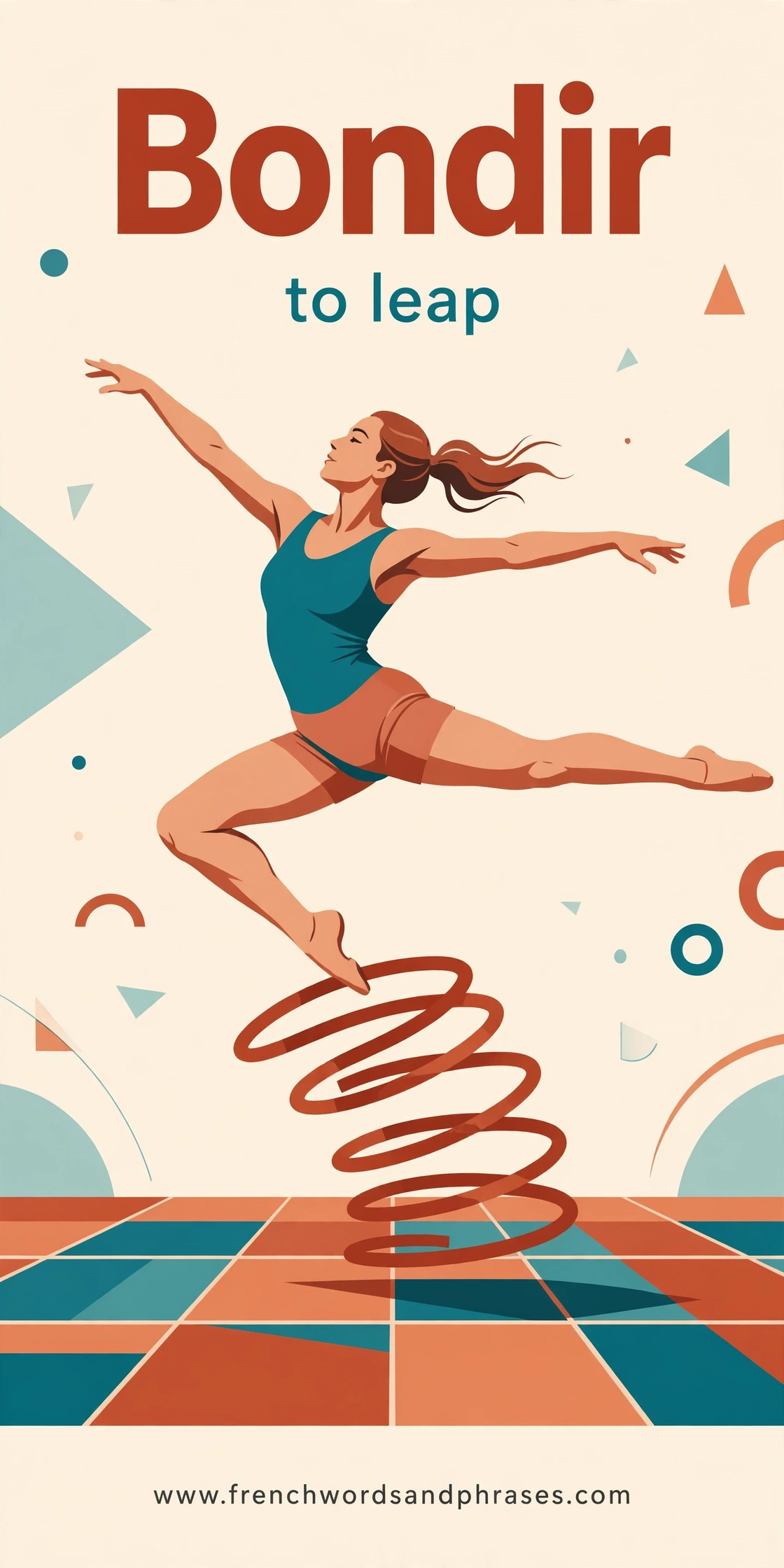
A French Word to Live By
How to Conjugate Bondir in French
/bɔ̃.diʁ/
Bondir means to leap, to bound, or to pounce.
The cat at the mouse, the dancer at the climax, the heart at the good news — bondir is the leap with spring in it: sudden, high, and impossible to ignore. Where sauter jumps, bondir bounds.
In this guide, you’ll learn how to conjugate bondir in all the major French tenses and moods. Explore complete conjugation tables, French examples, English translations, and practice quizzes.
Understanding the French Verb Bondir
Bondir is a regular French verb belonging to the second group of verbs, those ending in -ir.
It means to leap, to bound, or to pounce. It is commonly used for animals pouncing, dancers leaping, people starting up in surprise, and the heart leaping — le cœur bondit — at sudden news.
Verb classification: Second group (-ir)
Auxiliary verb: Avoir
Past participle: bondi
Present participle: bondissant
English equivalents: To leap, to bound, to spring, to pounce.
One important detail: bondir belongs to the second group, the regular -ir verbs of the finir family — its trademark is the -iss- that appears in the plural and the derived tenses: nous bondissons, ils bondissaient, en bondissant. Learn finir once and bondir comes free.
Experience the Word
Bondir is the verb of the coiled spring — the leap that was waiting inside the stillness, released all at once.
Imagine the cat in the garden, motionless for a minute that lasts forever — then, in one silent explosion of muscle, it bondit, and the butterfly’s career is over.
You have not just jumped. You have sprung — the way joy and hunger and surprise all move.
How to Conjugate Bondir: Complete French Conjugation Guide
Let’s explore every major conjugation of bondir, beginning with the indicative mood.
How to Conjugate Bondir in the Indicative Mood
The indicative mood is used to express facts, observations, actions, and events.
How to Conjugate Bondir in the Present Tense (Présent)
Used for actions happening now, habitual actions, and general truths.
| Subject | Conjugation |
|---|---|
| je | bondis |
| tu | bondis |
| il / elle | bondit |
| nous | bondissons |
| vous | bondissez |
| ils / elles | bondissent |
Example
Le chat bondit sur la souris en jouet.
The cat pounces on the toy mouse.
Quick Quiz 1
Complete the sentence:
Nous ______ de joie.
Reveal the answer
bondissons
Nous bondissons de joie.
We are leaping for joy — the -iss- of the second group.
How to Conjugate Bondir in the Passé Composé
Used for completed actions in the past. Bondir takes the auxiliary verb avoir.
| Subject | Conjugation |
|---|---|
| j’ | ai bondi |
| tu | as bondi |
| il / elle | a bondi |
| nous | avons bondi |
| vous | avez bondi |
| ils / elles | ont bondi |
Example
Le danseur a bondi au centre de la scène.
The dancer leapt into the centre of the stage.
How to Conjugate Bondir in the Imparfait (Imperfect Tense)
Used for habitual past actions, descriptions, and ongoing situations in the past.
| Subject | Conjugation |
|---|---|
| je | bondissais |
| tu | bondissais |
| il / elle | bondissait |
| nous | bondissions |
| vous | bondissiez |
| ils / elles | bondissaient |
Example
Mon cœur bondissait à chaque bonne nouvelle.
My heart used to leap at every piece of good news.
Quick Quiz 2
Choose the correct form:
The cat pounced on the toy.
Le chat ______ sur le jouet. (a bondi / est bondi)
Reveal the answer
a bondi
Le chat a bondi sur le jouet.
Bondir takes avoir in the passé composé.
How to Conjugate Bondir in the Plus-que-parfait
Used to describe an action that had already been completed before another past event.
| Subject | Conjugation |
|---|---|
| j’ | avais bondi |
| tu | avais bondi |
| il / elle | avait bondi |
| nous | avions bondi |
| vous | aviez bondi |
| ils / elles | avaient bondi |
Example
Le chien avait bondi par-dessus la barrière.
The dog had leapt over the fence.
How to Conjugate Bondir in the Passé Simple
Primarily used in formal writing, literature, and historical narratives. It is rarely used in everyday conversation.
| Subject | Conjugation |
|---|---|
| je | bondis |
| tu | bondis |
| il / elle | bondit |
| nous | bondîmes |
| vous | bondîtes |
| ils / elles | bondirent |
Example
Le lièvre bondit hors du buisson.
The hare bounded out of the bush.
How to Conjugate Bondir in the Passé Antérieur
A literary tense used to express an action completed immediately before another past action, generally in the passé simple.
| Subject | Conjugation |
|---|---|
| j’ | eus bondi |
| tu | eus bondi |
| il / elle | eut bondi |
| nous | eûmes bondi |
| vous | eûtes bondi |
| ils / elles | eurent bondi |
Example
Dès que le chat eut bondi, l’oiseau s’envola.
As soon as the cat had pounced, the bird flew off.
How to Conjugate Bondir in the Future Tense (Futur Simple)
Used to describe actions that will take place in the future.
| Subject | Conjugation |
|---|---|
| je | bondirai |
| tu | bondiras |
| il / elle | bondira |
| nous | bondirons |
| vous | bondirez |
| ils / elles | bondiront |
Example
À la fin du spectacle, elle bondira de joie.
At the end of the show, she will leap for joy.
How to Conjugate Bondir in the Futur Antérieur (Future Perfect)
Used for an action that will have been completed before a particular point in the future.
| Subject | Conjugation |
|---|---|
| j’ | aurai bondi |
| tu | auras bondi |
| il / elle | aura bondi |
| nous | aurons bondi |
| vous | aurez bondi |
| ils / elles | auront bondi |
Example
À minuit, le chat aura bondi dix fois sur le jouet.
By midnight, the cat will have pounced on the toy ten times.
How to Conjugate Bondir in the Near Future (Futur Proche)
Used to describe something that is going to happen soon. Formed with aller + infinitive.
| Subject | Conjugation |
|---|---|
| je | vais bondir |
| tu | vas bondir |
| il / elle | va bondir |
| nous | allons bondir |
| vous | allez bondir |
| ils / elles | vont bondir |
Example
Attention, le chien va bondir !
Watch out, the dog is going to leap!
How to Conjugate Bondir in the Conditional Mood
The conditional mood expresses what would happen under certain circumstances. It is also frequently used to make polite requests or express wishes.
How to Conjugate Bondir in the Present Conditional
| Subject | Conjugation |
|---|---|
| je | bondirais |
| tu | bondirais |
| il / elle | bondirait |
| nous | bondirions |
| vous | bondiriez |
| ils / elles | bondiraient |
Example
Je bondirais de joie si tu venais.
I would leap for joy if you came.
How to Conjugate Bondir in the Past Conditional
| Subject | Conjugation |
|---|---|
| j’ | aurais bondi |
| tu | aurais bondi |
| il / elle | aurait bondi |
| nous | aurions bondi |
| vous | auriez bondi |
| ils / elles | auraient bondi |
Example
Il aurait bondi plus haut avec de l’élan.
He would have leapt higher with a run-up.
Bondir in the Literary Past Conditional Form
This less common literary form uses the imperfect subjunctive of avoir.
| Subject | Conjugation |
|---|---|
| j’ | eusse bondi |
| tu | eusses bondi |
| il / elle | eût bondi |
| nous | eussions bondi |
| vous | eussiez bondi |
| ils / elles | eussent bondi |
Example
Le cerf eût bondi dans la clairière au moindre bruit.
The deer would have bounded into the clearing at the slightest noise.
How to Conjugate Bondir in the Subjunctive Mood
The subjunctive is used to express wishes, emotions, doubts, necessity, and uncertainty. It frequently follows expressions such as il faut que (it is necessary that) or bien que (although).
How to Conjugate Bondir in the Present Subjunctive
| Subject | Conjugation |
|---|---|
| que je | bondisse |
| que tu | bondisses |
| qu’il / qu’elle | bondisse |
| que nous | bondissions |
| que vous | bondissiez |
| qu’ils / qu’elles | bondissent |
Example
Il faut que tu bondisses au signal.
You need to leap at the signal.
Quick Quiz 3
Complete the sentence using the subjunctive:
Il faut que vous ______ au signal.
Reveal the answer
bondissiez
Il faut que vous bondissiez au signal.
You need to leap at the signal.
How to Conjugate Bondir in the Imperfect Subjunctive
A literary tense, rarely encountered in modern spoken French.
| Subject | Conjugation |
|---|---|
| que je | bondisse |
| que tu | bondisses |
| qu’il / qu’elle | bondît |
| que nous | bondissions |
| que vous | bondissiez |
| qu’ils / qu’elles | bondissent |
Example
Il attendait que le chat bondît.
He was waiting for the cat to pounce.
How to Conjugate Bondir in the Pluperfect Subjunctive
A literary construction used to express an action completed before another past action.
| Subject | Conjugation |
|---|---|
| que j’ | eusse bondi |
| que tu | eusses bondi |
| qu’il / qu’elle | eût bondi |
| que nous | eussions bondi |
| que vous | eussiez bondi |
| qu’ils / qu’elles | eussent bondi |
Example
Je riais qu’ils eussent bondi de joie ensemble.
I laughed that they had leapt for joy together.
How to Conjugate Bondir in the Past Subjunctive
| Subject | Conjugation |
|---|---|
| que j’ | aie bondi |
| que tu | aies bondi |
| qu’il / qu’elle | ait bondi |
| que nous | ayons bondi |
| que vous | ayez bondi |
| qu’ils / qu’elles | aient bondi |
Example
Je suis content que tu aies bondi de joie.
I am glad you leapt for joy.
How to Conjugate Bondir in the Imperative
The imperative is used to give commands, instructions, invitations, or suggestions. Subject pronouns are omitted.
How to Conjugate Bondir in the Present Imperative
| Person | Conjugation |
|---|---|
| (tu) | bondis |
| (nous) | bondissons |
| (vous) | bondissez |
Example
Bondis au signal, pas avant !
Leap at the signal, not before!
Quick Quiz 4
How would you say Leap!, using the tu form?
Reveal the answer
Bondis !
French Participles of Bondir
Participles are verb forms that can be used in compound tenses and other grammatical constructions.
Present Participle of Bondir
bondissant
En bondissant, le danseur a traversé la scène.
Leaping, the dancer crossed the stage.
Past Participle of Bondir
bondi
Le chat a bondi, l’oiseau s’est envolé.
The cat pounced, the bird flew away.
Bondir in Everyday French: Real-Life Examples
Now that you know the conjugations, let’s see how bondir appears in everyday French.
Example 1 — Present
Le chat bondit sur le canapé.
The cat leaps onto the sofa.
Example 2 — Passé composé
Elle a bondi de joie à l’annonce.
She leapt for joy at the announcement.
Example 3 — Imparfait
Les enfants bondissaient sur le trampoline.
The children used to bounce on the trampoline.
Example 4 — Future
Le danseur bondira au-dessus de la scène.
The dancer will leap across the stage.
Example 5 — Heart
Son cœur a bondi en la voyant.
His heart leapt when he saw her.
Example 6 — Surprise
Il a bondi de sa chaise au bruit.
He jumped up from his chair at the noise.
See bondir in a story: Dance Vocabulary: French Vocabulary (Le Vocabulaire de la Danse) — a village fête under the lights.
Beyond Translation: The Meaning of Bondir
English splits leap, bound and pounce where French springs with one verb — bondir — and its noun, un bond, is the leap itself: d’un bond, in one bound. The verb keeps the spring in everything it touches: bodies, hearts (le cœur bondit), even prices in a headline. Sauter jumps; bondir erupts.
To bondir is to be released — like a spring, a cat, or a heart.
It evokes the dancer suspended at the top of the leap, the hare out of the bush, and the small explosion of bondir de joie.
How to Remember the French Verb Bondir
Remember it this way: Bondir is about bondir — the finir family spring: bondissons, bondi, d’un bond.
- You spot the -iss- — nous bondissons: bondir is the finir family, second group.
- You leap with avoir — le chat a bondi: participle bondi.
- You keep the noun — d’un bond, in one leap; le cœur bondit, the heart leaps.
The key idea is bondir — the finir family spring: bondissons, bondi, d’un bond.
Test Your Knowledge of Bondir
Let’s see how much you’ve learned. Try answering these questions before revealing the answers.
Question 1
What is the past participle of bondir?
Reveal the answer
Bondi.
Question 2
How do you say The cat is pouncing in French?
Reveal the answer
Le chat bondit.
Question 3
Translate: She leapt for joy.
Reveal the answer
Elle a bondi de joie.
Question 4
What is un bond?
Reveal the answer
A leap, a bound — d’un bond, in one leap.
Question 5
Complete the sentence:
Il faut que tu ______ au signal.
Reveal the answer
bondisses
Il faut que tu bondisses au signal.
You need to leap at the signal.
Your Final Challenge
Can You Use It?
How would you say this in French?
The dancer leaps into the centre of the stage to applause.
Reveal the answer
Le danseur bondit au centre de la scène sous les applaudissements.
The dancer leaps into the centre of the stage to applause.
A little French. A little curiosity. A richer everyday life.
LEARN FRENCH ONE WORD AT A TIME




