A French Word to Live By
Translate Froissé to English
/fʁwa.se/
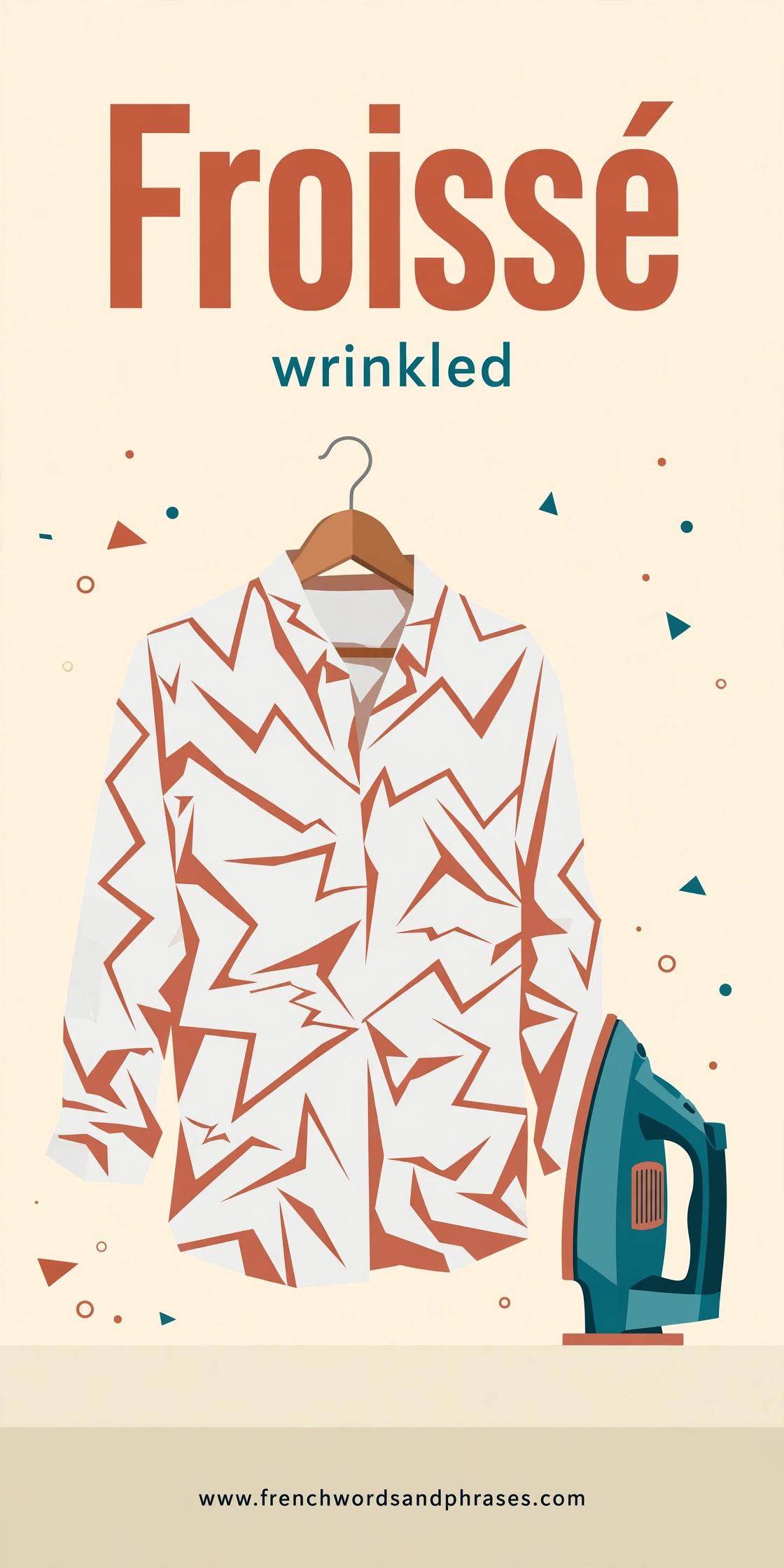
Froissé means wrinkled.
The shirt comes out of the suitcase looking like a map of mountains — creases across the back, one sleeve folded the wrong way all night. Before anything else, it needs the iron: it is froissé, wrinkled.
In this guide, you’ll learn what froissé means in English, its four forms, the verb it comes from, and why a froissé person is not creased at all. Explore French examples, English translations, and practice quizzes.
Understanding the French Adjective Froissé
Froissé is a French adjective — the past participle of the verb froisser, to crease or crumple. It agrees with the noun it describes: un papier froissé, une chemise froissée. English splits its work between wrinkled (clothes, skin) and crumpled (paper) — French keeps one word for both.
It means wrinkled, creased, crumpled — the state of cloth or paper that has been crushed out of smoothness: une chemise froissée after the journey, une feuille froissée thrown at the bin. And it has a second, human life: être froissé is to be offended, put out — a ruffled feeling for a ruffled shirt.
Type: Adjective — past participle of froisser, to crease
Answers the question: What is it like? — wrinkled, crumpled
Changes form: Yes — froissé, froissée, froissés, froissées
English equivalents: Wrinkled; crumpled; (of a person) offended, put out.
One important usage detail: for skin, French prefers ridé — un visage ridé, a wrinkled face; rides are the wrinkles of age. Froissé is for cloth and paper (and feelings). Keep the pair straight: la chemise est froissée, le visage est ridé.
Experience the Word
Froissé is the adjective of the morning after the journey — the shirt that slept in a suitcase, the letter crushed in a pocket, everything that was smooth yesterday.
Imagine the steam rising from the ironing board, the shirt laid out in its creases, and the slow pass of the iron making the world flat again.
You have not just seen creases. You have seen the journey written on the cloth.
How to Use Froissé in French: Complete Guide
Let’s explore how froissé works in French, beginning with the whole word on one card.
Froissé at a Glance
Before the details, here is the whole word on one card.
The Whole Word on One Card
Meaning, type, position and forms — froissé in four lines.
| Point | Froissé |
|---|---|
| Meaning | wrinkled, crumpled |
| Type | adjective — past participle of froisser |
| Usual position | after the noun — une chemise froissée |
| Forms | froissé / froissée / froissés / froissées |
Example
Sa chemise est toute froissée après le voyage.
His shirt is all wrinkled after the journey.
The Four Forms of Froissé
Froissé agrees with the noun it describes — the regular participle pattern, adding -e for feminine and -s for plural.
| Form | Froissé | Example |
|---|---|---|
| Masculine singular | froissé | un papier froissé — a crumpled paper |
| Feminine singular | froissée | une chemise froissée — a wrinkled shirt |
| Masculine plural | froissés | des papiers froissés — crumpled papers |
| Feminine plural | froissées | des chemises froissées — wrinkled shirts |
Example
Elle sort des chemises froissées de la valise.
She takes wrinkled shirts out of the suitcase.
Quick Quiz 1
Which form of froissé goes with chemise (feminine)?
Reveal the answer
froissée
Une chemise froissée.
A wrinkled shirt.
From the Verb Froisser: To Crease
Froissé is the past participle of froisser — to crease, to crumple, and, with a person as its object, to offend. The verb explains both lives of the adjective.
| French | In English |
|---|---|
| froisser | to crease, to crumple; to offend |
| se froisser | to take offence; (a muscle) to strain |
| défroisser | to uncrease, to smooth out |
| un froissement | a crumpling, a rustling |
| froisser une feuille | to crumple a sheet of paper |
| sans froisser personne | without offending anyone |
Example
Il a froissé la lettre et l’a jetée.
He crumpled the letter and threw it away.
Where Froissé Goes: After the Noun
Participles follow the noun — the thing first, then its state: une chemise froissée. Toute, all, can slip in front of the participle for emphasis.
| Pattern | Example |
|---|---|
| noun + froissé | une chemise froissée — a wrinkled shirt |
| With tout | toute froissée — all wrinkled |
| After être | la chemise est froissée — the shirt is wrinkled |
| Before the noun | une froissée chemise — never; froissé goes after |
Example
Le pantalon est tout froissé, passe-le au fer.
The trousers are all wrinkled, run the iron over them.
Quick Quiz 2
Where does froissé stand — before or after the noun?
Reveal the answer
After
Une chemise froissée, un papier froissé.
A wrinkled shirt, a crumpled paper.
More Wrinkled: Comparing with Froissé
Froissé takes the regular comparison pattern when you need degrees of creasing.
| Degree | Example |
|---|---|
| As wrinkled as | aussi froissé que — as wrinkled as |
| More wrinkled | plus froissé — more wrinkled |
| The most wrinkled | le plus froissé — the most wrinkled |
| All wrinkled | tout froissé — all wrinkled |
| Slightly wrinkled | un peu froissé — slightly wrinkled |
Example
Cette chemise est plus froissée que l’autre.
This shirt is more wrinkled than the other one.
Everyday Expressions with Froissé
Froissé creases shirts — and ruffles people. The feeling came from the cloth.
| Expression | In English |
|---|---|
| être froissé | to be offended, put out (of a person) |
| froisser quelqu’un | to offend someone |
| un papier froissé | a crumpled paper |
| se froisser un muscle | to strain a muscle |
| sans se froisser | without taking offence |
| une mine froissée | a ruffled, offended look |
Example
Il est froissé parce qu’on ne l’a pas invité.
He is offended because he wasn’t invited.
Quick Quiz 3
A colleague whispers: « Il est froissé. » Is his shirt creased?
Reveal the answer
Not necessarily — he is offended. Of a person, froissé means put out, ruffled in feeling.
Il est froissé depuis la réunion.
He has been offended since the meeting.
Froissé and Its Neighbours
Around the ironing board, French keeps a whole shelf of cloth states — froissé between the smooth and the ruined.
| French | In English |
|---|---|
| repassé | ironed — the rescued state |
| lisse | smooth |
| ridé | wrinkled (of skin, faces) |
| plié | folded |
| chiffonné | crumpled, creased (familiar) |
| impeccable | spotless, uncreased |
Example
Après le fer, la chemise froissée devient impeccable.
After the iron, the wrinkled shirt becomes spotless.
Watch Out: The Traps Around Froissé
Three traps — the face, the person, and the false friend in the wardrobe.
| Trap | The truth |
|---|---|
| un visage froissé | faces take ridé, not froissé — un visage ridé |
| froissé of a person | means offended, not creased |
| chiffonné | a near-twin for cloth — but froissé is the standard word |
| froissé before the noun | never — participles follow: une chemise froissée |
Example
Son visage ridé raconte une longue vie.
His wrinkled face tells of a long life.
Quick Quiz 4
Which word describes a wrinkled face — froissé or ridé?
Reveal the answer
ridé
Froissé is for cloth and paper; ridé is for skin.
Un visage ridé, une chemise froissée.
Froissé in Everyday French: Real-Life Examples
Now that you know the word, let’s see how froissé appears in everyday French.
Example 1 — The suitcase
Toutes mes chemises sont froissées !
All my shirts are wrinkled!
Example 2 — Ironing
Je repasse la chemise froissée ce soir.
I’ll iron the wrinkled shirt this evening.
Example 3 — Paper
Il jette le papier froissé dans la corbeille.
He throws the crumpled paper in the bin.
Example 4 — Feelings
Elle est froissée par sa remarque.
She is offended by his remark.
Example 5 — Linen
Le lin est beau mais toujours froissé.
Linen is beautiful but always wrinkled.
Example 6 — The rescue
Un coup de fer et la robe n’est plus froissée.
One pass of the iron and the dress is no longer wrinkled.
See froissé in a story: The State of Clothes: French Vocabulary (L’état des Vêtements) — laundry day with the Martin family.
Beyond Translation: The Meaning of Froissé
English splits wrinkled and crumpled where French keeps froissé — one word for every crushed smoothness, from the shirt in the suitcase to the letter in the bin. And then French does something lovely with it: the creased cloth becomes the creased feeling, and a person can be froissé too — ruffled, offended, in need of a gentle smoothing.
To say froissé is to see the crease — in the cloth, or in the mood.
It evokes steam and ironing boards, linen in summer, and the diplomacy of remarks that must not froisser anyone.
How to Remember the French Adjective Froissé
Remember it this way: Froissé is wrinkled — cloth and paper only; on a person it means offended, and on a face the word is ridé.
- You iron it out — une chemise froissée, after the noun, agreeing.
- You spare the face — un visage ridé, never froissé.
- You mind the feelings — être froissé, to be offended.
The key idea is froissée for the shirt — ridé for the face, froissé for the feelings.
Test Your Knowledge of Froissé
Let’s see how much you’ve learned. Try answering these questions before revealing the answers.
Question 1
What does froissé mean?
Reveal the answer
Wrinkled, crumpled — the past participle of froisser, to crease.
Question 2
What are the forms of froissé?
Reveal the answer
froissé, froissée, froissés, froissées — the regular participle pattern.
Question 3
Translate: His shirt is all wrinkled.
Reveal the answer
Sa chemise est toute froissée.
Question 4
Of a person, what does froissé mean?
Reveal the answer
Offended, put out — ruffled in feeling, not in cloth.
Question 5
Complete the sentence:
Elle repasse une chemise ______.
Reveal the answer
froissée
Elle repasse une chemise froissée.
She is ironing a wrinkled shirt.
Your Final Challenge
Can You Use It?
How would you say this in French?
“All my shirts are wrinkled after the journey.”
Reveal the answer
Toutes mes chemises sont froissées après le voyage.
All my shirts are wrinkled after the journey.
A little French. A little curiosity. A richer everyday life.
LEARN FRENCH ONE WORD AT A TIME