A French Word to Live By
Translate Taché to English
/ta.ʃe/
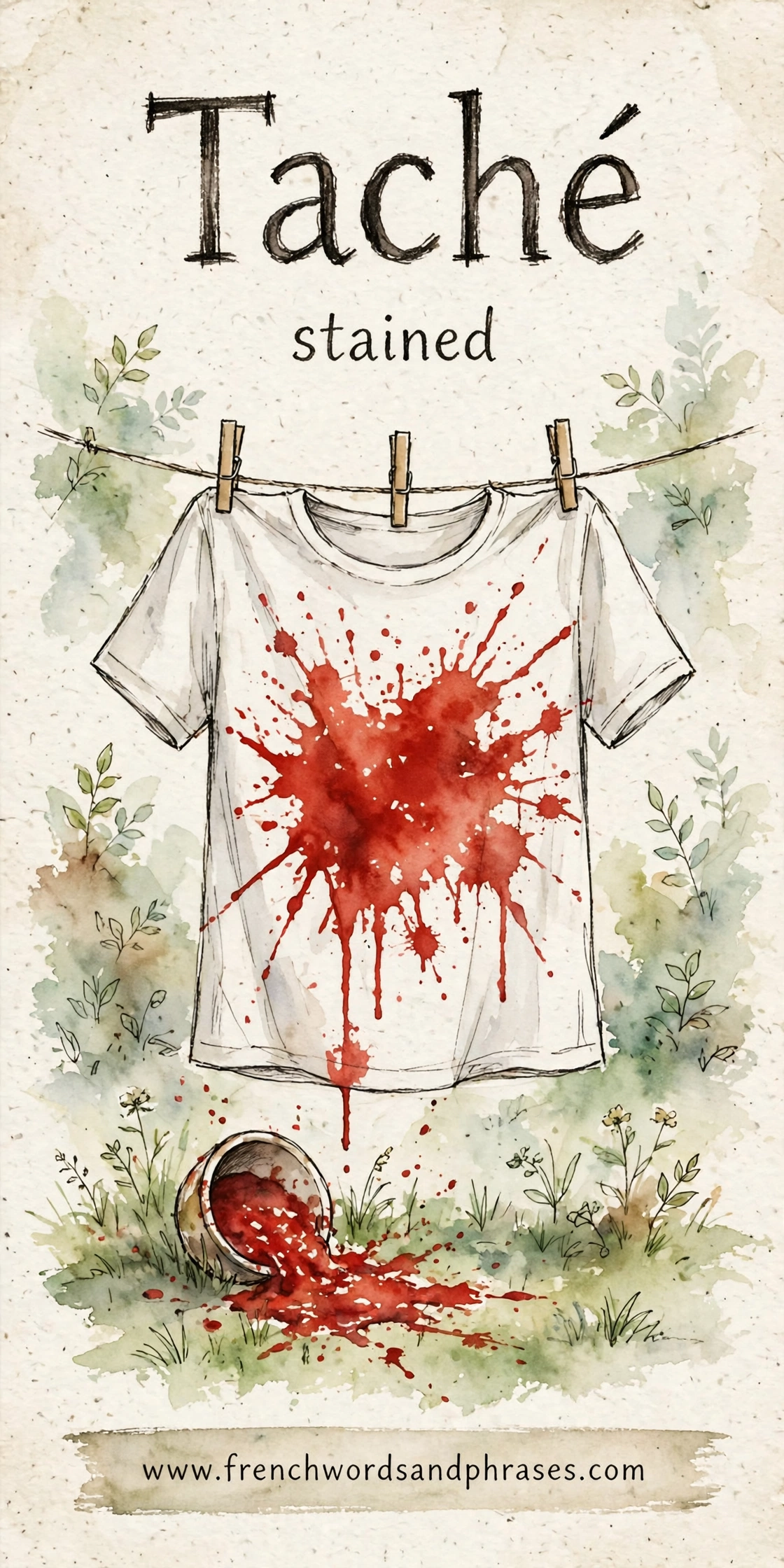
Taché means stained.
The white t-shirt was perfect at breakfast. Then came the tomato sauce, the coffee, and the mysterious brown splash nobody will admit to. By evening it tells the whole day’s story: it is taché, stained.
In this guide, you’ll learn what taché means in English, its four forms, the stain hiding inside it, and the one-letter trap between a stain and a task. Explore French examples, English translations, and practice quizzes.
Understanding the French Adjective Taché
Taché is a French adjective — the past participle of the verb tacher, to stain. It agrees with the noun it describes: un tee-shirt taché, une nappe tachée. Behind it stands the noun une tache, a stain — the mark itself. The adjective is the verdict after the mark has landed.
It means stained — marked by something that should not be there: un tee-shirt taché de sauce, a t-shirt stained with sauce. French names the culprit with de: taché de vin, de café, d’encre — stained with wine, coffee, ink. Some stains wash out; the word keeps the suspense.
Type: Adjective — past participle of tacher, to stain
Answers the question: What is it like? — stained
Changes form: Yes — taché, tachée, tachés, tachées
English equivalents: Stained; the mark itself is une tache, a stain.
One important usage detail: mind the famous one-letter trap. Une tache (no accent) is a stain; une tâche (with a circumflex) is a task, a job to do. Taché belongs to the stain: un tee-shirt taché has sauce on it, not homework. The accent changes the whole afternoon.
Experience the Word
Taché is the adjective of the accident — the splash at lunch, the pen in the pocket, the glass tipped at exactly the wrong moment over exactly the wrong shirt.
Imagine the white tablecloth at the end of a long Sunday lunch: a ring of wine, a spot of sauce, a constellation of the whole meal, mapped in stains.
You have not just seen marks. You have read the story of the meal.
How to Use Taché in French: Complete Guide
Let’s explore how taché works in French, beginning with the whole word on one card.
Taché at a Glance
Before the details, here is the whole word on one card.
The Whole Word on One Card
Meaning, type, position and forms — taché in four lines.
| Point | Taché |
|---|---|
| Meaning | stained |
| Type | adjective — past participle of tacher |
| Usual position | after the noun — un tee-shirt taché |
| Forms | taché / tachée / tachés / tachées |
Example
Son tee-shirt blanc est taché de sauce.
His white t-shirt is stained with sauce.
The Four Forms of Taché
Taché agrees with the noun it describes — the regular participle pattern, adding -e for feminine and -s for plural.
| Form | Taché | Example |
|---|---|---|
| Masculine singular | taché | un tee-shirt taché — a stained t-shirt |
| Feminine singular | tachée | une nappe tachée — a stained tablecloth |
| Masculine plural | tachés | des tee-shirts tachés — stained t-shirts |
| Feminine plural | tachées | des nappes tachées — stained tablecloths |
Example
Elle met les tee-shirts tachés dans la machine.
She puts the stained t-shirts in the machine.
Quick Quiz 1
Which form of taché goes with nappe (feminine)?
Reveal the answer
tachée
Une nappe tachée.
A stained tablecloth.
From the Verb Tacher: To Stain
Taché is the past participle of tacher — and its noun, une tache, is the stain itself. Name the culprit with de: taché de vin, de café, d’herbe.
| French | In English |
|---|---|
| tacher | to stain |
| une tache | a stain, a mark |
| taché de vin | stained with wine |
| taché d’herbe | stained with grass |
| détacher | to remove stains; also to untie, to detach |
| un détachant | a stain remover |
Example
Le vin rouge a taché la nappe blanche.
The red wine stained the white tablecloth.
Where Taché Goes: After the Noun
Participles follow the noun — the thing first, then its state: un tee-shirt taché. The culprit follows with de.
| Pattern | Example |
|---|---|
| noun + taché | un tee-shirt taché — a stained t-shirt |
| With the culprit | taché de sauce — stained with sauce |
| After être | la nappe est tachée — the tablecloth is stained |
| Before the noun | un taché tee-shirt — never; taché goes after |
Example
Ses mains sont tachées d’encre.
His hands are stained with ink.
Quick Quiz 2
How does French name what did the staining — taché ___ vin?
Reveal the answer
de
Taché de vin.
Stained with wine — the culprit travels with de.
More Stained: Comparing with Taché
Taché takes the regular comparison pattern when one shirt has suffered more than another.
| Degree | Example |
|---|---|
| As stained as | aussi taché que — as stained as |
| More stained | plus taché — more stained |
| The most stained | le plus taché — the most stained |
| Slightly stained | un peu taché — slightly stained |
| Stained all over | taché partout — stained everywhere |
Example
Son tablier est plus taché que le mien.
His apron is more stained than mine.
Everyday Expressions with Taché
Stains have their usual suspects — wine, grass, ink — and one famous false friend with an accent.
| Expression | In English |
|---|---|
| taché de + noun | stained with + noun |
| une tache de vin | a wine stain |
| faire une tache | to make a stain |
| une tâche (accent!) | a task — not a stain |
| partir à la machine | to come out in the wash (of a stain) |
| une réputation tachée | a stained reputation |
Example
Heureusement, la tache est partie à la machine.
Luckily, the stain came out in the wash.
Quick Quiz 3
Which is the stain — une tache or une tâche?
Reveal the answer
une tache, without the accent
Une tâche with a circumflex is a task, a job. The stain has no accent — and no mercy.
Une tache de café, une tâche difficile.
Taché and Its Neighbours
In the laundry basket, taché sits between clean and ruined, among the words of marks and damage.
| French | In English |
|---|---|
| sale | dirty — the general word |
| propre | clean — the rescued state |
| déchiré | torn |
| mouillé | wet |
| sans tache | spotless, without a stain |
| impeccable | spotless, flawless |
Example
Sale et taché, le tee-shirt va directement à la machine.
Dirty and stained, the t-shirt goes straight into the machine.
Watch Out: The Traps Around Taché
The accent trap above all — plus the verb that also unties, and the participle’s place.
| Trap | The truth |
|---|---|
| tâche with an accent | a task, not a stain — the circumflex changes everything |
| détacher | removes stains — and also unties: détacher un chien |
| taché before the noun | never — participles follow: un tee-shirt taché |
| tâcher de | a different verb again: tâcher de = to try to |
Example
Ma tâche du jour : détacher cette tache.
My task of the day: to remove this stain.
Quick Quiz 4
How do you say ‘a stained t-shirt’ — un taché tee-shirt or un tee-shirt taché?
Reveal the answer
un tee-shirt taché
The participle follows the noun.
Un tee-shirt taché de sauce — a t-shirt stained with sauce.
Taché in Everyday French: Real-Life Examples
Now that you know the word, let’s see how taché appears in everyday French.
Example 1 — At lunch
Attention, tu vas tacher ta chemise !
Careful, you’re going to stain your shirt!
Example 2 — The verdict
Le tee-shirt blanc est taché de café.
The white t-shirt is stained with coffee.
Example 3 — Grass stains
Les genoux du pantalon sont tachés d’herbe.
The knees of the trousers are stained with grass.
Example 4 — Laundry hope
J’espère que la tache partira à la machine.
I hope the stain will come out in the wash.
Example 5 — Ink
Ses doigts sont tachés d’encre.
His fingers are stained with ink.
Example 6 — The tablecloth
Après le repas, la nappe est tachée de vin.
After the meal, the tablecloth is stained with wine.
See taché in a story: The State of Clothes: French Vocabulary (L’état des Vêtements) — laundry day with the Martin family.
Beyond Translation: The Meaning of Taché
English says stained for the meaning of taché — a plain verdict. But French hides a whole spelling drama inside it: tache the stain and tâche the task, one circumflex apart, so that a single accent decides whether the shirt needs washing or the afternoon needs working. The stain even reaches reputations — une réputation tachée — where no machine can help.
To say taché is to point at the mark and name its maker.
It evokes white shirts and red wine, grass-stained knees, inky fingers — and the wash-day hope that this tache, at least, partira à la machine.
How to Remember the French Adjective Taché
Remember it this way: Taché is stained — participle of tacher, with the culprit named by de, and an accent trap for a neighbour.
- You name the culprit — taché de vin, de café, d’herbe.
- You dodge the accent — une tache is the stain; une tâche is a task.
- You hope for the wash — la tache part à la machine.
The key idea is taché de + the culprit — tache without the accent.
Test Your Knowledge of Taché
Let’s see how much you’ve learned. Try answering these questions before revealing the answers.
Question 1
What does taché mean?
Reveal the answer
Stained — the past participle of tacher, to stain.
Question 2
What are the forms of taché?
Reveal the answer
taché, tachée, tachés, tachées — the regular participle pattern.
Question 3
Translate: The tablecloth is stained with wine.
Reveal the answer
La nappe est tachée de vin.
Question 4
Which word means a task — tache or tâche?
Reveal the answer
Tâche, with the circumflex. Tache without it is the stain.
Question 5
Complete the sentence:
Son tee-shirt est ______ de sauce.
Reveal the answer
taché
Son tee-shirt est taché de sauce.
His t-shirt is stained with sauce.
Your Final Challenge
Can You Use It?
How would you say this in French?
“His white t-shirt is stained with coffee.”
Reveal the answer
Son tee-shirt blanc est taché de café.
His white t-shirt is stained with coffee.
A little French. A little curiosity. A richer everyday life.
LEARN FRENCH ONE WORD AT A TIME