A French Word to Live By
Translate Fierté to English
/fjɛʁ.te/
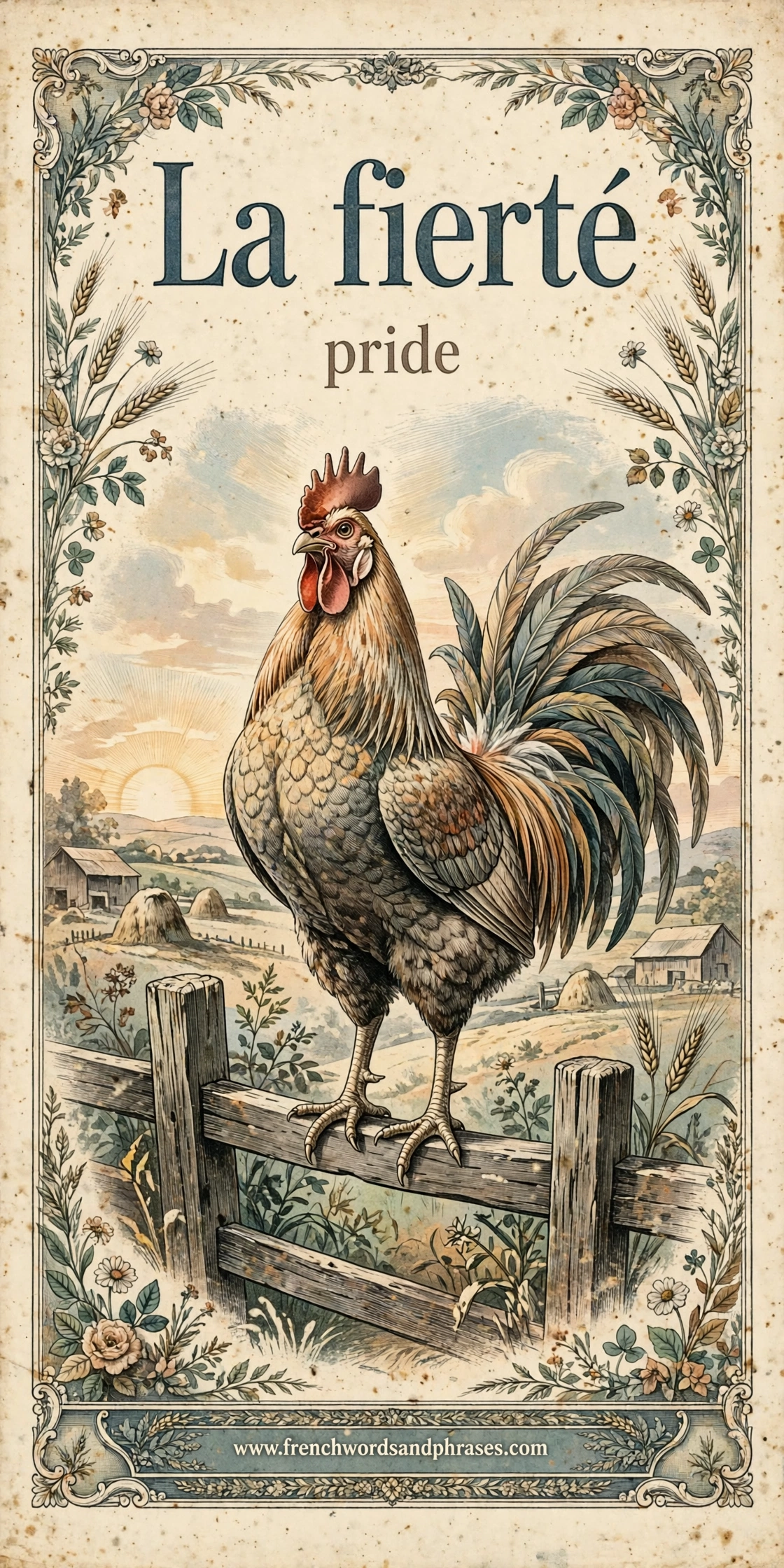
La fierté means pride.
On the podium, the young gymnast raises her medal, looks for her parents in the crowd, and finds them both crying. What shines on all three faces has a name: la fierté — pride.
In this guide, you’ll learn what fierté means in English, how to use it with its articles, how to form its plural, and how it appears in everyday French. Explore French examples, English translations, and practice quizzes.
Understanding the French Noun Fierté
Fierté is a feminine French noun. It is learned together with its article: la fierté, une fierté. It is an abstract noun built from the adjective fier (proud) with the suffix -té — the same abstract ending as beauté and liberté. Fier itself comes from a Latin word for wild and untamed: pride, in French, keeps a little wildness.
It means pride — above all the good kind: the deep satisfaction we feel in our own work or in someone we love: la fierté d’une mère (a mother’s pride), la fierté du travail bien fait (pride in work well done). French uses the adjective constantly: je suis fier de toi, I am proud of you — fier for a man, fière for a woman.
Gender: Feminine
Definite article: la — la fierté (the pride)
Indefinite article: une — une fierté (a pride, a source of pride)
Plural: les fiertés (rare)
English equivalents: Pride; être fier / fière de — to be proud of.
One important usage detail: everyday French praises with the adjective, not the noun — je suis très fier de toi is what parents actually say. The noun appears for the feeling itself and for its sources: sa fille est sa grande fierté, his daughter is his great pride. Beware the dark twin: pride as arrogance is l’orgueil, a deadly sin; fierté is dignity, and French keeps the two carefully apart.
Experience the Word
Fierté is more than a medal feeling. It is the quiet straightening of the back when work is well done — the baker surveying his morning loaves, the grandmother reading her grandson’s first published poem.
Imagine an old carpenter running his hand along a table he made forty years ago, still level, still strong. He says nothing. His son, watching, understands everything: some things are not sold, they are signed — with la fierté.
You have not just succeeded. You have earned la fierté — the dignity of a thing well done.
How to Use Fierté in French: Complete Guide
Let’s explore how fierté works in French, beginning with its articles.
Fierté with the Definite Article (La, Les)
Used for the pride everyone can see — the one shining on a face.
| Number | French |
|---|---|
| Singular | la fierté |
| Plural | les fiertés |
Example
La fierté se lisait dans les yeux de ses parents.
The pride could be read in his parents’ eyes.
Fierté with the Indefinite Article (Une, Des)
Une fierté often names the source of the pride — the child, the work, the house built by hand.
| Number | French |
|---|---|
| Singular | une fierté |
| Plural | des fiertés |
Example
Ce jardin est une fierté pour tout le village.
This garden is a source of pride for the whole village.
Fierté with the Partitive Article (De la)
Feelings are measured with the partitive: de la fierté, some pride — in the voice, in the heart.
| Quantity | French |
|---|---|
| some | de la fierté |
| a lot of | beaucoup de fierté |
| a little | un peu de fierté |
| too much | trop de fierté |
| no, none | pas de fierté |
Example
Elle a annoncé la nouvelle avec beaucoup de fierté.
She announced the news with a lot of pride.
Quick Quiz 1
How do you say ‘I am proud of you’ in French?
Reveal the answer
Je suis fier de toi (fier for a man speaking, fière for a woman) — daily praise uses the adjective.
Je suis très fière de toi, ma fille.
I am very proud of you, my daughter.
The Plural of Fierté
Fierté can add an -s — les fiertés — but the plural is rare; pride is usually one feeling with one source at a time.
| Number | French |
|---|---|
| Singular | la fierté |
| Plural | les fiertés (rare) |
Example
Nos enfants sont nos fiertés, chacun à sa manière.
Our children are our prides, each in their own way.
Fierté with Possessive Adjectives (Ma, Ta, Sa…)
Possessives agree with the noun, not with the owner — and fierté is feminine, so it takes ma, ta, sa.
| Owner | French |
|---|---|
| my | ma fierté |
| your (tu) | ta fierté |
| his / her | sa fierté |
| our | notre fierté |
| your (vous) | votre fierté |
| their | leur fierté |
Example
Sa grande fierté, c’est sa fille médecin.
His great pride is his daughter the doctor.
Quick Quiz 2
Complete the sentence:
Il parle de son fils avec une immense ______. (pride)
Reveal the answer
fierté
Il parle de son fils avec une immense fierté.
He speaks of his son with immense pride.
Fierté with Demonstrative Adjectives (Cette, Ces)
Used to point: this pride here, in this family, in this work.
| Number | French |
|---|---|
| Singular | cette fierté |
| Plural | ces fiertés |
Example
Cette fierté discrète est typique de son caractère.
This quiet pride is typical of his character.
Fierté with Adjectives
Adjectives agree with fierté, feminine — grande, légitime, discrète.
| Adjective | With Fierté |
|---|---|
| grande (great) | une grande fierté |
| légitime (legitimate, well-earned) | une fierté légitime |
| discrète (quiet, modest) | une fierté discrète |
| nationale (national) | la fierté nationale |
| immense (immense) | une immense fierté |
Example
C’est une fierté légitime après tant d’années de travail.
It is a well-earned pride after so many years of work.
Quick Quiz 3
Complete the sentence:
Après sa victoire, elle ressent une fierté ______. (immense)
Reveal the answer
immense
Après sa victoire, elle ressent une fierté immense.
After her victory, she feels an immense pride.
Everyday Expressions with Fierté
Praising, beaming and standing tall — the fierté phrases of daily life.
| Expression | In English |
|---|---|
| être fier / fière de | to be proud of |
| avec fierté | with pride, proudly |
| la fierté du travail bien fait | pride in work well done |
| une source de fierté | a source of pride |
| rayonnant de fierté | beaming with pride |
| la fierté nationale | national pride |
Example
Il a présenté son invention avec fierté devant toute la classe.
He presented his invention with pride in front of the whole class.
Words from the Same Family as Fierté
Proud people and dignified words — the words that travel with fierté.
| French | In English |
|---|---|
| fier / fière | proud |
| l’orgueil | pride as arrogance — the dark twin |
| la dignité | dignity |
| la honte | shame — pride’s opposite |
| féliciter | to congratulate |
| réussir | to succeed |
Example
Fière mais jamais orgueilleuse, elle a remercié toute son équipe.
Proud but never arrogant, she thanked her whole team.
Quick Quiz 4
Which word means pride as a fault — arrogance — rather than dignity?
Reveal the answer
L’orgueil — the pride of the deadly sin. Fierté is the healthy kind: dignity and satisfaction.
Son orgueil l’empêche de demander pardon.
His arrogance stops him from apologising.
Fierté in Everyday French: Real-Life Examples
Now that you know the word, let’s see how fierté appears in everyday French.
Example 1 — At the ceremony
Les parents rayonnent de fierté pendant la remise des diplômes.
The parents beam with pride during the graduation ceremony.
Example 2 — A father’s words
Je suis fier de toi, tu as travaillé si dur.
I am proud of you, you worked so hard.
Example 3 — The baker’s morning
Il regarde ses pains dorés avec fierté.
He looks at his golden loaves with pride.
Example 4 — A village garden
Ce jardin fleuri est la fierté du village entier.
This flower-filled garden is the pride of the whole village.
Example 5 — National day
Le défilé du 14 juillet réveille la fierté nationale.
The 14 July parade awakens national pride.
Example 6 — Work well done
Elle a rangé l’atelier avec la fierté du travail bien fait.
She tidied the workshop with pride in work well done.
Beyond Translation: The Meaning of Fierté
French draws a line English blurs: fierté is dignity, orgueil is arrogance, and never the twain shall meet. A French parent is fier; a French villain is orgueilleux. The distinction is a whole moral philosophy in two words — be proud of the work, never proud against other people.
To say fierté is to stand tall without standing on anyone.
It evokes the medal and the morning loaves, the hand run along a forty-year-old table, and the sentence every French child works to hear: je suis fier de toi.
How to Remember the French Noun Fierté
Remember it this way: Fierté is pride — feminine, built from fier with the -té ending, and the healthy pride that is never orgueil.
- You build the word — fier plus -té, like beauté from beau.
- You praise with the adjective — je suis fier de toi, fière if a woman speaks.
- You dodge the twin — l’orgueil is arrogance; fierté is dignity.
The key idea is la fierté — dignity earned, never arrogance.
Test Your Knowledge of Fierté
Let’s see how much you’ve learned. Try answering these questions before revealing the answers.
Question 1
Is fierté masculine or feminine?
Reveal the answer
Feminine — la fierté, une fierté.
Question 2
How does a mother say ‘I am proud of you’?
Reveal the answer
Je suis fière de toi — fière, with the feminine ending, because she is a woman.
Question 3
Translate: This house is his great pride.
Reveal the answer
Cette maison est sa grande fierté.
Question 4
What is the difference between fierté and orgueil?
Reveal the answer
Fierté is healthy pride — dignity and satisfaction; orgueil is arrogance, pride as a fault.
Question 5
Complete the sentence:
Elle annonce son mariage avec ______.
Reveal the answer
fierté
Elle annonce son mariage avec fierté.
She announces her engagement with pride.
Your Final Challenge
Can You Use It?
How would you say this in French?
“I am proud of my daughter.”
Reveal the answer
Je suis fier de ma fille.
I am proud of my daughter.
A little French. A little curiosity. A richer everyday life.
LEARN FRENCH ONE WORD AT A TIME