A French Word to Live By
Translate Colère to English
/kɔ.lɛʁ/
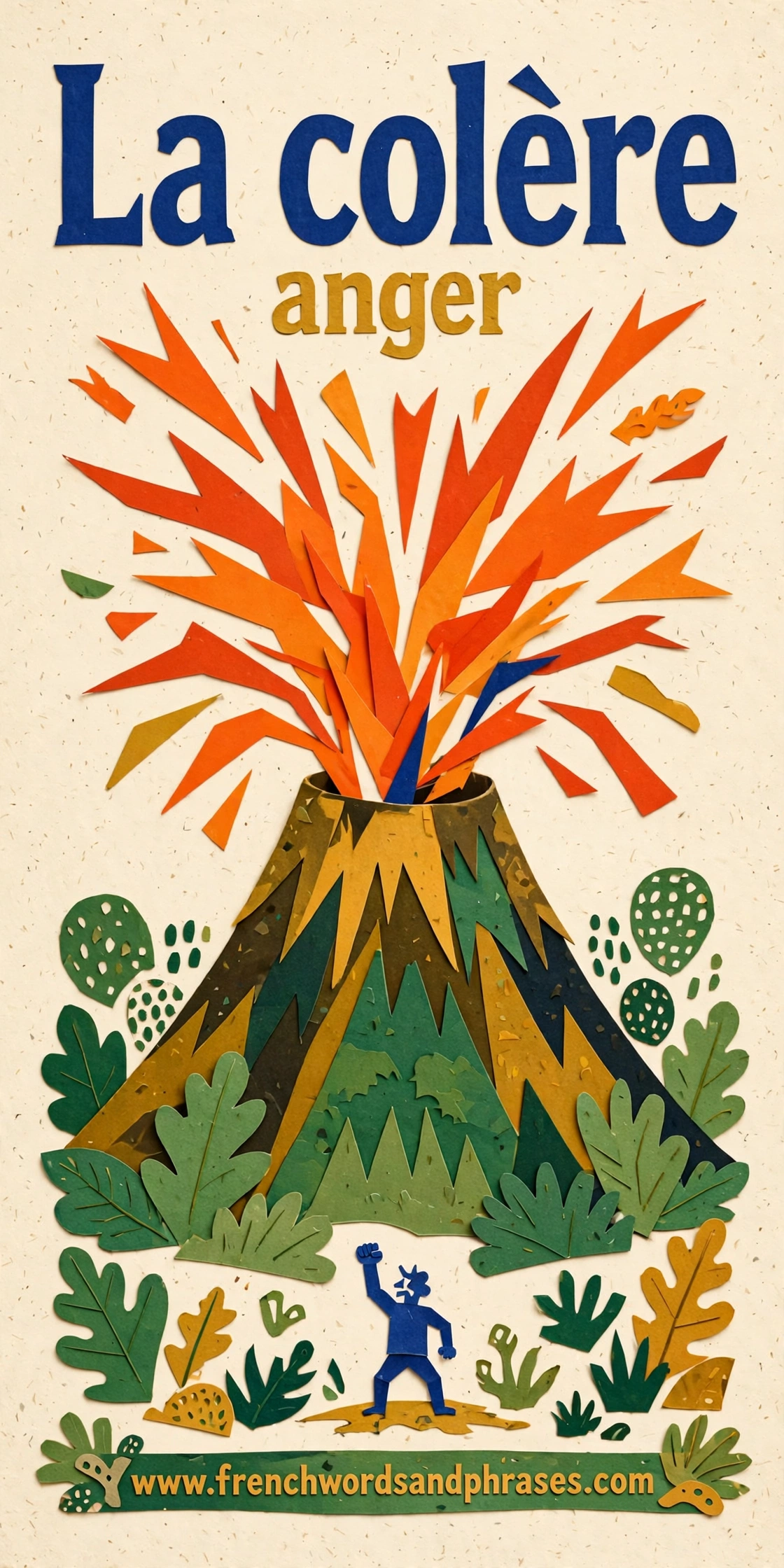
La colère means anger.
The train is cancelled for the third time this week. On the platform, a man’s voice rises, his fists clench, and the whole crowd steps back a little. Nobody needs a dictionary for what he is feeling: la colère.
In this guide, you’ll learn what colère means in English, how to use it with its articles, how to form its plural, and how it appears in everyday French. Explore French examples, English translations, and practice quizzes.
Understanding the French Noun Colère
Colère is a feminine French noun. It is learned together with its article: la colère, une colère. It is an abstract noun naming the hot, rising feeling of anger. French usually meets it inside verb phrases: être en colère, to be angry, and se mettre en colère, to get angry — literally, to put oneself into anger.
It means anger — the strong feeling that rises when we are wronged, blocked or treated unfairly: la colère des habitants (the anger of the residents), une colère noire (a black, terrible anger). French grades it finely: below it sits l’énervement, irritation; beside it, la fureur, fury; and its calm opposite is le calme itself.
Gender: Feminine
Definite article: la — la colère (the anger)
Indefinite article: une — une colère (an outburst of anger)
Plural: les colères (fits of anger)
English equivalents: Anger, wrath; être en colère — to be angry.
One important usage detail: French does not say « je suis colère » — anger is a state you are in: je suis en colère, I am angry, with en. And note the famous trap next door: le choléra, with an h, is the disease cholera. Colère, the feeling, has no h and no microbe.
Experience the Word
Colère is more than a raised voice. It is the body’s alarm at injustice — the heat in the face when a promise is broken, a queue is jumped, a lie is told to our face.
Imagine a nurse who has asked three times for more staff on her ward. Today she stands in the director’s office, calm, precise, immovable. Her colère is not noise; it is fuel — and the ward gets its nurses.
You have not just lost your temper. You have felt la colère — and, at its best, it moves mountains.
How to Use Colère in French: Complete Guide
Let’s explore how colère works in French, beginning with its articles.
Colère with the Definite Article (La, Les)
Used for the anger everyone in the conversation knows — the one filling the room.
| Number | French |
|---|---|
| Singular | la colère |
| Plural | les colères |
Example
La colère des voyageurs grandissait à chaque annonce.
The travellers’ anger grew with every announcement.
Colère with the Indefinite Article (Une, Des)
Une colère is one outburst — a fit of anger with a beginning and an end.
| Number | French |
|---|---|
| Singular | une colère |
| Plural | des colères |
Example
Une colère terrible l’a saisi en lisant la lettre.
A terrible anger seized him as he read the letter.
Colère with the Partitive Article (De la)
Feelings are measured with the partitive: de la colère, some anger — in the voice, under the words.
| Quantity | French |
|---|---|
| some | de la colère |
| a lot of | beaucoup de colère |
| a little | un peu de colère |
| so much | tant de colère |
| no, none | pas de colère |
Example
Il y avait de la colère dans sa voix, malgré son sourire.
There was anger in his voice, despite his smile.
Quick Quiz 1
How do you say ‘I am angry’ in French?
Reveal the answer
Je suis en colère — anger is a state you are in: être en colère.
Je suis en colère contre ce retard répété.
I am angry about this repeated delay.
The Plural of Colère
Colère adds an -s in the plural — les colères — for repeated fits and outbursts.
| Number | French |
|---|---|
| Singular | la colère |
| Plural | les colères |
Example
Les colères de l’enfant durent rarement plus de cinq minutes.
The child’s fits of anger rarely last more than five minutes.
Colère with Possessive Adjectives (Ma, Ta, Sa…)
Possessives agree with the noun, not with the owner — and colère is feminine, so it takes ma, ta, sa.
| Owner | French |
|---|---|
| my | ma colère |
| your (tu) | ta colère |
| his / her | sa colère |
| our | notre colère |
| your (vous) | votre colère |
| their | leur colère |
Example
Elle a caché sa colère jusqu’à la fin de la réunion.
She hid her anger until the end of the meeting.
Quick Quiz 2
Complete the sentence:
Il n’a pas pu contenir ______ colère devant l’injustice. (his)
Reveal the answer
sa
Il n’a pas pu contenir sa colère devant l’injustice.
He could not contain his anger in the face of the injustice.
Colère with Demonstrative Adjectives (Cette, Ces)
Used to point: this anger here, those outbursts there.
| Number | French |
|---|---|
| Singular | cette colère |
| Plural | ces colères |
Example
Cette colère soudaine a surpris tout le monde.
This sudden anger surprised everyone.
Colère with Adjectives
Adjectives agree with colère, feminine — grande, noire, froide.
| Adjective | With Colère |
|---|---|
| grande (great) | une grande colère |
| noire (black, terrible) | une colère noire |
| froide (cold) | une colère froide |
| soudaine (sudden) | une colère soudaine |
| contenue (restrained) | une colère contenue |
Example
Une colère froide est parfois plus inquiétante qu’un cri.
A cold anger is sometimes more worrying than a shout.
Quick Quiz 3
Complete the sentence:
En apprenant la nouvelle, il est entré dans une colère ______. (black, terrible)
Reveal the answer
noire
En apprenant la nouvelle, il est entré dans une colère noire.
On hearing the news, he flew into a terrible rage.
Everyday Expressions with Colère
Getting angry, calming down and speaking out — the colère phrases of daily life.
| Expression | In English |
|---|---|
| être en colère | to be angry |
| se mettre en colère | to get angry, to lose one’s temper |
| entrer dans une colère noire | to fly into a terrible rage |
| passer sa colère sur quelqu’un | to take one’s anger out on someone |
| la colère gronde | anger is rumbling (of a crowd) |
| calmer sa colère | to calm one’s anger |
Example
Ne passe pas ta colère sur moi, je n’y suis pour rien.
Don’t take your anger out on me, it’s nothing to do with me.
Words from the Same Family as Colère
Anger and its neighbours — the words that travel with colère.
| French | In English |
|---|---|
| en colère | angry (the state) |
| la fureur | fury — anger at full power |
| l’énervement | irritation — anger’s little brother |
| se fâcher | to get angry, to fall out |
| le calme | calm — anger’s opposite |
| s’énerver | to get worked up |
Example
Après l’énervement du matin, le calme est revenu dans la maison.
After the morning’s irritation, calm returned to the house.
Quick Quiz 4
Which is stronger: l’énervement or la fureur?
Reveal the answer
La fureur — fury is anger at full power; l’énervement is mere irritation, the bottom of the scale.
Un simple énervement peut devenir une fureur si on l’alimente.
Simple irritation can become fury if you feed it.
Colère in Everyday French: Real-Life Examples
Now that you know the word, let’s see how colère appears in everyday French.
Example 1 — At the station
Les voyageurs en colère demandent des explications au guichet.
The angry travellers demand explanations at the ticket office.
Example 2 — A parent speaks
Elle s’est mise en colère parce que la chambre était encore en désordre.
She got angry because the bedroom was still in a mess.
Example 3 — In the office
Il a quitté la réunion pour calmer sa colère.
He left the meeting to calm his anger.
Example 4 — Reading the news
La colère des habitants grandit après la fermeture de l’usine.
The residents’ anger is growing after the factory closure.
Example 5 — An apology after
Pardon, je n’aurais pas dû passer ma colère sur toi.
Sorry, I shouldn’t have taken my anger out on you.
Example 6 — The storm passes
Sa colère est tombée aussi vite qu’elle était venue.
His anger subsided as quickly as it had come.
Beyond Translation: The Meaning of Colère
French anger has a geography: it is something you enter (entrer dans une colère), something you are inside (être en colère), and something that falls when it leaves (la colère tombe). The language treats it as weather — and weather passes. That may be why French colère, for all its thunder, so often ends in discussion: the storm clears the air.
To say colère is to name the storm — and to remember that storms end.
It evokes the platform and the clenched fists, the nurse standing immovable in the office, and the quiet sentence that closes so many French quarrels: la colère est tombée.
How to Remember the French Noun Colère
Remember it this way: Colère is anger — feminine, a state you are in (être en colère), never a word you are.
- You are in it — je suis en colère, never « je suis colère ».
- You grade it — l’énervement below, la colère in the middle, la fureur above.
- You dodge the trap — le choléra, with an h, is a disease, not a feeling.
The key idea is la colère — the storm you enter, and leave.
Test Your Knowledge of Colère
Let’s see how much you’ve learned. Try answering these questions before revealing the answers.
Question 1
Is colère masculine or feminine?
Reveal the answer
Feminine — la colère, une colère.
Question 2
How do you say ‘She is angry’ in French?
Reveal the answer
Elle est en colère.
Question 3
Translate: He got angry at the news.
Reveal the answer
Il s’est mis en colère en apprenant la nouvelle.
Question 4
What is the difference between la colère and le choléra?
Reveal the answer
La colère is the feeling, anger; le choléra, with an h, is the disease cholera.
Question 5
Complete the sentence:
Ils sont ______ colère contre la décision.
Reveal the answer
en
Ils sont en colère contre la décision.
They are angry about the decision.
Your Final Challenge
Can You Use It?
How would you say this in French?
“The travellers are angry about the cancelled train.”
Reveal the answer
Les voyageurs sont en colère à cause du train annulé.
The travellers are angry about the cancelled train.
A little French. A little curiosity. A richer everyday life.
LEARN FRENCH ONE WORD AT A TIME