A French Word to Live By
Translate Honte to English
/ɔ̃t/
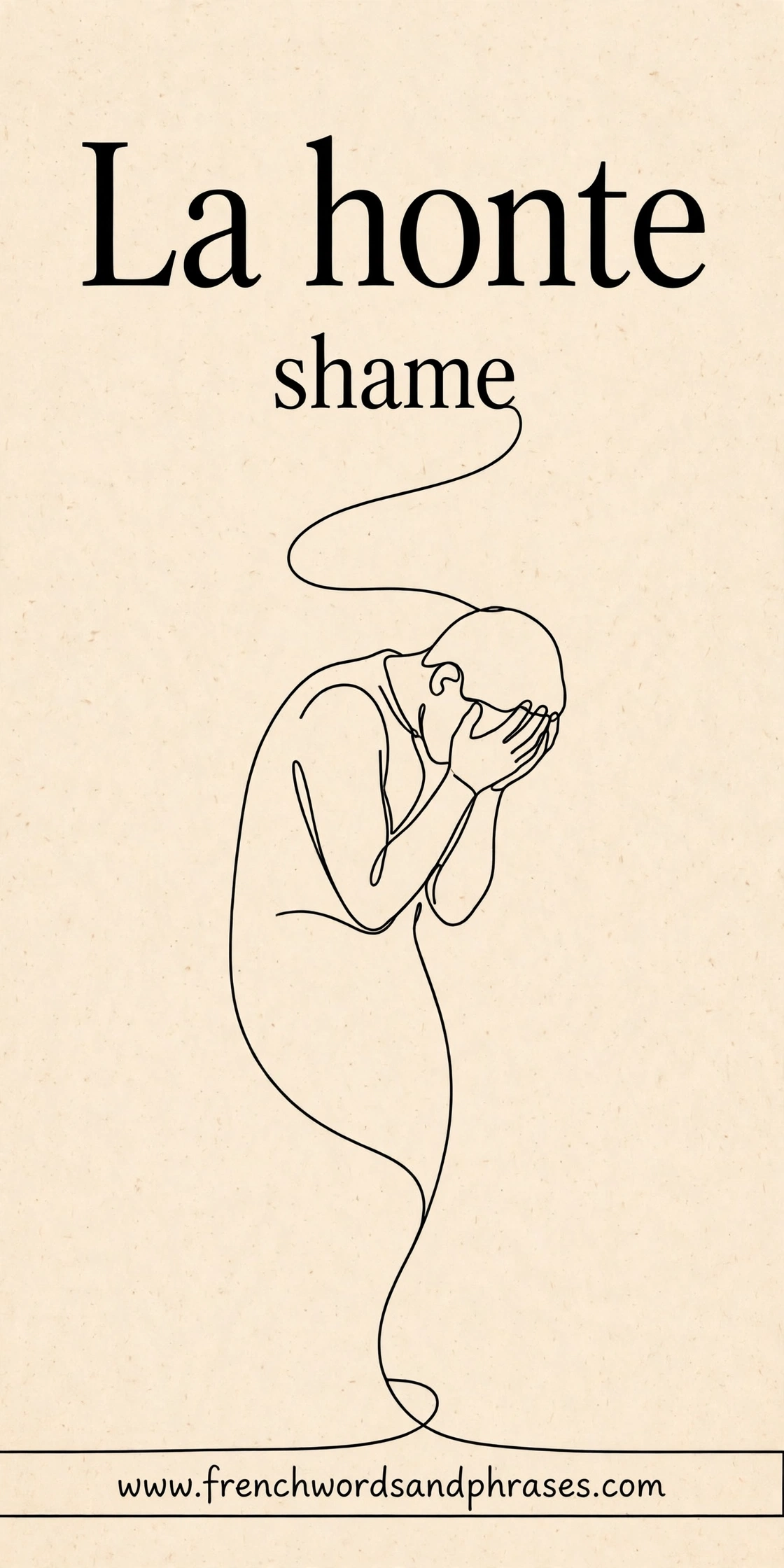
La honte means shame.
In the middle of the school play, the young actor forgets his line. The silence stretches, his ears turn red, and he wishes the stage would swallow him. Every person in the audience knows that burning feeling: la honte.
In this guide, you’ll learn what honte means in English, how to use it with its articles, how to form its plural, and how it appears in everyday French. Explore French examples, English translations, and practice quizzes.
Understanding the French Noun Honte
Honte is a feminine French noun. It is learned together with its article: la honte, une honte. It is an abstract noun naming the painful feeling of shame — and, like peur, it works with the verb avoir: avoir honte, to be ashamed, literally to have shame. Watch the h: it is an aspirate h, so the article never shrinks — always la honte, never « l’honte ».
It means shame — the hot, shrinking feeling when we have done something wrong or ridiculous: avoir honte de son erreur (to be ashamed of one’s mistake). French also turns it outward: c’est une honte ! is a scandal, a disgrace — the cry of a crowd at an injustice, not a private blush. One word covers both the shame we feel and the shame we denounce.
Gender: Feminine
Definite article: la — la honte (the shame)
Indefinite article: une — une honte (a disgrace, a scandal)
Plural: les hontes (rare)
English equivalents: Shame; c’est une honte ! — it’s a disgrace, it’s scandalous!
One important usage detail: honte has an aspirate h, so there is no elision and no liaison — la honte, les hontes said with a clean break, and cette honte, never « l’honte ». The working phrase is avoir honte de: j’ai honte de mon erreur, I am ashamed of my mistake. And note the scale of feelings: for small social embarrassment, French often prefers la gêne; honte is the deeper word, tied to fault and conscience.
Experience the Word
Honte is more than embarrassment. It is the feeling that makes us want to disappear — and, used well, the compass that tells us we have crossed our own line.
Imagine a cashier who realises, at home, that she gave an old lady too little change that morning. She barely sleeps. At opening time she is waiting at the door of the shop with the coins in her hand — la honte, turned into honesty.
You have not just felt ashamed. You have listened to la honte — and let it put things right.
How to Use Honte in French: Complete Guide
Let’s explore how honte works in French, beginning with its articles.
Honte with the Definite Article (La, Les)
Used for the shame everyone can see — the one burning on someone’s face.
| Number | French |
|---|---|
| Singular | la honte |
| Plural | les hontes |
Example
La honte se lisait sur son visage.
The shame could be read on his face.
Honte with the Indefinite Article (Une, Des)
Une honte most often judges a thing, not a feeling: a scandal, a disgrace.
| Number | French |
|---|---|
| Singular | une honte |
| Plural | des hontes |
Example
Laisser cette école sans chauffage en hiver, c’est une honte !
Leaving this school without heating in winter is a disgrace!
Honte with the Partitive Article (De la)
With verbs of feeling, honte arrives with de la — some shame, mixed into the moment.
| Quantity | French |
|---|---|
| some | de la honte |
| a lot of | beaucoup de honte |
| a little | un peu de honte |
| no, none | pas de honte |
Example
Il a ressenti un peu de honte en entendant les rires.
He felt a little shame when he heard the laughter.
Quick Quiz 1
How do you say ‘I am ashamed’ in French?
Reveal the answer
J’ai honte — like fear, shame is something you have: avoir honte.
J’ai honte de mon comportement d’hier soir.
I am ashamed of my behaviour last night.
The Plural of Honte
Honte can add an -s — les hontes — but the plural is rare; shame is usually spoken of as one feeling.
| Number | French |
|---|---|
| Singular | la honte |
| Plural | les hontes (rare) |
Example
Il a oublié les petites hontes de son enfance.
He has forgotten the small shames of his childhood.
Honte with Possessive Adjectives (Ma, Ta, Sa…)
Possessives agree with the noun, not with the owner — and honte is feminine, so it takes ma, ta, sa.
| Owner | French |
|---|---|
| my | ma honte |
| your (tu) | ta honte |
| his / her | sa honte |
| our | notre honte |
| your (vous) | votre honte |
| their | leur honte |
Example
Elle a reconnu sa honte et elle s’est excusée.
She acknowledged her shame and apologised.
Quick Quiz 2
Complete the sentence:
Il cache ______ honte derrière des plaisanteries. (his)
Reveal the answer
sa
Il cache sa honte derrière des plaisanteries.
He hides his shame behind jokes.
Honte with Demonstrative Adjectives (Cette, Ces)
Used to point: this shame here, that disgrace there.
| Number | French |
|---|---|
| Singular | cette honte |
| Plural | ces hontes |
Example
Cette honte publique a marqué toute sa carrière.
This public shame marked his whole career.
Honte with Adjectives
Adjectives agree with honte, feminine — grande, publique, secrète.
| Adjective | With Honte |
|---|---|
| grande (great) | une grande honte |
| publique (public) | une honte publique |
| secrète (secret) | une honte secrète |
| profonde (deep) | une honte profonde |
| honteuse in reverse | un comportement honteux (a shameful act) |
Example
Garder ce secret est devenu sa honte secrète.
Keeping this secret became her secret shame.
Quick Quiz 3
Complete the sentence:
C’est une honte ______ de traiter les gens ainsi. (public)
Reveal the answer
publique
C’est une honte publique de traiter les gens ainsi.
It is a public disgrace to treat people like that.
Everyday Expressions with Honte
Blushing, apologising and protesting — the honte phrases of daily life.
| Expression | In English |
|---|---|
| avoir honte de | to be ashamed of |
| c’est une honte ! | it’s a disgrace! it’s scandalous! |
| mourir de honte | to die of shame |
| honte à toi ! | shame on you! |
| faire honte à quelqu’un | to put someone to shame |
| sans honte | shameless, without shame |
Example
Honte à celui qui a volé l’argent des enfants !
Shame on whoever stole the children’s money!
Words from the Same Family as Honte
Shame and its neighbours — the words that travel with honte.
| French | In English |
|---|---|
| honteux / honteuse | ashamed; shameful |
| la gêne | embarrassment, unease |
| rougir | to blush |
| s’excuser | to apologise |
| la fierté | pride — shame’s opposite |
| le remords | remorse |
Example
Honteux, il a rougi et il s’est excusé aussitôt.
Ashamed, he blushed and apologised at once.
Quick Quiz 4
The town hall closes the library to save money and the crowd shouts. Which sentence are they shouting?
Reveal the answer
C’est une honte ! — turned outward, honte judges a scandal, not a private feeling.
Fermer la bibliothèque ? C’est une honte !
Closing the library? It’s a disgrace!
Honte in Everyday French: Real-Life Examples
Now that you know the word, let’s see how honte appears in everyday French.
Example 1 — On stage
Il a oublié son texte et il est mort de honte.
He forgot his lines and died of shame.
Example 2 — An apology
J’ai honte de mon retard, pardonnez-moi.
I am ashamed of being late, forgive me.
Example 3 — In the newspaper
Les habitants répètent : cette fermeture, c’est une honte.
The residents keep saying: this closure is a disgrace.
Example 4 — A confession
Elle a avoué sa honte d’avoir menti à sa sœur.
She confessed her shame at having lied to her sister.
Example 5 — Making amends
Il a rapporté l’argent le lendemain, poussé par la honte.
He brought the money back the next day, driven by shame.
Example 6 — Shame on you
Honte à toi, tu savais que c’était interdit !
Shame on you, you knew it was forbidden!
Beyond Translation: The Meaning of Honte
Honte does double duty in French: it is the most private of feelings and the most public of judgements. The same word that burns a child’s cheeks on stage thunders from a crowd at an injustice — c’est une honte ! Perhaps that is its lesson: the feeling we hide is the standard we hold the world to.
To say honte is to name the moment conscience speaks — softly in us, loudly in the street.
It evokes the forgotten line and the red ears, the coins returned at opening time, and the old cry that has defended a thousand libraries: honte à celui qui…
How to Remember the French Noun Honte
Remember it this way: Honte is shame — feminine, felt with avoir (j’ai honte), and shouted at scandals (c’est une honte !).
- You have it — j’ai honte de plus the thing you are ashamed of.
- You shout it — c’est une honte ! when something is a disgrace.
- You outgrow it — the opposite waiting on the other side is la fierté, pride.
The key idea is la honte — felt inside, shouted outside.
Test Your Knowledge of Honte
Let’s see how much you’ve learned. Try answering these questions before revealing the answers.
Question 1
Is honte masculine or feminine?
Reveal the answer
Feminine — la honte, une honte.
Question 2
How do you say ‘I am ashamed of my mistake’ in French?
Reveal the answer
J’ai honte de mon erreur.
Question 3
Translate: It’s a disgrace!
Reveal the answer
C’est une honte !
Question 4
What is the difference between la honte and la gêne?
Reveal the answer
La honte is deep shame, tied to fault and conscience; la gêne is lighter social embarrassment.
Question 5
Complete the sentence:
Elle a ______ de son comportement.
Reveal the answer
honte
Elle a honte de son comportement.
She is ashamed of her behaviour.
Your Final Challenge
Can You Use It?
How would you say this in French?
“He is ashamed of his mistake.”
Reveal the answer
Il a honte de son erreur.
He is ashamed of his mistake.
A little French. A little curiosity. A richer everyday life.
LEARN FRENCH ONE WORD AT A TIME