A French Word to Live By
Translate Danger to English
/dɑ̃.ʒe/
Le danger means the danger.
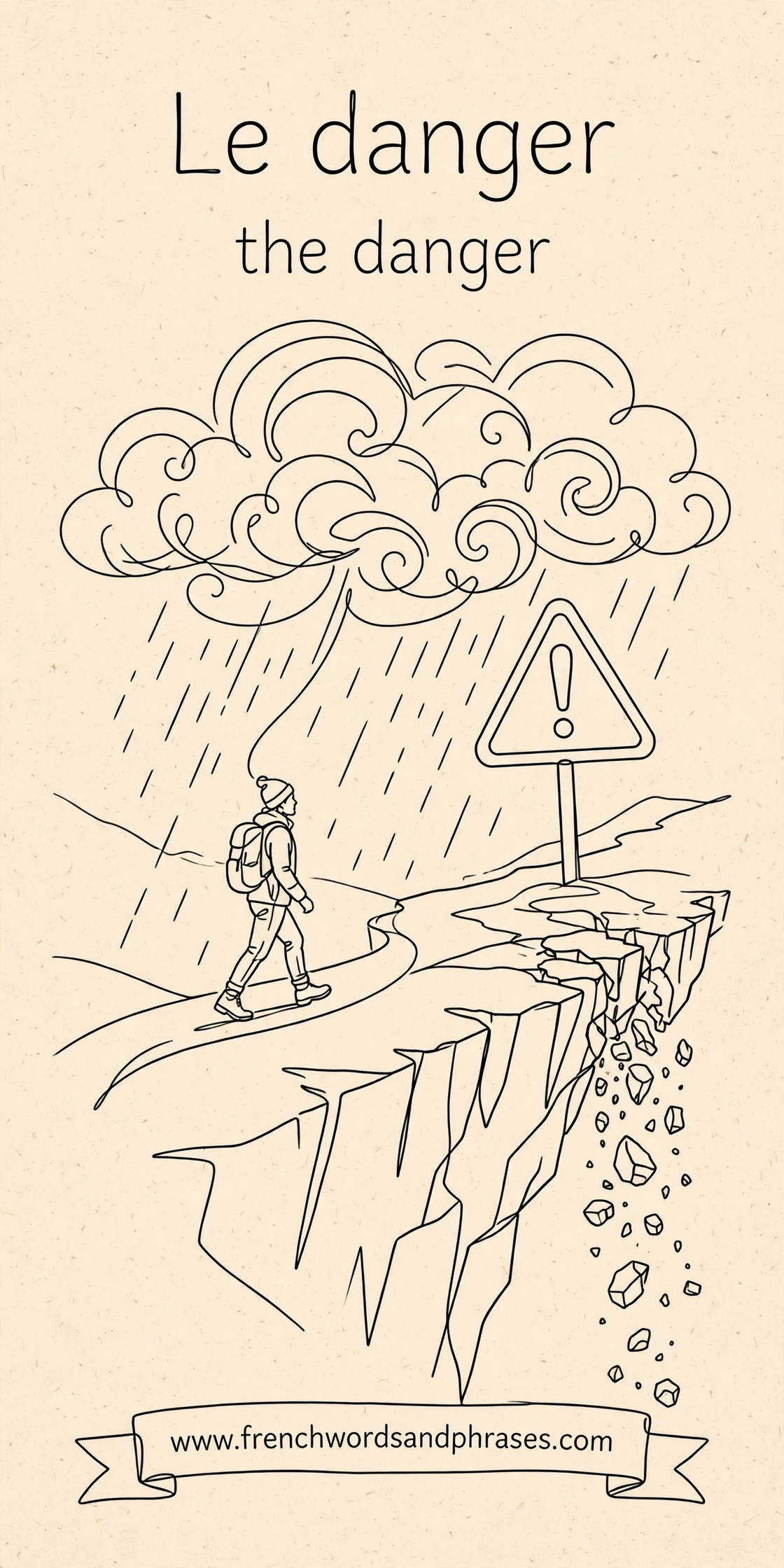
The red sign at the cliff edge, the ice on the morning road, the current under the calm river: le danger, the danger — the word that stands between the world and its warnings.
In this guide, you’ll learn what danger means in English, how to use it with its articles, how to form its plural, and how it appears in everyday French. Explore French examples, English translations, and practice quizzes.
Understanding the French Noun Danger
Danger is a masculine French noun, learned with its article: le danger, un danger. Its adjective is dangereux (feminine dangereuse), dangerous. French places people and things en danger, in danger, and rescues them hors de danger, out of danger — the two fixed frames of every rescue story.
It means danger — the risk of harm: un danger réel, a real danger, le danger d’incendie, the danger of fire, courir un danger, to run a risk. It names both the threat itself and the state of being threatened: être en danger, to be in danger, mettre quelqu’un en danger, to put someone in danger. On signs it stands alone, absolute: DANGER — with a skull, a cliff, or a bolt of lightning beneath.
Gender: Masculine — le danger
Definite article: le — le danger (the danger)
Indefinite article: un — un danger (a danger)
Plural: les dangers — regular, with a simple -s
Spelling note: the g before e stays soft: danger rhymes with manger
The two frames: en danger (in danger) — hors de danger (out of danger)
English equivalents: The danger, the risk, the hazard.
The preposition does the work: en danger is the state, hors de danger the rescue, and un danger de names the source: un danger d’avalanche. To face it bravely is affronter le danger; to run it, courir un danger. The adjective dangereux follows the noun: un chemin dangereux, a dangerous path.
Experience the Word
Danger is the word on the sign that everyone reads twice — the thin line between the path and the cliff.
Imagine the mountain refuge’s notice board in February: a red map, a crossed slope, one word at the top in capitals — DANGER D’AVALANCHE. The skiers study it in silence, and the whole room’s plans quietly change. The word has done its work before anyone clips a boot.
You have not just named a risk. You have named the warning itself — le danger, the danger, posted at every edge of the safe world.
How to Use Danger in French: Complete Guide
Let’s explore how danger works in French, beginning with its articles — le danger, un danger, en danger.
Danger with the Definite Article (Le, Les)
Used for a specific danger — the one on the sign, the one everyone fears.
| Form | French |
|---|---|
| Masculine singular | le danger |
| Plural | les dangers |
Example
Le danger vient de la rivière en crue.
The danger comes from the river in flood.
Danger with the Indefinite Article (Un, Des)
Used for a danger in general — any threat on the road of life.
| Form | French |
|---|---|
| Masculine singular | un danger |
| Plural | des dangers |
Example
La glace sur la route est un danger pour tous.
The ice on the road is a danger for everyone.
Danger with Its Frames (En, Hors de, De…)
In danger, out of danger, danger of — the prepositions draw the whole map of risk.
| Frame | French |
|---|---|
| to be in danger | être en danger |
| out of danger | hors de danger |
| a danger of fire | un danger d’incendie |
| to run a risk | courir un danger |
| to put in danger | mettre en danger |
Example
Après l’opération, le malade est hors de danger.
After the operation, the patient is out of danger.
Quick Quiz 1
Complete the sentence:
______ danger est passé, tout le monde va bien. (the)
Reveal the answer
Le
Le danger est passé, tout le monde va bien.
The danger has passed, everyone is well — danger is masculine, so le.
The Plural of Danger
Danger takes a regular plural in -s — the dangers of the road, of the sea, of the trade.
| Number | French |
|---|---|
| Singular | le danger |
| Plural | les dangers |
Example
Les dangers de la montagne sont réels en hiver.
The dangers of the mountains are real in winter.
Danger with Possessive Adjectives (Mon, Ton, Son…)
Possessives agree with the noun: danger is masculine, so mon, ton, son in the singular.
| Owner | French |
|---|---|
| my | mon danger |
| your (tu) | ton danger |
| his / her | son danger |
| our | notre danger |
| your (vous) | votre danger |
| their | leur danger |
Example
Il connaît son danger et avance prudemment.
He knows his danger and moves forward carefully.
Quick Quiz 2
Complete the sentence:
Les enfants sont ______ danger maintenant. (out of)
Reveal the answer
hors de
Les enfants sont hors de danger maintenant.
The children are out of danger now — the fixed rescue frame.
Danger with Demonstrative Adjectives (Ce, Ces)
Used to point: ce danger, this danger — the one ahead, the one on the board.
| Form | French |
|---|---|
| Masculine singular | ce danger |
| Plural | ces dangers |
Example
Ce danger guette tous les conducteurs fatigués.
This danger lies in wait for all tired drivers.
Danger with Adjectives
Adjectives agree with danger — masculine singular: un danger réel, un grand danger.
| Adjective | With Danger |
|---|---|
| réel (real) | un danger réel |
| grand (great) | un grand danger |
| imminent (imminent) | un danger imminent |
| caché (hidden) | un danger caché |
| mortel (deadly) | un danger mortel |
Example
Un danger caché vaut deux dangers visibles.
A hidden danger is worth two visible ones.
Quick Quiz 3
Complete the sentence:
C’est un danger ______ pour les petits bateaux. (real)
Reveal the answer
réel
C’est un danger réel pour les petits bateaux.
It is a real danger for small boats — réel agrees with the masculine noun.
Everyday Expressions with Danger
Signs, rescues and weather warnings — the danger phrases of daily life.
| Expression | In English |
|---|---|
| être en danger | to be in danger |
| hors de danger | out of danger |
| mettre en danger | to put in danger, to endanger |
| courir un danger | to run a risk |
| un danger public | a public danger, a menace |
Example
Ne mets pas les enfants en danger, ralentis.
Don’t put the children in danger, slow down.
Words from the Same Family as Danger
Risk and rescue — the words that travel with danger.
| French | In English |
|---|---|
| dangereux | dangerous (the adjective) |
| un risque | a risk — the close cousin |
| un secours | help, rescue |
| prudent | careful, prudent |
| un avertissement | a warning |
Example
Les secours arrivent toujours vite dans ce village.
Help always arrives quickly in this village.
Quick Quiz 4
What does hors de danger mean?
Reveal the answer
Out of danger — safe at last, the words every rescue ends with.
Le blessé est hors de danger.
The injured man is out of danger.
Danger in Everyday French: Real-Life Examples
Now that you know the word, let’s see how danger appears in everyday French.
Example 1 — The road
La glace sur la route est un vrai danger.
The ice on the road is a real danger.
Example 2 — The hospital
Bonne nouvelle : il est hors de danger.
Good news: he is out of danger.
Example 3 — Children
Ne laisse pas les petits près de l’eau sans surveillance, c’est un danger.
Don’t leave the little ones near the water unsupervised, it’s a danger.
Example 4 — The mountains
Les dangers d’avalanche sont annoncés à la radio.
The avalanche dangers are announced on the radio.
Example 5 — Courage
Les pompiers affrontent le danger chaque jour.
Firefighters face danger every day.
Example 6 — Warning
Ce panneau signale un danger caché.
This sign warns of a hidden danger.
Beyond Translation: The Meaning of Danger
Danger once meant something stranger than risk: in Old French, dangier was power, dominion — to be en dangier was to be in someone’s power, at their mercy. The word slid from the lord’s authority to the peril of being under it, and kept the feeling: danger is what has power over you. Modern French posts it at cliff edges and hospital doors alike, and answers it with its oldest comfort: hors de danger.
To say danger is to admit what has power over us — and to start watching it.
It evokes the red sign, the held breath and the rescuer’s voice — peril, and the way out of it.
How to Remember the French Noun Danger
Remember it this way: Danger is the danger — masculine: le danger, and its two frames are en danger and hors de danger.
- Always masculine — le danger, un danger, mon danger.
- The frames — en danger, in danger; hors de danger, out of danger.
- The adjective — dangereux, dangereuse: un chemin dangereux.
The key idea is le danger — the danger, masculine; en danger / hors de danger.
Test Your Knowledge of Danger
Let’s see how much you’ve learned. Try answering these questions before revealing the answers.
Question 1
Is danger masculine or feminine?
Reveal the answer
Masculine — le danger, un danger.
Question 2
How do you say to be in danger?
Reveal the answer
Être en danger.
Question 3
Translate: The patient is out of danger.
Reveal the answer
Le malade est hors de danger.
Question 4
What is the adjective from danger?
Reveal the answer
Dangereux (feminine dangereuse) — dangerous.
Question 5
Complete the sentence:
______ dangers de la mer sont nombreux. (the)
Reveal the answer
Les
Les dangers de la mer sont nombreux.
The dangers of the sea are many.
Your Final Challenge
Can You Use It?
How would you say this in French?
“Good news: he is out of danger.”
Reveal the answer
Bonne nouvelle : il est hors de danger.
Good news: he is out of danger.
A little French. A little curiosity. A richer everyday life.
LEARN FRENCH ONE WORD AT A TIME