A French Word to Live By
Translate Capital to English
/ka.pi.tal/
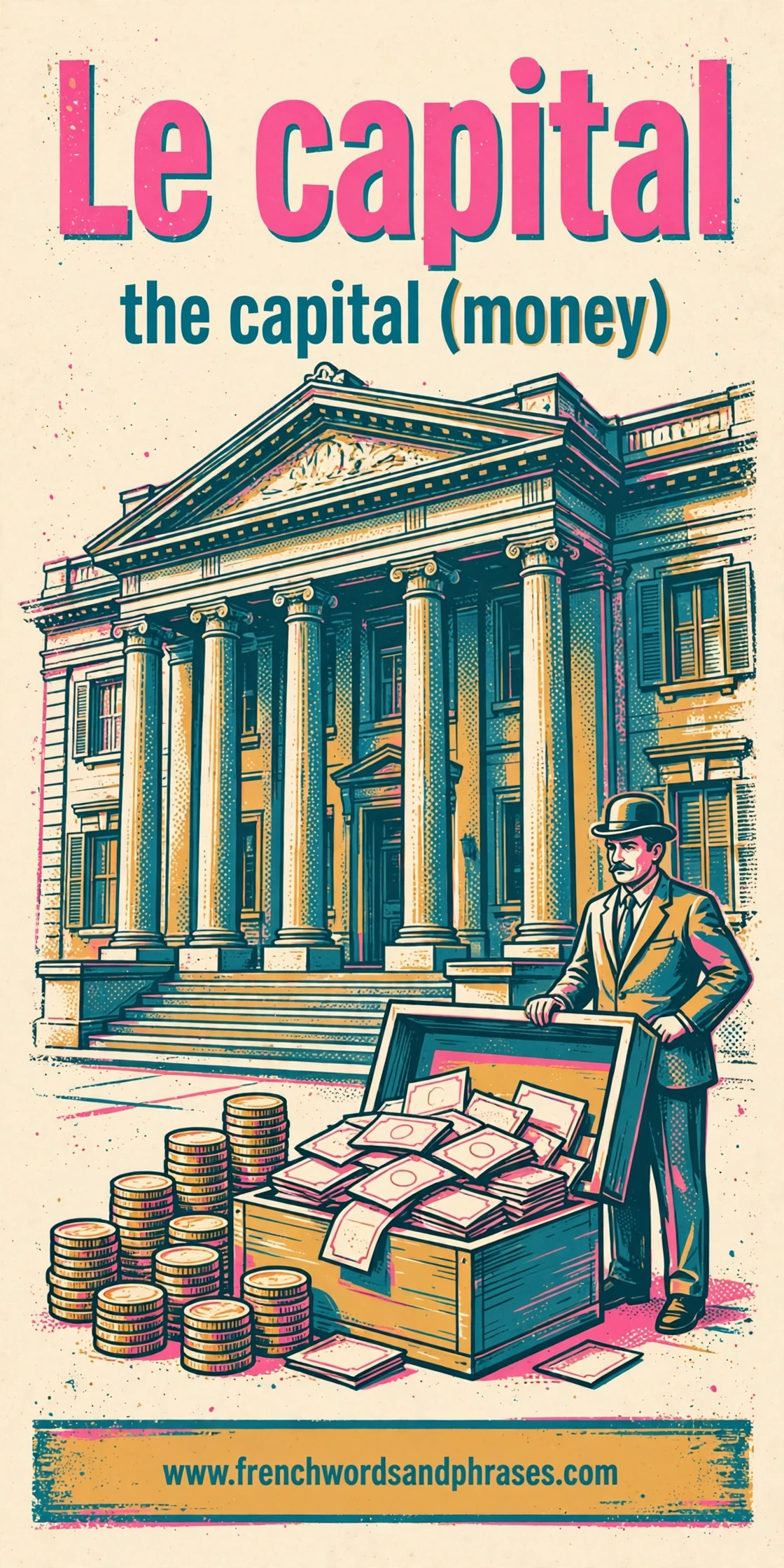
Le capital means the capital (money).
The sum a founder puts on the table, the savings a lifetime built, the fund a company grows from: le capital, the capital — money in its working clothes, the stock from which everything else is made.
In this guide, you’ll learn what capital means in English, how to use it with its articles, how to form its plural, and how it appears in everyday French. Explore French examples, English translations, and practice quizzes.
Understanding the French Noun Capital
Capital is a masculine French noun, learned with its article: le capital, un capital. Beware the famous twin: the capital city is feminine — la capitale, Paris est la capitale de la France. Le capital, masculine, is money and assets: the funds of a business, the wealth of a family.
It means capital in the money sense — the funds invested or owned: le capital d’une entreprise, a company’s capital, investir un capital, to invest capital, le capital de départ, the starting capital. It widens to any precious stock: un capital santé, one’s health capital, le capital sympathie, the goodwill someone has banked. The adjective capital exists too — une importance capitale, a capital, crucial importance.
Gender: Masculine — le capital
Definite article: le — le capital (the capital, money)
Indefinite article: un — un capital (capital, a sum)
Plural: les capitaux — with an x, like all nouns in -al
Spelling note: the city is la capitale (feminine); the money is le capital (masculine)
The widened sense: un capital santé, un capital sympathie — any stock worth keeping
English equivalents: The capital (funds, assets).
The gender is the whole lesson: le capital sits in the bank, la capitale sits on the map. The plural of capital is capitaux — les capitaux propres, equity, own funds. And the adjective capital (feminine capitale) means crucial: une question capitale, a crucial question — the same capitale spelling as the city, so context must steer.
Experience the Word
Capital is money pictured as a head — caput in Latin — the principal sum from which all the smaller sums descend.
Imagine the young baker signing at the notary’s: her savings, her parents’ loan, the bank’s promise, all gathered into one line of the deed — le capital. It is not yet the bakery, the oven or the first croissant; it is the possibility of all three, counted.
You have not just named money. You have named the seed sum — le capital, the capital, from which enterprises grow.
How to Use Capital in French: Complete Guide
Let’s explore how capital works in French, beginning with its articles — le capital, un capital, les capitaux.
Capital with the Definite Article (Le, Les)
Used for the capital in question — the company’s, the family’s, the bank’s.
| Form | French |
|---|---|
| Masculine singular | le capital |
| Plural | les capitaux |
Example
Le capital de la société a été doublé cette année.
The company’s capital was doubled this year.
Capital with the Indefinite Article (Un, Des)
Used for a capital sum in general — any fund waiting to work.
| Form | French |
|---|---|
| Masculine singular | un capital |
| Plural | des capitaux |
Example
Il faut un capital de départ pour ouvrir un commerce.
Starting capital is needed to open a business.
Capital with Its Frames (De départ, Propre, Santé…)
Capital is specified by its job — starting, own, or the widened stocks of health and goodwill.
| Frame | French |
|---|---|
| starting capital | le capital de départ |
| equity, own funds | les capitaux propres |
| health capital | le capital santé |
| to invest capital | investir un capital |
| to increase the capital | augmenter le capital |
Example
Son capital santé, elle le protège en marchant chaque jour.
Her health capital — she protects it by walking every day.
Quick Quiz 1
Complete the sentence:
______ capital de l’entreprise a augmenté. (the)
Reveal the answer
Le
Le capital de l’entreprise a augmenté.
The company’s capital has increased — capital (money) is masculine, so le.
The Plural of Capital
Capital takes the -al plural in -aux: capitaux, like chevaux and journaux.
| Number | French |
|---|---|
| Singular | le capital |
| Plural | les capitaux |
Example
Les capitaux étrangers arrivent dans la région.
Foreign capital is arriving in the region.
Capital with Possessive Adjectives (Mon, Ton, Son…)
Possessives agree with the noun: capital is masculine, so mon, ton, son in the singular.
| Owner | French |
|---|---|
| my | mon capital |
| your (tu) | ton capital |
| his / her | son capital |
| our | notre capital |
| your (vous) | votre capital |
| their | leur capital |
Example
Elle a placé son capital dans une petite entreprise.
She placed her capital in a small business.
Quick Quiz 2
Complete the sentence:
Il a investi tout ______ capital dans son atelier. (his)
Reveal the answer
son
Il a investi tout son capital dans son atelier.
He invested all his capital in his workshop — son, because capital is masculine.
Capital with Demonstrative Adjectives (Ce, Ces)
Used to point: ce capital, this capital — this fund, this sum on the table.
| Form | French |
|---|---|
| Masculine singular | ce capital |
| Plural | ces capitaux |
Example
Ce capital suffira pour rénover la boutique.
This capital will be enough to renovate the shop.
Capital with Adjectives
Adjectives agree with capital — masculine singular: un capital important, le capital initial.
| Adjective | With Capital |
|---|---|
| important (substantial) | un capital important |
| initial (initial) | le capital initial |
| propre (own — equity) | les capitaux propres |
| disponible (available) | un capital disponible |
| énorme (enormous) | un énorme capital |
Example
Le capital initial était modeste, l’affaire a grandi lentement.
The initial capital was modest, the business grew slowly.
Quick Quiz 3
Complete the sentence:
Paris est la ______ de la France. (capital city)
Reveal the answer
capitale
Paris est la capitale de la France.
The city is feminine — la capitale; the money is le capital.
Everyday Expressions with Capital
Banks, businesses and widened stocks — the capital phrases of daily life.
| Expression | In English |
|---|---|
| le capital de départ | the starting capital |
| les capitaux propres | equity, shareholders’ funds |
| investir un capital | to invest capital |
| le capital santé | one’s health capital (stock of health) |
| une importance capitale | crucial importance (adjective) |
Example
Ce détail est d’une importance capitale pour le dossier.
This detail is of crucial importance for the file.
Words from the Same Family as Capital
Heads and funds — the words that travel with capital.
| French | In English |
|---|---|
| la capitale | the capital city — the feminine twin |
| le capitalisme | capitalism |
| un investissement | an investment |
| la tête | the head — caput, the Latin root |
| épargner | to save (money) |
Example
Elle épargne chaque mois pour son capital de départ.
She saves every month towards her starting capital.
Quick Quiz 4
Le capital or la capitale — which one is in the bank?
Reveal the answer
Le capital — masculine, the money. La capitale, feminine, is the city.
Le capital dort à la banque ; la capitale ne dort jamais.
The capital sleeps in the bank; the capital city never sleeps.
Capital in Everyday French: Real-Life Examples
Now that you know the word, let’s see how capital appears in everyday French.
Example 1 — Business
Le capital de départ était de vingt mille euros.
The starting capital was twenty thousand euros.
Example 2 — The bank
Il a placé son capital dans des actions sûres.
He placed his capital in safe shares.
Example 3 — The map
La capitale de l’Espagne est Madrid.
The capital of Spain is Madrid.
Example 4 — Health
Dormir assez protège ton capital santé.
Sleeping enough protects your health capital.
Example 5 — Importance
C’est une question capitale pour l’avenir du village.
It is a crucial question for the village’s future.
Example 6 — Growth
Les capitaux propres de la société ont doublé.
The company’s equity has doubled.
Beyond Translation: The Meaning of Capital
Capital is Latin caput, the head, wearing a suit: the head sum, the principal, from which interest and profit are the offspring. French split the inheritance by gender — le capital for the fund, la capitale for the chief city, each the « head » of its own world. Modern French then stretched the money word over every stock worth husbanding: health, goodwill, even beauty have their capital, spent or saved like money.
To say capital is to count the seed, not the harvest.
It evokes the notary’s deed, the founder’s signature and the saver’s patience — beginnings, measured in sums.
How to Remember the French Noun Capital
Remember it this way: Capital is the money — masculine: le capital. The city is the twin: la capitale, feminine.
- The gender split — le capital in the bank, la capitale on the map.
- The plural — les capitaux, with -aux, like chevaux.
- The widened stocks — le capital santé, le capital sympathie.
The key idea is le capital — the capital (money), masculine; la capitale = the capital city.
Test Your Knowledge of Capital
Let’s see how much you’ve learned. Try answering these questions before revealing the answers.
Question 1
Is capital (money) masculine or feminine?
Reveal the answer
Masculine — le capital, un capital.
Question 2
How do you say the capital city?
Reveal the answer
La capitale — feminine: Paris est la capitale.
Question 3
Translate: The starting capital was modest.
Reveal the answer
Le capital de départ était modeste.
Question 4
What is the plural of capital?
Reveal the answer
Capitaux — the -al nouns take -aux: les capitaux propres, equity.
Question 5
Complete the sentence:
______ capitaux arrivent de l’étranger. (the)
Reveal the answer
Les
Les capitaux arrivent de l’étranger.
Capital (funds) is flowing in from abroad.
Your Final Challenge
Can You Use It?
How would you say this in French?
“Starting capital is needed to open a business.”
Reveal the answer
Il faut un capital de départ pour ouvrir un commerce.
Starting capital is needed to open a business.
A little French. A little curiosity. A richer everyday life.
LEARN FRENCH ONE WORD AT A TIME