A French Word to Live By
Translate Décès to English
/de.sɛ/
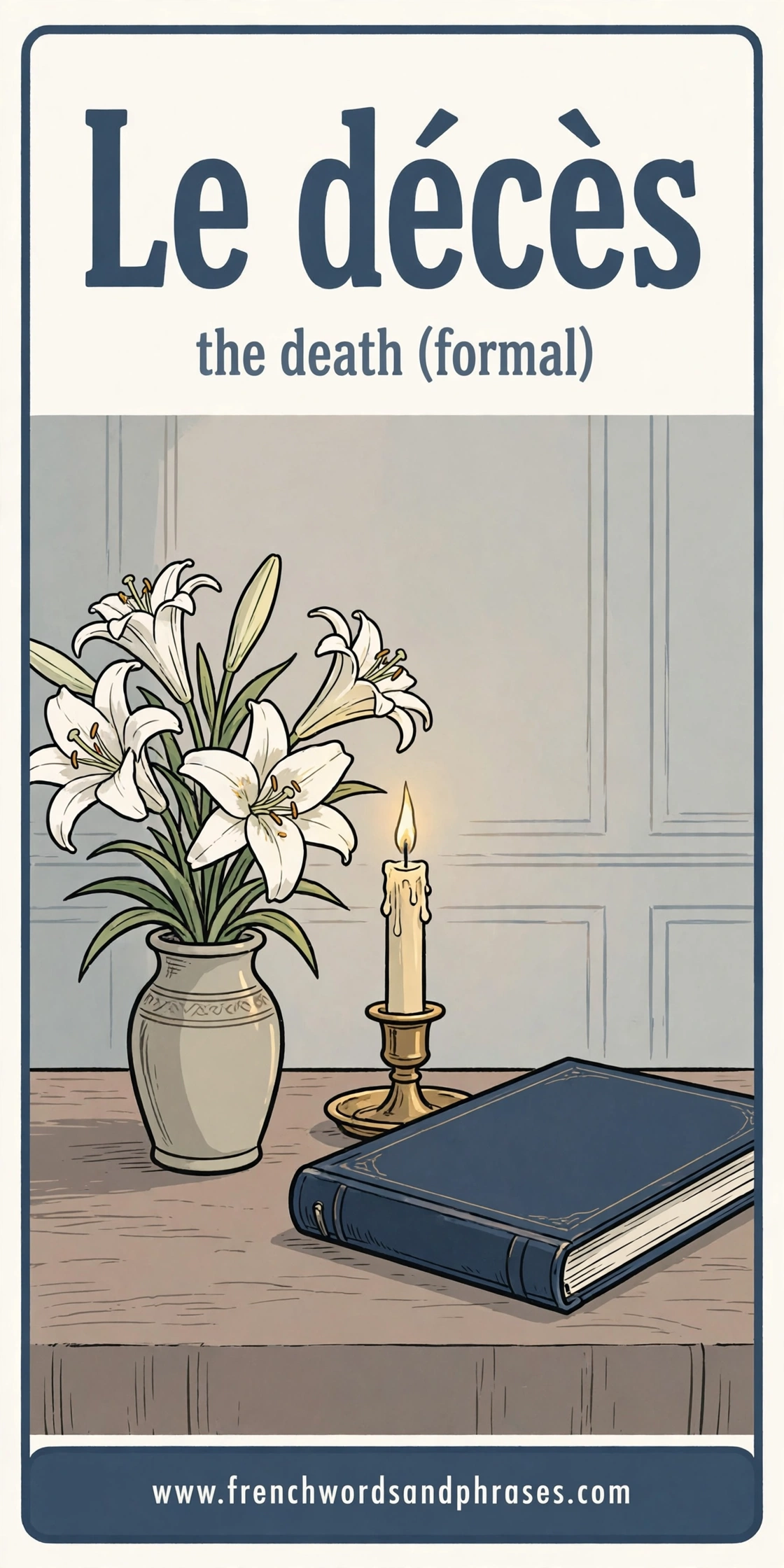
Le décès means a death (formal).
It is the word on the official form, in the registrar’s careful handwriting, in the newspaper’s smallest print: le décès, a death — the formal, administrative word French uses when a life is recorded as ended.
In this guide, you’ll learn what décès means in English, how to use it with its articles, how to form its plural, and how it appears in everyday French. Explore French examples, English translations, and practice quizzes.
Understanding the French Noun Décès
Décès is a masculine French noun, learned with its article: le décès, un décès. It belongs to the formal register: it is the word of town halls, hospitals, insurance files and obituaries. Everyday French more often says la mort for death itself, and il est mort for « he died » — décès is the death as an event to be declared, certified and announced.
It means a death — the passing of a person, in formal language: annoncer un décès, to announce a death, un certificat de décès, a death certificate, la date du décès, the date of death. The verb of the register office is décéder, to pass away, and the person is le défunt or la défunte, the deceased. Statistics count it coldly: le nombre de décès, the number of deaths.
Gender: Masculine — le décès
Definite article: le — le décès (the death)
Indefinite article: un — un décès (a death)
Plural: les décès — written the same, with a final -s already in the singular
Spelling note: the singular already ends in -s: un décès, des décès — the word does not change
Register: formal and administrative — la mort is the everyday word
English equivalents: A death; a passing (formal).
Use décès where French uses it: on forms and in announcements — déclarer un décès à la mairie, to register a death at the town hall, un avis de décès, a death notice in the newspaper. For the fact of death in ordinary speech, choose la mort; for « he has died », il est décédé is the formal phrase, il est mort the everyday one. The adjective for the person is défunt: son défunt père, his late father.
Experience the Word
Décès is death wearing its official clothes: measured, dated, signed — the moment a private grief becomes a line in a register.
Imagine the small office at the mairie, the clerk opening the heavy book, the family speaking quietly — le décès est déclaré, and a whole life is given its final date with care and respect.
You have not just named an ending. You have named the formal farewell — le décès, the death as the record keeps it.
How to Use Décès in French: Complete Guide
Let’s explore how décès works in French, beginning with its articles — le décès, un décès, un certificat de décès.
Décès with the Definite Article (Le, Les)
Used for a specific death — the one being announced or recorded.
| Form | French |
|---|---|
| Masculine singular | le décès |
| Plural | les décès |
Example
Le décès a été annoncé ce matin.
The death was announced this morning.
Décès with the Indefinite Article (Un, Des)
Used for a death in general — one death among the records.
| Form | French |
|---|---|
| Masculine singular | un décès |
| Plural | des décès |
Example
Un décès a été signalé dans la nuit.
A death was reported during the night.
Décès in Its Official Phrases (Certificat, avis, date…)
Décès lives in the paperwork of farewell — certificates, notices and dates.
| Item | French |
|---|---|
| a death certificate | un certificat de décès |
| a death notice (newspaper) | un avis de décès |
| the date of death | la date du décès |
| to announce a death | annoncer un décès |
| to register a death | déclarer un décès |
Example
Il faut un certificat de décès pour les démarches.
A death certificate is needed for the formalities.
Quick Quiz 1
Complete the sentence:
______ décès de son grand-père l’a beaucoup touchée. (the)
Reveal the answer
Le
Le décès de son grand-père l’a beaucoup touchée.
Her grandfather’s death affected her deeply — décès is masculine, so le.
The Plural of Décès
Décès already ends in -s in the singular, so the plural is written identically — only the article changes.
| Number | French |
|---|---|
| Singular | le décès |
| Plural | les décès |
Example
Le journal publie les décès de la semaine.
The newspaper publishes the week’s deaths.
Décès with Possessive Adjectives (Mon, Ton, Son…)
Possessives agree with the noun: décès is masculine, so mon, ton, son in the singular.
| Owner | French |
|---|---|
| my | mon décès |
| your (tu) | ton décès |
| his / her | son décès |
| our | notre décès |
| your (vous) | votre décès |
| their | leur décès |
Example
Après son décès, la maison est restée vide.
After his death, the house stayed empty.
Quick Quiz 2
Complete the sentence:
La famille a annoncé ______ décès dans le journal. (his)
Reveal the answer
son
La famille a annoncé son décès dans le journal.
The family announced his death in the newspaper — son, because décès is masculine.
Décès with Demonstrative Adjectives (Ce, Ces)
Used to point: ce décès, this death — this loss, spoken of with care.
| Form | French |
|---|---|
| Masculine singular | ce décès |
| Plural | ces décès |
Example
Ce décès a ému tout le village.
This death moved the whole village.
Décès with Adjectives
Adjectives agree with décès — masculine singular: un décès soudain, un décès récent.
| Adjective | With Décès |
|---|---|
| soudain (sudden) | un décès soudain |
| récent (recent) | un décès récent |
| brutal (sudden, harsh) | un décès brutal |
| naturel (natural) | un décès naturel |
| officiel (official) | un décès officiel |
Example
Son décès soudain a surpris tout le monde.
His sudden death surprised everyone.
Quick Quiz 3
Complete the sentence:
C’est un décès très ______, il avait quatre-vingt-quinze ans. (natural)
Reveal the answer
naturel
C’est un décès très naturel, il avait quatre-vingt-quinze ans.
It is a very natural death, he was ninety-five — naturel, masculine, to agree with décès.
Everyday Expressions with Décès
Formal phrases, met with respect — the décès phrases of official and family life.
| Expression | In English |
|---|---|
| un certificat de décès | a death certificate |
| un avis de décès | a death notice, an obituary notice |
| annoncer un décès | to announce a death |
| la date du décès | the date of death |
| le nombre de décès | the number of deaths |
Example
L’avis de décès paraît demain dans le journal.
The death notice appears in tomorrow’s newspaper.
Words from the Same Family as Décès
Endings and farewells — the words that travel with décès.
| French | In English |
|---|---|
| décéder | to pass away, to die (formal verb) |
| la mort | death — the everyday word |
| le défunt / la défunte | the deceased (person) |
| les funérailles | the funeral |
| le deuil | mourning, grief |
Example
Le défunt était aimé de tout le quartier.
The deceased was loved by the whole neighbourhood.
Quick Quiz 4
What is un certificat de décès?
Reveal the answer
A death certificate — the official document recording a death.
La mairie délivre le certificat de décès.
The town hall issues the death certificate.
Décès in Everyday French: Real-Life Examples
Now that you know the word, let’s see how décès appears in everyday French.
Example 1 — The announcement
La famille a annoncé le décès hier.
The family announced the death yesterday.
Example 2 — At the town hall
Il faut déclarer le décès à la mairie.
The death must be registered at the town hall.
Example 3 — The certificate
Le certificat de décès est prêt.
The death certificate is ready.
Example 4 — The notice
L’avis de décès est dans le journal de ce matin.
The death notice is in this morning’s newspaper.
Example 5 — After
Après son décès, ses lettres ont été publiées.
After his death, his letters were published.
Example 6 — Statistics
Le nombre de décès a baissé cette année.
The number of deaths fell this year.
Beyond Translation: The Meaning of Décès
French keeps two words for the end of a life, and the difference is a whole culture: la mort is the fact — ancient, blunt, poetic — while le décès is the event as society handles it, with forms, dates and notices. Décès comes from the Latin decessus, a departure: the formal word still pictures death politely as a leaving. That is why the register office does not record that someone « est mort » but that le décès is declared — the paperwork softens what the heart cannot.
To say décès is to speak of death the way France files it — with dignity, dates and a signature.
It evokes the heavy register at the mairie, the small print of the avis de décès, and the quiet respect of official words.
How to Remember the French Noun Décès
Remember it this way: Décès is the formal word for a death — masculine: le décès, the word of certificates and announcements; la mort is the everyday word.
- Always masculine — le décès, un décès, son décès.
- The spelling trap — the singular already ends in -s: un décès, des décès, unchanged.
- The register — décès for forms and notices; la mort for everyday speech.
The key idea is le décès — a death (formal), masculine; singular already ends in -s.
Test Your Knowledge of Décès
Let’s see how much you’ve learned. Try answering these questions before revealing the answers.
Question 1
Is décès masculine or feminine?
Reveal the answer
Masculine — le décès, un décès.
Question 2
How do you say a death certificate?
Reveal the answer
Un certificat de décès.
Question 3
Translate: The family announced the death yesterday.
Reveal the answer
La famille a annoncé le décès hier.
Question 4
What is the everyday French word for death?
Reveal the answer
La mort — décès is the formal, administrative word.
Question 5
Complete the sentence:
______ décès de la semaine sont publiés le jeudi. (the)
Reveal the answer
Les
Les décès de la semaine sont publiés le jeudi.
The week’s deaths are published on Thursday.
Your Final Challenge
Can You Use It?
How would you say this in French?
“The death must be registered at the town hall.”
Reveal the answer
Il faut déclarer le décès à la mairie.
The death must be registered at the town hall.
A little French. A little curiosity. A richer everyday life.
LEARN FRENCH ONE WORD AT A TIME