A French Word to Live By
Translate Fruit to English
/fʁɥi/
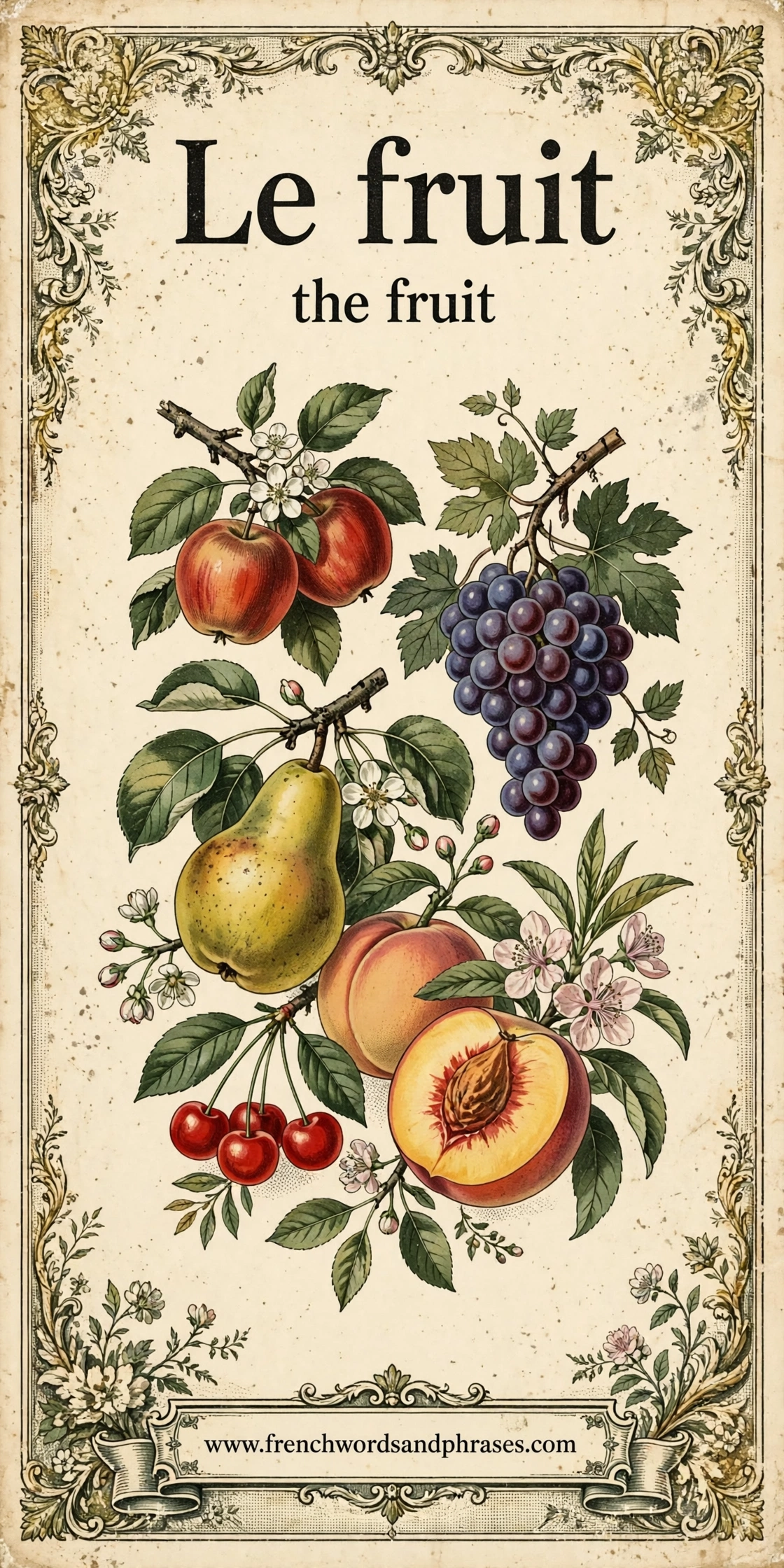
Le fruit means the fruit.
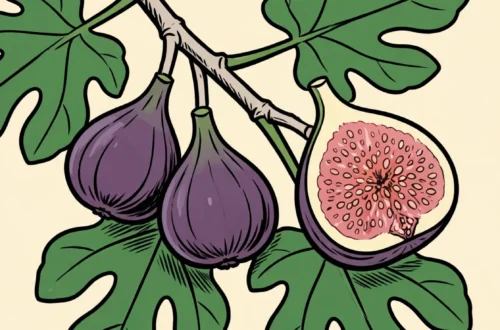
The apple in the lunchbox, the figs warm from the tree, the market stall piled with colour: le fruit, the fruit — the orchard’s gift, and French’s favourite picture of a reward that ripens slowly.
In this guide, you’ll learn what fruit means in English, how to use it with its articles, how to form its plural, and how it appears in everyday French. Explore French examples, English translations, and practice quizzes.
Understanding the French Noun Fruit
Fruit is a masculine French noun, learned with its article: le fruit, un fruit. It names both one piece — un fruit, an apple, a pear — and the whole family at table: les fruits, fruit in general, served en dessert. Figuratively, work and patience bear it: le fruit de son travail, the fruit of one’s labour.
It means fruit — the edible product of trees and plants: un fruit mûr, a ripe fruit, des fruits frais, fresh fruit, un jus de fruits, a fruit juice, une salade de fruits, a fruit salad. The orchard shelf is rich: les fruits rouges, red berries; les fruits secs, dried fruit and nuts; les fruits de mer — seafood, the fruit of the sea, shellfish above all. And the figurative sense is everywhere: porter ses fruits, to bear fruit, to pay off.
Gender: Masculine — le fruit
Definite article: le — le fruit (the fruit)
Indefinite article: un — un fruit (a fruit, one piece)
Plural: les fruits — fruit in general, and fruits of every kind
Spelling note: the final t is silent: fruit sounds like the pronoun lui with an fr-
The sea’s harvest: les fruits de mer — seafood, shellfish
English equivalents: The fruit, a piece of fruit.
Counting matters: un fruit is one piece, and a doctor’s advice in French runs cinq fruits et légumes par jour — five portions of fruit and vegetables a day. For fruit in general, the plural is natural: j’adore les fruits. The figurative frames: le fruit de + noun — le fruit de son travail, de sa patience, de ses efforts.
Experience the Word
Fruit is the year’s patience made edible — blossom in April, shade in June, and sweetness in September, all in one word.
Imagine the orchard at the end of summer: ladders against the pear trees, baskets filling, the air smelling of sugar and warm leaves. Le fruit se cueille à la main, one by one — the harvest is the slowest shopping in the world, and the most satisfying.
You have not just named a dessert. You have named ripeness itself — le fruit, the fruit, of the tree and of the work.
How to Use Fruit in French: Complete Guide
Let’s explore how fruit works in French, beginning with its articles — le fruit, un fruit, les fruits de mer.
Fruit with the Definite Article (Le, Les)
Used for fruit in general, or the specific fruit in question — ripe, forbidden, or just picked.
| Form | French |
|---|---|
| Masculine singular | le fruit |
| Plural | les fruits |
Example
Le fruit tombe de l’arbre quand il est mûr.
The fruit falls from the tree when it is ripe.
Fruit with the Indefinite Article (Un, Des)
Un fruit is one piece — an apple, a fig — and des fruits fills the basket.
| Form | French |
|---|---|
| Masculine singular | un fruit |
| Plural | des fruits |
Example
Elle mange un fruit à la fin de chaque repas.
She eats a piece of fruit at the end of every meal.
Fruit with Quantities and Kinds (Frais, Rouges, Secs…)
Fruit is counted by the piece and sorted by family — fresh, red, dried, or from the sea.
| Quantity | French |
|---|---|
| five fruit and vegetables a day | cinq fruits et légumes par jour |
| fresh fruit | des fruits frais |
| red berries | les fruits rouges |
| dried fruit and nuts | les fruits secs |
| seafood | les fruits de mer |
Example
Au dessert, je prends des fruits frais.
For dessert, I’ll have fresh fruit.
Quick Quiz 1
Complete the sentence:
______ fruit de cet arbre est sucré. (the)
Reveal the answer
Le
Le fruit de cet arbre est sucré.
The fruit of this tree is sweet — fruit is masculine, so le.
The Plural of Fruit
Fruit takes a regular plural in -s — the plural of markets, desserts and harvests.
| Number | French |
|---|---|
| Singular | le fruit |
| Plural | les fruits |
Example
Les fruits du marché sentent le soleil.
The fruit at the market smells of the sun.
Fruit with Possessive Adjectives (Mon, Ton, Son…)
Possessives agree with the noun: fruit is masculine, so mon, ton, son in the singular.
| Owner | French |
|---|---|
| my | mon fruit |
| your (tu) | ton fruit |
| his / her | son fruit |
| our | notre fruit |
| your (vous) | votre fruit |
| their | leur fruit |
Example
L’enfant cache son fruit pour le goûter.
The child hides his fruit for the afternoon snack.
Quick Quiz 2
Complete the sentence:
Ce travail est le fruit de ______ patience. (his/her)
Reveal the answer
sa
Ce travail est le fruit de sa patience.
This work is the fruit of her patience — sa agrees with patience, the feminine noun it belongs to.
Fruit with Demonstrative Adjectives (Ce, Ces)
Used to point: ce fruit, this fruit — the ripe one, the strange one.
| Form | French |
|---|---|
| Masculine singular | ce fruit |
| Plural | ces fruits |
Example
Ce fruit exotique vient d’Asie.
This exotic fruit comes from Asia.
Fruit with Adjectives
Adjectives agree with fruit — masculine singular: un fruit mûr, un fruit frais.
| Adjective | With Fruit |
|---|---|
| mûr (ripe) | un fruit mûr |
| frais (fresh) | un fruit frais |
| sucré (sweet) | un fruit sucré |
| exotique (exotic) | un fruit exotique |
| défendu (forbidden) | le fruit défendu |
Example
Le fruit défendu attire toujours les enfants.
Forbidden fruit always attracts children.
Quick Quiz 3
Complete the sentence:
Choisis un fruit bien ______, pas vert. (ripe)
Reveal the answer
mûr
Choisis un fruit bien mûr, pas vert.
Choose a really ripe fruit, not a green one — mûr agrees with the masculine noun.
Everyday Expressions with Fruit
Orchards, desserts and proverbs — the fruit phrases of daily life.
| Expression | In English |
|---|---|
| les fruits de mer | seafood, shellfish |
| le fruit de son travail | the fruit of one’s labour |
| porter ses fruits | to bear fruit, to pay off |
| un jus de fruits | a fruit juice |
| le fruit défendu | forbidden fruit |
Example
Ses efforts ont fini par porter leurs fruits.
His efforts ended up bearing fruit.
Words from the Same Family as Fruit
Orchards and harvests — the words that travel with fruit.
| French | In English |
|---|---|
| un verger | an orchard |
| mûrir | to ripen (the verb) |
| une récolte | a harvest, a crop |
| un fruitier | a fruit seller; also a fruit bowl/tree |
| cueillir | to pick, to gather |
Example
On cueille les pommes du verger en septembre.
The apples are picked from the orchard in September.
Quick Quiz 4
What are les fruits de mer?
Reveal the answer
Seafood — literally the fruit of the sea: shellfish, prawns, oysters and their kin.
Le plateau de fruits de mer arrive avec du citron.
The seafood platter arrives with lemon.
Fruit in Everyday French: Real-Life Examples
Now that you know the word, let’s see how fruit appears in everyday French.
Example 1 — Dessert
Je prends un fruit, merci, pas de gâteau.
I’ll have a piece of fruit, thank you, no cake.
Example 2 — Health
Cinq fruits et légumes par jour, dit le médecin.
Five fruit and vegetables a day, says the doctor.
Example 3 — The market
Les fruits rouges sont arrivés : fraises et cerises !
The red berries have arrived: strawberries and cherries!
Example 4 — Seafood
Le plateau de fruits de mer est pour deux personnes.
The seafood platter is for two people.
Example 5 — Work
Ce livre est le fruit de dix ans de travail.
This book is the fruit of ten years of work.
Example 6 — The orchard
Les fruits mûrissent plus vite cette année.
The fruit is ripening faster this year.
Beyond Translation: The Meaning of Fruit
Fruit descends from Latin fructus — enjoyment, produce, profit, all in one: what a tree, a field or an effort yields for our use. French kept the whole inheritance: the orchard’s produce, the table’s dessert, and the reward of patience — le fruit de son travail is still the noblest compliment paid to slow work. Even the sea was made an orchard: les fruits de mer.
To say fruit is to say that waiting has become sweetness.
It evokes the ladder in the pear tree, the market’s coloured stalls and the first bite of September — ripeness, in fruit and in life.
How to Remember the French Noun Fruit
Remember it this way: Fruit is the fruit — masculine: le fruit, un fruit for one piece, and les fruits de mer for seafood.
- Always masculine — le fruit, un fruit, mon fruit.
- One piece — un fruit; in general, les fruits: j’adore les fruits.
- The sea’s orchard — les fruits de mer, seafood.
The key idea is le fruit — the fruit, masculine; les fruits de mer = seafood.
Test Your Knowledge of Fruit
Let’s see how much you’ve learned. Try answering these questions before revealing the answers.
Question 1
Is fruit masculine or feminine?
Reveal the answer
Masculine — le fruit, un fruit.
Question 2
How do you say a piece of fruit?
Reveal the answer
Un fruit — one apple, one pear, one piece.
Question 3
Translate: This book is the fruit of ten years of work.
Reveal the answer
Ce livre est le fruit de dix ans de travail.
Question 4
What are les fruits rouges?
Reveal the answer
Red berries — strawberries, cherries, raspberries and their family.
Question 5
Complete the sentence:
______ fruits de mer arrivent ce matin. (the)
Reveal the answer
Les
Les fruits de mer arrivent ce matin.
The seafood arrives this morning.
Your Final Challenge
Can You Use It?
How would you say this in French?
“His efforts ended up bearing fruit.”
Reveal the answer
Ses efforts ont fini par porter leurs fruits.
His efforts ended up bearing fruit.
A little French. A little curiosity. A richer everyday life.
LEARN FRENCH ONE WORD AT A TIME