A French Word to Live By
Translate Degré to English
/də.ɡʁe/
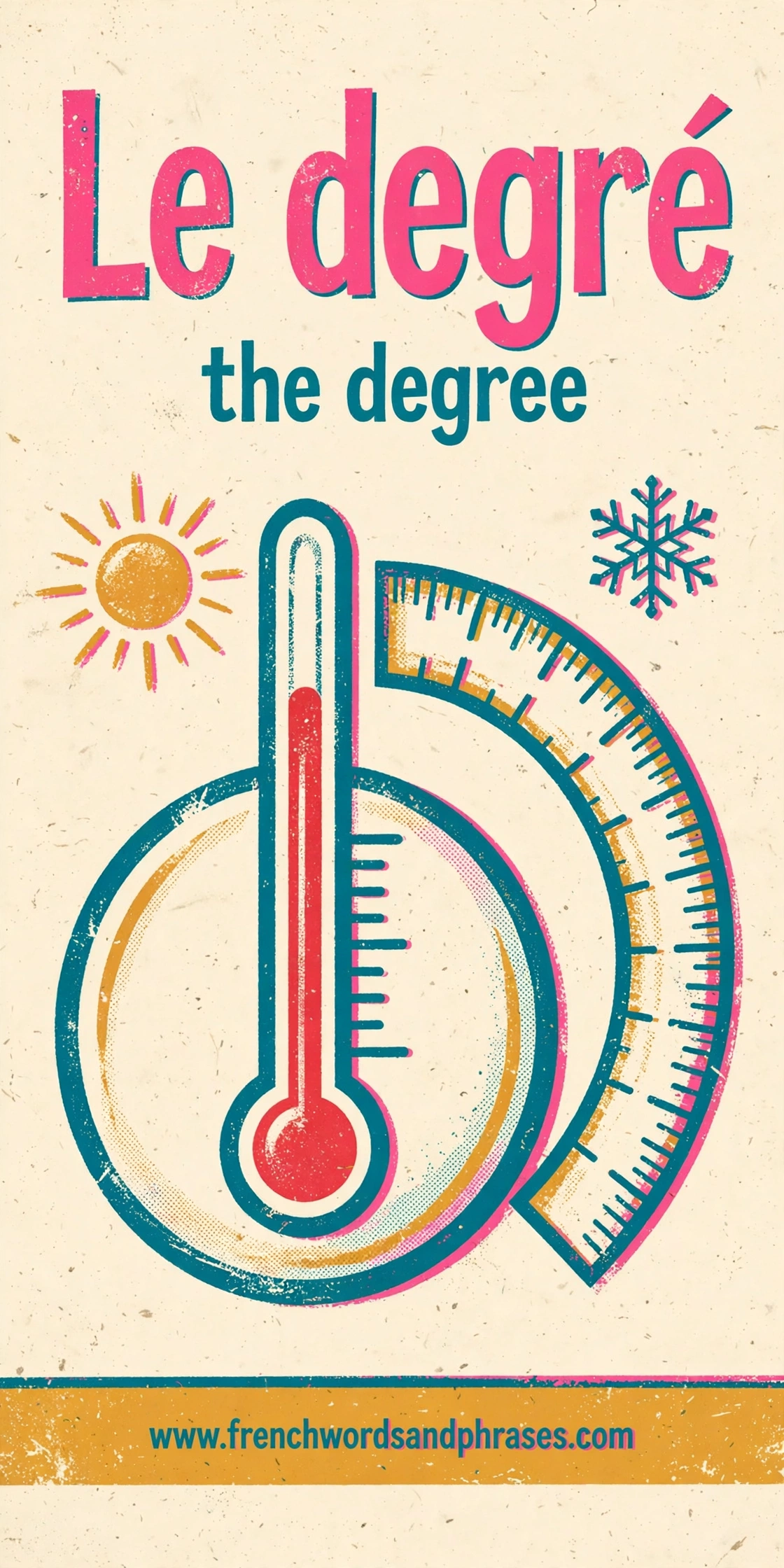
Le degré means the degree.
The thermometer climbs past thirty, the compass needle settles on north, the sauce burns au troisième degré: le degré, the degree — the little step by which French measures heat, angles, kinship and everything else that climbs by stages.
In this guide, you’ll learn what degré means in English, how to use it with its articles, how to form its plural, and how it appears in everyday French. Explore French examples, English translations, and practice quizzes.
Understanding the French Noun Degré
Degré is a masculine French noun, learned with its article: le degré, un degré. It comes from the Latin degradus — a step down (or up) a stair. The stair is still inside the word: degrees are steps — of temperature (trente degrés), of angles (un angle de quatre-vingt-dix degrés), of family closeness (le degré de parenté), and of intensity in set phrases like au plus haut degré, to the highest degree.
Its most spoken life is the weather: il fait vingt degrés, it is twenty degrees — in France, always Celsius unless stated. Then the angle: un angle droit mesure quatre-vingt-dix degrés. Then the scale of everything else: un degré d’alcool, a degree of alcohol in wine; des brûlures au deuxième degré, second-degree burns; le second degré, the figurative, ironic sense of words — a very French idea: prendre au second degré, to take something ironically, not literally.
Gender: Masculine — le degré
Definite article: le — le degré (the degree)
Indefinite article: un — un degré (a degree)
Plural: les degrés — regular, with a simple -s
Spelling note: from Latin degradus, a step of a stair — degrees are steps
Home ground: temperature (Celsius), angles, and scales of intensity
English equivalents: The degree.
For weather, French drops the word Celsius: il fait trente degrés is complete. The symbol follows the number with no space in careful French typography: 30 °C. The trap for learners is the university sense: a degree (diploma) is un diplôme, never un degré. And keep the ironic treasure: l’humour au second degré, humour to be taken with a pinch of salt.
Experience the Word
Degré is the step of every stair the world climbs — heat, angles, wine and jokes all rise by degrés.
Imagine the village square in August, the pharmacy thermometer glowing green at trente-huit degrés: strangers who have never spoken nod at it and agree — aujourd’hui, il fait un degré de trop, today is one degree too many.
You have not just named a unit. You have named the step itself — le degré, by which everything intensifies.
How to Use Degré in French: Complete Guide
Let’s explore how degré works in French, beginning with its articles — le degré, un degré, trente degrés.
Degré with the Definite Article (Le, Les)
Used for a specific degree — the temperature, the angle, the level in question.
| Form | French |
|---|---|
| Masculine singular | le degré |
| Plural | les degrés |
Example
Le degré d’alcool de ce vin est de douze.
The alcohol degree of this wine is twelve.
Degré with the Indefinite Article (Un, Des)
Used for a degree in general — one step on any scale.
| Form | French |
|---|---|
| Masculine singular | un degré |
| Plural | des degrés |
Example
Un degré de plus et l’eau bout.
One more degree and the water boils.
Degré in Numbers (Trente degrés…)
The degree lives in numbers — weather first, then angles and alcohol.
| Quantity | French |
|---|---|
| twenty degrees | vingt degrés |
| below zero | moins cinq degrés — five degrees below zero |
| ninety degrees (angle) | quatre-vingt-dix degrés |
| twelve degrees (wine) | douze degrés d’alcool |
| to rise by three degrees | monter de trois degrés |
Example
Demain, il fera vingt-cinq degrés.
Tomorrow, it will be twenty-five degrees.
Quick Quiz 1
Complete the sentence:
______ degré de parenté entre cousins est le quatrième. (the)
Reveal the answer
Le
Le degré de parenté entre cousins est le quatrième.
The degree of kinship between cousins is the fourth — degré is masculine, so le.
The Plural of Degré
Degré takes a regular plural in -s — thermometers and protractors live in the plural.
| Number | French |
|---|---|
| Singular | le degré |
| Plural | les degrés |
Example
Les degrés sont marqués en rouge sur le thermomètre.
The degrees are marked in red on the thermometer.
Degré with Possessive Adjectives (Mon, Ton, Son…)
Possessives agree with the noun: degré is masculine, so mon, ton, son in the singular.
| Owner | French |
|---|---|
| my | mon degré |
| your (tu) | ton degré |
| his / her | son degré |
| our | notre degré |
| your (vous) | votre degré |
| their | leur degré |
Example
Chacun supporte la chaleur à son degré.
Everyone bears the heat to their own degree.
Quick Quiz 2
Complete the sentence:
Il fait trente ______ aujourd’hui. (degrees)
Reveal the answer
degrés
Il fait trente degrés aujourd’hui.
It is thirty degrees today — degrés, plural after a number.
Degré with Demonstrative Adjectives (Ce, Ces)
Used to point: ce degré, this degree — this step of heat or of irony.
| Form | French |
|---|---|
| Masculine singular | ce degré |
| Plural | ces degrés |
Example
À ce degré de fatigue, il faut s’arrêter.
At this degree of tiredness, we must stop.
Degré with Adjectives
Adjectives agree with degré — masculine singular: un degré élevé, le second degré.
| Adjective | With Degré |
|---|---|
| élevé (high) | un degré élevé |
| second (second) | le second degré |
| troisième (third) | le troisième degré |
| faible (low) | un faible degré |
| exact (exact) | le degré exact |
Example
Ses plaisanteries sont toujours au second degré.
His jokes are always to be taken ironically.
Quick Quiz 3
Complete the sentence:
C’est une brûlure au deuxième ______. (degree)
Reveal the answer
degré
C’est une brûlure au deuxième degré.
It is a second-degree burn — au deuxième degré, the fixed scale phrase.
Everyday Expressions with Degré
Weather, wine and irony — the degré phrases of daily life.
| Expression | In English |
|---|---|
| il fait vingt degrés | it is twenty degrees |
| un angle de quatre-vingt-dix degrés | a ninety-degree angle |
| au plus haut degré | to the highest degree |
| le second degré | the ironic, figurative sense |
| un degré d’alcool | a degree of alcohol |
Example
Ne le prends pas mal, c’était du second degré.
Don’t take it badly, it was ironic.
Words from the Same Family as Degré
Steps and scales — the words that travel with degré.
| French | In English |
|---|---|
| la température | the temperature |
| un thermomètre | a thermometer |
| un angle | an angle |
| le diplôme | the diploma — the university « degree » |
| graduel | gradual (adjective) |
Example
La température monte degré par degré.
The temperature rises degree by degree.
Quick Quiz 4
A friend says « il fait dix degrés » — what is the temperature?
Reveal the answer
Ten degrees — Celsius, as always in France.
Il fait dix degrés, prends un manteau.
It is ten degrees, take a coat.
Degré in Everyday French: Real-Life Examples
Now that you know the word, let’s see how degré appears in everyday French.
Example 1 — Weather
Il fait vingt-huit degrés, quel bel été !
It is twenty-eight degrees, what a lovely summer!
Example 2 — Winter
Moins trois degrés ce matin, les routes glissent.
Minus three degrees this morning, the roads are slippery.
Example 3 — Geometry
Un angle droit mesure quatre-vingt-dix degrés.
A right angle measures ninety degrees.
Example 4 — Wine
Ce vin titre treize degrés.
This wine is thirteen degrees (of alcohol).
Example 5 — Irony
C’était une blague au second degré.
It was an ironic joke.
Example 6 — The oven
Préchauffe le four à cent quatre-vingts degrés.
Preheat the oven to one hundred and eighty degrees.
Beyond Translation: The Meaning of Degré
Degré keeps its staircase inside it: Latin degradus is a step, and French still climbs everything by steps — the thermometer’s degrés, the protractor’s, the wine’s, the burn’s, even the family’s (degré de parenté). Its most French invention is le second degré: the idea that words themselves have steps, and that the second step — irony — is where the real meaning stands, smiling. A learner who masters au second degré has understood something deep about how France talks.
To say degré is to measure the world one honest step at a time.
It evokes pharmacy thermometers, oven dials and jokes that must not be taken literally.
How to Remember the French Noun Degré
Remember it this way: Degré is masculine — le degré — for heat, angles and irony; but a university degree is un diplôme.
- Always masculine — le degré, un degré, mon degré.
- The weather formula — il fait trente degrés, Celsius understood.
- The irony treasure — le second degré, to be taken with a pinch of salt.
The key idea is le degré — the degree, masculine; il fait X degrés = it is X degrees.
Test Your Knowledge of Degré
Let’s see how much you’ve learned. Try answering these questions before revealing the answers.
Question 1
Is degré masculine or feminine?
Reveal the answer
Masculine — le degré, un degré.
Question 2
How do you say it is twenty degrees?
Reveal the answer
Il fait vingt degrés.
Question 3
Translate: A right angle measures ninety degrees.
Reveal the answer
Un angle droit mesure quatre-vingt-dix degrés.
Question 4
What is the French for a university degree (diploma)?
Reveal the answer
Un diplôme — never un degré.
Question 5
Complete the sentence:
______ degrés tombent la nuit en hiver. (the)
Reveal the answer
Les
Les degrés tombent la nuit en hiver.
The degrees fall at night in winter.
Your Final Challenge
Can You Use It?
How would you say this in French?
“Tomorrow, it will be twenty-five degrees.”
Reveal the answer
Demain, il fera vingt-cinq degrés.
Tomorrow, it will be twenty-five degrees.
A little French. A little curiosity. A richer everyday life.
LEARN FRENCH ONE WORD AT A TIME