A French Word to Live By
Translate Discours to English
/dis.kuʁ/
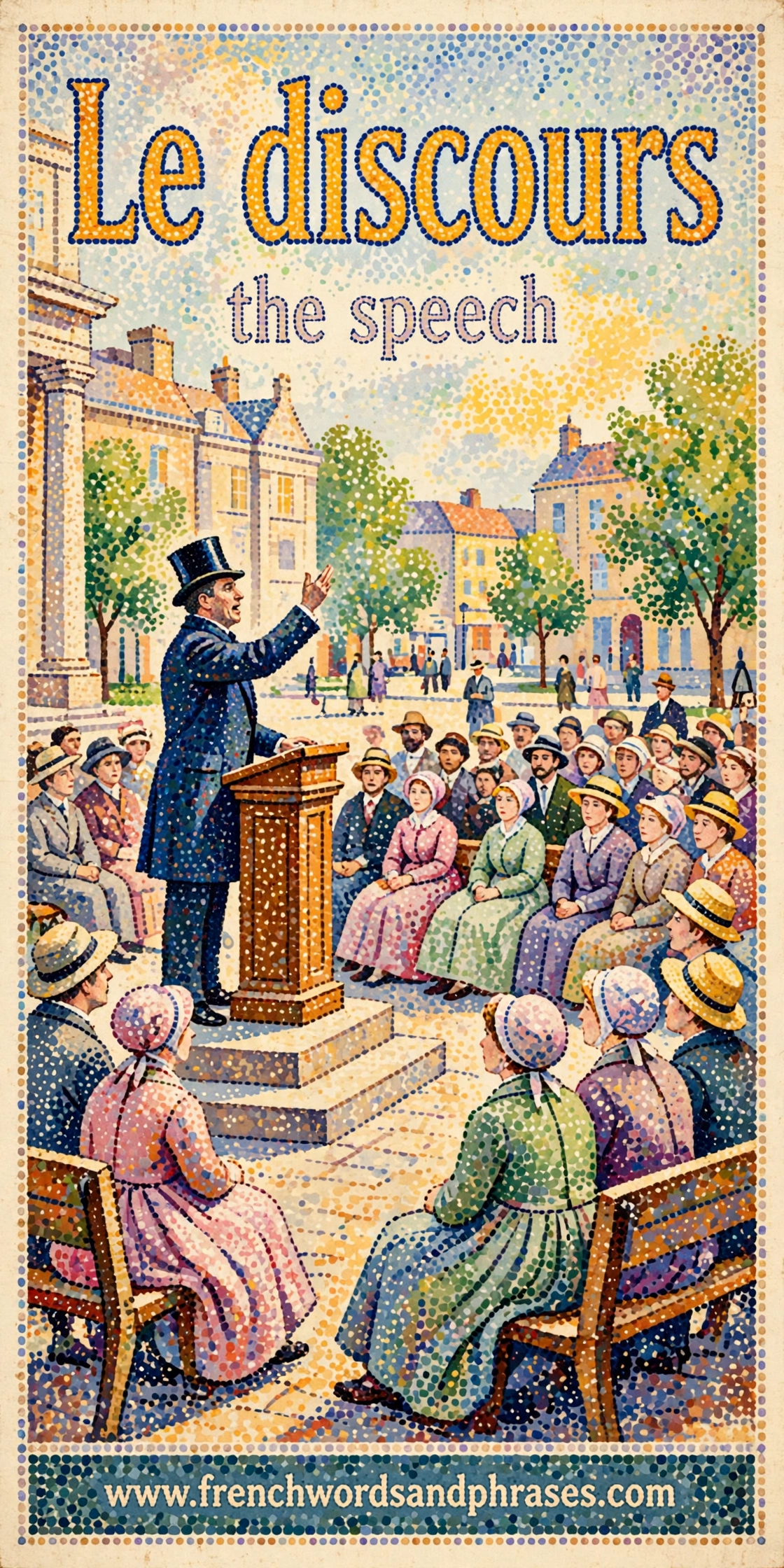
Le discours means the speech.
The hall falls silent, the speaker unfolds a single page, and two hundred people lean forward: le discours, the speech — words prepared, ordered and delivered on purpose, from the mayor’s toast to the president’s address to the nation.
In this guide, you’ll learn what discours means in English, how to use it with its articles, how to form its plural, and how it appears in everyday French. Explore French examples, English translations, and practice quizzes.
Understanding the French Noun Discours
Discours is a masculine French noun, learned with its article: le discours, un discours. It comes from the Latin discursus, a running about — language on the move. French uses it for the formal speech first, and then, in the language of linguists and critics, for discourse itself: le discours politique, political discourse, un discours de haine, hate speech.
Its centre is the prepared public speech: prononcer un discours, to deliver a speech, le discours du président, the president’s speech, un discours de mariage, a wedding speech — the best man’s trial by fire. The verbs are ceremonial: one fait or prononce un discours, one does not merely say it. In its extended sense it is any sustained way of speaking: tenir un discours, to hold forth, and the critic’s le discours médiatique, media discourse.
Gender: Masculine — le discours
Definite article: le — le discours (the speech)
Indefinite article: un — un discours (a speech)
Plural: les discours — the final -s is part of the word, singular and plural alike
Spelling note: from Latin discursus, a running about — speech is language in motion
Key verb: prononcer un discours — to deliver a speech
English equivalents: The speech, the address, discourse.
The -s of discours is always there and never pronounced: un discours, des discours — the spelling does not change in the plural. For a chat or a talk, French uses other words: une conversation, un exposé (a presentation), une conférence (a lecture). Discours is the formal, written-in-advance, stand-up-and-deliver kind — with one familiar exception: arrête ton discours !, stop lecturing me, says the teenager to the parent.
Experience the Word
Discours is speech with its Sunday clothes on — prepared, ordered, and aimed at a room full of listeners.
Imagine the village wedding at the long table: glasses stilled, the best man rises, paper shaking slightly, and begins le discours he has rewritten eleven times — three minutes that the couple will quote for fifty years.
You have not just named talking. You have named the set piece — le discours, words built to be remembered.
How to Use Discours in French: Complete Guide
Let’s explore how discours works in French, beginning with its articles — le discours, un discours, prononcer un discours.
Discours with the Definite Article (Le, Les)
Used for a specific speech — the president’s, the best man’s, yesterday’s.
| Form | French |
|---|---|
| Masculine singular | le discours |
| Plural | les discours |
Example
Le discours du maire a duré dix minutes.
The mayor’s speech lasted ten minutes.
Discours with the Indefinite Article (Un, Des)
Used for a speech in general — any prepared address.
| Form | French |
|---|---|
| Masculine singular | un discours |
| Plural | des discours |
Example
Il a prononcé un discours magnifique.
He delivered a magnificent speech.
Discours with Its Verbs (Prononcer, Faire, Écrire…)
A speech is written, delivered, listened to — its verbs are ceremonial.
| Verb | French |
|---|---|
| to deliver a speech | prononcer un discours |
| to make a speech | faire un discours |
| to write a speech | écrire un discours |
| to listen to a speech | écouter un discours |
| to applaud a speech | applaudir un discours |
Example
Elle écrit son discours de mariage depuis un mois.
She has been writing her wedding speech for a month.
Quick Quiz 1
Complete the sentence:
______ discours du président commence à vingt heures. (the)
Reveal the answer
Le
Le discours du président commence à vingt heures.
The president’s speech begins at eight o’clock — discours is masculine, so le.
The Plural of Discours
Discours already ends in -s: the plural is written exactly like the singular.
| Number | French |
|---|---|
| Singular | le discours |
| Plural | les discours |
Example
Les discours de la soirée étaient courts et drôles.
The speeches of the evening were short and funny.
Discours with Possessive Adjectives (Mon, Ton, Son…)
Possessives agree with the noun: discours is masculine, so mon, ton, son in the singular.
| Owner | French |
|---|---|
| my | mon discours |
| your (tu) | ton discours |
| his / her | son discours |
| our | notre discours |
| your (vous) | votre discours |
| their | leur discours |
Example
Son discours a ému toute la salle.
His speech moved the whole room.
Quick Quiz 2
Complete the sentence:
Je répète ______ discours devant le miroir. (my)
Reveal the answer
mon
Je répète mon discours devant le miroir.
I rehearse my speech in front of the mirror — mon, because discours is masculine.
Discours with Demonstrative Adjectives (Ce, Ces)
Used to point: ce discours, this speech — the famous one, the endless one.
| Form | French |
|---|---|
| Masculine singular | ce discours |
| Plural | ces discours |
Example
Ce discours restera dans l’histoire du pays.
This speech will go down in the country’s history.
Discours with Adjectives
Adjectives agree with discours — masculine singular: un discours émouvant, un long discours.
| Adjective | With Discours |
|---|---|
| émouvant (moving) | un discours émouvant |
| long (long) | un long discours |
| court (short) | un discours court |
| officiel (official) | un discours officiel |
| célèbre (famous) | un discours célèbre |
Example
Un discours court vaut mieux qu’un long discours ennuyeux.
A short speech is better than a long boring one.
Quick Quiz 3
Complete the sentence:
C’était un discours très ______. (moving)
Reveal the answer
émouvant
C’était un discours très émouvant.
It was a very moving speech — émouvant, masculine, to agree with discours.
Everyday Expressions with Discours
Weddings, podiums and family dinners — the discours phrases of daily life.
| Expression | In English |
|---|---|
| prononcer un discours | to deliver a speech |
| un discours de mariage | a wedding speech |
| le discours direct / indirect | direct / reported speech (grammar) |
| arrête ton discours | stop lecturing me (familiar) |
| un discours de haine | hate speech |
Example
Le discours de mariage du témoin a fait rire toute la salle.
The best man’s wedding speech made the whole room laugh.
Words from the Same Family as Discours
Public speaking — the words that travel with discours.
| French | In English |
|---|---|
| un exposé | a presentation |
| une conférence | a lecture |
| un toast | a toast (short speech) |
| parler en public | to speak in public |
| un orateur | a speaker, an orator |
Example
L’orateur a captivé le public dès la première phrase.
The speaker captivated the audience from the first sentence.
Quick Quiz 4
What verb goes with discours for delivering it formally?
Reveal the answer
Prononcer — prononcer un discours, to deliver a speech.
Le président prononcera un discours ce soir.
The president will deliver a speech tonight.
Discours in Everyday French: Real-Life Examples
Now that you know the word, let’s see how discours appears in everyday French.
Example 1 — Politics
Le président prononce un discours ce soir.
The president is delivering a speech tonight.
Example 2 — A wedding
Le discours du témoin était drôle et court.
The best man’s speech was funny and short.
Example 3 — Rehearsal
Elle répète son discours à voix haute.
She rehearses her speech out loud.
Example 4 — Boredom
Ce discours dure depuis une heure.
This speech has been going on for an hour.
Example 5 — Family
Arrête ton discours et passe-moi le sel.
Stop lecturing me and pass the salt.
Example 6 — History
Ce discours célèbre date de 1940.
This famous speech dates from 1940.
Beyond Translation: The Meaning of Discours
Discours began as movement — discursus, a running here and there — and French still feels the journey in it: a speech is language that travels from one mind to a roomful. The word governs two empires: the ceremony (le discours du président, le discours de mariage) and the critique (le discours politique, le discours médiatique — the way institutions talk, studied and suspected). Between the podium and the seminar room, discours is where French keeps its idea that public words are deeds.
To say discours is to stand up, unfold the page, and address the room.
It evokes wedding tables, national evenings and the best man’s trembling paper.
How to Remember the French Noun Discours
Remember it this way: Discours is masculine — le discours — and its -s never changes: un discours, des discours; the verb is prononcer.
- Always masculine — le discours, un discours, mon discours.
- The spelling trap — the plural is identical: les discours.
- The delivery verb — prononcer un discours, to deliver a speech.
The key idea is le discours — the speech, masculine; prononcer un discours = deliver it.
Test Your Knowledge of Discours
Let’s see how much you’ve learned. Try answering these questions before revealing the answers.
Question 1
Is discours masculine or feminine?
Reveal the answer
Masculine — le discours, un discours.
Question 2
How do you say to deliver a speech?
Reveal the answer
Prononcer un discours.
Question 3
Translate: The mayor’s speech lasted ten minutes.
Reveal the answer
Le discours du maire a duré dix minutes.
Question 4
What is the plural of discours?
Reveal the answer
Discours — unchanged: les discours; the -s belongs to the word.
Question 5
Complete the sentence:
______ discours de la soirée étaient courts. (the)
Reveal the answer
Les
Les discours de la soirée étaient courts.
The speeches of the evening were short.
Your Final Challenge
Can You Use It?
How would you say this in French?
“The president is delivering a speech tonight.”
Reveal the answer
Le président prononce un discours ce soir.
The president is delivering a speech tonight.
A little French. A little curiosity. A richer everyday life.
LEARN FRENCH ONE WORD AT A TIME