
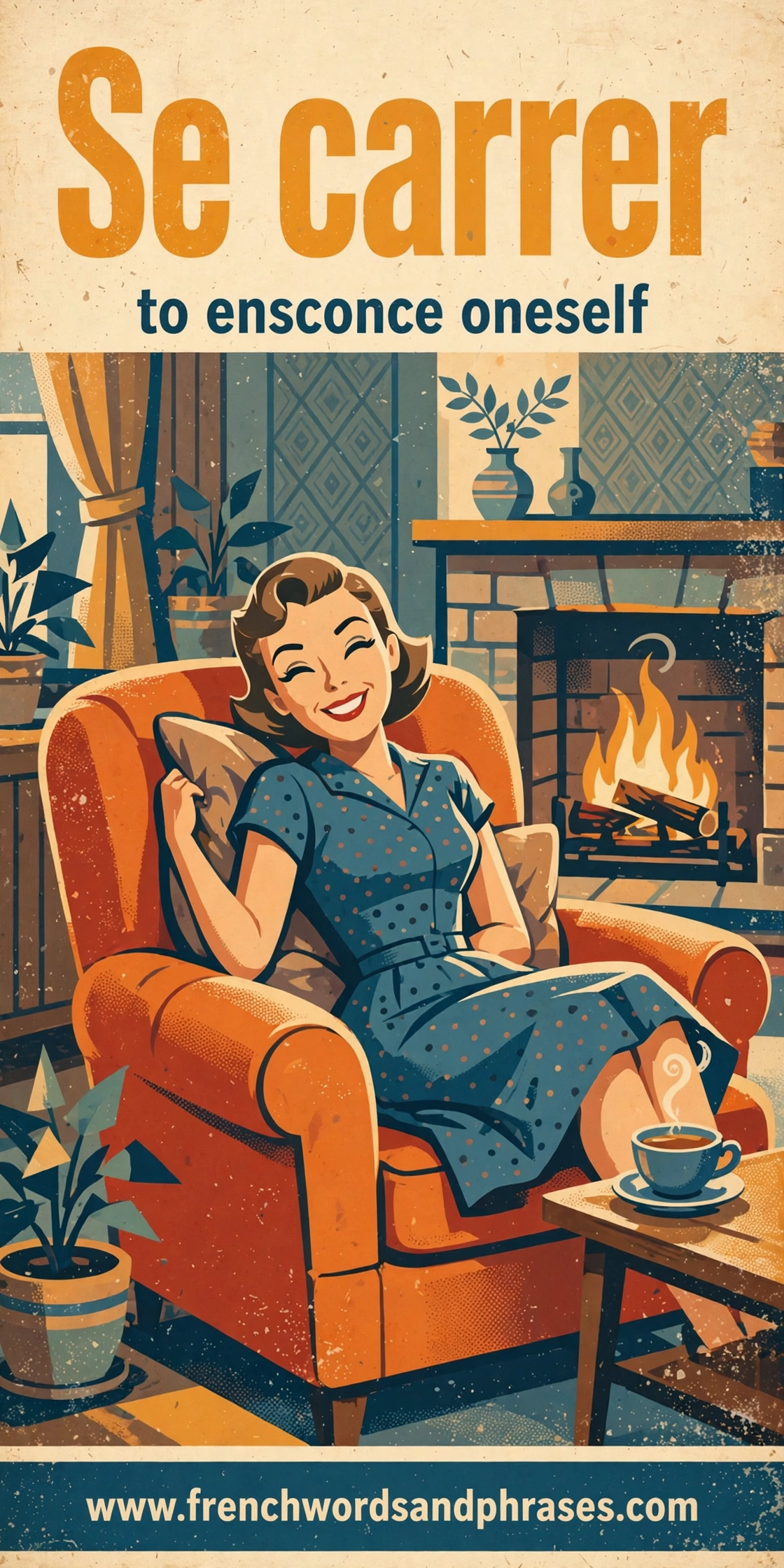
A French Word to Live By
How to Conjugate Se carrer in French
/sə ka.ʁe/
Se carrer means to ensconce oneself — to settle yourself squarely and comfortably into a deep chair or a good corner, planted there like a square block that does not intend to move.
A grandfather sinking into his favourite armchair after lunch, a cat installing itself in the one sunny corner of the sofa — se carrer is the verb of the comfortable settlement: body placed, cushions arranged, occupation complete.
In this guide, you’ll learn how to conjugate se carrer in all the major French tenses and moods. Explore complete conjugation tables, French examples, English translations, and practice quizzes.
Understanding the French Verb Se carrer
Se carrer is a regular French verb belonging to the first group of verbs, those ending in-er.
It means to ensconce oneself. It is a cosy, slightly humorous verb of everyday life — grandparents, cats and tired travellers se carrent dans the best seats, and the word always suggests comfort, a certain squareness of occupation, and no intention of moving soon. It can shade into planting yourself defiantly, shoulders squared, but the armchair sense rules the word.
Verb classification: First group (-er), reflexive
Auxiliary verb: Être
Past participle: carré
Present participle: carrant
English equivalents: To ensconce oneself, to settle oneself comfortably; se carrer dans un fauteuil — to ensconce oneself in an armchair; se carrer dans un coin — to settle into a corner; bien carré dans son siège — well ensconced in one’s seat; se carrer devant la cheminée — to settle in front of the fire.
One important detail: se carrer is the reflexive of carrer, to square — picture yourself as the block the mason squares and sets in place: once carré in your armchair, you are planted, four-square and immovable. The inseparable partner is dans: one settles dans a chair, a corner, a seat — il se carre dans son fauteuil, elle s’est carrée près du feu. Being reflexive, it takes être in every compound tense and the past participle agrees with the subject: elles se sont carrées dans les meilleurs fauteuils. The tu imperative tucks the pronoun behind the verb: carre-toi dans ce fauteuil !
Experience the Word
Se carrer is the verb of the perfect landing — a body arriving in a chair the way a block arrives in a wall: exactly, and for good.
Imagine a grandfather after Sunday lunch. The best armchair by the fire has been waiting all morning; he approaches, turns, lowers himself with ceremony — et il se carre dans son fauteuil, cushion behind the back, newspaper on the knees, while the whole family understands that the chair question is settled until dinner.
He has not just sat down. He has ensconced himself — carré, squarely, comfortably, for the duration.
How to Conjugate Se carrer: Complete French Conjugation Guide
Let’s explore every major conjugation of se carrer, beginning with the indicative mood.
How to Conjugate Se carrer in the Indicative Mood
The indicative mood is used to express facts, observations, actions, and events.
How to Conjugate Se carrer in the Present Tense (Présent)
Used for actions happening now, habitual actions, and general truths.
| Subject | Conjugation |
|---|---|
| je | me carre |
| tu | te carres |
| il / elle | se carre |
| nous | nous carrons |
| vous | vous carrez |
| ils / elles | se carrent |
Example
Le chat se carre dans le fauteuil près de la fenêtre.
The cat ensconces itself in the armchair by the window.
Quick Quiz 1
Complete the sentence:
Nous nous ______ dans les fauteuils du salon.
Reveal the answer
carrons
Nous nous carrons dans les fauteuils du salon.
We ensconce ourselves in the sitting-room armchairs.
How to Conjugate Se carrer in the Passé Composé
Used for completed actions in the past. Se carrer takes the auxiliary verb être.
| Subject | Conjugation |
|---|---|
| je | me suis carré / me suis carrée |
| tu | t’es carré / t’es carrée |
| il / elle | s’est carré / s’est carrée |
| nous | nous sommes carrés / nous sommes carrées |
| vous | vous êtes carrés / vous êtes carrées / vous êtes carré / vous êtes carrée |
| ils / elles | se sont carrés / se sont carrées |
Example
Grand-père s’est carré dans son fauteuil après le déjeuner.
Grandfather ensconced himself in his armchair after lunch.
How to Conjugate Se carrer in the Imparfait (Imperfect Tense)
Used for habitual past actions, descriptions, and ongoing situations in the past.
| Subject | Conjugation |
|---|---|
| je | me carrais |
| tu | te carrais |
| il / elle | se carrait |
| nous | nous carrions |
| vous | vous carriez |
| ils / elles | se carraient |
Example
Chaque soir, elle se carrait dans le même coin du canapé.
Every evening, she used to settle herself in the same corner of the sofa.
Quick Quiz 2
Choose the correct form:
She ensconced herself by the window.
Elle ______ près de la fenêtre. (s’est carrée / a carré)
Reveal the answer
s’est carrée
Elle s’est carrée près de la fenêtre.
Se carrer is reflexive, takes être, and the participle agrees: carrée.
How to Conjugate Se carrer in the Plus-que-parfait
Used to describe an action that had already been completed before another past event.
| Subject | Conjugation |
|---|---|
| je | m’étais carré / m’étais carrée |
| tu | t’étais carré / t’étais carrée |
| il / elle | s’était carré / s’était carrée |
| nous | nous étions carrés / nous étions carrées |
| vous | vous étiez carrés / vous étiez carrées / vous étiez carré / vous étiez carrée |
| ils / elles | s’étaient carrés / s’étaient carrées |
Example
Les enfants s’étaient carrés devant la cheminée avant la veillée.
The children had ensconced themselves in front of the fireplace before the evening gathering.
How to Conjugate Se carrer in the Passé Simple
Primarily used in formal writing, literature, and historical narratives. It is rarely used in everyday conversation.
| Subject | Conjugation |
|---|---|
| je | me carrai |
| tu | te carras |
| il / elle | se carra |
| nous | nous carrâmes |
| vous | vous carrâtes |
| ils / elles | se carrèrent |
Example
Le vieux monsieur se carra dans le fauteuil du salon.
The old gentleman ensconced himself in the sitting-room armchair.
How to Conjugate Se carrer in the Passé Antérieur
A literary tense used to express an action completed immediately before another past action, generally in the passé simple.
| Subject | Conjugation |
|---|---|
| je | me fus carré / me fus carrée |
| tu | te fus carré / te fus carrée |
| il / elle | se fut carré / se fut carrée |
| nous | nous fûmes carrés / nous fûmes carrées |
| vous | vous fûtes carrés / vous fûtes carrées / vous fûtes carré / vous fûtes carrée |
| ils / elles | se furent carrés / se furent carrées |
Example
Dès qu’il se fut carré dans son siège, le train démarra.
As soon as he had settled himself in his seat, the train set off.
How to Conjugate Se carrer in the Future Tense (Futur Simple)
Used to describe actions that will take place in the future.
| Subject | Conjugation |
|---|---|
| je | me carrerai |
| tu | te carreras |
| il / elle | se carrera |
| nous | nous carrerons |
| vous | vous carrerez |
| ils / elles | se carreront |
Example
Ce soir, tu te careras devant la cheminée avec un bon livre.
This evening, you will ensconce yourself in front of the fire with a good book.
How to Conjugate Se carrer in the Futur Antérieur (Future Perfect)
Used for an action that will have been completed before a particular point in the future.
| Subject | Conjugation |
|---|---|
| je | me serai carré / me serai carrée |
| tu | te seras carré / te seras carrée |
| il / elle | se sera carré / se sera carrée |
| nous | nous serons carrés / nous serons carrées |
| vous | vous serez carrés / vous serez carrées / vous serez carré / vous serez carrée |
| ils / elles | se seront carrés / se seront carrées |
Example
À huit heures, tout le monde se sera carré dans les fauteuils.
By eight o’clock, everyone will have ensconced themselves in the armchairs.
How to Conjugate Se carrer in the Near Future (Futur Proche)
Used to describe something that is going to happen soon. Formed with aller + infinitive.
| Subject | Conjugation |
|---|---|
| je | vais me carrer |
| tu | vas te carrer |
| il / elle | va se carrer |
| nous | allons nous carrer |
| vous | allez vous carrer |
| ils / elles | vont se carrer |
Example
Regarde le chat, il va se carrer sur tes genoux.
Look at the cat, it is going to settle itself on your knees.
How to Conjugate Se carrer in the Conditional Mood
The conditional mood expresses what would happen under certain circumstances. It is also frequently used to make polite requests or express wishes.
How to Conjugate Se carrer in the Present Conditional
| Subject | Conjugation |
|---|---|
| je | me carrerais |
| tu | te carrerais |
| il / elle | se carrerait |
| nous | nous carrerions |
| vous | vous carreriez |
| ils / elles | se carreraient |
Example
Avec un feu de bois, je me carrerais volontiers dans ce fauteuil.
With a wood fire, I would gladly ensconce myself in that armchair.
How to Conjugate Se carrer in the Past Conditional
| Subject | Conjugation |
|---|---|
| je | me serais carré / me serais carrée |
| tu | te serais carré / te serais carrée |
| il / elle | se serait carré / se serait carrée |
| nous | nous serions carrés / nous serions carrées |
| vous | vous seriez carrés / vous seriez carrées / vous seriez carré / vous seriez carrée |
| ils / elles | se seraient carrés / se seraient carrées |
Example
Elle se serait carrée près de la fenêtre si la place avait été libre.
She would have settled herself by the window if the seat had been free.
Se carrer in the Literary Past Conditional Form
This less common literary form uses the imperfect subjunctive of être.
| Subject | Conjugation |
|---|---|
| je | me fusse carré / me fusse carrée |
| tu | te fusses carré / te fusses carrée |
| il / elle | se fût carré / se fût carrée |
| nous | nous fussions carrés / nous fussions carrées |
| vous | vous fussiez carrés / vous fussiez carrées / vous fussiez carré / vous fussiez carrée |
| ils / elles | se fussent carrés / se fussent carrées |
Example
Le vieillard se fût carré dans son fauteuil jusqu’au soir.
The old man would have ensconced himself in his armchair until evening.
How to Conjugate Se carrer in the Subjunctive Mood
The subjunctive is used to express wishes, emotions, doubts, necessity, and uncertainty. It frequently follows expressions such as il faut que (it is necessary that) or bien que (although).
How to Conjugate Se carrer in the Present Subjunctive
| Subject | Conjugation |
|---|---|
| que je | me carre |
| que tu | te carres |
| qu’il / qu’elle | se carre |
| que nous | nous carrions |
| que vous | vous carriez |
| qu’ils / qu’elles | se carrent |
Example
Il faut que tu te carres dans ce siège pour le voyage.
You must settle yourself in this seat for the journey.
Quick Quiz 3
Complete the sentence using the subjunctive:
Il faut que vous vous ______ dans vos sièges.
Reveal the answer
carriez
Il faut que vous vous carriez dans vos sièges.
You must settle yourselves in your seats.
How to Conjugate Se carrer in the Imperfect Subjunctive
A literary tense, rarely encountered in modern spoken French.
| Subject | Conjugation |
|---|---|
| que je | me carrasse |
| que tu | te carrasses |
| qu’il / qu’elle | se carrât |
| que nous | nous carrassions |
| que vous | vous carrassiez |
| qu’ils / qu’elles | se carrassent |
Example
On attendait que le président se carrât dans son fauteuil.
They waited for the chairman to ensconce himself in his armchair.
How to Conjugate Se carrer in the Pluperfect Subjunctive
A literary construction used to express an action completed before another past action.
| Subject | Conjugation |
|---|---|
| que j’ | me fusse carré / me fusse carrée |
| que tu | te fusses carré / te fusses carrée |
| qu’il / qu’elle | se fût carré / se fût carrée |
| que nous | nous fussions carrés / nous fussions carrées |
| que vous | vous fussiez carrés / vous fussiez carrées / vous fussiez carré / vous fussiez carrée |
| qu’ils / qu’elles | se fussent carrés / se fussent carrées |
Example
On racontait que le chat se fût carré sur le meilleur coussin.
People said the cat had ensconced itself on the best cushion.
How to Conjugate Se carrer in the Past Subjunctive
| Subject | Conjugation |
|---|---|
| que j’ | me sois carré / me sois carrée |
| que tu | te sois carré / te sois carrée |
| qu’il / qu’elle | se soit carré / se soit carrée |
| que nous | nous soyons carrés / nous soyons carrées |
| que vous | vous soyez carrés / vous soyez carrées / vous soyez carré / vous soyez carrée |
| qu’ils / qu’elles | se soient carrés / se soient carrées |
Example
Je suis amusé qu’il se soit carré dans le fauteuil du directeur.
I am amused that he ensconced himself in the director’s armchair.
How to Conjugate Se carrer in the Imperative
The imperative is used to give commands, instructions, invitations, or suggestions. Subject pronouns are omitted.
How to Conjugate Se carrer in the Present Imperative
| Person | Conjugation |
|---|---|
| (tu) | carre-toi |
| (nous) | carrons-nous |
| (vous) | carrez-vous |
Example
Carre-toi dans ce fauteuil et repose-toi !
Ensconce yourself in that armchair and rest!
Quick Quiz 4
How would you say Ensconce yourself in that armchair (tu form)?
Reveal the answer
Carre-toi dans ce fauteuil !
French Participles of Se carrer
Participles are verb forms that can be used in compound tenses and other grammatical constructions.
Present Participle of Se carrer
carrant
En se carrant dans le canapé, elle a renversé son thé.
While settling herself into the sofa, she spilt her tea.
Past Participle of Se carrer
carré
Carrée dans son fauteuil, grand-mère écoutait la radio.
Ensconced in her armchair, grandmother listened to the radio.
Se carrer in Everyday French: Real-Life Examples
Now that you know the conjugations, let’s see how se carrer appears in everyday French.
Example 1 — Present
Le chat se carre dans le fauteuil.
The cat ensconces itself in the armchair.
Example 2 — Passé composé
Grand-père s’est carré dans son fauteuil.
Grandfather ensconced himself in his armchair.
Example 3 — Imparfait
Elle se carrait toujours dans le même coin.
She always used to settle in the same corner.
Example 4 — Future
Tu te careras devant la cheminée ce soir.
You will ensconce yourself in front of the fire this evening.
Example 5 — Conditional
Je me carrerais volontiers dans ce fauteuil.
I would gladly ensconce myself in that armchair.
Example 6 — Imperative
Carre-toi dans ce fauteuil et repose-toi !
Ensconce yourself in that armchair and rest!
Beyond Translation: The Meaning of Se carrer
English ensconce is a fortress word — to settle behind a sconce, a small fort — and French se carrer is its comfortable cousin: to settle like a squared block into its place.
Comfort with a hint of occupation.
The grandparent in the armchair and the cat on the cushion are not merely sitting: they have taken the position, squarely, and the family, the fire and the evening arrange themselves around the fact.
How to Remember the French Verb Se carrer
Remember it this way: Se carrer is about grandfather lowering himself into the best armchair — settled until dinner.
- Always reflexive in this sense: je me carre, elle s’est carrée — être, and the participle agrees.
- Dans is its favourite preposition: se carrer dans un fauteuil, dans un coin, dans un siège.
- Built on carrer, to square: you settle like a squared block — placed, comfortable, immovable.
The key idea is grandfather lowering himself into the best armchair — settled until dinner.
Test Your Knowledge of Se carrer
Let’s see how much you’ve learned. Try answering these questions before revealing the answers.
Question 1
Which auxiliary does se carrer use, and why?
Reveal the answer
Être — it is a reflexive verb: elle s’est carrée dans son fauteuil.
Question 2
How do you say The cat ensconces itself in the armchair in French?
Reveal the answer
Le chat se carre dans le fauteuil.
Question 3
Translate: Grandfather ensconced himself in his armchair.
Reveal the answer
Grand-père s’est carré dans son fauteuil.
Question 4
What is the past participle of se carrer?
Reveal the answer
Carré — agreeing: carrée, carrés, carrées.
Question 5
Complete the sentence:
Il faut que tu te ______ dans ce siège pour le voyage.
Reveal the answer
carres
Il faut que tu te carres dans ce siège pour le voyage.
You must settle yourself in this seat for the journey.
Your Final Challenge
Can You Use It?
How would you say this in French?
After lunch, grandfather ensconces himself in his armchair by the fire, and the world can turn without him until dinner.
Reveal the answer
Après le déjeuner, grand-père se carre dans son fauteuil près du feu, et le monde peut bien tourner sans lui jusqu’au dîner.
After lunch, grandfather ensconces himself in his armchair by the fire, and the world can turn without him until dinner.
A little French. A little curiosity. A richer everyday life.
LEARN FRENCH ONE WORD AT A TIME




