
A French Word to Live By
How to Conjugate Carrer in French
/ka.ʁe/
Carrer means to square — to make something square or right-angled, to square a number in arithmetic, and, with shoulders, to square oneself bravely for what is coming.
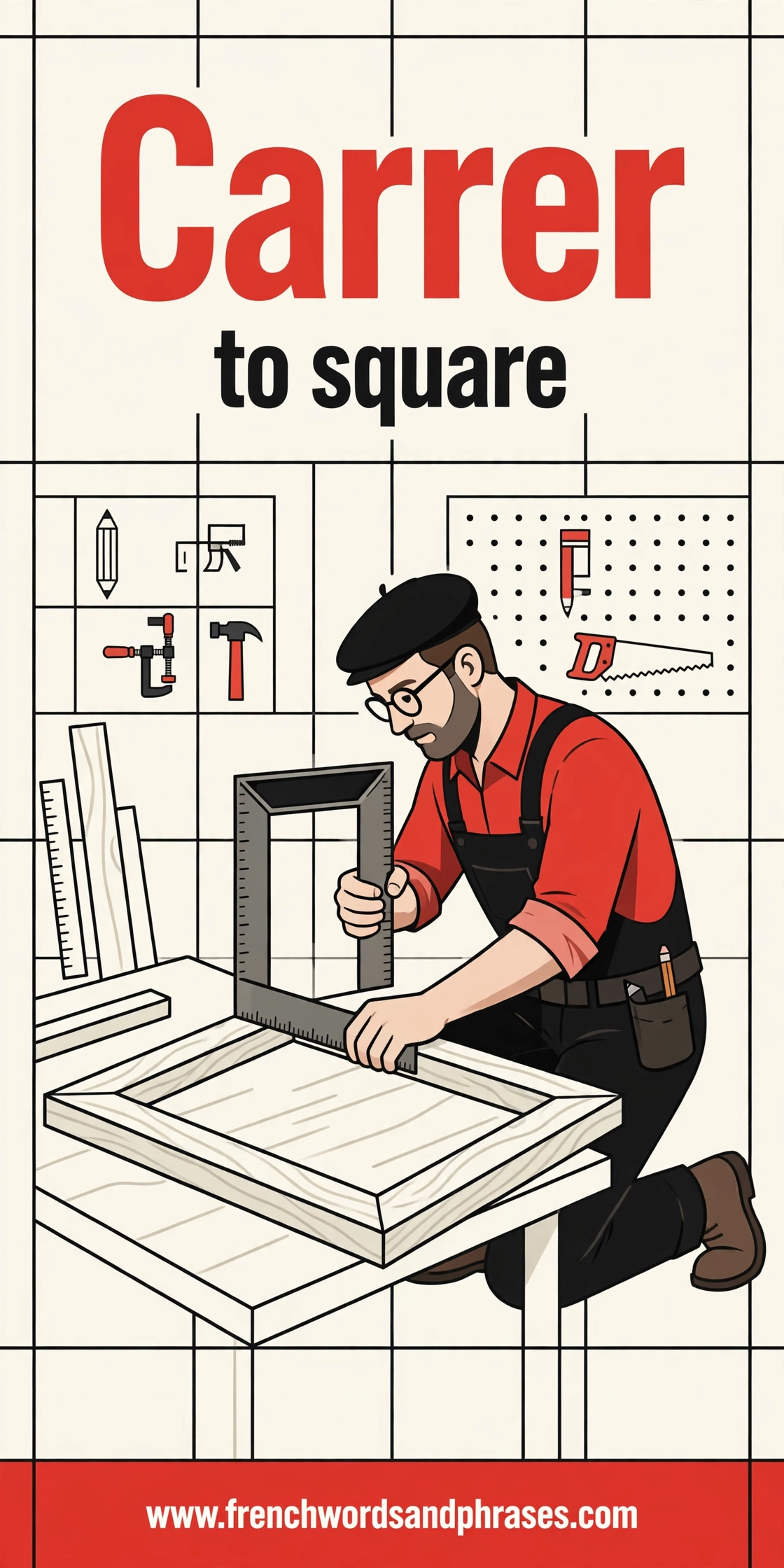
A carpenter checking a frame against his set square, a schoolboy squaring numbers in the margin of his exercise book — carrer is the verb of the right angle: of things made true, exact and four-square.
In this guide, you’ll learn how to conjugate carrer in all the major French tenses and moods. Explore complete conjugation tables, French examples, English translations, and practice quizzes.
Understanding the French Verb Carrer
Carrer is a regular French verb belonging to the first group of verbs, those ending in-er.
It means to square. It is used by carpenters and masons for making timbers and stones truly square, by schoolchildren for squaring numbers (carrer un nombre, more often élever au carré), and figuratively of squaring one’s shoulders. In familiar speech au carré has wandered off on its own: un type carré, un travail au carré — straight, honest, properly done.
Verb classification: First group (-er)
Auxiliary verb: Avoir
Past participle: carré
Present participle: carrant
English equivalents: To square, to make square; carrer un nombre — to square a number; carrer une pièce de bois — to square a piece of timber; carrer les épaules — to square one’s shoulders; au carré — squared, and (fam.) neat and sorted.
One important detail: carrer is perfectly regular, double r throughout: je carre, nous carrons, ils carrent, past participle carré — the very word for a square itself, so that un carré is a square and cinq au carré is five squared. The physical gesture survives in carrer les épaules, to square one’s shoulders before a difficulty. Do not confuse it with its reflexive twin se carrer, which means settling yourself comfortably into a chair.
Experience the Word
Carrer is the verb of the right angle — nothing crooked survives it.
Imagine a carpenter’s bench in the morning light. The old craftsman lifts his frame, sets the équerre against the corner, frowns, planes a shaving’s width away, and carre la pièce once more — until the angle is true and the square sits flat and satisfied.
The frame will stand straight for a hundred years. It has been squared — carrée, corner by corner, by a patient hand.
How to Conjugate Carrer: Complete French Conjugation Guide
Let’s explore every major conjugation of carrer, beginning with the indicative mood.
How to Conjugate Carrer in the Indicative Mood
The indicative mood is used to express facts, observations, actions, and events.
How to Conjugate Carrer in the Present Tense (Présent)
Used for actions happening now, habitual actions, and general truths.
| Subject | Conjugation |
|---|---|
| je | carre |
| tu | carres |
| il / elle | carre |
| nous | carrons |
| vous | carrez |
| ils / elles | carrent |
Example
Le menuisier carre chaque pièce avant de l’assembler.
The joiner squares each piece before assembling it.
Quick Quiz 1
Complete the sentence:
Nous ______ les pierres avant de bâtir le mur.
Reveal the answer
carrons
Nous carrons les pierres avant de bâtir le mur.
We square the stones before building the wall.
How to Conjugate Carrer in the Passé Composé
Used for completed actions in the past. Carrer takes the auxiliary verb avoir.
| Subject | Conjugation |
|---|---|
| j’ | ai carré |
| tu | as carré |
| il / elle | a carré |
| nous | avons carré |
| vous | avez carré |
| ils / elles | ont carré |
Example
Nous avons carré les poutres avant la pose.
We squared the beams before fitting them.
How to Conjugate Carrer in the Imparfait (Imperfect Tense)
Used for habitual past actions, descriptions, and ongoing situations in the past.
| Subject | Conjugation |
|---|---|
| je | carrais |
| tu | carrais |
| il / elle | carrait |
| nous | carrions |
| vous | carriez |
| ils / elles | carraient |
Example
Autrefois, les tailleurs de pierre carraient les blocs à la main.
In the old days, stonemasons used to square the blocks by hand.
Quick Quiz 2
Choose the correct form:
He squared his shoulders.
Il ______ les épaules. (a carré / est carré)
Reveal the answer
a carré
Il a carré les épaules.
Carrer takes avoir.
How to Conjugate Carrer in the Plus-que-parfait
Used to describe an action that had already been completed before another past event.
| Subject | Conjugation |
|---|---|
| j’ | avais carré |
| tu | avais carré |
| il / elle | avait carré |
| nous | avions carré |
| vous | aviez carré |
| ils / elles | avaient carré |
Example
Il avait carré les épaules avant d’entrer dans le bureau du directeur.
He had squared his shoulders before going into the director’s office.
How to Conjugate Carrer in the Passé Simple
Primarily used in formal writing, literature, and historical narratives. It is rarely used in everyday conversation.
| Subject | Conjugation |
|---|---|
| je | carrai |
| tu | carras |
| il / elle | carra |
| nous | carrâmes |
| vous | carrâtes |
| ils / elles | carrèrent |
Example
Le charpentier carra la poutre d’un seul coup d’œil sûr.
The carpenter squared the beam with one sure glance.
How to Conjugate Carrer in the Passé Antérieur
A literary tense used to express an action completed immediately before another past action, generally in the passé simple.
| Subject | Conjugation |
|---|---|
| j’ | eus carré |
| tu | eus carré |
| il / elle | eut carré |
| nous | eûmes carré |
| vous | eûtes carré |
| ils / elles | eurent carré |
Example
Quand il eut carré toutes les pièces, il commença l’assemblage.
When he had squared all the pieces, he began the assembly.
How to Conjugate Carrer in the Future Tense (Futur Simple)
Used to describe actions that will take place in the future.
| Subject | Conjugation |
|---|---|
| je | carrerai |
| tu | carreras |
| il / elle | carrera |
| nous | carrerons |
| vous | carrerez |
| ils / elles | carreront |
Example
Demain, tu carreras les nombres dans l’exercice de mathématiques.
Tomorrow, you will square the numbers in the maths exercise.
How to Conjugate Carrer in the Futur Antérieur (Future Perfect)
Used for an action that will have been completed before a particular point in the future.
| Subject | Conjugation |
|---|---|
| j’ | aurai carré |
| tu | auras carré |
| il / elle | aura carré |
| nous | aurons carré |
| vous | aurez carré |
| ils / elles | auront carré |
Example
À midi, l’ouvrier aura carré toutes les pierres du mur.
By noon, the workman will have squared all the stones of the wall.
How to Conjugate Carrer in the Near Future (Futur Proche)
Used to describe something that is going to happen soon. Formed with aller + infinitive.
| Subject | Conjugation |
|---|---|
| je | vais carrer |
| tu | vas carrer |
| il / elle | va carrer |
| nous | allons carrer |
| vous | allez carrer |
| ils / elles | vont carrer |
Example
Il va carrer les épaules et répondre au directeur.
He is going to square his shoulders and answer the director.
How to Conjugate Carrer in the Conditional Mood
The conditional mood expresses what would happen under certain circumstances. It is also frequently used to make polite requests or express wishes.
How to Conjugate Carrer in the Present Conditional
| Subject | Conjugation |
|---|---|
| je | carrerais |
| tu | carrerais |
| il / elle | carrerait |
| nous | carrerions |
| vous | carreriez |
| ils / elles | carreraient |
Example
Avec une meilleure équerre, je carrerais ce cadre parfaitement.
With a better set square, I would square this frame perfectly.
How to Conjugate Carrer in the Past Conditional
| Subject | Conjugation |
|---|---|
| j’ | aurais carré |
| tu | aurais carré |
| il / elle | aurait carré |
| nous | aurions carré |
| vous | auriez carré |
| ils / elles | auraient carré |
Example
Ils auraient carré les blocs si la carrière avait livré à temps.
They would have squared the blocks if the quarry had delivered in time.
Carrer in the Literary Past Conditional Form
This less common literary form uses the imperfect subjunctive of avoir.
| Subject | Conjugation |
|---|---|
| j’ | eusse carré |
| tu | eusses carré |
| il / elle | eût carré |
| nous | eussions carré |
| vous | eussiez carré |
| ils / elles | eussent carré |
Example
Le maçon eût carré les pierres avant l’hiver.
The mason would have squared the stones before winter.
How to Conjugate Carrer in the Subjunctive Mood
The subjunctive is used to express wishes, emotions, doubts, necessity, and uncertainty. It frequently follows expressions such as il faut que (it is necessary that) or bien que (although).
How to Conjugate Carrer in the Present Subjunctive
| Subject | Conjugation |
|---|---|
| que je | carre |
| que tu | carres |
| qu’il / qu’elle | carre |
| que nous | carrions |
| que vous | carriez |
| qu’ils / qu’elles | carrent |
Example
Il faut que tu carres ce cadre avant de le clouer.
You must square this frame before nailing it.
Quick Quiz 3
Complete the sentence using the subjunctive:
Il faut que vous ______ ce cadre avant de le clouer.
Reveal the answer
carriez
Il faut que vous carriez ce cadre avant de le clouer.
You must square this frame before nailing it.
How to Conjugate Carrer in the Imperfect Subjunctive
A literary tense, rarely encountered in modern spoken French.
| Subject | Conjugation |
|---|---|
| que je | carrasse |
| que tu | carrasses |
| qu’il / qu’elle | carrât |
| que nous | carrassions |
| que vous | carrassiez |
| qu’ils / qu’elles | carrassent |
Example
L’architecte exigeait que l’on carrât les pierres du portail.
The architect demanded that the stones of the gateway be squared.
How to Conjugate Carrer in the Pluperfect Subjunctive
A literary construction used to express an action completed before another past action.
| Subject | Conjugation |
|---|---|
| que j’ | eusse carré |
| que tu | eusses carré |
| qu’il / qu’elle | eût carré |
| que nous | eussions carré |
| que vous | eussiez carré |
| qu’ils / qu’elles | eussent carré |
Example
On racontait que les Égyptiens eussent carré leurs blocs sans machines.
People said the Egyptians had squared their blocks without machines.
How to Conjugate Carrer in the Past Subjunctive
| Subject | Conjugation |
|---|---|
| que j’ | aie carré |
| que tu | aies carré |
| qu’il / qu’elle | ait carré |
| que nous | ayons carré |
| que vous | ayez carré |
| qu’ils / qu’elles | aient carré |
Example
Je suis content que vous ayez carré les épaules devant lui.
I am glad you squared your shoulders in front of him.
How to Conjugate Carrer in the Imperative
The imperative is used to give commands, instructions, invitations, or suggestions. Subject pronouns are omitted.
How to Conjugate Carrer in the Present Imperative
| Person | Conjugation |
|---|---|
| (tu) | carre |
| (nous) | carrons |
| (vous) | carrez |
Example
Carre les épaules et entre !
Square your shoulders and go in!
Quick Quiz 4
How would you say Square your shoulders (tu form)?
Reveal the answer
Carre les épaules !
French Participles of Carrer
Participles are verb forms that can be used in compound tenses and other grammatical constructions.
Present Participle of Carrer
carrant
En carrant la pièce, il vérifie l’angle à chaque coup.
While squaring the piece, he checks the angle with every stroke.
Past Participle of Carrer
carré
Carrée au cordeau, la pierre prit sa place dans le mur.
Squared true to the line, the stone took its place in the wall.
Carrer in Everyday French: Real-Life Examples
Now that you know the conjugations, let’s see how carrer appears in everyday French.
Example 1 — Present
Le menuisier carre chaque pièce de bois.
The joiner squares each piece of wood.
Example 2 — Passé composé
Il a carré les épaules avant d’entrer.
He squared his shoulders before going in.
Example 3 — Imparfait
Les tailleurs de pierre carraient les blocs à la main.
Stonemasons used to square blocks by hand.
Example 4 — Future
Tu carreras les nombres dans l’exercice.
You will square the numbers in the exercise.
Example 5 — Conditional
Je carrerais ce cadre avec une meilleure équerre.
I would square this frame with a better set square.
Example 6 — Imperative
Carre les épaules et entre !
Square your shoulders and go in!
Beyond Translation: The Meaning of Carrer
English square does the same double duty — shape and arithmetic — and French carrer is its cousin, from Latin quadrare, to make four-cornered.
Un carré is the shape; carrer is the making of it.
From the mason’s yard the word walked into character: un homme carré is a straight, blunt, four-square man, and to carrer les épaules is to set yourself squarely against whatever comes through the door.
How to Remember the French Verb Carrer
Remember it this way: Carrer is about the carpenter’s set square sitting flat and satisfied on a true corner.
- Un carré is a square: carrer is to make one — in timber, in stone, in arithmetic.
- The human gesture: carrer les épaules, to square one’s shoulders.
- Regular -er with a double r: je carre, nous carrons, past participle carré.
The key idea is the carpenter’s set square sitting flat and satisfied on a true corner.
Test Your Knowledge of Carrer
Let’s see how much you’ve learned. Try answering these questions before revealing the answers.
Question 1
What does carrer les épaules mean?
Reveal the answer
To square one’s shoulders — to set yourself bravely before a difficulty or an interview.
Question 2
How do you say The joiner squares each piece in French?
Reveal the answer
Le menuisier carre chaque pièce.
Question 3
Translate: He squared his shoulders before going in.
Reveal the answer
Il a carré les épaules avant d’entrer.
Question 4
What is the past participle of carrer?
Reveal the answer
Carré — the same word as the noun un carré, a square.
Question 5
Complete the sentence:
Il faut que tu ______ ce cadre avant de le clouer.
Reveal the answer
carres
Il faut que tu carres ce cadre avant de le clouer.
You must square this frame before nailing it.
Your Final Challenge
Can You Use It?
How would you say this in French?
The joiner squares his piece one last time, sets down the set square, and smiles: the angle is true, the work will last.
Reveal the answer
Le menuisier carre sa pièce une dernière fois, pose l’équerre, et sourit: l’angle est vrai, l’ouvrage tiendra.
The joiner squares his piece one last time, sets down the set square, and smiles: the angle is true, the work will last.
A little French. A little curiosity. A richer everyday life.
LEARN FRENCH ONE WORD AT A TIME




