A French Word to Live By
Translate Camion to English
/ka.mjɔ̃/
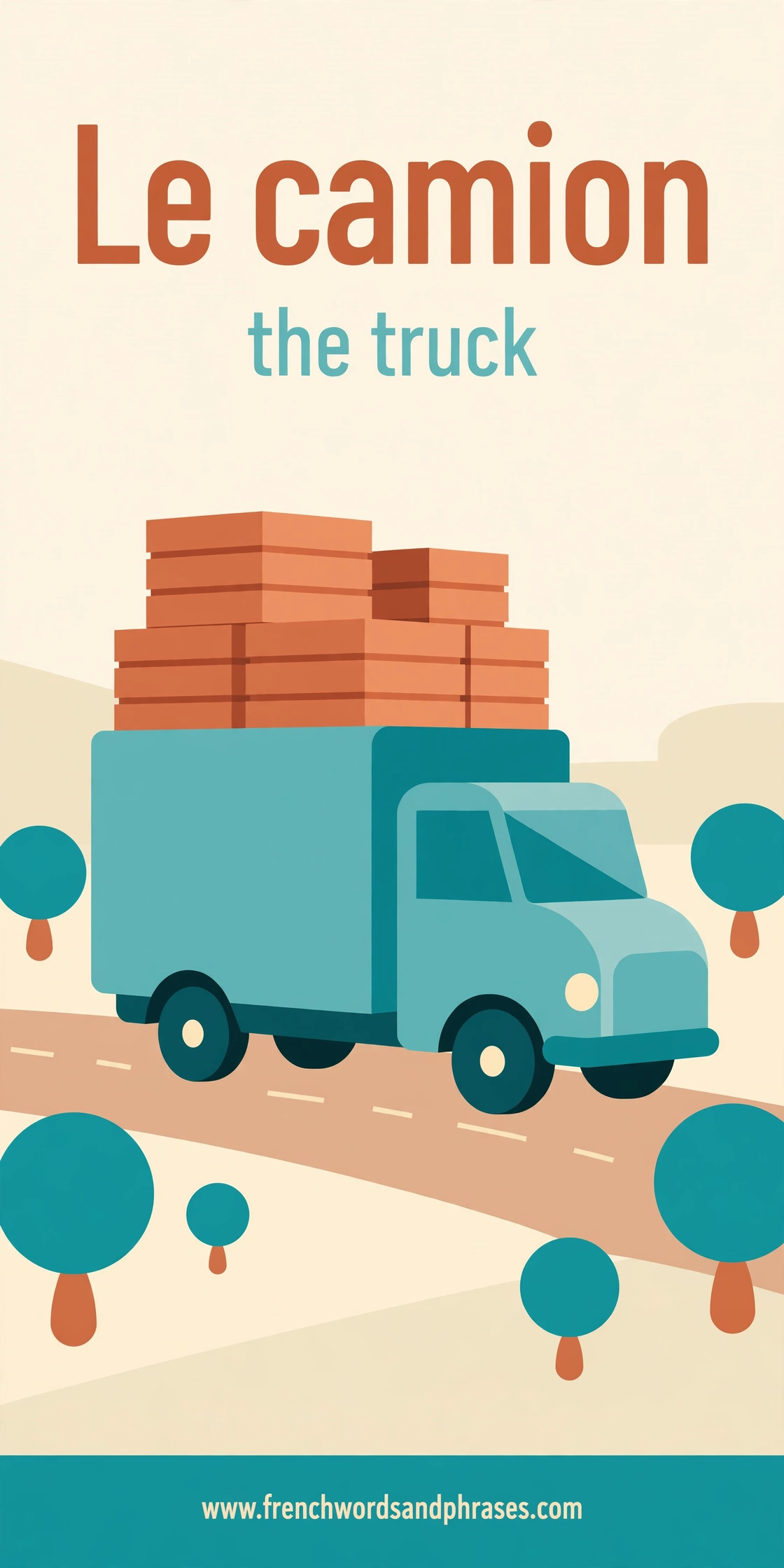
Le camion means the truck.
Headlights in the dawn, a rumble down the village street, boxes stacked to the roof: le camion, the truck — the workhorse of French roads, carrying bread to the bakery, wine to the port and furniture to every new home in the land.
In this guide, you’ll learn what camion means in English, how to use it with its articles, how to form its plural, and how it appears in everyday French. Explore French examples, English translations, and practice quizzes.
Understanding the French Noun Camion
Camion is a masculine French noun, learned with its article: le camion, un camion. The word travelled far before it settled in French: it is thought to come from Picard and Norman speech, possibly from a word for a cart path — and it has since driven into Spanish (camión) and beyond, carrying French roads with it.
It means a truck, a lorry — a large vehicle for carrying goods: un camion de livraison, a delivery truck, un camion de déménagement, a removal van, un camion de pompiers, a fire engine. The driver is un chauffeur de camion, and the long-distance drivers, les routiers, are a French institution with their own roadside restaurants. Its smaller cousin is la camionnette, the little van — never confuse the two sizes at a rental desk.
Gender: Masculine — le camion
Definite article: le — le camion (the truck)
Indefinite article: un — un camion (a truck)
Plural: les camions — regular, with a simple -s
Spelling note: the little van is la camionnette — feminine, and a different vehicle
The driver: un chauffeur de camion — a truck driver; les routiers, long-distance drivers
English equivalents: The truck, the lorry.
Camion covers almost everything with a cargo bed or a box body: delivery lorries, removal vans, tankers (un camion-citerne) and fire engines (un camion de pompiers). Goods travel en camion or par camion — la livraison se fait par camion, delivery is by truck. The driver conduit un camion, and on the motorway the slow lane belongs to les poids lourds, the heavy goods vehicles.
Experience the Word
Camion is the sound of France at work before sunrise: the bakery’s flour, the market’s vegetables, the wine leaving the village — all of it moves by camion.
Imagine the déménagement, moving day in Paris: le camion stationné en bas, hazard lights blinking, the sofa coming down the stairs and the whole street reorganised around one patient truck.
You have not just named a vehicle. You have named the carrier of everything — le camion, the truck, France’s moving backbone.
How to Use Camion in French: Complete Guide
Let’s explore how camion works in French, beginning with its articles — le camion, un camion, un camion de livraison.
Camion with the Definite Article (Le, Les)
Used for a specific truck — the one outside, the one that just left.
| Form | French |
|---|---|
| Masculine singular | le camion |
| Plural | les camions |
Example
Le camion de livraison arrive à huit heures.
The delivery truck arrives at eight o’clock.
Camion with the Indefinite Article (Un, Des)
Used for a truck in general — any lorry on any road.
| Form | French |
|---|---|
| Masculine singular | un camion |
| Plural | des camions |
Example
Un camion bloque la rue depuis ce matin.
A truck has been blocking the street since this morning.
Kinds of Camion (Livraison, Déménagement, Pompiers…)
French names its trucks by their job — the working vocabulary of the road.
| Kind | French |
|---|---|
| a delivery truck | un camion de livraison |
| a removal van | un camion de déménagement |
| a fire engine | un camion de pompiers |
| a tanker truck | un camion-citerne |
| a rubbish truck | un camion-poubelle |
Example
Le camion de pompiers passe, toutes sirènes hurlantes.
The fire engine goes past, sirens wailing.
Quick Quiz 1
Complete the sentence:
______ camion attend devant la boulangerie. (the)
Reveal the answer
Le
Le camion attend devant la boulangerie.
The truck is waiting in front of the bakery — camion is masculine, so le.
The Plural of Camion
Camion takes a regular plural in -s — trucks travel in convoys on the autoroute.
| Number | French |
|---|---|
| Singular | le camion |
| Plural | les camions |
Example
Les camions roulent lentement dans la neige.
The trucks are driving slowly in the snow.
Camion with Possessive Adjectives (Mon, Ton, Son…)
Possessives agree with the noun: camion is masculine, so mon, ton, son in the singular.
| Owner | French |
|---|---|
| my | mon camion |
| your (tu) | ton camion |
| his / her | son camion |
| our | notre camion |
| your (vous) | votre camion |
| their | leur camion |
Example
Le chauffeur gare son camion près de l’entrepôt.
The driver parks his truck near the warehouse.
Quick Quiz 2
Complete the sentence:
Il charge ______ camion avant l’aube. (his)
Reveal the answer
son
Il charge son camion avant l’aube.
He loads his truck before dawn — son, because camion is masculine.
Camion with Demonstrative Adjectives (Ce, Ces)
Used to point: ce camion, this truck — this lorry, this van.
| Form | French |
|---|---|
| Masculine singular | ce camion |
| Plural | ces camions |
Example
Ce camion transporte des fruits vers le marché.
This truck is carrying fruit to the market.
Camion with Adjectives
Adjectives agree with camion — masculine singular: un gros camion, un camion plein.
| Adjective | With Camion |
|---|---|
| gros (big, heavy) | un gros camion |
| plein (full) | un camion plein |
| vide (empty) | un camion vide |
| rouge (red) | un camion rouge |
| ancien (old) | un ancien camion |
Example
Un gros camion manœuvre dans la petite rue.
A big truck is manoeuvring in the little street.
Quick Quiz 3
Complete the sentence:
Le camion de pompiers est tout ______. (red)
Reveal the answer
rouge
Le camion de pompiers est tout rouge.
The fire engine is all red — rouge has the same form for masculine and feminine.
Everyday Expressions with Camion
Motorways, removals and fire stations — the camion phrases of daily life.
| Expression | In English |
|---|---|
| un chauffeur de camion | a truck driver |
| par camion | by truck, by lorry |
| un poids lourd | a heavy goods vehicle (HGV) |
| les routiers | long-distance truck drivers |
| un camion de déménagement | a removal van |
Example
Les meubles arrivent par camion vendredi.
The furniture arrives by truck on Friday.
Words from the Same Family as Camion
Roads and carrying — the words that travel with camion.
| French | In English |
|---|---|
| la camionnette | the small van — the camion’s little sister |
| le chauffeur | the driver |
| la remorque | the trailer |
| conduire | to drive (the verb) |
| la livraison | the delivery |
Example
La camionnette du boulanger passe chaque matin.
The baker’s little van goes past every morning.
Quick Quiz 4
What is un camion de pompiers?
Reveal the answer
A fire engine — the fire brigade’s truck, red and unmistakable.
Le camion de pompiers arrive devant l’école.
The fire engine arrives in front of the school.
Camion in Everyday French: Real-Life Examples
Now that you know the word, let’s see how camion appears in everyday French.
Example 1 — Morning delivery
Le camion du lait passe à six heures.
The milk truck goes past at six o’clock.
Example 2 — Moving day
Nous avons loué un camion de déménagement.
We hired a removal van.
Example 3 — On the motorway
Les camions roulent sur la file de droite.
The trucks drive in the right-hand lane.
Example 4 — The fire engine
Un camion de pompiers traverse le village.
A fire engine crosses the village.
Example 5 — At work
Son père est chauffeur de camion.
His father is a truck driver.
Example 6 — The blockage
Un camion en panne bloque le pont.
A broken-down truck is blocking the bridge.
Beyond Translation: The Meaning of Camion
Camion is a word that emigrated: from northern French dialect it rolled into Spanish as camión and into the transport vocabulary of half the Mediterranean. In France it built a whole culture — les routiers, the long-haul drivers, with their relay restaurants flying the Routiers sign, where a four-course lunch still honours the men and women who move the country’s food. Every déménagement, every market morning, every vendange begins the same way: someone backs a camion up to a door.
To say camion is to hear France loading up at dawn.
It evokes headlights on wet tarmac, crates of vegetables, and the removal van double-parked outside a new life.
How to Remember the French Noun Camion
Remember it this way: Camion is the truck — masculine: le camion, and its little sister is la camionnette, the van.
- Always masculine — le camion, un camion, mon camion.
- Named by its job — un camion de livraison, de déménagement, de pompiers.
- The driver — un chauffeur de camion; the little van is la camionnette.
The key idea is le camion — the truck, masculine; la camionnette is the small van.
Test Your Knowledge of Camion
Let’s see how much you’ve learned. Try answering these questions before revealing the answers.
Question 1
Is camion masculine or feminine?
Reveal the answer
Masculine — le camion, un camion.
Question 2
How do you say a removal van?
Reveal the answer
Un camion de déménagement.
Question 3
Translate: The delivery truck arrives at eight.
Reveal the answer
Le camion de livraison arrive à huit heures.
Question 4
What is la camionnette?
Reveal the answer
The small van — the camion’s little sister, and feminine.
Question 5
Complete the sentence:
______ camions attendent devant l’usine. (the)
Reveal the answer
Les
Les camions attendent devant l’usine.
The trucks are waiting in front of the factory.
Your Final Challenge
Can You Use It?
How would you say this in French?
“The furniture arrives by truck on Friday.”
Reveal the answer
Les meubles arrivent par camion vendredi.
The furniture arrives by truck on Friday.
A little French. A little curiosity. A richer everyday life.
LEARN FRENCH ONE WORD AT A TIME