A French Word to Live By
Translate Camp to English
/kɑ̃/
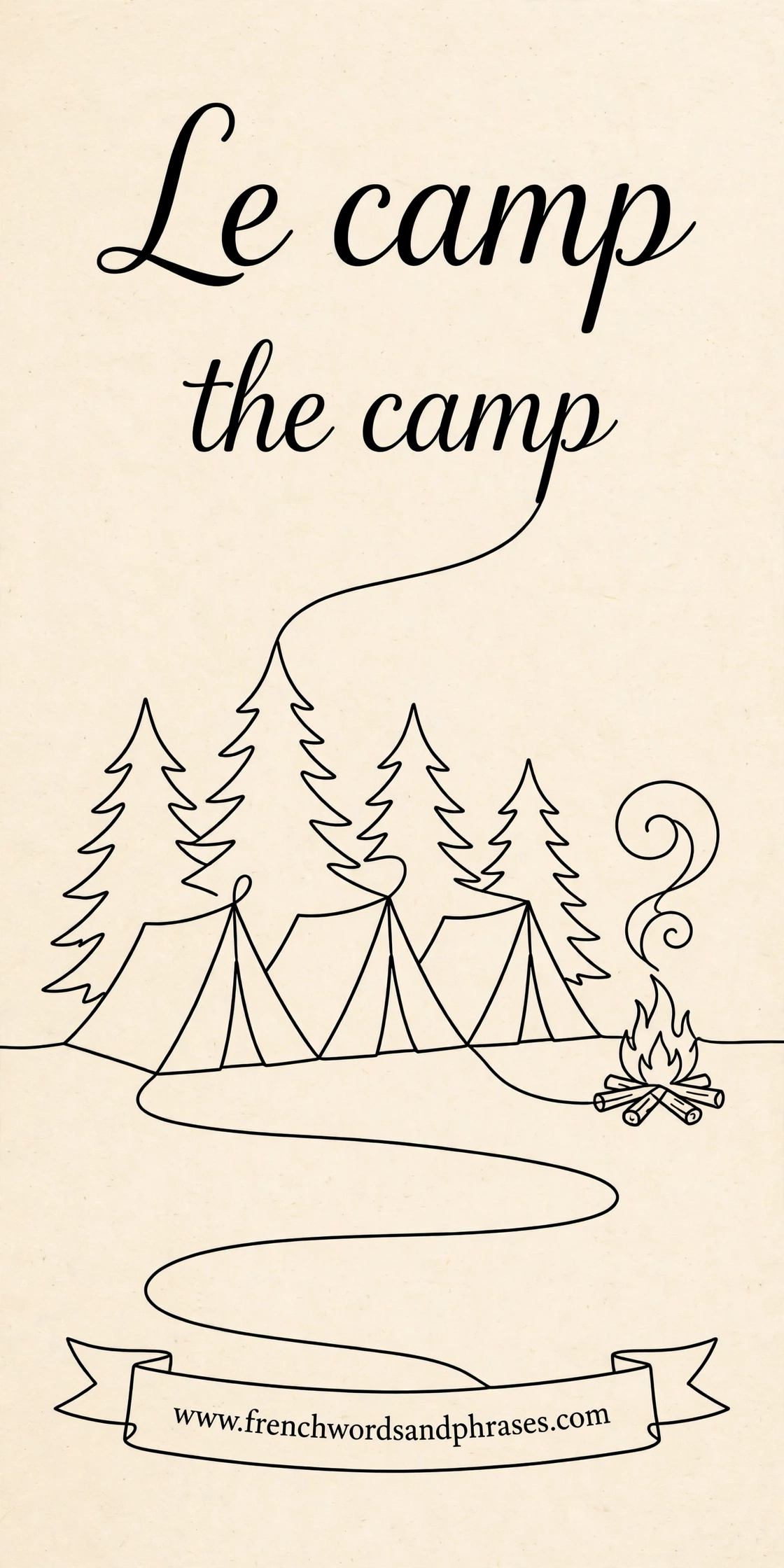
Le camp means the camp.
Tents in a pine wood smelling of resin, a fire circle of stones, soldiers’ rows at dawn and children’s cabins by a lake: le camp, the camp — the temporary town that people pitch, live in, and strike again, leaving only flattened grass.
In this guide, you’ll learn what camp means in English, how to use it with its articles, how to form its plural, and how it appears in everyday French. Explore French examples, English translations, and practice quizzes.
Understanding the French Noun Camp
Camp is a masculine French noun, learned with its article: le camp, un camp. The final p is silent — camp sounds like the nasal kã. It comes from the Latin campus, an open field: the field where the army pitched, which gave both the camp and, in the other direction, the campus and the countryside’s cousin campagne.
It means a camp — a place of tents or huts for a temporary stay: un camp de vacances, a holiday camp, un camp militaire, a military camp, monter le camp, to pitch camp. It widens to a side in a conflict: choisir son camp, to choose one’s side, le camp adverse, the opposing camp. Its dark page of history stands in un camp de concentration, a concentration camp — a term French keeps with gravity.
Gender: Masculine — le camp
Definite article: le — le camp (the camp)
Indefinite article: un — un camp (a camp)
Plural: les camps — regular, with a simple -s; the p stays silent
Spelling note: the final p is never pronounced: camp = kã, in singular and plural alike
Close neighbour: un camping — a campsite, the organised ground; le camp is the camp itself
English equivalents: The camp.
The verb of the camp is camper — camper dans la forêt, to camp in the forest — and its fixed phrase is monter le camp or dresser le camp, to pitch camp; the morning after, one lève le camp, strikes camp. In arguments, être dans le même camp means to be on the same side.
Experience the Word
Camp is the town that fits in a rucksack: canvas, rope and fire, raised in an hour and gone in ten minutes.
Imagine the scouts’ meadow at dusk. The tents stand in a crescent, the flag is up, smoke rises straight in the windless air — le camp est monté, and for two weeks this field will have streets, rules and a name.
You have not just named tents. You have named the temporary home itself — le camp.
How to Use Camp in French: Complete Guide
Let’s explore how camp works in French, beginning with its articles — le camp, un camp, monter le camp.
Camp with the Definite Article (Le, Les)
Used for a specific camp — the one in the wood, the one by the lake.
| Form | French |
|---|---|
| Masculine singular | le camp |
| Plural | les camps |
Example
Le camp se trouve près de la rivière.
The camp is near the river.
Camp with the Indefinite Article (Un, Des)
Used for a camp in general — any temporary town of tents or huts.
| Form | French |
|---|---|
| Masculine singular | un camp |
| Plural | des camps |
Example
Ils ont monté un camp au bord du lac.
They pitched a camp by the lake.
Camp with Quantities (Un, Deux, Assez de…)
Camps are counted valley by valley — one per troop, one per summer.
| Quantity | French |
|---|---|
| one camp | un camp |
| two camps | deux camps |
| a big camp | un grand camp |
| enough camps | assez de camps |
| no camp | aucun camp |
Example
Deux camps de scouts partagent la même prairie.
Two scout camps share the same meadow.
Quick Quiz 1
Complete the sentence:
______ camp des enfants est dans la forêt. (the)
Reveal the answer
Le
Le camp des enfants est dans la forêt.
The children’s camp is in the forest — camp is masculine, so le.
The Plural of Camp
Camp takes a regular plural in -s — and the p stays silent in the plural too.
| Number | French |
|---|---|
| Singular | le camp |
| Plural | les camps |
Example
Les camps de vacances ouvrent en juillet.
The holiday camps open in July.
Camp with Possessive Adjectives (Mon, Ton, Son…)
Possessives agree with the noun: camp is masculine, so mon, ton, son in the singular.
| Owner | French |
|---|---|
| my | mon camp |
| your (tu) | ton camp |
| his / her | son camp |
| our | notre camp |
| your (vous) | votre camp |
| their | leur camp |
Example
Son camp de base se trouve au pied de la montagne.
His base camp is at the foot of the mountain.
Quick Quiz 2
Complete the sentence:
Nous montons ______ camp près du ruisseau. (our)
Reveal the answer
notre
Nous montons notre camp près du ruisseau.
We pitch our camp near the stream — notre, for a singular possessed noun.
Camp with Demonstrative Adjectives (Ce, Ces)
Used to point: ce camp, this camp — usually the one with the best view.
| Form | French |
|---|---|
| Masculine singular | ce camp |
| Plural | ces camps |
Example
Ce camp accueille deux cents enfants chaque été.
This camp welcomes two hundred children every summer.
Camp with Adjectives
Adjectives agree with camp — masculine singular: un camp militaire, un camp provisoire.
| Adjective | With Camp |
|---|---|
| militaire (military) | un camp militaire |
| provisoire (temporary) | un camp provisoire |
| grand (big) | un grand camp |
| petit (small) | un petit camp |
| nouveau (new) | un nouveau camp |
Example
Un camp provisoire accueille les sinistrés.
A temporary camp shelters the disaster victims.
Quick Quiz 3
Complete the sentence:
C’est un camp très ______. (big)
Reveal the answer
grand
C’est un très grand camp.
It is a very big camp — grand, masculine, to agree with camp.
Everyday Expressions with Camp
Scouts, soldiers and sides — the camp phrases of daily life.
| Expression | In English |
|---|---|
| un camp de vacances | a holiday camp |
| monter le camp | to pitch camp |
| lever le camp | to strike camp, to pack up and go |
| choisir son camp | to choose one’s side |
| un camp de base | a base camp |
Example
Au matin, les randonneurs lèvent le camp en silence.
In the morning, the hikers strike camp in silence.
Words from the Same Family as Camp
Fields and tents — the words that travel with camp.
| French | In English |
|---|---|
| camper | to camp (the verb) |
| un camping | a campsite |
| une tente | a tent |
| la campagne | the countryside — the campus cousin |
| un campeur | a camper |
Example
Les campeurs dorment sous la tente.
The campers sleep in the tent.
Quick Quiz 4
What does lever le camp mean?
Reveal the answer
To strike camp — to pack up the tents and leave.
À l’aube, ils ont levé le camp.
At dawn, they struck camp.
Camp in Everyday French: Real-Life Examples
Now that you know the word, let’s see how camp appears in everyday French.
Example 1 — Scouts
Le camp des scouts est au bord du lac.
The scouts’ camp is by the lake.
Example 2 — Pitching
Nous montons le camp avant la pluie.
We pitch camp before the rain.
Example 3 — Holidays
Les enfants adorent le camp de vacances.
The children love the holiday camp.
Example 4 — Morning
À l’aube, le camp se réveille doucement.
At dawn, the camp wakes slowly.
Example 5 — Sides
Dans ce débat, chacun choisit son camp.
In this debate, everyone chooses their side.
Example 6 — Striking
Dimanche, nous levons le camp à sept heures.
On Sunday, we strike camp at seven.
Beyond Translation: The Meaning of Camp
Camp is the field made temporary home: Rome’s armies carried it across Europe, and the word settled everywhere they did — scouts and soldiers, refugees and holidaymakers all still monter le camp. French keeps its metaphor close: a political camp, a camp de base for climbers, the grave historical camps that the language names plainly so as never to soften them.
To say camp is to name the home you can carry.
It evokes pine woods and flag poles, dawn rows of tents and fires at dusk — wherever French pitches, belongs for a while, and moves on.
How to Remember the French Noun Camp
Remember it this way: Camp is the camp — masculine with a silent p: le camp, and you monter le camp when you pitch it.
- Always masculine — le camp, un camp, mon camp; the final p is silent.
- The pitching phrase — monter le camp, to pitch camp; lever le camp, to strike it.
- Not the campsite — the organised ground is un camping; le camp is the camp itself.
The key idea is le camp — the camp, masculine; monter le camp = to pitch camp.
Test Your Knowledge of Camp
Let’s see how much you’ve learned. Try answering these questions before revealing the answers.
Question 1
Is camp masculine or feminine?
Reveal the answer
Masculine — le camp, un camp.
Question 2
How do you say to pitch camp in French?
Reveal the answer
Monter le camp.
Question 3
Translate: The camp is near the river.
Reveal the answer
Le camp se trouve près de la rivière.
Question 4
Is the final p of camp pronounced?
Reveal the answer
No — camp sounds like kã, in the singular and plural alike.
Question 5
Complete the sentence:
______ camps de vacances ouvrent en juillet. (the)
Reveal the answer
Les
Les camps de vacances ouvrent en juillet.
The holiday camps open in July.
Your Final Challenge
Can You Use It?
How would you say this in French?
“We pitch camp by the lake before the rain.”
Reveal the answer
Nous montons le camp au bord du lac avant la pluie.
We pitch camp by the lake before the rain.
A little French. A little curiosity. A richer everyday life.
LEARN FRENCH ONE WORD AT A TIME