A French Word to Live By
Translate Chaise to English
/ʃɛz/
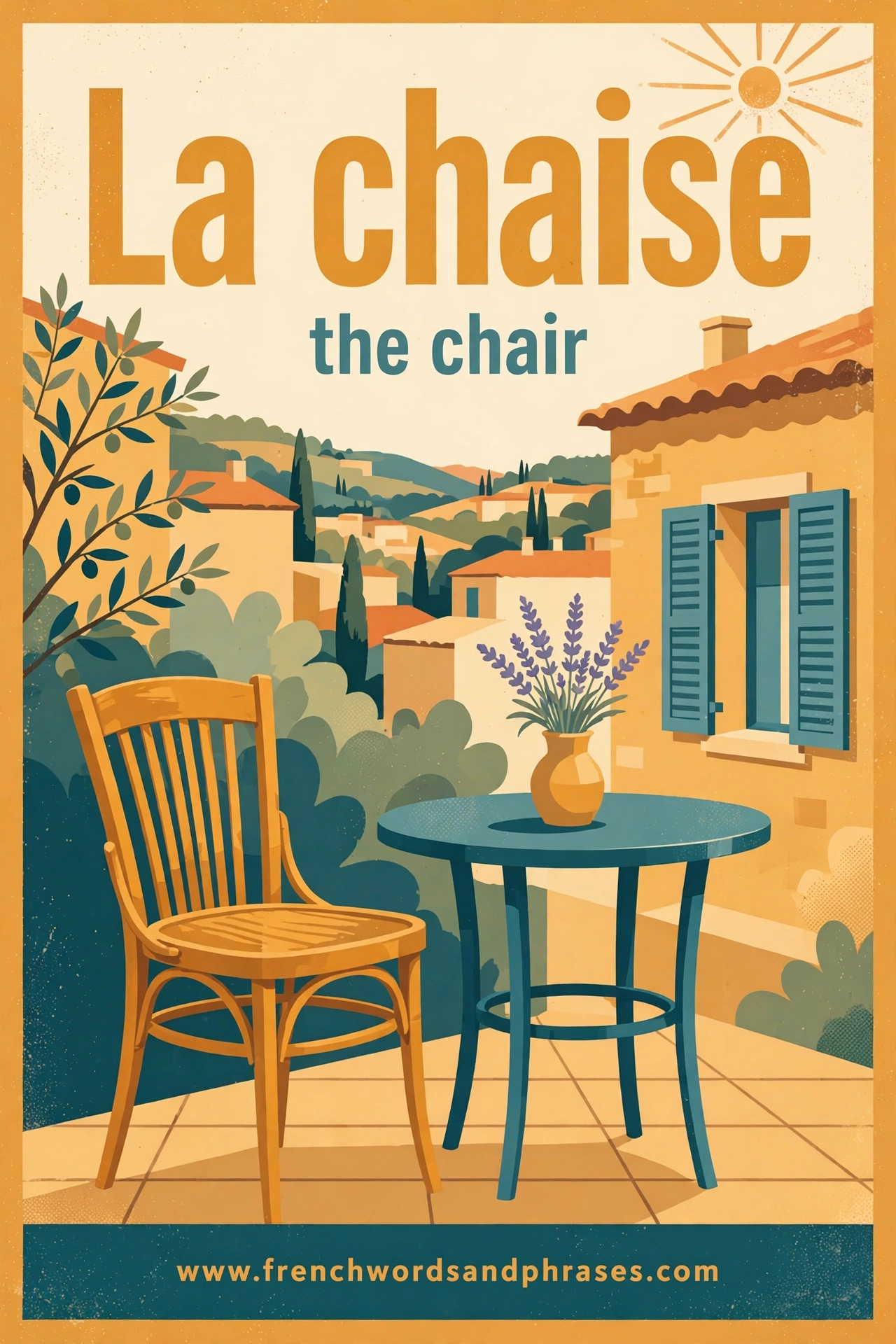
La chaise means the chair.
Four legs, a back, and an invitation to sit down: la chaise, the chair — the most democratic piece of furniture ever made, one per person at the table, from the kitchen stool’s prouder cousin to the throne it quietly descends from.
In this guide, you’ll learn what chaise means in English, how to use it with its articles, how to form its plural, and how it appears in everyday French. Explore French examples, English translations, and practice quizzes.
Understanding the French Noun Chaise
Chaise is a feminine French noun, learned with its article: la chaise, une chaise. It descends from the Latin cathedra, a seat of honour — the same word that gives English cathedral, the church that houses a bishop’s seat. The humble kitchen chair and the cathedral share a grandmother.
It means a chair — a seat for one person, with a back and usually four legs: une chaise en bois, a wooden chair, s’asseoir sur une chaise, to sit on a chair. French keeps a whole family of specialised chaises: une chaise longue, a deckchair, une chaise haute, a baby’s highchair, une chaise roulante, a wheelchair, and the grim chaise électrique, the electric chair. Do not confuse it with un fauteuil, an armchair — the chaise has no arms and no padding to speak of.
Gender: Feminine — la chaise
Definite article: la — la chaise (the chair)
Indefinite article: une — une chaise (a chair)
Plural: les chaises — regular, with a simple -s
Spelling note: from Latin cathedra — the bishop’s seat that also named the cathedral
Close neighbour: un fauteuil — an armchair; the chaise is the plain, armless seat
English equivalents: The chair.
You sit sur une chaise — literally on a chair — and you offer one with prenez une chaise, take a seat. In a classroom the teacher’s cry is tout le monde sur sa chaise !, everyone on their chair. And when the music stops in les chaises musicales, musical chairs, there is famously never a chaise for everyone.
Experience the Word
Chaise is equality you can sit on: at the family table, every chaise is the same height, and everyone gets exactly one.
Imagine the café terrace at noon, a hundred chaises turned towards the sun, each one holding a coffee, a newspaper and an hour of doing nothing beautifully.
You have not just named a seat. You have named the throne of everyday life — la chaise, the chair, four legs and a welcome.
How to Use Chaise in French: Complete Guide
Let’s explore how chaise works in French, beginning with its articles — la chaise, une chaise, s’asseoir sur une chaise.
Chaise with the Definite Article (La, Les)
Used for a specific chair — the one by the window, the one that wobbles.
| Form | French |
|---|---|
| Feminine singular | la chaise |
| Plural | les chaises |
Example
La chaise près de la fenêtre est libre.
The chair near the window is free.
Chaise with the Indefinite Article (Une, Des)
Used for a chair in general — any seat to pull up to the table.
| Form | French |
|---|---|
| Feminine singular | une chaise |
| Plural | des chaises |
Example
Apporte une chaise, nous avons un invité de plus.
Bring a chair, we have one more guest.
Chaise with Quantities (Une, Deux, Assez de…)
Chairs are counted one by one — around a table, in a hall, in a classroom.
| Quantity | French |
|---|---|
| one chair | une chaise |
| four chairs | quatre chaises |
| enough chairs | assez de chaises |
| too many chairs | trop de chaises |
| a row of chairs | une rangée de chaises |
Example
Il nous faut six chaises pour le dîner de dimanche.
We need six chairs for Sunday’s dinner.
Quick Quiz 1
Complete the sentence:
______ chaise du professeur est au fond de la classe. (the)
Reveal the answer
La
La chaise du professeur est au fond de la classe.
The teacher’s chair is at the back of the classroom — chaise is feminine, so la.
The Plural of Chaise
Chaise takes a regular plural in -s — chairs travel in groups.
| Number | French |
|---|---|
| Singular | la chaise |
| Plural | les chaises |
Example
Les chaises sont rangées le long du mur.
The chairs are lined up along the wall.
Chaise with Possessive Adjectives (Ma, Ta, Sa…)
Possessives agree with the noun: chaise is feminine, so ma, ta, sa in the singular.
| Owner | French |
|---|---|
| my | ma chaise |
| your (tu) | ta chaise |
| his / her | sa chaise |
| our | notre chaise |
| your (vous) | votre chaise |
| their | leur chaise |
Example
Prends ma chaise, je resterai debout.
Take my chair, I’ll stay standing.
Quick Quiz 2
Complete the sentence:
Elle a reculé ______ chaise et s’est levée. (her)
Reveal the answer
sa
Elle a reculé sa chaise et s’est levée.
She pushed back her chair and stood up — sa, because chaise is feminine.
Chaise with Demonstrative Adjectives (Cette, Ces)
Used to point: cette chaise, this chair — usually the wobbly one.
| Form | French |
|---|---|
| Feminine singular | cette chaise |
| Plural | ces chaises |
Example
Cette chaise bouge, prends-en une autre.
This chair wobbles, take another one.
Chaise with Adjectives
Adjectives agree with chaise — feminine singular: une chaise confortable, une vieille chaise.
| Adjective | With Chaise |
|---|---|
| confortable (comfortable) | une chaise confortable |
| en bois (wooden) | une chaise en bois |
| vieille (old) | une vieille chaise |
| haute (high) | une chaise haute |
| roulante (wheeled) | une chaise roulante |
Example
Le bébé mange dans sa chaise haute.
The baby eats in his highchair.
Quick Quiz 3
Complete the sentence:
C’est une chaise très ______. (comfortable)
Reveal the answer
confortable
C’est une chaise très confortable.
It’s a very comfortable chair — confortable has the same form for masculine and feminine.
Everyday Expressions with Chaise
Terraces, classrooms and beaches — the chaise phrases of daily life.
| Expression | In English |
|---|---|
| s’asseoir sur une chaise | to sit on a chair |
| une chaise longue | a deckchair |
| une chaise haute | a highchair |
| les chaises musicales | musical chairs |
| une chaise roulante | a wheelchair |
Example
À la plage, il dort sur une chaise longue.
At the beach, he sleeps on a deckchair.
Words from the Same Family as Chaise
Seats and sitting — the words that travel with chaise.
| French | In English |
|---|---|
| un fauteuil | an armchair |
| un tabouret | a stool |
| s’asseoir | to sit down (the verb) |
| un siège | a seat (in a theatre, a plane) |
| la cathédrale | the cathedral — the bishop’s seat, same Latin root |
Example
Il s’est assis sur le tabouret près du comptoir.
He sat down on the stool near the counter.
Quick Quiz 4
What is une chaise longue?
Reveal the answer
A deckchair — the long, low chair of beaches and gardens.
Elle lit sur une chaise longue au soleil.
She reads on a deckchair in the sun.
Chaise in Everyday French: Real-Life Examples
Now that you know the word, let’s see how chaise appears in everyday French.
Example 1 — At the café
Il s’assied sur une chaise à la terrasse.
He sits down on a chair on the terrace.
Example 2 — At home
Mets les chaises autour de la table.
Put the chairs around the table.
Example 3 — In class
Chaque élève a sa chaise et son bureau.
Each pupil has their chair and their desk.
Example 4 — The wobbly one
Cette chaise bouge, elle a un pied cassé.
This chair wobbles, it has a broken leg.
Example 5 — At the beach
Une chaise longue et un parasol, c’est le bonheur.
A deckchair and a parasol, that’s happiness.
Example 6 — The game
Les enfants jouent aux chaises musicales.
The children are playing musical chairs.
Beyond Translation: The Meaning of Chaise
Chaise began life as a seat of authority: Latin cathedra was the chair a teacher or a bishop sat in to speak with weight, and the building that held the bishop’s cathedra became the cathedral. French democratised the word — it slid down from the bishop to the schoolchild — but the chaise kept a whisper of ceremony: we still pull one up for a guest, offer one to an elder, and feel the small insult of a room with no chair left for us.
To say chaise is to offer someone a place in the room.
It evokes the café terrace, the family table and the classroom — everywhere French life arranges itself, one chair per person, face to face.
How to Remember the French Noun Chaise
Remember it this way: Chaise is the chair — one seat, one person, feminine: la chaise, and you sit sur une chaise.
- Always feminine — la chaise, une chaise, ma chaise.
- The sitting phrase — s’asseoir sur une chaise, to sit on a chair.
- Not an armchair — that is un fauteuil; the chaise is plain and armless.
The key idea is la chaise — the chair, feminine; from cathedra, the bishop’s seat.
Test Your Knowledge of Chaise
Let’s see how much you’ve learned. Try answering these questions before revealing the answers.
Question 1
Is chaise masculine or feminine?
Reveal the answer
Feminine — la chaise, une chaise.
Question 2
How do you say to sit on a chair?
Reveal the answer
S’asseoir sur une chaise.
Question 3
Translate: Bring a chair, please.
Reveal the answer
Apporte une chaise, s’il te plaît.
Question 4
What is the difference between une chaise and un fauteuil?
Reveal the answer
The fauteuil is an armchair — padded, with arms; the chaise is the plain seat.
Question 5
Complete the sentence:
______ chaises sont autour de la table. (the)
Reveal the answer
Les
Les chaises sont autour de la table.
The chairs are around the table.
Your Final Challenge
Can You Use It?
How would you say this in French?
“Put the chairs around the table.”
Reveal the answer
Mets les chaises autour de la table.
Put the chairs around the table.
A little French. A little curiosity. A richer everyday life.
LEARN FRENCH ONE WORD AT A TIME