A French Word to Live By
Translate On to English
/ɔ̃/
On means we, one — the indefinite subject pronoun, and spoken French’s word for we.
A family at Sunday lunch, plans being made between the cheese and the dessert: « On va au cinéma ? On mange à quelle heure ? » Nobody says nous — everybody says on. It is the most used subject word in spoken French: we, one, people, they — all in two letters.
Let’s explore how on works in French, beginning with the whole word on one card.
Understanding the French Pronoun On
On is a French indefinite subject pronoun. It descends from the Latin homo, man — on was once the word for « man » in general, and it still carries that sense: on dit que…, people say that…. But in modern spoken French it has a second, bigger job: it has replaced nous as the everyday word for we. In both lives it behaves the same way grammatically: the verb is always third person singular — on est, on a, on va — however many people it means.
It means we — in conversation, almost always: on va au marché, we’re going to the market; on est prêts, we’re ready (the adjective agrees with the real people, not with on). And it means one, people, they in general: en France, on mange tard, in France, people eat late; on ne sait jamais, you never know. Context, tone and the sentence around it tell you which on you are hearing — and French speakers switch between the two without ever noticing.
Type: Indefinite subject pronoun — also the spoken form of we
Answers the question: Qui ? — Who? (we, one, people in general)
Agreement: Verb always 3rd person singular: on est, on va; adjectives agree with the real people: on est prêtes (a group of women)
Watch the pair: on (pronoun) vs ont (they have) — same sound, different words
One important usage detail: after on, the possessives are son, sa, ses (third person), even when on means we: on a oublié son parapluie, we forgot our umbrella — spoken French accepts son here where English expects our. And in careful style, on becomes l’on after a vowel sound to avoid a clash: ce que l’on dit, what people say — the l’ is pure elegance, never obligatory in speech.
Experience the Word
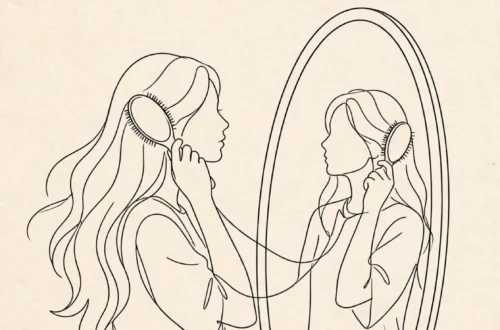
On is the pronoun of the group hug and the shrug at once: it means us, all of us — and also nobody in particular, people, the world.
Imagine the village café at eight in the morning. The patron wipes the counter and delivers the day’s philosophy: « On ne sait plus à qui se fier. » People don’t know who to trust any more. Is he talking about the village, the country, himself? With on, he is talking about everyone — that is the word’s genius.
You have not found a vague shortcut. You have picked up the hardest-working pronoun in France — on, the sound of we and of everybody.
How to Use On in French: Complete Guide
Let’s explore how on works in French, beginning with the whole word on one card.
On at a Glance
The Whole Word on One Card
Meanings, verb, agreement and family — on in four lines.
| Point | On |
|---|---|
| Meanings | we (spoken) — and one, people, they in general |
| Verb | always 3rd person singular: on est, on a, on va |
| Agreement | adjectives follow the real people: on est prêts, on est arrivées |
| Its family | nous (the written we), quelqu’un (someone), tout le monde (everyone) |
Example
On est prêts, on y va !
We’re ready, let’s go!
The Pattern in Action: The Two Lives of On
The same word, two jobs — the group in the room, and people in general.
| Pattern | Example |
|---|---|
| on = we (spoken) | on va au cinéma ce soir — we’re going to the cinema tonight |
| on = one, people | en Italie, on dîne tard — in Italy, people dine late |
| on = they (unnamed) | on a volé mon vélo — someone stole my bike (they stole my bike) |
| on in sayings | on ne sait jamais — you never know |
Example
On dit que le printemps sera beau.
They say spring will be beautiful.
Quick Quiz 1
Which verb form goes with on — on sommes or on est?
Reveal the answer
On est — the verb with on is always 3rd person singular.
On est en retard, dépêchons-nous !
We’re late, let’s hurry!
On at Work: The Verbs It Lives With
On spends its days in the most common sentences in France — learn these and you are already conversing.
| Pattern | Example |
|---|---|
| on y va | let’s go — the great departure cry |
| on va + infinitive | on va manger — we’re going to eat |
| on a + participle | on a bien dormi — we slept well |
| on est + adjective | on est contents — we’re happy (adjective plural!) |
| on se + verb | on se lève tôt — we get up early |
Example
On se retrouve à huit heures devant le cinéma.
We’ll meet at eight in front of the cinema.
On or Nous? The Spoken Twin and the Written Twin
Same we, different clothes: on for the café and the kitchen, nous for the letter and the speech.
| Situation | Example |
|---|---|
| everyday speech | on part demain — we’re leaving tomorrow |
| formal writing | nous partirons demain — we shall leave tomorrow |
| emphasis | nous, on s’en occupe — we’ll take care of it (nous stresses, on works) |
| after a preposition | chez nous — at our place (on cannot follow a preposition) |
Example
Chez nous, on mange à midi pile.
At our place, we eat at noon sharp.
Quick Quiz 2
In conversation, how do French people usually say « we’re going » — nous allons or on va?
Reveal the answer
On va — spoken French has almost entirely replaced nous with on.
On va au marché, tu viens ?
We’re going to the market, are you coming?
Everyday Expressions with On
On turns up in the phrases French speakers say a hundred times a week.
| Expression | In English |
|---|---|
| on y va ! | let’s go! |
| on ne sait jamais | you never know |
| on dit que… | they say that…, people say that… |
| on s’en va | we’re off, we’re leaving |
| qu’est-ce qu’on fait ? | what shall we do? / what are we doing? |
| on verra | we’ll see |
Example
On verra bien demain, on ne sait jamais.
We’ll see tomorrow, you never know.
Close Cousins: Nous, Quelqu’un, Tout le monde
The subject family: the written we, the someone, and the everyone.
| Word | The difference |
|---|---|
| on | we (spoken) or one/people — verb singular |
| nous | we — written, formal, or stressed; verb plural |
| quelqu’un | someone — one specific unknown person |
| tout le monde | everyone — the whole group, named |
Example
Tout le monde est là, on peut commencer.
Everyone is here, we can start.
Quick Quiz 3
In on a sonné à la porte, who rang — « we » or « someone »?
Reveal the answer
Someone — on names an unknown person here: someone rang at the door.
On a sonné, va ouvrir !
Someone rang, go and open!
On and Its Neighbours
The indefinite shelf: the people-words that never name names.
| French | In English |
|---|---|
| nous | we (formal, written) |
| quelqu’un | someone |
| personne | nobody, no one (with ne) |
| chacun | each one, everyone individually |
| les gens | people (the noun) |
Example
Les gens disent qu’on ne peut plus se fier à personne.
People say you can’t trust anyone any more.
Watch Out: The Traps Around On
The traps: its sound-alike ont, a plural verb, and adjectives that forget the real people.
| Trap | The truth |
|---|---|
| on vs ont | ont is the verb (ils ont, they have) — on is the pronoun: on a, with a, never ont as a subject word |
| a plural verb | the verb stays singular: on va, on est — never « on allons » |
| adjective agreement | adjectives agree with the real people: Marie et moi, on est prêtes |
| on after a preposition | impossible: after à, avec, chez, French uses nous — chez nous, avec nous |
Example
Elles ont dit qu’on était prêtes à partir.
They said we were ready to leave.
Quick Quiz 4
Complete: ______ est contents de te voir ! (we)
Reveal the answer
On — with a singular verb and a plural adjective, because the real people are plural.
On est contents de te voir !
We’re happy to see you!
On in Everyday French: Real-Life Examples
Now that you know the word, let’s see how on appears in everyday French.
Example 1 — Plans
On va au restaurant ce soir ?
Shall we go to a restaurant tonight?
Example 2 — Leaving
On y va, il est tard !
Let’s go, it’s late!
Example 3 — General truth
En France, on déjeune vers midi.
In France, people have lunch around noon.
Example 4 — Unknown person
On a téléphoné pour toi.
Someone phoned for you.
Example 5 — Agreement
On est d’accord, alors.
We’re agreed, then.
Example 6 — Proverb
On ne sait jamais, prends un parapluie.
You never know, take an umbrella.
Beyond Translation: The Meaning of On
On is Latin homo — man — worn down by two thousand years of mouths into a single nasal sound. Old French still had the noun (li om, the man); modern French kept the pronoun and let the noun go to homme. Then, in the last century, on performed a quiet coup: it took over the job of nous in speech, because on est is simply easier than nous sommes. Grammarians note that nous survives in writing, in speeches and under stress — nous, on insiste — but the café belongs to on. One word for we, one, people, they and someone: French traded precision for warmth, and the trade made conversation itself.
To say on is to speak as the group, and as everyone, in the same breath.
It evokes the family table, the café counter, and every « on y va ! » ever shouted at a doorway.
How to Remember the French Pronoun On
Remember it this way: On is we in speech and one in general — the verb is always singular, the adjective follows the real people.
- The verb — always 3rd person singular: on est, on a, on va, even for we.
- The adjective — agrees with reality: on est prêtes for a group of women.
- The twin — nous for writing and emphasis; after prepositions, only nous: chez nous.
The key idea is on = we (spoken) / one, people; verb always singular: on est.
Test Your Knowledge of On
Let’s see how much you’ve learned. Try answering these questions before revealing the answers.
Question 1
What are the two meanings of on?
Reveal the answer
We (in spoken French) and one, people, they in general.
Question 2
How do you say let’s go?
Reveal the answer
On y va !
Question 3
Translate: In France, people eat late.
Reveal the answer
En France, on mange tard.
Question 4
Complete the sentence:
______ a sonné à la porte. (someone)
Reveal the answer
On
On a sonné à la porte.
Someone rang at the door.
Question 5
Why is the verb in on est contents singular but the adjective plural?
Reveal the answer
On always takes a singular verb, but adjectives agree with the real people it stands for.
Your Final Challenge
Can You Use It?
How would you say this in French?
“We’re ready, let’s go!”
Reveal the answer
On est prêts, on y va !
We’re ready, let’s go!
A little French. A little curiosity. A richer everyday life.
LEARN FRENCH ONE WORD AT A TIME