A French Word to Live By
Translate Se to English
/sə/
Se means himself, herself, itself, themselves — the third-person reflexive pronoun.
He rises, she dresses, the door closes by itself, the two old friends meet after twenty years — il se lève, elle s’habille, la porte se ferme, ils se retrouvent. One tiny word, se, turns every third-person verb back on its subject, and half the verbs of French daily life are built with it.
Let’s explore how se works in French, beginning with the whole word on one card.
Understanding the French Pronoun Se
Se is a French reflexive pronoun — the third person’s member of the object-pronoun family. Where je has me and tu has te, il, elle, on, ils and elles all share se: il se lève, elle se trompe, ils se parlent, elles se souviennent. Before a vowel it shrinks to s’: il s’habille, elle s’assied. Placed before the verb, it tells you the action bends back on the subject — or, in its other great lives, that people act on each other (ils se téléphonent, they phone each other), or that the subject simply undergoes the action (la porte se ferme, the door closes).
It means himself, herself, itself, themselves — and each other: il se regarde dans le miroir, he looks at himself in the mirror; ils se regardent, they look at each other (or at themselves — context decides). Whole families of verbs exist only with se: se souvenir, to remember; se dépêcher, to hurry; s’asseoir, to sit down; se taire, to fall silent. And French uses se for the passive of everyday life: ça se fait, that is done; ce mot s’écrit ainsi, this word is written like this; le vin se boit frais, wine is drunk chilled.
Type: Reflexive pronoun — third person (il, elle, on, ils, elles)
Answers the question: Sur qui revient l’action ? — On whom does the action fall back? (himself, herself, themselves)
Position: Immediately before the verb: elle se couche; elides to s’ before a vowel: il s’assied
Watch the pair: se (reflexive pronoun) vs ce (this) — near neighbours in sound and spelling
One important usage detail: verbs built with se take être in the passé composé, and the participle usually agrees with the subject: elle s’est levée, ils se sont couchés. After an affirmative command, se becomes soi’s cousin toi-form only for tu — for il and ils there is no command — but the infinitive keeps se in front: avant de se coucher, before going to bed. And note the body-part rule: with se, French uses the definite article, not the possessive — il se lave les mains, he washes his hands (literally: he washes himself the hands).
Experience the Word
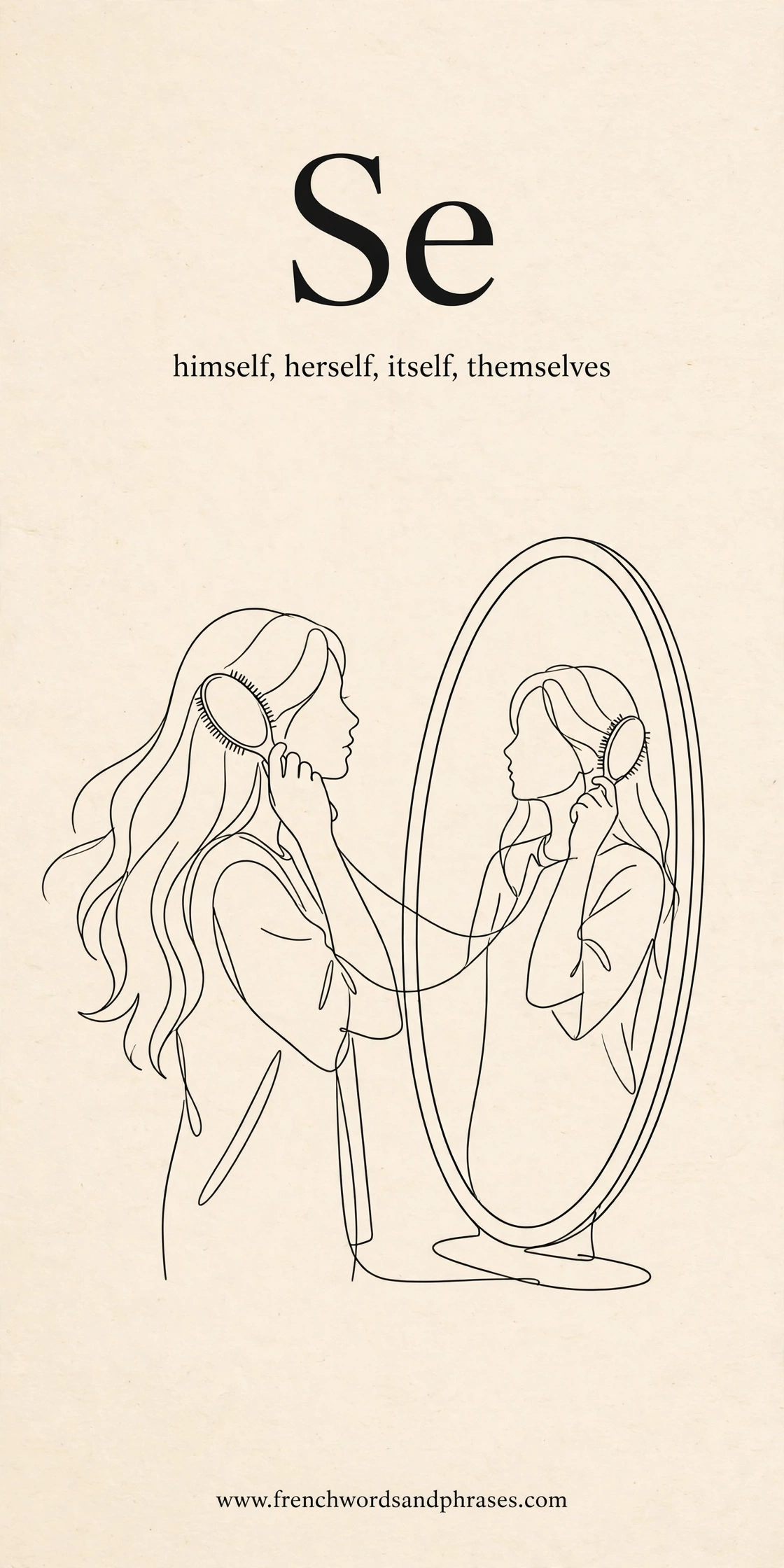
Se is the pronoun of the mirror: the subject acts, and the action comes home. French built its whole morning out of it — se lever, se laver, s’habiller, se dépêcher — a nation getting itself up, one se at a time.
Imagine the two brothers who have not spoken in ten years, meeting by chance on a platform in Lyon. They stop. They look. Ils se serrent la main, puis ils se parlent, puis ils s’embrassent — each se a small bridge rebuilt: they shake hands, they talk to each other, they embrace. The pronoun of the mirror turns out to be the pronoun of reconciliation too.
You have not just learned a pronoun. You have found the hinge of French verbs — se, where the action turns around.
How to Use Se in French: Complete Guide
Let’s explore how se works in French, beginning with the whole word on one card.
Se at a Glance
The Whole Word on One Card
Meaning, jobs, position and family — se in four lines.
| Point | Se |
|---|---|
| Meaning | himself, herself, itself, themselves — and each other |
| Jobs | reflexive pronoun; reciprocal marker; everyday passive builder |
| Position | just before the verb; s’ before a vowel: il s’habille |
| Its family | me (for je), te (for tu), nous, vous — the reflexive set |
Example
Elle se prépare pour la fête.
She is getting ready for the party.
The Pattern in Action: The Three Lives of Se
Se bends the action back, shares it between people, or lets the subject undergo it.
| Pattern | Example |
|---|---|
| reflexive | il se lève — he gets (himself) up |
| reciprocal | ils se téléphonent — they phone each other |
| undergone | la porte se ferme — the door closes (by itself) |
| the written rule | ce mot s’écrit avec deux s — this word is written with two s’s |
Example
Ils se sont retrouvés après vingt ans.
They met again after twenty years.
Quick Quiz 1
Which subjects use se — je, or il / elle / ils / elles?
Reveal the answer
Il, elle, on, ils, elles — the third person. Je uses me, tu uses te.
Elle se lève, il se lave, ils se couchent.
She gets up, he washes, they go to bed.
Se at Work: The Verbs That Live With It
Some of the most useful verbs in French exist only in their se form — learn them as single words.
| Pattern | Example |
|---|---|
| se lever / se coucher | to get up / to go to bed |
| s’asseoir | to sit down — il s’assied |
| se souvenir (de) | to remember — elle se souvient de tout |
| se dépêcher | to hurry — dépêche-toi is for tu; ils se dépêchent |
| se taire | to fall silent — il se tait |
Example
Elle s’assied et se souvient de tout.
She sits down and remembers everything.
Se in the Past: The Être Rule
In the passé composé, se-verbs take être and the participle agrees with the subject.
| Form | French | In English |
|---|---|---|
| Present | elle se lève | she gets up |
| Passé composé | elle s’est levée | she got up |
| Plural | ils se sont couchés | they went to bed |
| Infinitive | avant de se coucher | before going to bed |
| Negative | il ne s’est pas trompé | he did not make a mistake |
Example
Ils se sont levés avant le soleil.
They got up before the sun.
Quick Quiz 2
« She got up » — elle s’est levé or elle s’est levée?
Reveal the answer
Elle s’est levée — with se-verbs, the participle agrees with the subject.
Elle s’est levée à six heures.
She got up at six o’clock.
Everyday Expressions with Se
Se turns up in the phrases of reunion, routine and rules — all day, everywhere.
| Expression | In English |
|---|---|
| ça se fait | that is done, people do it |
| ça ne se fait pas | that is not done (bad manners) |
| comment ça s’écrit ? | how is that written, how do you spell it? |
| se rendre compte | to realise |
| s’il se peut | if it is possible (formal) |
Example
Ça ne se fait pas, dit la grand-mère.
That is not done, says the grandmother.
Close Cousins: Me, Te, Soi
The reflexive family — one pronoun per person, and the stressed cousin for the third person.
| Word | The difference |
|---|---|
| se | himself, herself, themselves — before the verb, third person |
| me / te | myself / yourself — the same job for je and tu |
| soi | oneself — the stressed form, after prepositions: chez soi, home |
| lui-même / elle-même | himself / herself — the emphatic long forms |
Example
Chacun rentre chez soi et se repose.
Everyone goes home (to their own place) and rests.
Quick Quiz 3
In ils se téléphonent, does se mean « themselves » or « each other »?
Reveal the answer
Each other — the reciprocal life of se.
Ils se téléphonent tous les dimanches.
They phone each other every Sunday.
Se and Its Neighbours
The shelf around se — its persons, its stressed cousin, and its sound-alike ce.
| French | In English |
|---|---|
| me / te | myself / yourself (before the verb) |
| soi | oneself — stressed: penser à soi |
| ce | this — ce livre; not a pronoun of return |
| s’asseoir, se lever… | the se-verbs of the daily routine |
| seul | alone — no relation, despite the look |
Example
Ce matin, il se lève seul et pense à soi… non, à elle.
This morning, he gets up alone and thinks of himself… no, of her.
Watch Out: The Traps Around Se
The traps: avoir for être, the forgotten agreement, and possessives where French wants the article.
| Trap | The truth |
|---|---|
| « elle a se levée » | se-verbs take être: elle s’est levée |
| « ils se sont couché » | the participle agrees: ils se sont couchés |
| « il se lave ses mains » | body parts take the article with se: il se lave les mains |
| se for je or tu | je takes me, tu takes te: je me lève, tu te lèves, il se lève |
Example
Il se lave les mains avant de manger.
He washes his hands before eating.
Quick Quiz 4
Complete: elle ______ habille vite le matin (gets dressed)
Reveal the answer
s’ — se elides before a vowel: elle s’habille.
Elle s’habille vite le matin.
She gets dressed quickly in the morning.
Se in Everyday French: Real-Life Examples
Now that you know the word, let’s see how se appears in everyday French.
Example 1 — Morning
Il se lève à sept heures précises.
He gets up at seven o’clock sharp.
Example 2 — Sitting
Elle s’assied près de la fenêtre.
She sits down near the window.
Example 3 — Each other
Ils se téléphonent tous les soirs.
They phone each other every evening.
Example 4 — Remembering
Tu crois qu’il se souvient de nous ?
Do you think he remembers us?
Example 5 — Rules
Ce vin se boit frais, dit le sommelier.
This wine is drunk chilled, says the sommelier.
Example 6 — Manners
Ça ne se fait pas, mon enfant.
That is not done, my child.
Beyond Translation: The Meaning of Se
Se is the hardest-working syllable in French. One small word does the work of the mirror (il se regarde), of the embrace (ils s’embrassent), of the machine that runs itself (la porte se ferme), of the rule book (ça ne se fait pas) and of the recipe (se boit frais). Latin had a reflexive pronoun, sē, and French kept it while English was losing its own — English must spell out himself, themselves, each other, or build a passive; French just leans se against the verb and lets the sense bloom. Learn to hear se and you have learned to hear French thinking about itself.
To say se is to bend the verb home.
It evokes the morning mirror, the platform reunion, and the door that closes, quietly, all by itself.
How to Remember the French Pronoun Se
Remember it this way: Se is the third person’s reflexive — himself, herself, themselves, each other — with être in the past and agreement on the participle.
- The persons — il, elle, on, ils, elles take se; je takes me, tu takes te.
- The past — être plus agreement: elle s’est levée, ils se sont couchés.
- The three lives — reflexive (il se lave), reciprocal (ils se parlent), undergone (la porte se ferme).
The key idea is se = himself/herself/themselves/each other; passé composé with être + agreement.
Test Your Knowledge of Se
Let’s see how much you’ve learned. Try answering these questions before revealing the answers.
Question 1
What does se mean?
Reveal the answer
Himself, herself, itself, themselves — and each other between people.
Question 2
How do you say she gets up?
Reveal the answer
Elle se lève.
Question 3
Translate: They phone each other every evening.
Reveal the answer
Ils se téléphonent tous les soirs.
Question 4
Complete the sentence:
Il ______ assied près de la porte. (sits down)
Reveal the answer
s’
Il s’assied près de la porte.
He sits down near the door.
Question 5
Which auxiliary do se-verbs take in the passé composé?
Reveal the answer
Être — elle s’est levée, with the participle agreeing with the subject.
Your Final Challenge
Can You Use It?
How would you say this in French?
“They met again after twenty years.”
Reveal the answer
Ils se sont retrouvés après vingt ans.
They met again after twenty years.
A little French. A little curiosity. A richer everyday life.
LEARN FRENCH ONE WORD AT A TIME