A French Word to Live By
Translate À pied to English
/a pje/
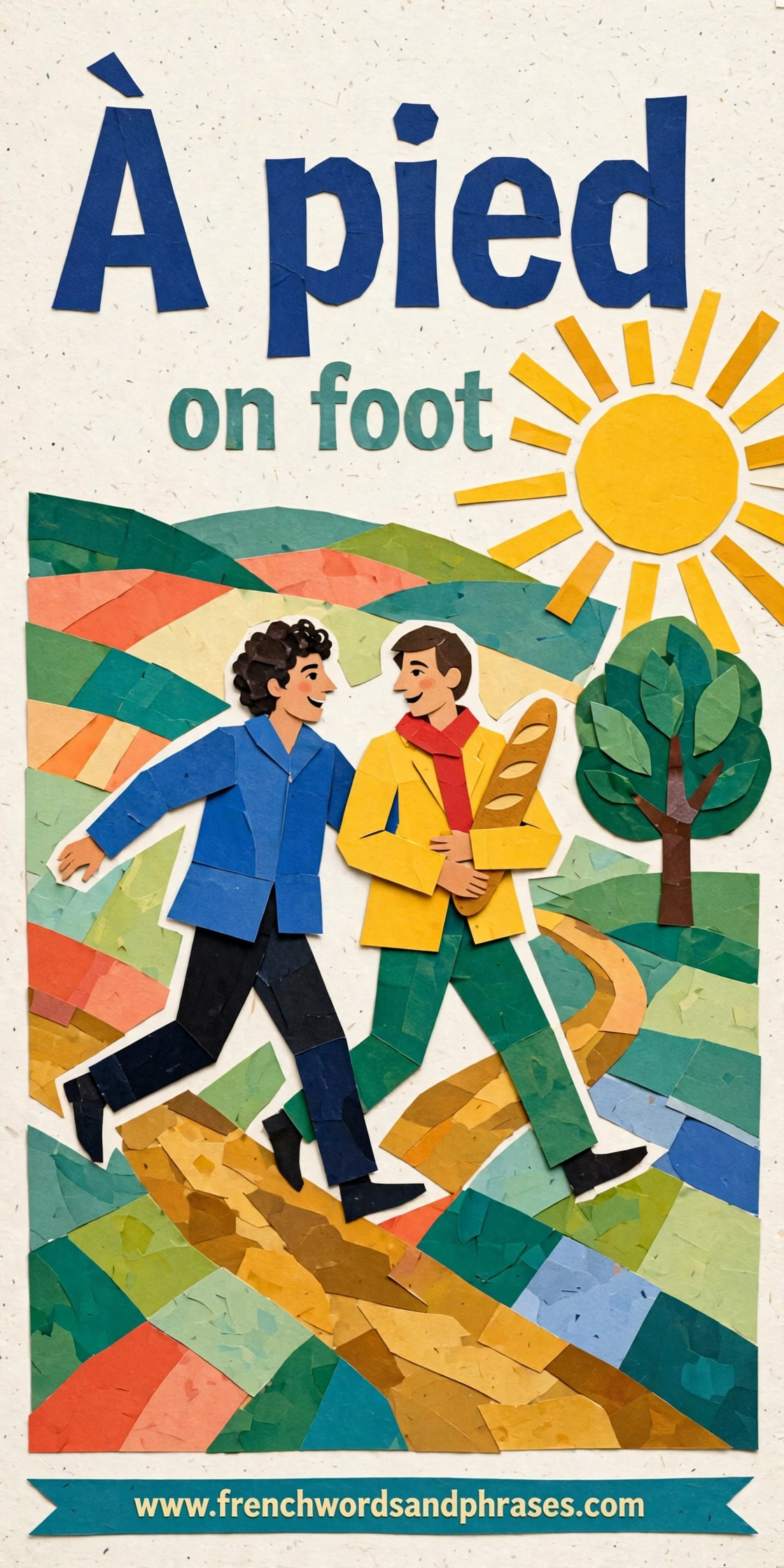
À pied means on foot — walking, by walking.
No car, no bus, no bicycle — just shoes, a road, and time: à pied, on foot. It is the oldest way of travelling in the world, and French still names it with the body’s own vehicle: le pied, the foot.
Let’s explore how à pied works in French, beginning with the whole phrase on one card.
Understanding the French Phrase À pied
À pied is a French adverbial phrase built from the preposition à and pied, the foot — a noun that has its own page on this site. It belongs to French’s great system of travel phrases, where the little word before the vehicle tells the story: à for what the body powers or touches (à pied, à vélo, à cheval), en for what encloses you (en voiture, en train, en avion). À pied is the head of that family: the journey made by your own two feet.
It means on foot, by walking: aller à pied, to go on foot, venir à pied, to come on foot, rentrer à pied, to walk home, dix minutes à pied, ten minutes on foot — the phrase French uses to measure every distance in a town. It never changes and never takes an article: not « au pied » (that is the foot of a mountain or a page) and not « en pied ». After the verbs of moving — aller, venir, partir, rentrer, retourner — à pied simply attaches, and the walk is understood.
Type: Adverbial phrase — manner of travel (à + noun, no article)
Answers the question: Comment ? — How? (by what means of travel)
The system: à for body-powered travel (à pied, à vélo, à cheval); en for enclosed vehicles (en voiture)
Its measure: dix minutes à pied — distances in walking time
One important usage detail: à pied is invariable and article-free — on va à pied, never « aux pieds » for travelling (aux pieds means at someone’s feet, by their shoes). And mind the famous trap of the system: on foot is à pied, by bike is à vélo, on horseback is à cheval — but by car, bus, train and plane all take en: en voiture, en bus, en train, en avion.
Experience the Word
À pied is the phrase of the unhurried: the journey at walking pace, where the town reveals what the car windows hide.
Imagine the old man in the village who has walked to the bakery every morning for sixty years — à pied, always à pied. He knows every stone of the lane, every dog by name, and the exact minute the bread comes out of the oven. The car in his garage is for Sundays and funerals; his real vehicle is in the phrase.
English goes on foot too, body part and all. French simply made it the rule for everything the body drives: à pied, à vélo, à cheval — the à of effort.
How to Use À pied in French: Complete Guide
Let’s explore how à pied works in French, beginning with the whole phrase on one card.
À pied at a Glance
The Whole Phrase on One Card
Meaning, picture, system and measure — à pied in four lines.
| Point | À pied |
|---|---|
| What it really means | on foot, by walking — travelling by your own feet |
| Word for word | at foot — the body as the vehicle |
| The system | à + body-powered means: à pied, à vélo, à cheval |
| Its measure | distances in walking minutes: cinq minutes à pied |
Example
L’école est à cinq minutes à pied.
The school is five minutes away on foot.
Word by Word: Building the Phrase
Two pieces — the preposition of manner and the foot itself.
| Word | Literal meaning | Its job in the phrase |
|---|---|---|
| à | at, by | the manner marker: the means touches or is powered by the body |
| pied | the foot | the vehicle — always singular, never an article |
| aller / venir / rentrer + à pied | to go / come / return | the movement verbs the phrase attaches to |
Example
Nous rentrons à pied ce soir.
We are walking home this evening.
Quick Quiz 1
Which is correct for « on foot » — à pied or en pied?
Reveal the answer
À pied — body-powered travel takes à.
On y va à pied, c’est tout près.
We’ll go on foot, it’s very close.
The Travel System: À or En?
French sorts every journey: à for what the body powers, en for what carries the body inside.
| Means | Example |
|---|---|
| on foot | à pied — aller à pied |
| by bike | à vélo — venir à vélo |
| on horseback | à cheval — partir à cheval |
| by car | en voiture — voyager en voiture |
| by train / plane / bus | en train, en avion, en bus |
Example
Elle vient à vélo, lui à pied, et les autres en voiture.
She comes by bike, he on foot, and the others by car.
À pied in Its Sentences: The Walking Verbs
The phrase follows the verbs of moving — going, coming, returning, and the walk itself.
| Form | French | In English |
|---|---|---|
| Present | je vais à pied au travail | I walk to work |
| Passé composé | ils sont rentrés à pied | they walked home |
| Imparfait | on allait à pied à l’école | we used to walk to school |
| Future | vous reviendrez à pied | you will come back on foot |
| Measure | c’est à dix minutes à pied | it is ten minutes on foot |
Example
Autrefois, les enfants allaient à pied à l’école.
In the old days, children walked to school.
Quick Quiz 2
Complete it: la gare est à quinze minutes ______ (on foot)
Reveal the answer
à pied — distances are measured in walking minutes with à pied.
La gare est à quinze minutes à pied.
The station is fifteen minutes away on foot.
Everyday Expressions: Building on the Walk
À pied slots into these frames — each one ready to use as it stands.
| Frame | In English |
|---|---|
| aller à pied | to go on foot, to walk (there) |
| rentrer à pied | to walk home |
| à cinq minutes à pied | five minutes away on foot |
| une rue piétonne | a pedestrian street — the walker’s street |
| un piéton | a pedestrian — the person à pied |
Example
Le centre est une zone piétonne, on y va à pied.
The centre is a pedestrian zone, you go there on foot.
Close Cousins: The Other Ways to Travel
The whole travel family — each cousin with its little word in front.
| Expression | The difference |
|---|---|
| à vélo | by bike — body-powered, so à |
| à cheval | on horseback — the oldest à of all |
| en voiture | by car — enclosed, so en |
| à moto | by motorbike — straddled, so à |
| marcher | to walk — the verb itself, when the walking is the point |
Example
À pied ou à vélo, jamais en voiture : c’est sa règle.
On foot or by bike, never by car: that’s his rule.
Quick Quiz 3
Which cousin takes en instead of à — vélo or voiture?
Reveal the answer
Voiture — enclosed vehicles take en; body-powered means take à.
Elle va au travail en voiture, lui à vélo.
She goes to work by car, he by bike.
À pied and Its Neighbours
The walking shelf around the phrase — the foot, the walker and the street.
| French | In English |
|---|---|
| le pied | the foot — the noun inside the phrase |
| le piéton | the pedestrian |
| la promenade | the walk, the stroll |
| se promener | to go for a walk |
| le trottoir | the pavement, the sidewalk — the walker’s road |
Example
Les piétons traversent au passage, à pied comme toujours.
The pedestrians cross at the crossing, on foot as always.
Watch Out: The Traps Around À pied
The traps: au pied, aux pieds, and en where à belongs.
| Trap | The truth |
|---|---|
| au pied de… | that is at the foot of (a mountain, a page) — a place, not a journey |
| aux pieds | at someone’s feet — être aux pieds de quelqu’un; not a way of travelling |
| « en pied » | does not exist for travel: on foot is à pied, always |
| à pied with an article | never « au pied » or « à les pieds » for walking — the phrase is fixed and bare |
Example
On dort au pied de la montagne, et demain on repart à pied.
We sleep at the foot of the mountain, and tomorrow we set off again on foot.
Quick Quiz 4
How do you say ‘the station is ten minutes away on foot’?
Reveal the answer
la gare est à dix minutes à pied
Two à in one sentence — the distance à and the walking à pied.
La gare est à dix minutes à pied. — The station is ten minutes away on foot.
À pied in Everyday French: Real-Life Examples
Now that you know the word, let’s see how à pied appears in everyday French.
Example 1 — In town
On y va à pied, c’est à côté.
We’ll walk there, it’s nearby.
Example 2 — To school
Les enfants vont à pied à l’école.
The children walk to school.
Example 3 — Measuring
La plage est à vingt minutes à pied.
The beach is twenty minutes away on foot.
Example 4 — Coming home
Nous sommes rentrés à pied sous la pluie.
We walked home in the rain.
Example 5 — No car
Sans voiture, tout se fait à pied.
Without a car, everything is done on foot.
Example 6 — The stroll
Le dimanche, on se promène à pied dans le parc.
On Sundays, we stroll on foot in the park.
Beyond Translation: The Meaning of À pied
À pied is the first phrase of a system French children absorb before they can explain it: the preposition knows how you travel. If your body does the work or straddles the machine — pied, vélo, cheval, moto — the word is à; if the machine wraps around you — voiture, train, avion, bus, bateau — the word is en. Linguists call à the preposition of contact and en the preposition of containment, but a French schoolchild just knows: on ne dit pas « en vélo ». And at the head of the system stands the foot — the original vehicle, which measures every town in minutes and asks for nothing but shoes.
À pied is the phrase of the journey you power yourself.
Learn the system with it, and every French journey — à cheval, en avion — falls into place.
How to Remember the French Phrase À pied
Remember it this way: À pied is on foot — fixed, bare, invariable, and the head of the travel system: à for the body, en for the box.
- The fixed phrase — à pied, no article, no plural, ever.
- The system — à vélo, à cheval, à moto (body) against en voiture, en train, en avion (enclosed).
- The measure — à dix minutes à pied, ten minutes away on foot.
The key idea is à pied = on foot; à + body-powered travel, en + enclosed vehicles.
Test Your Knowledge of À pied
Let’s see how much you’ve learned. Try answering these questions before revealing the answers.
Question 1
What does à pied mean?
Reveal the answer
On foot, by walking — travelling by your own feet.
Question 2
How do you say to walk home?
Reveal the answer
Rentrer à pied.
Question 3
Translate: The school is five minutes away on foot.
Reveal the answer
L’école est à cinq minutes à pied.
Question 4
Complete the sentence:
Elle vient au bureau ______ vélo, jamais en voiture.
Reveal the answer
à
Elle vient au bureau à vélo, jamais en voiture.
She comes to the office by bike, never by car.
Question 5
What is the difference between au pied de la montagne and à pied?
Reveal the answer
Au pied de is a place — at the foot of the mountain; à pied is a way of travelling — on foot.
Your Final Challenge
Can You Use It?
How would you say this in French?
“We are walking home this evening.”
Reveal the answer
Nous rentrons à pied ce soir.
We are walking home this evening.
A little French. A little curiosity. A richer everyday life.
LEARN FRENCH ONE WORD AT A TIME