A French Word to Live By
Translate Toi to English
/twa/
Toi means you — the stressed, disjunctive pronoun for tu.
« Et toi ? — Moi ? — Oui, toi ! » The finger points, the name is called, the turn passes across the table. Toi is the you that stands on its own feet: after prepositions (avec toi, chez toi), in comparisons (comme toi), in exclamations and one-word answers — the you of tu, promoted to full strength.
Let’s explore how toi works in French, beginning with the whole word on one card.
Understanding the French Pronoun Toi
Toi is a French stressed pronoun — a pronom tonique, also called disjunctive: the strong, independent form of tu. Where tu is the subject and te leans unstressed against the verb, toi carries the stress everywhere else: after prepositions (avec toi, pour toi, chez toi), in comparisons (plus jeune que toi), doubled for emphasis (toi, tu sais…), after c’est (c’est toi, it is you), in commands (lève-toi !), and standing alone (et toi ?). It belongs to the tu world only: the stressed form of vous is vous itself.
It means you — with weight on it: je pense à toi, I am thinking of you; ce cadeau est pour toi, this present is for you; viens chez toi ? no — chez toi is your place: on se retrouve chez toi, we’ll meet at your place. In et toi ? it is the great conversation-passer, handing the question back. And in c’est toi it is recognition itself: the face in the crowd, the voice on the phone — c’est toi !, it’s you!
Type: Stressed (disjunctive) pronoun — the strong form of tu
Answers the question: Qui ? — Who? (you — with the stress on it)
Homes: After prepositions, after c’est, in comparisons, alone, and in commands
Watch the pair: toi (stressed, standing strong) vs te (unstressed, before the verb)
One important usage detail: toi has a famous twin construction — moi, je… / toi, tu… — where the stressed pronoun fronts the sentence and the subject pronoun follows: toi, tu connais Paris ? As for the commands: affirmative commands take toi behind the verb (assieds-toi !, sit down!), while the negative restores te in front (ne t’assieds pas !). And after chez, toi means your home — chez toi is never about a person, always about a place.
Experience the Word
Toi is the you with a spotlight on it: not the you inside the machine of the sentence, but the you singled out, pointed at, handed the turn.
Imagine the birthday dinner, the candles lit, the whole table turning towards the guest of honour with the old question: « Et toi, qu’est-ce que tu veux ? » And you? In that toi lives the entire ceremony of attention — a whole table pausing so that one you, this you, can answer. French keeps toi for exactly such moments: the you that matters, now.
You have not just learned a pronoun. You have found the you that French stresses — toi, standing on its own feet.
How to Use Toi in French: Complete Guide
Let’s explore how toi works in French, beginning with the whole word on one card.
Toi at a Glance
The Whole Word on One Card
Meaning, homes, strength and family — toi in four lines.
| Point | Toi |
|---|---|
| Meaning | you — the familiar you, with stress |
| Homes | after prepositions, after c’est, in comparisons, alone, in commands |
| Strength | stressed and independent — it never leans on a verb |
| Its family | moi (me), lui, elle, nous, vous, eux, elles — the strong set |
Example
Ce message est pour toi, pas pour lui.
This message is for you, not for him.
The Pattern in Action: Where Toi Stands
Toi appears wherever a pronoun must stand without a verb to lean on.
| Pattern | Example |
|---|---|
| after a preposition | je pars avec toi — I’m leaving with you |
| after c’est | c’est toi ! — it’s you! |
| in a comparison | elle court plus vite que toi — she runs faster than you |
| fronted, with tu | toi, tu sais tout — you, you know everything |
Example
Toi, tu viens avec moi, d’accord ?
You, you’re coming with me, all right?
Quick Quiz 1
« With you » — avec te or avec toi?
Reveal the answer
Avec toi — after a preposition, only the stressed form can stand.
Je pars avec toi demain.
I’m leaving with you tomorrow.
Toi at Work: The Prepositions It Follows
Every preposition in French calls for the strong set — and toi answers for tu.
| Pattern | Example |
|---|---|
| pour toi | for you — ce cadeau est pour toi |
| chez toi | at your place — on dîne chez toi ? |
| sans toi | without you — je ne pars pas sans toi |
| à toi | yours, your turn — c’est à toi de jouer |
| devant / derrière toi | in front of you / behind you |
Example
Sans toi, la fête n’est pas la même.
Without you, the party isn’t the same.
Toi or Te? The Strong Twin and the Leaning Twin
Same person, different jobs: te works inside the verb phrase, toi stands outside it.
| Situation | Example |
|---|---|
| object of the verb | je te vois — I see you (te, before the verb) |
| after a preposition | avec toi — with you (toi, standing strong) |
| in a command | lève-toi ! — get up! (toi behind the verb) |
| handing back a question | et toi ? — and you? (toi alone) |
Example
Je te regarde : c’est bien toi ?
I’m looking at you: is it really you?
Quick Quiz 2
« It’s you! » on the telephone — c’est te or c’est toi?
Reveal the answer
C’est toi — after c’est, the stressed form stands.
Ah, c’est toi ! Je te reconnais à peine.
Oh, it’s you! I hardly recognise you.
Everyday Expressions with Toi
Toi turns up in the phrases of turn-taking, turns at games, and belonging.
| Expression | In English |
|---|---|
| et toi ? | and you? what about you? |
| à toi de jouer | your turn to play |
| c’est à toi | it’s yours — it belongs to you |
| chez toi | at your place, your home |
| toi-même | yourself — fais-le toi-même, do it yourself |
Example
À toi de jouer, je te regarde.
Your turn to play, I’m watching you.
Close Cousins: Moi, Lui, Eux
The strong set: every person has a standing form, and they march together after prepositions.
| Word | The difference |
|---|---|
| toi | you — the strong form of tu |
| moi | me — the strong form of je: avec moi |
| lui / elle | him / her — the strong third person singular |
| eux / elles | them — the strong third person plural |
Example
Moi, lui et toi, on part chez eux.
Me, him and you, we’re going to their place.
Quick Quiz 3
In chez toi, are we at a person or at a place?
Reveal the answer
A place — chez toi is your home.
On se retrouve chez toi à sept heures.
We’ll meet at your place at seven.
Toi and Its Neighbours
The shelf around toi — its leaning twin, its persons, and its emphatic long form.
| French | In English |
|---|---|
| te | you — unstressed, before the verb |
| tu | you — the subject form |
| moi | me — stressed |
| toi-même | yourself — with your own hands |
| vous | you — the strong form of vous (formal and plural) |
Example
Tu te connais toi-même, mieux que moi.
You know yourself, better than I do.
Watch Out: The Traps Around Toi
The traps: te after a preposition, toi before a verb, and toi said to a vous.
| Trap | The truth |
|---|---|
| « avec te » | after a preposition, the strong form: avec toi |
| « je toi vois » | before the verb, the leaning form: je te vois |
| toi to a vous person | the strong form of vous is vous: avec vous, Madame |
| commands | affirmative: assieds-toi (toi behind); negative: ne t’assieds pas (te in front) |
Example
Ne t’inquiète pas, je pars avec toi.
Don’t worry, I’m leaving with you.
Quick Quiz 4
Complete: ce siège est pour ______ (for you, to a friend)
Reveal the answer
toi — pour calls for the stressed form.
Ce siège est pour toi, assieds-toi.
This seat is for you, sit down.
Toi in Everyday French: Real-Life Examples
Now that you know the word, let’s see how toi appears in everyday French.
Example 1 — Handing back
Moi, je vais bien. Et toi ?
Me, I’m fine. And you?
Example 2 — Presents
Ce cadeau est pour toi, ouvre-le !
This present is for you, open it!
Example 3 — Homes
On dîne chez toi ou chez moi ?
Are we eating at your place or mine?
Example 4 — Recognition
C’est toi ! Quelle surprise !
It’s you! What a surprise!
Example 5 — Turns
À toi de jouer, maintenant.
Your turn to play, now.
Example 6 — Comparisons
Il est plus grand que toi, ton frère.
He is taller than you, your brother.
Beyond Translation: The Meaning of Toi
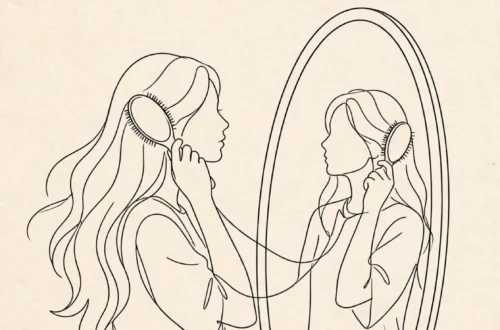
Toi descends from the Latin stressed tē, and it keeps an old dignity: it is the form French uses when the person must be seen, not just processed by the verb. The whole strong set — moi, toi, lui, elle, nous, vous, eux, elles — is French’s portrait gallery, the forms that appear in mirrors (c’est toi !), in doorways (entre, c’est pour toi) and in the great handing-back of conversation, et toi ? Learn toi and you have learned where French puts its emphasis: not louder, but standing alone, after the little words that point at people.
To say toi is to point at the you that counts.
It evokes the pointed finger, the passed turn, and the voice on the telephone that makes you smile: c’est toi.
How to Remember the French Pronoun Toi
Remember it this way: Toi is the strong you — after prepositions, after c’est, in comparisons and alone — while te leans on the verb.
- The homes — avec toi, pour toi, chez toi, sans toi; after prepositions, always toi.
- The recognition — c’est toi ! and the handover et toi ?
- The command — lève-toi ! but ne te lève pas !
The key idea is toi = stressed you (tu-world); te = the leaning form before the verb.
Test Your Knowledge of Toi
Let’s see how much you’ve learned. Try answering these questions before revealing the answers.
Question 1
What is toi?
Reveal the answer
The stressed form of tu — the you that stands on its own.
Question 2
How do you say with you (to a friend)?
Reveal the answer
Avec toi.
Question 3
Translate: It’s you!
Reveal the answer
C’est toi !
Question 4
Complete the sentence:
On se retrouve chez ______ à sept heures. (at your place)
Reveal the answer
toi
On se retrouve chez toi à sept heures.
We’ll meet at your place at seven.
Question 5
When does toi appear in a command?
Reveal the answer
Behind the verb in affirmative commands — lève-toi ! — while negatives use te in front.
Your Final Challenge
Can You Use It?
How would you say this in French?
“And you, what about you?”
Reveal the answer
Et toi, qu’est-ce que tu fais ?
And you, what about you?
A little French. A little curiosity. A richer everyday life.
LEARN FRENCH ONE WORD AT A TIME