A French Word to Live By
Translate Eux to English
/ø/
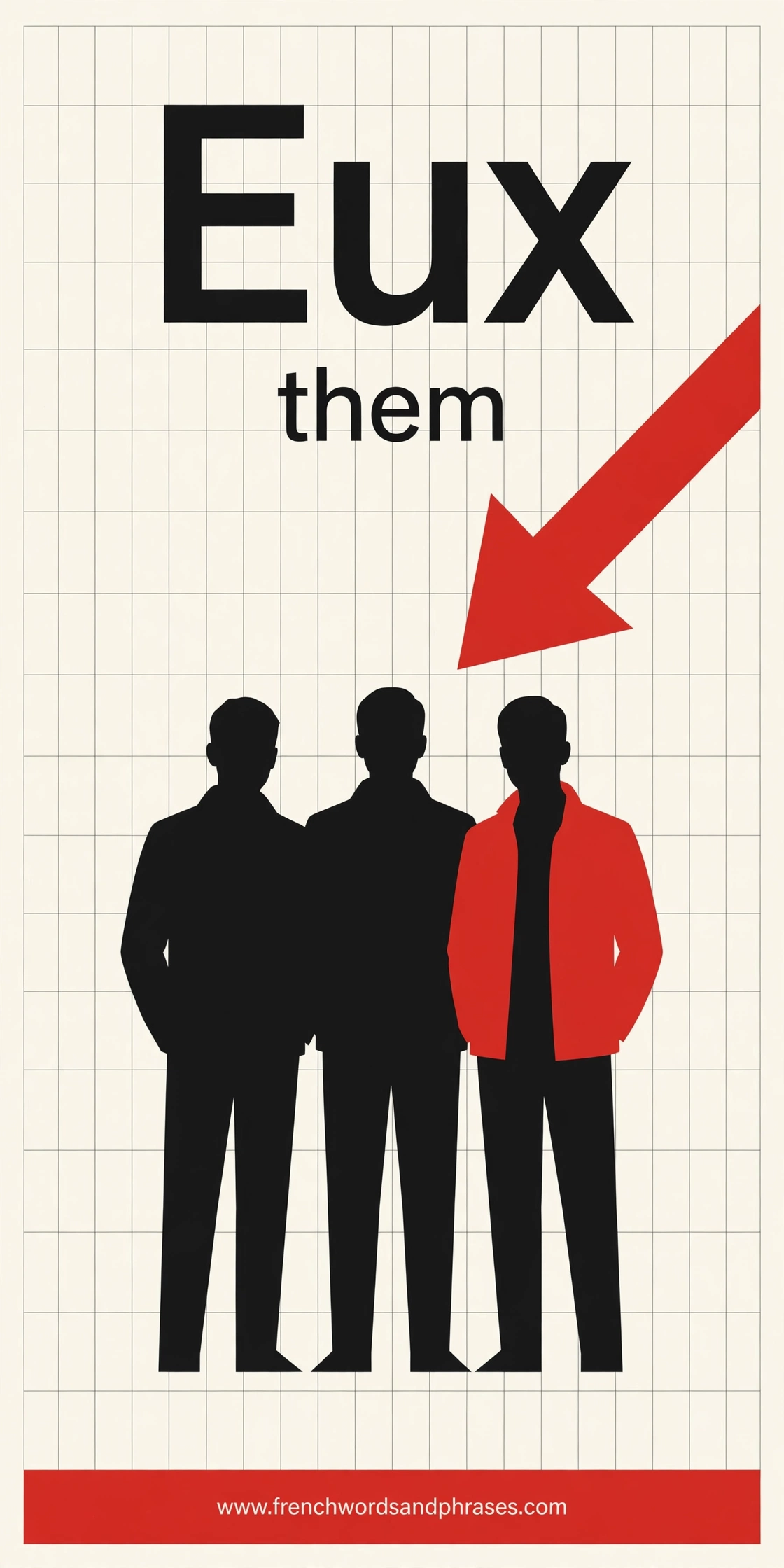
Eux means them — the stressed pronoun for ils (masculine or mixed groups).
The neighbours, the brothers, the other team — « C’est eux ! Avec eux, chez eux, pour eux… » Eux is the strong form of ils: the them that stands on its own after prepositions, in comparisons and in recognition, whenever the group is masculine or mixed. One small word, pronounced like a rounded sigh: /ø/.
Let’s explore how eux works in French, beginning with the whole word on one card.
Understanding the French Pronoun Eux
Eux is a French stressed pronoun — a pronom tonique, the strong, independent form of ils. It stands for a masculine or mixed group wherever a pronoun must carry stress: after prepositions (avec eux, chez eux, pour eux), after c’est (ce sont eux, it is them), in comparisons (plus riches qu’eux), fronted for emphasis (eux, ils savent), and standing alone. Its feminine counterpart is elles (avec elles), and its leaning relatives before the verb are les (je les vois) and leur (je leur parle) — eux never leans.
It means them — the men, the boys, the mixed crowd: je pars avec eux, I am leaving with them; ce cadeau est pour eux, this present is for them; chez eux, at their place — the home of the group. In ce sont eux it is the knock at the door answered: it’s them! And in eux aussi, them too, it carries the solidarity of groups: eux aussi ont le droit de parler, they too have the right to speak. Whenever the group is all-female, eux yields to elles: avec elles.
Type: Stressed (disjunctive) pronoun — the strong form of ils
Answers the question: Qui ? — Who? (them — masculine or mixed, with stress)
Homes: After prepositions, after ce sont, in comparisons, fronted, and alone
Watch the pair: eux (stressed, standing strong) vs les / leur (leaning, before the verb)
One important usage detail: eux covers mixed groups as well as all-male ones — un homme et cent femmes, in the old classroom rule, still makes eux — while an all-female group takes elles. And chez eux is a place, their home or their country: chez eux, on mange tard, at their place, people eat late. After c’est, the verb agrees in the plural: ce sont eux, never « c’est eux » in careful French.
Experience the Word
Eux is the pronoun of the other group seen from across the room — the brothers, the neighbours, the visitors — named with the respect of distance: not processed by a verb, but standing, all together, as them.
Imagine the village fête, two long tables under the plane trees, and the mayor rising with his glass: « À eux ! » — To them! — to the volunteers who hung the lights and built the stage. The whole square turns, glasses lift, and for one syllable the group stands in the light, named by its strong pronoun. Eux is the sound of a group being honoured.
You have not just learned a pronoun. You have found the strong form of they — eux, the group standing on its own feet.
How to Use Eux in French: Complete Guide
Let’s explore how eux works in French, beginning with the whole word on one card.
Eux at a Glance
The Whole Word on One Card
Meaning, homes, strength and family — eux in four lines.
| Point | Eux |
|---|---|
| Meaning | them — masculine or mixed group, with stress |
| Homes | after prepositions, after ce sont, in comparisons, fronted, alone |
| Strength | stressed and independent — it never leans on a verb |
| Its family | elles (feminine), lui (him), eux-mêmes (themselves, emphatic) |
Example
Ce sont eux, les frères de Marie.
It’s them, Marie’s brothers.
The Pattern in Action: Where Eux Stands
Eux appears wherever a pronoun must stand without a verb to lean on.
| Pattern | Example |
|---|---|
| after a preposition | je pars avec eux — I’m leaving with them |
| after ce sont | ce sont eux ! — it’s them! |
| in a comparison | nous sommes plus jeunes qu’eux — we are younger than them |
| fronted, with ils | eux, ils connaissent la route — they know the road |
Example
Eux, ils arrivent par le train de midi.
They are arriving on the midday train.
Quick Quiz 1
« With them » (the brothers) — avec les or avec eux?
Reveal the answer
Avec eux — after a preposition, only the stressed form can stand.
Je pars en vacances avec eux.
I’m going on holiday with them.
Eux at Work: The Prepositions It Follows
Every preposition in French calls for the strong set — and eux answers for ils.
| Pattern | Example |
|---|---|
| pour eux | for them — ce cadeau est pour eux |
| chez eux | at their place — on dîne chez eux samedi |
| sans eux | without them — on ne commence pas sans eux |
| contre eux | against them — jouer contre eux |
| entre eux | among themselves — ils parlent entre eux |
Example
Entre eux, ils se disent tout.
Between themselves, they tell each other everything.
Eux or Les? The Strong Form and the Leaning Forms
Them, two ways: les and leur lean on the verb; eux stands outside it.
| Situation | Example |
|---|---|
| direct object | je les vois — I see them (les, before the verb) |
| indirect object | je leur parle — I speak to them (leur, before the verb) |
| after a preposition | avec eux — with them (eux, standing strong) |
| standing alone | qui est là ? — eux ! — who is there? — them! |
Example
Je les attends : ce sont eux, enfin !
I’m waiting for them: it’s them, at last!
Quick Quiz 2
For an all-female group, « with them » — avec eux or avec elles?
Reveal the answer
Avec elles — eux is for masculine or mixed groups only.
Mes sœurs ? Je pars avec elles.
My sisters? I’m leaving with them.
Everyday Expressions with Eux
Eux turns up wherever groups are pointed at, waited for, or toasted.
| Expression | In English |
|---|---|
| ce sont eux | it’s them |
| eux aussi | them too, they too |
| chez eux | at their place, back home (for them) |
| entre eux | among themselves, between them |
| eux-mêmes | themselves — ils l’ont fait eux-mêmes, they did it themselves |
Example
Eux aussi veulent venir chez eux ce soir.
They too want to come to their place tonight.
Close Cousins: Elles, Lui, Nous
The strong set: eux and its feminine twin, its singular, and the strong we.
| Word | The difference |
|---|---|
| eux | them — masculine or mixed group |
| elles | them — all-female group |
| lui | him — the strong singular: avec lui |
| nous / vous | us / you — strong forms identical to the subjects |
Example
Lui part avec nous, elles partent avec eux.
He leaves with us, they (the women) leave with them.
Quick Quiz 3
In chez eux, are we at people or at a place?
Reveal the answer
A place — chez eux is their home.
Chez eux, on déjeune dans le jardin.
At their place, people have lunch in the garden.
Eux and Its Neighbours
The shelf around eux — its leaning relatives, its feminine twin, and its emphatic long form.
| French | In English |
|---|---|
| les | them — direct object, before the verb |
| leur | to them — indirect object, before the verb |
| elles | them — stressed, all-female group |
| eux-mêmes | themselves — emphatic |
| ils | they — the subject form |
Example
Ils les ont faits eux-mêmes, pour elles.
They made them themselves, for them (the women).
Watch Out: The Traps Around Eux
The traps: les after a preposition, eux before a verb, and eux for an all-female group.
| Trap | The truth |
|---|---|
| « avec les » | after a preposition, the strong form: avec eux |
| « je eux vois » | before the verb, the leaning form: je les vois |
| eux for women only | an all-female group takes elles: avec elles |
| « c’est eux » | careful French agrees: ce sont eux |
Example
Ce sont eux, et je les rejoins chez eux.
It’s them, and I’m joining them at their place.
Quick Quiz 4
Complete: ce cadeau est pour ______ (for them, the brothers)
Reveal the answer
eux — pour calls for the stressed form.
Ce cadeau est pour eux, pas pour elles.
This present is for them, not for them (the sisters).
Eux in Everyday French: Real-Life Examples
Now that you know the word, let’s see how eux appears in everyday French.
Example 1 — Leaving together
Je pars avec eux demain matin.
I’m leaving with them tomorrow morning.
Example 2 — Recognition
Ce sont eux ! Les voilà enfin.
It’s them! Here they are at last.
Example 3 — Homes
On passe le week-end chez eux.
We’re spending the weekend at their place.
Example 4 — Waiting
Sans eux, on ne commence pas.
Without them, we’re not starting.
Example 5 — Solidarity
Eux aussi ont travaillé toute la semaine.
They too worked all week.
Example 6 — Between them
Entre eux, il n’y a pas de secrets.
Between them, there are no secrets.
Beyond Translation: The Meaning of Eux
Eux comes from the Latin illōs — those men — worn smooth by centuries into a single rounded vowel, /ø/, the same sound as œuf and deux. It is the last of the strong set to learn and the one that completes the portrait gallery: moi, toi, lui, elle, nous, vous, eux, elles — the forms French uses when people must be seen standing, not absorbed into a verb. Grammarians call them disjunctive because they are unjoined, free of the verb phrase; poets might call them the forms of presence. With eux, the gallery is complete: every person in French can now both act in a sentence and stand, lit, in the doorway of one.
To say eux is to let the group stand in the light.
It evokes the raised glass at the village fête, the knock answered — ce sont eux ! — and every chez eux where the door is open.
How to Remember the French Pronoun Eux
Remember it this way: Eux is the strong them for ils — masculine or mixed — standing after prepositions and in the light, while les and leur lean on the verb.
- The homes — avec eux, pour eux, chez eux, sans eux; after prepositions, always eux.
- The gender — all-female groups take elles: avec elles.
- The recognition — ce sont eux ! with the plural verb.
The key idea is eux = stressed them (ils); elles = all-female; les/leur = the leaning forms.
Test Your Knowledge of Eux
Let’s see how much you’ve learned. Try answering these questions before revealing the answers.
Question 1
What is eux?
Reveal the answer
The stressed form of ils — them, for a masculine or mixed group.
Question 2
How do you say with them (the brothers)?
Reveal the answer
Avec eux.
Question 3
Translate: It’s them!
Reveal the answer
Ce sont eux !
Question 4
Complete the sentence:
On dîne chez ______ samedi. (at their place)
Reveal the answer
eux
On dîne chez eux samedi.
We’re having dinner at their place on Saturday.
Question 5
When is eux NOT used for « them »?
Reveal the answer
For an all-female group — then the stressed form is elles; and before a verb, them is les or leur.
Your Final Challenge
Can You Use It?
How would you say this in French?
“It’s them, here they are at last!”
Reveal the answer
Ce sont eux, les voilà enfin !
It’s them, here they are at last!
A little French. A little curiosity. A richer everyday life.
LEARN FRENCH ONE WORD AT A TIME