A French Word to Live By
Translate Le leur to English
/lə lœʁ/
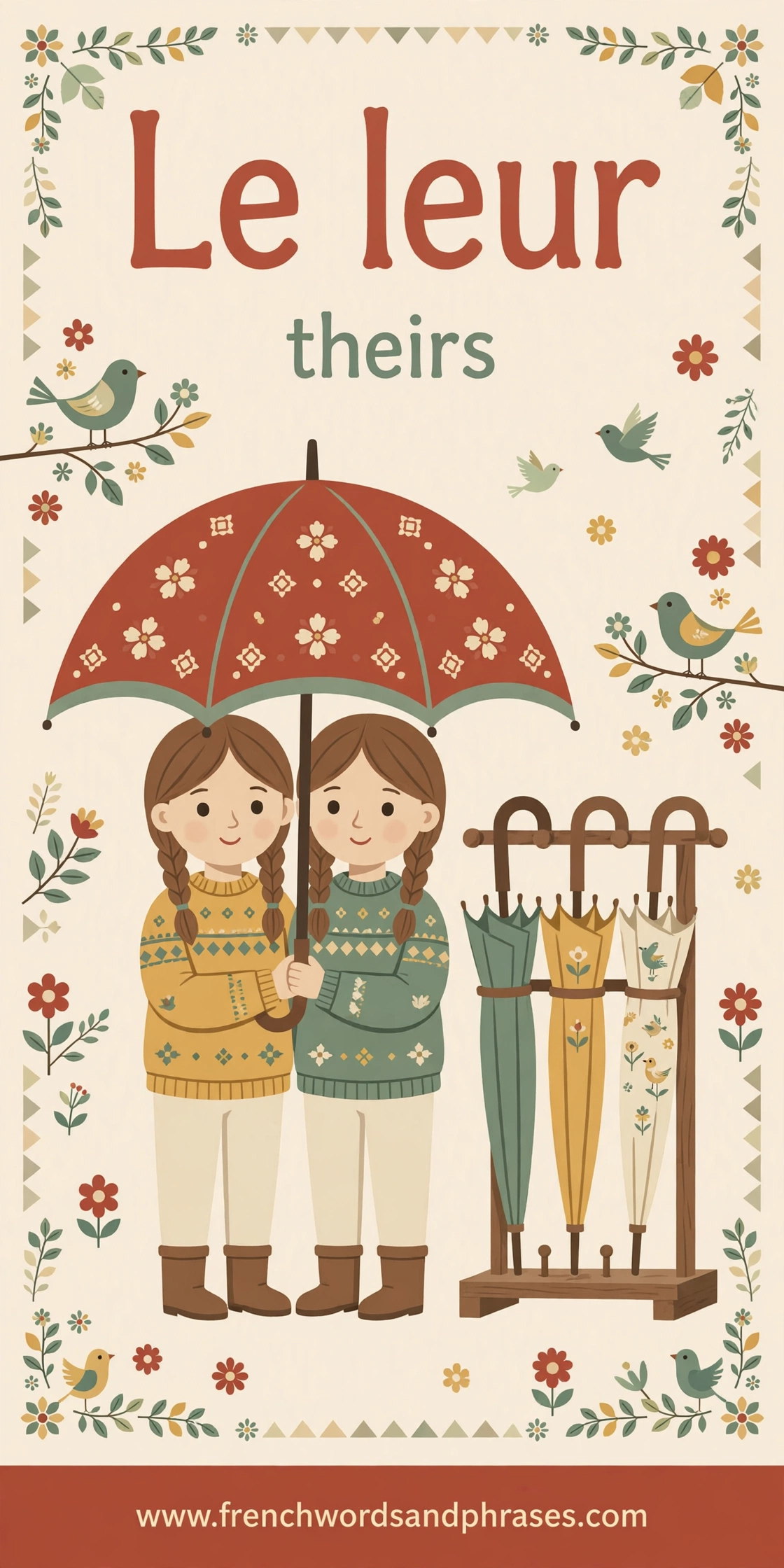
Le leur means theirs.
Two families share a picnic blanket on the grass, and the baskets look almost the same. « Ce panier est le nôtre, et celui-là, c’est le leur » — this basket is ours, and that one is theirs. Le leur is the French way of saying theirs: it hands a thing back to its owners — they — without naming the thing again.
Let’s explore how le leur works in French, beginning with the whole phrase on one card.
Understanding the French Pronoun Le leur
Le leur is a French possessive pronoun — the ‘theirs’ of the possessive family le mien, le tien, le sien, le nôtre, le vôtre, le leur. It replaces a noun phrase completely: instead of ‘their car’, you simply say la leur, the one that belongs to them.
It means theirs. The picture it paints is a hand returning something across a fence: this one is ours, that one is theirs. Like every French possessive pronoun, le leur is built from two pieces — the article (le, la, les) matches the thing owned, and leur names the owners: they, more than one person, or a polite ‘you’ treated as several.
Type: Possessive pronoun — theirs (owners: they, plural)
Answers the question: À qui ? — Whose is it? (Answer: theirs)
What follows it: Nothing has to follow — it stands alone as a complete answer: C’est le leur.
Watch the pair: le leur (pronoun, theirs — no noun after it) vs leur + noun (determiner, their): leur maison = their house, la leur = theirs
One important usage detail: le leur agrees with the thing owned, never with the owners. One car belonging to a whole family is la leur (car is feminine); two cars are les leurs. The owners stay ‘they’ in every form — it is the possession that changes shape.
Experience the Word
Le leur is the pronoun of the shared garden fence — it sorts the world into ours and theirs without a single argument.
Imagine two neighbouring gardens after a storm: the red ball has rolled into the wrong yard. The children hold it up, look at each other, and settle it in three words: c’est le leur — it is theirs.
You have not just said who owns something. You have replaced the whole noun phrase — article, noun and all — with two small words.
How to Use Le leur in French: Complete Guide
Let’s explore how le leur works in French, beginning with the whole phrase on one card.
Le leur at a Glance
The Whole Phrase on One Card
Meaning, job, grid and pair — le leur in four lines.
| Point | Le leur |
|---|---|
| Meaning | theirs — the one (or ones) belonging to them |
| Job | possessive pronoun: replaces ‘their + noun’ completely |
| The grid | le leur (masc. sg.), la leur (fem. sg.), les leurs (plural) |
| What it agrees with | the thing owned — le livre → le leur, la voiture → la leur |
Example
Notre jardin est petit, mais le leur est immense.
Our garden is small, but theirs is huge.
The Pattern in Action: Handing Things Back to ‘Them’
Le leur connects an object to its owners — a group of people who are not in the conversation as speakers.
| Pattern | Example |
|---|---|
| after être, naming the owner | ce vélo est le leur — this bike is theirs |
| as the subject of a sentence | le leur est garé devant la maison — theirs is parked in front of the house |
| the feminine form | notre voiture est vieille, la leur est neuve — our car is old, theirs is new |
| the plural form | nos enfants sont ici, les leurs arrivent demain — our children are here, theirs arrive tomorrow |
Example
Tu as pris mon parapluie ? Non, j’ai pris le leur.
Did you take my umbrella? No, I took theirs.
Quick Quiz 1
“Their house” — do you say le leur maison or leur maison?
Reveal the answer
leur maison — before a noun, French uses the determiner leur with no article; le leur only works when the noun has disappeared.
Leur maison est grande, la leur est grande aussi.
Their house is big, theirs is big too.
The Tricky Bit: Le leur Is Not Leur
Two neighbours that learners swap constantly: leur walks in front of a noun, le leur stands completely alone.
| Form | How it works |
|---|---|
| leur + noun (determiner) | leur maison, leur chien, leurs enfants — ‘their’ glued to a noun that is actually there |
| le leur (pronoun) | le leur, la leur, les leurs — ‘theirs’, with the noun gone and understood |
| the article does the agreeing | le / la / les change with the thing owned: le jardin → le leur, la maison → la leur |
| one owner group, any number of things | one thing: le leur; several things: les leurs — the owners never change the ending |
Example
Leur fils habite à Paris, et le mien aussi — mais les leurs sont à Lyon.
Their son lives in Paris, and mine too — but theirs (their children) are in Lyon.
Where It Goes: Where the Noun Phrase Used to Be
Le leur simply takes the seat of the whole ‘their + noun’ phrase — subject, after être, or after a preposition.
| Position / pattern | Example |
|---|---|
| as a subject | le leur ne marche plus — theirs does not work anymore |
| after être | cette place est la leur — this seat is theirs |
| after a preposition | je travaille avec les leurs le samedi — I work with their children on Saturdays |
| in comparisons | notre équipe est forte, mais la leur est plus rapide — our team is strong, but theirs is faster |
Example
Entre notre appartement et le leur, je préfère le leur.
Between our flat and theirs, I prefer theirs.
Quick Quiz 2
A family owns one house (une maison). “Theirs is bigger” — le leur or la leur?
Reveal the answer
la leur — the pronoun copies the gender of the thing owned, and maison is feminine.
La leur est plus grande.
Theirs is bigger.
Everyday Expressions with Le leur
Le leur appears whenever two households, two teams or two families are compared.
| Expression | In English |
|---|---|
| c’est le leur | it is theirs |
| le leur aussi | theirs too |
| pas le leur | not theirs |
| les leurs | their family, their people (the plural form on its own) |
| le leur ou le nôtre ? | theirs or ours? |
Example
Ce chien n’est pas le nôtre, c’est le leur.
This dog is not ours, it is theirs.
Close Cousins: Le leur, Leur, Le nôtre
Three forms built on the same root — the difference is whether a noun follows, and who the owners are.
| Word | The difference |
|---|---|
| leur + noun | the determiner ‘their’ — it needs a noun right after it: leur voiture |
| le leur | the pronoun ‘theirs’ — the noun has vanished: la leur est rouge |
| le nôtre / le vôtre | the same pronoun job for other owners: le nôtre = ours, le vôtre = yours |
| le sien | his / hers — one owner, not a group: le sien est là-bas |
Example
Leur voiture est rouge ; la nôtre est bleue, et la leur est verte.
Their car is red; ours is blue, and theirs is green.
Quick Quiz 3
Which cousin means “ours” — le leur or le nôtre?
Reveal the answer
le nôtre — leur points to them, nôtre points back to us.
Le nôtre est prêt, le leur aussi.
Ours is ready, theirs too.
Le leur and Its Neighbours
The possessive shelf: the whole pronoun family, owner by owner.
| French | In English |
|---|---|
| le mien | mine |
| le tien | yours (for tu) |
| le sien | his / hers |
| le nôtre | ours |
| le vôtre | yours (for vous) |
| le leur | theirs |
Example
Le mien, le tien, le sien, le nôtre, le vôtre, le leur — chaque chose a son propriétaire.
Mine, yours, his, ours, yours, theirs — everything has its owner.
Watch Out: The Traps Around Le leur
The traps: a missing article, a noun that should not be there, and agreement aimed at the wrong target.
| Trap | The truth |
|---|---|
| saying ‘c’est leur’ for ‘it is theirs’ | the pronoun needs its article: c’est le leur, la leur, les leurs |
| putting a noun after le leur | le leur never takes a noun — with a noun, use leur: leur maison, not ‘le leur maison’ |
| agreeing with the owners | the form follows the thing owned: one house of theirs is la leur, even with five owners |
| dropping the s in the plural | several things owned take les leurs — the final s belongs to the things, not the owners |
Example
Non, ce n’est pas à nous — c’est le leur.
No, it is not ours — it is theirs.
Quick Quiz 4
Complete: Nos vélos sont vieux, mais ______ sont tout neufs. (ours are old, but theirs are brand new)
Reveal the answer
les leurs — several things owned (vélos, masculine plural) take les leurs.
Nos vélos sont vieux, mais les leurs sont tout neufs.
Our bikes are old, but theirs are brand new.
Le leur in Everyday French: Real-Life Examples
Now that you know the word, let’s see how le leur appears in everyday French.
Example Example 1 — Neighbours
Notre tondeuse est en panne, alors nous utilisons la leur.
Our mower is broken, so we are using theirs.
Example Example 2 — At school
Les enfants ont rangé leurs cahiers, et les leurs sont sur la table.
The children put away their exercise books, and theirs are on the table.
Example Example 3 — A lost dog
Ce chien perdu ? Je crois que c’est le leur.
This lost dog? I think it is theirs.
Example Example 4 — Comparing
Notre appartement est lumineux, mais le leur a un balcon.
Our flat is bright, but theirs has a balcony.
Example Example 5 — At the beach
Nous avons oublié notre parasol ; heureusement, le leur est grand.
We forgot our parasol; luckily, theirs is big.
Example Example 6 — Family
Les leurs arrivent par le train de midi.
Their family is arriving on the midday train.
Beyond Translation: The Meaning of Le leur
English “theirs” is a single, unchanging word — it tells you the owners and nothing else. French le leur tells two stories at once: leur names the owners, and the little article in front — le, la, les — quietly describes the thing itself, its gender and its number.
To say le leur is to hand something back across the fence: theirs, and here is its shape.
It also explains the plural les leurs on its own: in everyday French it often means ‘their people’ — the family, the children, the whole clan that belongs to them.
How to Remember the French Pronoun Le leur
Remember it this way: Remember it this way: Le leur is leur with its noun swallowed — when the noun goes away, the article steps in to carry its shape.
- You check for a noun — noun present: leur maison; noun gone: la leur.
- You agree with the thing, not the owners — le leur, la leur, les leurs follow the possession.
- You keep the family in order — le mien, le tien, le sien, le nôtre, le vôtre, le leur.
The key idea is le leur means theirs — leur before a noun means their, and the pronoun’s article agrees with the thing owned.
Test Your Knowledge of Le leur
Let’s see how much you’ve learned. Try answering these questions before revealing the answers.
Question 1
What does le leur mean?
Reveal the answer
Theirs — the possessive pronoun for something belonging to them.
Question 2
What are the three forms of the pronoun?
Reveal the answer
Le leur, la leur, les leurs — masculine singular, feminine singular, and plural, chosen by the thing owned.
Question 3
Translate: Their car is red, and theirs too.
Reveal the answer
Leur voiture est rouge, et la leur aussi.
Question 4
What is the difference between leur maison and la leur?
Reveal the answer
Leur maison is ‘their house’ (determiner + noun); la leur is ‘theirs’ (pronoun standing alone).
Question 5
Complete the sentence:
Ce sac n’est pas le nôtre, c’est ______. (This bag is not ours, it is theirs.)
Reveal the answer
le leur
Ce sac n’est pas le nôtre, c’est le leur.
This bag is not ours, it is theirs.
Your Final Challenge
Can You Use It?
How would you say this in French?
“How would you say this in French?”
Reveal the answer
Notre voiture est vieille, mais la leur est neuve.
Our car is old, but theirs is new.
A little French. A little curiosity. A richer everyday life.
LEARN FRENCH ONE WORD AT A TIME