A French Word to Live By
Translate Mon to English
/mɔ̃/
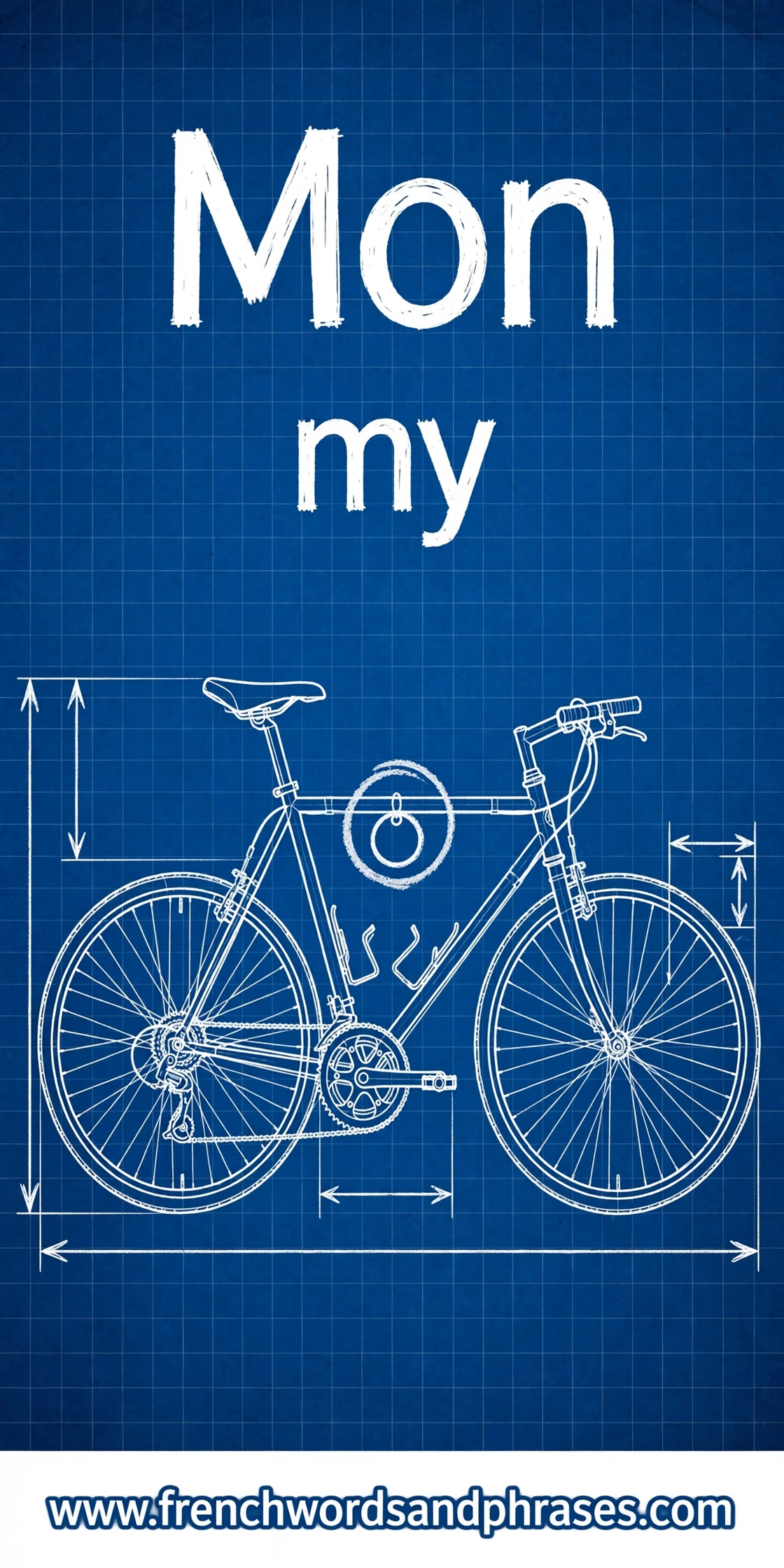
Mon means my.
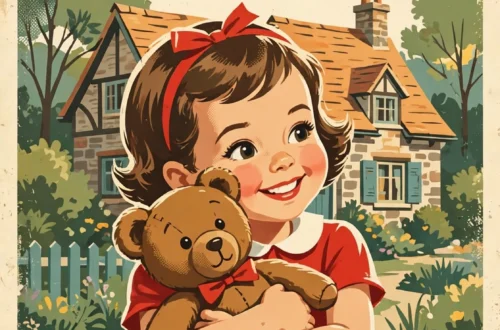
A little girl shows her drawing to the whole class, holding it high. « C’est mon dessin, et là, c’est ma maison et mon chien. » — It’s my drawing, and there is my house and my dog. Mon is the French word for my: the small banner every speaker plants on the things that belong to them.
Let’s explore how mon works in French, beginning with the whole word on one card.
Understanding the French Determiner Mon
Mon is a French possessive determiner — ‘my’. It stands before a noun and agrees with that noun, not with the speaker: mon for a masculine noun, ma for a feminine one, mes for plurals. A man and a woman use exactly the same three words.
It means my. The picture it paints is a hand resting gently on a thing — my book, my house, my turn. English ‘my’ never changes; French mon reshapes itself for every noun it guards, because in French it is the treasure that chooses the word, not the owner.
Type: Possessive determiner — my (mon / ma / mes)
Answers the question: À qui ? — Whose? (Answer: mine, belonging to me)
What follows it: A noun — the thing owned: mon livre, ma sœur, mes clés
Watch the pair: mon (the determiner, my, before a noun) vs le mien (the pronoun, mine, standing alone)
One important usage detail: before a feminine noun starting with a vowel or mute h, ma steps aside and mon takes its place — mon amie (my friend, a woman), mon école (my school). It is still feminine underneath; the adjectives give it away: mon amie est gentille.
Experience the Word
Mon is the first possessive word a child ever owns — the banner planted on drawings, dogs and best friends.
Imagine a schoolbag emptied on a table: mon cahier, ma règle, mes crayons — my exercise book, my ruler, my pencils — a whole small kingdom in three little words.
You have not just named a thing. You have claimed it — gently, completely, in one syllable.
How to Use Mon in French: Complete Guide
Let’s explore how mon works in French, beginning with the whole word on one card.
Mon at a Glance
The Whole Word on One Card
Meaning, job, forms and rule — mon in four lines.
| Point | Mon |
|---|---|
| Meaning | my |
| Job | possessive determiner — marks the noun as belonging to the speaker |
| The three forms | mon (m. sg.), ma (f. sg.), mes (plural) — plus mon before a feminine vowel |
| What decides the form | the noun owned — its gender and number, never the speaker |
Example
Mon frère et ma sœur arrivent demain.
My brother and my sister are arriving tomorrow.
The Pattern in Action: Claiming Your Things
Mon connects a noun to its owner — you — and reshapes itself for every noun it guards.
| Pattern | Example |
|---|---|
| with a masculine noun | mon livre est sur la table — my book is on the table |
| with a feminine noun | ma voiture est au garage — my car is at the garage |
| with a plural noun | mes clés sont dans ma poche — my keys are in my pocket |
| before a feminine vowel, mon again | mon amie habite à Lyon — my friend (a woman) lives in Lyon |
Example
Mon père travaille et ma mère aussi.
My father works and my mother too.
Quick Quiz 1
A woman says ‘my car’. Is it mon or ma?
Reveal the answer
ma — voiture is feminine; the noun decides, and the speaker’s own gender never matters.
Ma voiture est rouge.
My car is red.
The Tricky Bit: When Ma Becomes Mon
Ma has a stand-in: before a vowel sound, mon steps in — even for a feminine noun.
| Situation | What happens |
|---|---|
| before a vowel, ma -> mon | mon amie, mon école, mon histoire — the feminine noun borrows mon to avoid the clash of two vowels |
| before mute h, same rule | mon habitude (my habit) — h muet behaves like a vowel |
| before h aspiré, ma stays | ma hache (my axe) — this h blocks the change, like a consonant |
| the noun stays feminine | mon amie est gentille — the adjective gentille proves amie is still feminine |
Example
Mon école est loin, mais mon amie habite près d’ici.
My school is far, but my friend lives near here.
Where It Goes: Stuck to the Front of the Noun
Mon leads the whole noun group — and it completely replaces the article.
| Position / pattern | Example |
|---|---|
| directly before the noun | mon chien, ma maison, mes affaires |
| before adjective + noun, still first | mon petit frère, ma grande sœur — mon leads the whole group |
| it replaces the article | you never stack them: mon livre, never ‘le mon livre’ |
| repeated before each noun | mon père et ma mère — my father and my mother (each noun gets its own) |
Example
Mon vieux vélo roule encore très bien.
My old bike still rides very well.
Quick Quiz 2
“My friend” (a girl, une amie) — ma amie or mon amie?
Reveal the answer
mon amie — amie begins with a vowel, so ma steps aside for mon.
Mon amie est arrivée hier.
My friend arrived yesterday.
Everyday Expressions with Mon
Mon lives in opinions, affections and small exclamations.
| Expression | In English |
|---|---|
| mon Dieu | my God / good heavens |
| à mon avis | in my opinion |
| mon petit / ma petite | my little one (a term of affection) |
| mon amour | my love |
| de mon côté | for my part / on my side |
Example
À mon avis, mon équipe va gagner.
In my opinion, my team is going to win.
Close Cousins: Mon, Le mien, Ton, Notre
Four neighbours in the possessive family — the difference is who owns, and whether a noun follows.
| Word | The difference |
|---|---|
| le mien | mine — the pronoun that stands alone: c’est le mien (it’s mine); mon needs its noun |
| ton / son | your / his-her — the same three-form game for other owners: ton livre, son livre |
| ma / mes | mon’s own family: ma before a feminine consonant, mes for every plural |
| notre | our — the plural-owner determiner: notre maison (our house) |
Example
Mon livre est neuf ; le tien est ancien.
My book is new; yours is old.
Quick Quiz 3
Which one can answer a question all by itself — mon or le mien?
Reveal the answer
le mien — mon is a determiner and must hold onto a noun; le mien is the pronoun.
— C’est ton livre ? — Non, c’est le mien.
— Is it your book? — No, it’s mine.
Mon and Its Neighbours
The possessive determiner shelf: one row per owner, three forms each.
| French | In English |
|---|---|
| mon / ma / mes | my |
| ton / ta / tes | your (tu) |
| son / sa / ses | his / her |
| notre / nos | our |
| votre / vos | your (vous) |
| leur / leurs | their |
Example
Mon frère, ton cousin et son ami jouent ensemble.
My brother, your cousin and his friend play together.
Watch Out: The Traps Around Mon
The traps: agreeing with yourself, the impossible ma amie, and the pronoun’s job given to a determiner.
| Trap | The truth |
|---|---|
| agreeing with yourself | a woman says ma voiture and a man says mon livre — the noun decides, never the owner |
| writing ma before a vowel | ma amie is impossible — mon amie, mon école |
| using mon as a pronoun | mon cannot stand alone: ‘c’est mon’ is wrong — say c’est le mien |
| stacking with an article | never ‘le mon livre’ — the possessive replaces the article completely |
Example
Mon amie a perdu ses clés au marché.
My friend lost her keys at the market.
Quick Quiz 4
Complete: ______ histoire commence en 1900. (My story begins in 1900.)
Reveal the answer
Mon — histoire is feminine but begins with a mute h, so mon takes the place of ma.
Mon histoire commence en 1900.
My story begins in 1900.
Mon in Everyday French: Real-Life Examples
Now that you know the word, let’s see how mon appears in everyday French.
Example Example 1 — Family
Mon grand-père raconte des histoires du village.
My grandfather tells stories about the village.
Example Example 2 — At school
J’ai oublié mon cahier et mes crayons.
I forgot my exercise book and my pencils.
Example Example 3 — Home
Ma maison est petite mais mon jardin est grand.
My house is small but my garden is big.
Example Example 4 — A friend
Mon amie arrive ce soir par le train.
My friend is arriving this evening by train.
Example Example 5 — At work
Mon bureau est près de la fenêtre.
My desk is near the window.
Example Example 6 — Opinion
À mon avis, mon idée est la plus simple.
In my opinion, my idea is the simplest.
Beyond Translation: The Meaning of Mon
Every language gives a child one word before all others, and in French it is mon: the word that draws the first circle of belonging — my mother, my house, my dog. But French teaches a quiet lesson inside it: the word changes for the thing, not for the child.
To say mon is to claim a thing — and to let the thing itself choose the shape of the claim.
That is why mon amie can be a girl and mon livre a man’s: ownership in French is a relationship between words, and the noun always leads.
How to Remember the French Determiner Mon
Remember it this way: Remember it this way: Mon guards the noun in front of it — the treasure picks the form, and before a vowel even ma gives way to mon.
- You copy the noun, not yourself — mon livre, ma voiture, mes clés, whoever is speaking.
- You swap ma for mon before a vowel — mon amie, mon école, mon histoire.
- You never let it stand alone — alone, ‘mine’ is le mien.
The key idea is mon means my — mon, ma and mes agree with the noun owned, and mon replaces ma before a vowel or mute h.
Test Your Knowledge of Mon
Let’s see how much you’ve learned. Try answering these questions before revealing the answers.
Question 1
What does mon mean?
Reveal the answer
My — the possessive determiner of the speaker.
Question 2
What are the three forms of mon?
Reveal the answer
Mon, ma, mes — masculine singular, feminine singular, and plural.
Question 3
Translate: My sister and my brother are here.
Reveal the answer
Ma sœur et mon frère sont là.
Question 4
Why mon amie and not ma amie?
Reveal the answer
Amie begins with a vowel — ma steps aside and mon takes its place, though amie stays feminine.
Question 5
Complete the sentence:
______ père et ______ mère habitent à Paris. (My father and my mother live in Paris.)
Reveal the answer
mon / ma
Mon père et ma mère habitent à Paris.
My father and my mother live in Paris.
Your Final Challenge
Can You Use It?
How would you say this in French?
“How would you say this in French?”
Reveal the answer
Mon chien attend devant ma porte.
My dog is waiting in front of my door.
A little French. A little curiosity. A richer everyday life.
LEARN FRENCH ONE WORD AT A TIME